 Acts of Thomas
It is one of our few windows into early Syrian Christianity.
It is structurally complete, deeply poetic, and famous for its unyielding commitment to absolute celibacy (encratism) as the ultimate mark of Christian identity.
|
1
Κατ
ἐκεῖνον
τὸν
καιρὸν
ἦμεν
πάντες
οἱ
ἀπόστολοι
ἐν
Ἰεροσολύμοις,
Σίμων
ὁ
λεγόμενος
Πέτρος
καὶ
Ἀνδρέας
ὁ
ἀδελφὸς
αὐτοῦ,
Ἰάκωβος
ὁ
τοῦ
Ζεβεδαίου
καὶ
ἸωάννηςJohn
ὁ
ἀδελφὸς
αὐτοῦ,
ΦίλιπποςPhilip
καὶ
Βαρθολομαῖος,
Θωμᾶς
καὶ
ΜατθαῖοςMatthew
ὁ
τελώνης,
Ἰάκωβος
Ἁλφαίου
καὶ
Σίμων
ὁ
Καναναῖος,
καὶ
Ἰούδας
Ἰακώβου,
καὶ
διείλαμεν
τὰ
κλίματα
τῆς
οἰκουμένης,
ὅπως
εἷς
ἕκαστος
ἡμῶν
ἐν
τῷ
κλίματι
τῷ
λαχόντι
αὐτῷ
καὶ
εἰς
τὸ
ἔθνος
ἐν
ᾧ
ὁ
κύριος
αὐτὸν
ἀπέστειλεν
πορευθῇ.
κατὰ κλῆρον οὖν ἔλαχεν ἡ Ἰνδία Ἰούδᾳ Θωμᾷ τῷ καὶ Διδύμῳ· οὐκ ἐβούλετο δὲ ἀπελθεῖν, λέγων μὴ δύνασθαι μήτε χωρεῖν διὰ τὴν ἀσθένειαν τῆς σαρκός, καὶ ὅτι Ἄνθρωπος ὢν Ἑβραῖος πῶς δύναμαι πορευθῆναι ἐν τοῖς Ἰνδοῖς κηρύξαι τὴν ἀλήθειαν; Καὶ ταῦτα αὐτοῦ διαλογιζομένου καὶ λέγοντος ὤφθη αὐτῷ ὁ σωτὴρ διὰ τῆς νυκτός, καὶ λέγει αὐτῷ· Μὴ φοβοῦ Θωμᾶ, ἄπελθε εἰς τὴν Ἰνδίαν καὶ κήρυξον ἐκεῖ τὸν λόγον· ἡ γὰρ χάρις μού ἐστιν μετὰ σοῦ. Ὃ δὲ οὐκ ἐπείθετο, λέγων· Ὅπου βούλει με ἀποστεῖλαι ἀπόστειλον ἀλλαχοῦ· εἰς Ἰνδοὺς γὰρ οὐκ ἀπέρχομαι. |
1
At that season, we, all the apostles, were in Jerusalem:
Simon called Peter, and Andrew his brother;
James the son of Zebedee, and John his brother;
Philip and Bartholomew;
Thomas and Matthew the tax collector;
James the son of Alphaeus, and Simon the Canaanite;
and Judas the son of James.
And we divided the regions of the world, so that each one of us might journey to the region that fell to his lot, and to the nation to which the Lord sent him. By lot, then, India fell to Judas Thomas, who is also called Didymus ("the Twin"). But he did not wish to depart, saying that he was unable to travel on account of the weakness of the flesh, and saying: "I am a Hebrew man; how can I journey among the Indians to preach the truth?" And while he was reasoning and saying these things, the Savior appeared to him during the night and says to him: "Do not fear, Thomas; depart to India and preach the word there, for my grace is with you." But he would not be persuaded, saying: "Wherever you wish to send me, send me elsewhere; for to the Indians I am not going." |
|
2
Καὶ
ταῦτα
αὐτοῦ
λέγοντος
καὶ
ἐνθυμουμένου
ἔτυχεν
ἔμπορόν
τινα
εἶναι
ἐκεῖ
ἀπὸ
τῆς
Ἰνδίας
ἐλθόντα
ᾧ
ὄνομα
Ἀββάνης,
ἀπὸ
τοῦ
βασιλέως
Γουνδαφόρου
ἀποσταλέντα
καὶ
ἐντολὴν
παρ
αὐτοῦ
εἰληφότα
τέκτονα
πριάμενον
ἀγαγεῖν
αὐτῷ.
ὁ δὲ κύριος ἰδὼν αὐτὸν ἐν τῇ ἀγορᾷ περιπατοῦντα τὸ μεσημβρινὸν εἶπεν αὐτῷ· Βούλει τέκτονα πρίασθαι; Ὃ δὲ εἶπεν αὐτῷ· Ναι. Καὶ ὁ κύριος ἔφη αὐτῷ· Ἔχω δοῦλον τέκτονα καὶ βούλομαι αὐτὸν πωλῆσαι. Καὶ ταῦτα εἰπὼν ὑπέδειξεν αὐτῷ τὸν Θωμᾶν ἀπὸ μακρόθεν, καὶ συνεφώνησεν μεταὐτοῦ τριῶν λιτρῶν ἀσήμου, καὶ ἔγραψεν ὠνὴν λέγων· Ἐγὼ Ἰησοῦς υἱὸς Ἰωσήφ τοῦ τέκτονος ὁμολογῶ πεπρακέναι ἐμὸν δοῦλον Ἰούδαν ὀνόματι σοὶ τῷ Ἀββάνῃ ἐμπόρῳ Γουνδαφόρου τοῦ βασιλέως τῶν Ἰνδῶν. Τῆς δὲ ὠνῆς τελεσθείσης ὁ σωτὴρ παραλαβὼν Ἰούδαν τὸν καὶ Θωμᾶν ἀπήγαγεν πρὸς Ἀββάνην τὸν ἔμπορον· καὶ ἰδὼν αὐτὸν ὁ Ἀββάνης εἶπεν πρὸς αὐτόν· Οὖτός ἐστιν ὁ δεσπότης σου; Καὶ ἀποκριθεὶς ὁ ἀπόστολος εἶπεν· Ναί, κύριός μού ἐστιν. Ὃ δέ φησιν· Ἠγόρασά σε παρ αὐτοῦ. Καὶ ὁ ἀπόστολος ἡσύχαζεν. |
2
While he was saying and thinking these things, it happened that a certain merchant from India was there named Abbanes, who had been sent by King Gundaphorus and had received a command from him to buy a carpenter and bring him to him.
Now the Lord, seeing him walking in the marketplace at noon, said to him: "Do you wish to buy a carpenter?" And he said to him: "Yes." And the Lord said to him: "I have a slave who is a carpenter, and I wish to sell him." And having said this, he pointed out Thomas to him from a distance, and agreed with him on a price of three litras of uncoined silver. And he wrote out a bill of sale, saying: "I, Jesus, son of Joseph the carpenter, acknowledge that I have sold my slave, Judas by name, to you, Abbanes, the merchant of Gundaphorus, King of the Indians." When the bill of sale was completed, the Savior took Judas, who is also called Thomas, and led him away to Abbanes the merchant. And when Abbanes saw him, he said to him: "Is this your master?" And the apostle answered and said: "Yes, he is my Lord." And he says: "I have bought you from him." And the apostle kept silent. |
|
3
Τῇ
δὲ
ἑξῆς
ὄρθρου
εὐξάμενος
καὶ
δεηθεὶς
τοῦ
κυρίου
εἶπεν
ὁ
ἀπόστολος·
Πορεύομαι
ὅπου
βούλει
κύριε
Ἰησοῦ·
τὸ
θέληματὸ
σὸν
γενέσθω.
Ἀπῆλθεν δὲ πρὸς Ἀββάνην τὸν ἔμπορον μηδὲν ὅλως τι μεθ᾽ ἑαυτοῦ κομισάμενος ἀλλ᾽ ἢ τὸ τίμημα αὐτοῦ μόνον. δεδώκει γὰρ αὐτῷ ὁ κύριος λέγων· Ἥτω μετὰ σοῦ καὶ ἡ τιμή σου μετὰ τῆς χάριτός μου ὅπου ἂν ἀπέρχῃ. Κατέλαβεν δὲ ὁ ἀπόστολος τὸν Ἀββάνην ἴσως τὰ σκεύη αὐτοῦ ἀναφέροντα εἰς τὸ πλοῖον· ἤρξατο οὖν καὶ αὐτὸς συναναφέρειν αὐτῷ. ἐμβάντων δὲ αὐτῶν εἰς τὸ πλοῖον καὶ καθεσθέντων ἐξήταζεν ὁ Ἀββάνης τὸν ἀπόστολον λέγων· Ποίαν ἐργασίαν οἶδας; Ὃ δὲ ἔφη· Ἐν μὲν ξύλοις ἄροτρα καὶ ζυγοὺς καὶ τρυτάνας καὶ πλοῖα καὶ κώπας πλοίων καὶ ἱστοὺς καὶ τροχίσκους, ἐν δὲ λίθοις στήλας τε καὶ ναοὺς καὶ πραιτώρια βασιλικά . Εἶπεν δὲ αὐτῷ ὁ Ἁββάνης ὁ ἔμπορος· Τοιούτου γὰρ καὶ χρείαν ἔχομεν τεχνίτου. Ἤρξαντο οὖν καταπλέειν· ἔσχον δὲ ἐπιτήδειον ἄνεμον, καὶ προθύμως ἔπλεον ἕως ὅτε κατήντησαν εἰς Ἀνδράπολιν, πόλιν βασιλικήν. |
3
On the next day at dawn, having prayed and besought the Lord, the apostle said:
"I will go wherever you wish, Lord Jesus;
your will be done."
And he departed to Abbanes the merchant, carrying absolutely nothing with him except his purchase price alone. For the Lord had given it to him, saying: "Let your price also be with you, along with my grace, wherever you depart." And the apostle caught up with Abbanes just as he was carrying his baggage up into the ship; so he also began to help him carry it up. And when they had embarked into the ship and sat down, Abbanes questioned the apostle, saying: "What kind of craftsmanship do you know?" And he said: "In wood: plows, yokes, scales, ships, oars for ships, masts, and pulleys; and in stone: monuments, temples, and royal palaces." And Abbanes the merchant said to him: "In truth, such is the craftsman we have need of." They began, therefore, to sail down; and they had a favorable wind, and they sailed eagerly until they arrived at Andrapolis, a royal city. |
|
4
Ἐξελθόντες
δὲ
ἀπὸ
τοῦ
πλοίου
εἰσῄεσαν
εἰς
τὴν
πόλιν.
καὶ ἰδοὺ φωναὶ αὐλητῶν καὶ ὑδραύλεων καὶ σάλπιγγες περιηχοῦσαι αὐτούς· ἐξήταζεν δὲ ὁ ἀπόστολος λέγων· Τίς ἐστιν αὕτη ἡ ἑορτὴ ἡ ἐν τῇ πόλει ταύτῃ; Ἔλεγον δὲ αὐτῷ οἱ ἐκεῖ ὅτι Καὶ σὲ οἱ θεοὶ ἤγαγον ἵνα εὐωχηθῇς ἐν τῇ πόλει ταύτῃ. ὁ γὰρ βασιλεὺς θυγατέρα μονογενῆ ἔχει, καὶ νῦν αὐτὴν ἐκδίδωσιν ἀνδρὶ πρὸς γάμον· τῶν οὖν γάμων ἡ χαρὰ καὶ ἡ πανήγυρίς ἐστιν αὕτη σήμερον ἣν εἶδες ἑορτήν. ὁ δὲ βασιλεὺς κήρυκας ἀπέστειλεν κηρύξαι πανταχοῦ πάντας παρατυχεῖν εἰς τοὺς γάμους, πλουσίους τε καὶ πένητας, δούλους τε καὶ ἐλευθέρους, ξένους τε καὶ πολίτας· εἴ τις δὲ παραιτήσηται καὶ μὴ παρατύχῃ εἰς τοὺς γάμους, ὑπεύθυνος ἔσται τῷ βασιλεῖ. Ἀββάνης δὲ ἀκούσας εἶπεν τῷ ἀποστόλῳ· Ἀπέλθωμεν οὖν καὶ ἡμεῖς, ἵνα μὴ προσκρούσωμεν τῷ βασιλεῖ, καὶ μάλιστα ξένοι ὄντες. Ὃ δὲ εἶπεν· Ἀπέλθωμεν. Καταλύσαντες δὲ ἐν τῷ ξενοδοχείῳ καὶ ὀλίγον ἀναπαέντες ἀπῆλθον εἰς τοὺς γάμους. καὶἰδὼν ὁ ἀπόστολος ἀνακεκλιμένους πάντας ἀνεκλίθη καὶ αὐτὸς ἐν τῷ μέσῳ· ἀπέβλεπον δὲ εἰς αὐτὸν πάντες ὡς εἰς ξένον καὶ ἐξ ἀλλοδαπῆς ἐλθόντα γῆς· Ἀββάνης δὲ ὁ ἔμπορος ὡς ἅτε δεσπότης εἰς ἄλλον τόπον ἀνεκλίθη. |
4
And having disembarked from the ship, they entered into the city.
And behold, the sounds of flute-players, water-organs, and trumpets echoed all around them. And the apostle questioned them, saying: "What is this festival that is in this city?" And those there said to him: "The gods have brought you also to be feasted in this city! For the king has an only-begotten daughter, and now he is giving her away to a man in marriage. This joy and festival today, which you see, is the celebration of the wedding. And the king has sent heralds to proclaim everywhere that everyone must attend the wedding—rich and poor, slaves and free, foreigners and citizens alike. And if anyone should excuse himself and not attend the wedding, he will be answerable to the king." When Abbanes heard this, he said to the apostle: "Let us also go, then, so that we do not offend the king, and especially since we are foreigners." And he said: "Let us go." And having taken lodging in the inn and rested a little, they went to the wedding. And when the apostle saw everyone reclining, he also reclined in their midst. And everyone stared at him as at a foreigner who had come from a foreign land; but Abbanes the merchant, inasmuch as he was the master, reclined in a different place. |
|
5
Δειπνησάντων
δὲ
αὐτῶν
καὶ
πιόντων
ὁ
ἀπόστολος
οὐδενὸς
ἐγεύσατο·
οἱ
οὖν
περὶ
αὐτὸν
ὄντες
ἔλεγον
αὐτῷ·
Τί
ἦλθες
ἐνθάδε
μήτε
ἐσθίων
μήτε
πίνων;
Ὃ
δὲ
ἀπεκρίνατο
αὐτοῖς
λέγων·
Διὰ
μεῖζόν
τι
τῆς
βρώσεως
ἣ
καὶ
τοῦ
πότου
ἦλθον
ἐνθάδε,
καὶ
ἵνα
τὸ
θέλημα
τοῦ
βασιλέως
τελέσω.
οἱ γὰρ κήρυκες τὰ τοῦ βασιλέως κηρύσσουσιν, καὶ ὃς ἂν μὴ ἀκούσῃτῶν κηρύκων ὑπόδικος ἔσται τῇ τοῦ βασιλέως κρίσει. Δειπνησάντων οὖν αὐτῶν καὶ πιόντων, καὶ στεφάνων καὶ μύρων προσενεχθέντων, λαβόντες μύρον ἕκαστος, ὃς μὲν τὴν ὄψιν αὐτοῦ κατήλειφεν, ὃς δὲ τὸ γένειον, ὃς δὲ καὶ ἄλλους τόπους τοῦ σώματος αὐτοῦ· ὁ δὲ ἀπόστολος τὴν κορυφὴν ἤλειψεν τῆς ἑαυτοῦ κεφαλῆς, καὶ ὀλίγον τι εἰς τοὺς μυκτῆρας ἐπέχρισεν ἑαυτοῦ, κατέσταξεν δὲ καὶ εἰς τὰς ἀκοὰς τὰς ἑαυτοῦ, προσῆπτε δὲ καὶ τοῖς ὀδοῦσιν αὐτοῦ, καὶ τὰ περὶ τὴν καρδίαν αὐτοῦ συνέχρισεν ἐπιμελῶς· καὶ τὸν στέφανον δὲ τὸν προσενεχθέντα αὐτῷ ἐκ μυρσίνης καὶ ἄλλων ἀνθέων πεπλεγμένον λαβὼν ἐπέθετο τῇ ἑαυτοῦ κεφαλῇ, κλάδον δὲ καλάμου ἔλαβεν ἐντῇ χειρὶ αὐτοῦ καὶ κατεῖχεν. ἡ δὲ αὐλήτρια κατέχουσα ἐν τῇ χειρὶ αὐτῆς τοὺς αὐλοὺς περιήρχετο πάντας καὶ ηὔλει· ὅτε δὲ ἦλθεν καθ ὃν τόπον ἦν ὁ ἀπόστολος, ἔστη ἐπάνω αὐτοῦ καταυλοῦσα πρὸς τὴν κεφαλὴν αὐτοῦ ὥραν πολλήν. ἦν δὲ Ἑβραία τῷ γένει ἡ αὐλήτρια ἐκείνη. |
5
As they dined and drank, the apostle tasted nothing.
Those around him, therefore, said to him: "Why did you come here, neither eating nor drinking?" And he answered them, saying: "I came here for something greater than food or drink, even that I might fulfill the will of the king. For the heralds proclaim the things of the king, and whoever does not listen to the heralds will be subject to the judgment of the king." When they had dined and drunk, and crowns and perfumes were brought forward, each person took perfume; one anointed his face, another his beard, and others different parts of their body. But the apostle anointed the crown of his own head, and smeared a little into his nostrils, and dropped some into his ears, and touched his teeth with it, and carefully anointed the area around his heart. And taking the crown that was brought to him, woven of myrtle and other flowers, he placed it upon his head; and he took a branch of a reed in his hand and held it. Now the flute-girl, holding the flutes in her hand, went around to everyone and played. And when she came to the place where the apostle was, she stood over him, playing her flute directly over his head for a long time. And that flute-girl was a Hebrew by race. |
|
6
Τοῦ
δὲ
ἀποστόλου
εἰς
τὴν
γῆν
ἀφορῶντος
εἷς
τις
τῶν
οἰνοχόων
ἐκτείνας
τὴν
χεῖρα
αὐτοῦ
ἐράπισεν
αὐτόν.
ἐπάρας δὲ ὁ ἀπόστολος τοὺς ὀφθαλμοὺς αὐτοῦ καὶ προσσχὼν τῷ τύψαντι αὐτὸν εἶπεν· Ὁ θεός μου ἀφήσει σοι εἰς τὸν μέλλοντα αἰῶνα τὴν ἀδικίαν ταύτην, εἰς δὲ τὸν κόσμον τοῦτον δείξει αὐτοῦ τὰ θαυμάσια, καὶ θεάσομαι ἤδη τὴν χεῖρα ἐκείνην τὴν τύψασάν με ὑπὸ κυνῶν συρομένην. |
While the apostle was looking down at the ground, one of the cupbearers extended his hand and slapped him.
And the apostle, lifting his eyes and fixing his attention on the one who struck him, said: "My God will forgive you this injustice in the world to come, but in this world he will show his wonders, and I shall already see that hand which struck me being dragged by dogs." |
(The Song of Sophia)
|
Καὶ
εἰπὼν
ταῦτα
ἤρξατο
ψάλλειν
καὶ
λέγειν
τὴν
ᾠδὴν
ταύτην·
Η
κόρη
τοῦ
φωτὸς
θυγάτηρ,
ᾗ
ἐνέστηκε
καὶ
ἔγκειται
τὸ
ἀπαύγασμα
τῶν
βασιλέων
τὸ
γαῦρον
,
καὶ
ἐπιτερπὲς
ταύτης
τὸ
θέαμα,
φαιδρῷ
κάλλει
καταυγάζουσα·
ἧς
τὰ
ἐνδύματα
ἔοικεν
ἐαρινοῖς
ἄνθεσιν,
ἀποφορὰ
δὲ
εὐωδίας
ἐξ
αὐτῶν
διαδίδοται·
καὶ
ἐν
τῇ
κορυφῇ
ἵδρυται
ὁ
βασιλεύς,
τρέφων
τῇ
ἑαυτοῦ
ἀμβροσίᾳ
τοὺς
ἐπ’
αὐτὸν
ἱδρυμένους·
ἔγκειται
δὲ
ταύτης
τῇ
κεφαλῇ
ἀλήθεια,
χαρὰν
δὲ
τοῖς
ποσὶν
αὐτῆς
ἐμφαίνει·
ἧς
τὸ
στόμα
ἀνέῳκται
καὶ
πρεπόντως
αὐτῇ·
τριάκοντα
καὶ
δύο
εἰσὶν
οἱ
ταύτην
ὑμνολογοῦντες·
ἧς
ἡ
γλῶττα
παραπετάσματι
ἔοικεν
τῆς
θύρας
ὃ
ἐκτινάσσεται
τοῖς
εἰσιοῦσιν·
ἧς
ὁ
αὐχὴν
εἰς
τύπον
βαθμῶν
ἔγκειται
ὧν
ὁ
πρῶτος
δημιουργὸς
ἐδημιούργησεν,
αἱ
δὲ
δύο
αὐτῆς
χεῖρες
σημαίνουσιν
καὶ
ὑποδεικνύουσιν
τὸν
χορὸν
τῶν
εὐδαιμόνων
αἰώνων
κηρύσσοντες,
οἱ
δὲ
δάκτυλοι
αὐτῆς
τὰς
πύλας
τῆς
πόλεως
ὑποδεικνύουσιν·
ἧς
ὁ
παστὸς
φωτεινός,
ἀποφορὰν
ἀπὸ
βαλσάμου
καὶ
παντὸς
ἀρώματος
διαπνέων,
ἀναδιδούςτε
ὀσμὴν
ἡδεῖανpleasant, sweet
σμύρνης
τε
καὶ
φύλλου,
ὑπέστρωνται
δὲ
ἐντὸς
μυρσίναι
καὶ
ἀνθέων
παμπόλλων
ἡδυπνόων,
αἱ
δὲ
κλειστάδες
ἐν
καλάμοις
κεκόσμηνται.
|
And having said these things, he began to chant and to speak this song:
The maiden is the daughter of light, upon whom stands and rests the proud radiance of kings; and delightful is the sight of her, shining with radiant beauty. Her garments are like spring flowers, and an odor of sweet fragrance is diffused from them. And upon the crown of her head sits the King, nourishing with his own ambrosia those who are seated upon him. Truth rests upon her head, and she displays joy at her feet. Her mouth is opened, and in a manner becoming to her; thirty-two are they who sing her praises. Her tongue is like the curtain of the door, which is shaken for those who enter. Her neck is set in the pattern of steps which the first Architect built. Her two hands signify and point out the dance of the blessed eons, proclaiming them; and her fingers point out the gates of the city. Her bridal chamber is luminous, breathing out a fragrance of balsam and every spice, giving off a sweet odor of myrrh and leaf; and within, myrtles are strewn and countless sweet-breathing flowers, and the doorposts are adorned with reeds. |
| 7 περιεστοιχισμένην δὲ αὐτὴν ἔχουσιν οἱ ταύτης νυμφίοι, ὧν ὁ ἀριθμὸς ἕβδομός ἐστιν, οὓς αὐτὴ ἐξελέξατο· αἱ δὲ ταύτης παράνυμφοί εἰσιν ἑπτά, οἳ ἔμπροσθεν αὐτῆς χορεύουσιν· δώδεκα δέ εἰσιν τὸν ἀριθμὸν οἱ ἔμπροσθεν αὐτῆς ὑπηρετοῦντες καὶ αὐτῇ ὑποκείμενοι, τὸν σκοπὸν καὶ τὸ θέαμα εἰς τὸν νυμφίον ἔχοντες, ἵνα διὰ τοῦ θεάματος αὐτοῦ φωτισθῶσιν· καὶ εἰς τὸν αἰῶνα σὺν αὐτῷ ἔσονται εἰς ἐκείνην τὴν χαρὰν τὴν αἰώνιον, καὶ ἔσονται ἐν τῷ γάμῳ ἐκείνῳ ἐν ᾧ οἱ μεγιστᾶνες συναθροίζονται, καὶ παραμενοῦσιν τῇ εὐωχίᾳ ἧς οἱ αἰώνιοι καταξιοῦνται, καὶ ἐνδύσονται βασιλικὰ ἐνδύματα καὶ ἀμφιάσονται στολὰς λαμπράς, καὶ ἐν χαρᾷ καὶ ἀγαλλιάσει ἔσονται ἀμφότεροι, καὶ δοξάσουσι τὸν πατέρα τῶν ὅλων· οὗ τὸ φῶς τὸ γαῦρον ἐδέξαντο, καὶ ἐφωτίσθησαν ἐν τῇ θέα τοῦ δεσπότου αὐτῶν, οὗ τὴν ἀμβροσίαν βρῶσιν ἐδέξαντο μηδὲν ὅλως ἀπουσίαν ἔχουσαν, ἔπιον δὲ καὶ ἀπὸ τοῦ οἴνου τοῦ μὴ δίψαν αὐτοῖς παρέχοντος καὶ ἐπιθυμίαν· ἐδόξασαν δὲ καὶ ὕμνησαν σὺν τῷ ζῶντι πνεύματι τὸν πατέρα τῆς ἀληθείας καὶ τὴν μητέρα τῆς σοφίας. |
7
Girding her around she has her bridegrooms, whose number is seven, whom she herself chose;
and her bridesmaids are seven, who dance before her.
And twelve are they in number who minister before her and are subject to her, having their gaze and their sight fixed upon the bridegroom, so that by the sight of him they may be enlightened. And forever they shall be with him in that eternal joy, and they shall be at that wedding feast where the grandees assemble, and they shall remain at the banquet of which the eternal ones are deemed worthy. And they shall put on royal garments and clothe themselves in bright robes, and both shall be in joy and exultation, and they shall glorify the Father of all, whose proud light they received; and they were enlightened by the sight of their master, whose ambrosial food they received, which has absolutely no deficiency, and they drank also of the wine which causes them neither thirst nor desire. And with the living Spirit, they glorified and sang praises to the Father of truth and the Mother of wisdom. |
|
8
Καὶ
ὅτε
ὕμνησεν
καὶ
ἐτέλεσεν
τὴν
ᾠδὴν
ταύτην,
πάντες
οἱ
ἐκεῖ
παρόντες
εἰς
αὐτὸν
ἀπέβλεπον·
καὶ
ἡσύχαζεν·
ἀπέβλεπον
δὲ
καὶ
τὸ
εἶδος
αὐτοῦ
ἐναλλαγέν,
τὰ
δὲ
ὑπ᾽
αὐτοῦ
λεχθέντα
οὐκ
ἐνόουν,
ἐπειδὴ
αὐτὸς
Ἑβραῖος
ἦν
καὶ
τὰ
λεχθέντα
ὑπ᾽
αὐτοῦ
Ἑβραϊστὶ
ἐλέχθη·
ἡ
δὲ
αὐλήτρια
πάντα
ἤκουσεν
μόνη,
Ἑβραία
γὰρ
ἦν
τῷ
γένει
·
καὶ
ἀποστᾶσα
ἀπ’
αὐτοῦ
ηὔλει
τοῖς
ἄλλοις,
εἰς
αὐτὸν
δὲ
τὰ
πολλὰ
ἀφεώρα
καὶ
ἀπέβλεπεν·
πάνυ
γὰρ
ἠγάπησεν
αὐτὸν
ὡς
ἄνθρωπον
ὁμόεθνον
αὐτῆς·
ἦν
δὲ
καὶ
τῇ
ἰδέᾳ
ὡραῖος
ὑπὲρ
πάντας
τοὺς
ἐκεῖσε
ὄντας.
καὶ ὅτε ἐτέλεσεν ἡ αὐλήτρια πάντας καὶ αὐλήσασα , ἄντικρυς αὐτοῦ ἐκαθέσθη, ἀφορῶσα καὶ ἀτενίζουσα εἰς αὐτόν· αὐτὸς δὲ ὅλως εἰς οὐδένα ἀφεώρα οὐδὲ προσεῖχέν τινι, εἰ μὴ μόνον εἰς τὴν γῆν ἔχων τοὺς ὀφθαλμοὺς αὐτοῦ προσεῖχεν, προσδεχόμενος πότε ἀναλύσῃ ἐκεῖθεν. ὁ δὲ οἰνοχόος ἐκεῖνος ὁ ῥαπίσας αὐτὸν κατῆλθεν εἰς τὴν πηγὴν ἀντλῆσαι ὕδωρ· ἔτυχεν δὲ ἐκεῖ εἶναι λέοντα, καὶ ἐθανάτωσεν αὐτὸν καὶ ἀφῆκεν κεῖσθαι ἐν τῷ τόπῳ κατακόψας τὰ μέλη αὐτοῦ· κύνες δὲ εὐθὺς ἔλαβον τὰ μέλη αὐτοῦ, ἐν οἷς καὶ εἷς μέλας κύων τὴν δεξιὰν αὐτοῦ χεῖρα τῷ στόματι κρατῶν εἰς τὸν τόπον τοῦ συμποσίου εἰσήνεγκεν. |
8
And when he had sung praises and finished this song, all those present looked at him;
and he kept silent.
And they saw that his appearance was altered, but they did not understand the things spoken by him, since he was a Hebrew and the things spoken by him were spoken in Hebrew. But the flute-girl alone heard everything, for she was a Hebrew by race; and moving away from him, she played for the others, but she kept looking back and staring mostly at him. For she loved him exceedingly as a man of her own nation; and he was also beautiful in form beyond all those who were there. And when the flute-girl had finished with everyone and played for them, she sat down directly opposite him, looking intently and gazing at him. But he did not look at anyone at all nor pay attention to anyone, but kept his eyes fixed only on the ground, waiting for when he might depart from there. Now that cupbearer who had slapped him went down to the spring to draw water; and it happened that a lion was there, and it killed him and left him lying in that place, tearing his limbs to pieces. And dogs immediately took his limbs, among which a black dog, holding his right hand in its mouth, carried it into the place of the banquet. |
|
9
Ἰδόντες
δὲ
ἐξεπλάγησαν
πάντες,
ἐξετάζοντες
ὅτι
τίς
ἐστιν
ὁ
ἐξ
αὐτῶν
ἀπολειφθείς.
ὡς δὲ φανερὸν ἐγένετο ὅτι τοῦ οἰνοχόου ἐστὶν ἡ χεὶρ τοῦ πατάξαντος τὸν ἀπόστολον, ἡ αὐλήτρια τοὺς αὐλοὺς αὐτῆς κατεάξασα ἔρριψεν, καὶ πρὸς τοὺς πόδας τοῦ ἀποστόλου ἀπελθοῦσα ἐκαθέσθη λέγουσα ὅτι Οὗτος ὁ ἄνθρωπος ἢ θεός ἐστιν ἢ ἀπόστολος τοῦ θεοῦ· ἐγὼ γὰρ ἤκουσα Ἑβραϊστὶ εἰπόντος τῷ οἰνοχόῳ ὅτι Ἤδη θεάσομαι τὴν χεῖρα τὴν τύψασάν με ὑπὸ κυνῶν συρομένην· Ὅπερ καὶ ὑμεῖς ἐθεάσασθε νῦν· ὡς γὰρ εἶπεν οὕτως καὶ συνέβη. Καὶ τινὲς μὲν ἐπίστευον αὐτῇ, τινὲς δὲ οὔ. ὁ δὲ βασιλεὺς ἀκούσας ταῦτα προσελθὼν εἶπεν τῷ ἀποστόλῳ· Ἀναστὰς ἐλθὲ μετ ἐμοῦ καὶ εὖξαι ὑπὲρ τῆς θυγατρὸς μου· μονογενῆ γὰρ αὐτὴν ἔχω, καὶ σήμερον αὐτὴν ἐκδίδωμι. Ὁ δὲ ἀπόστολος οὐκ ἐβούλετο συναπελθεῖναὐτῷ· οὐδέπω γὰρ ἦν ἐκεῖ αὐτῷ ὁ κύριος ἀποκαλυφθείς· ὁ δὲ βασιλεὺς ἄκοντα αὐτὸν ἀπήγαγεν εἰς τὸν νυμφῶνα, ὅπως εὔξηται ὑπὲρ αὐτῶν. |
9
Seeing this, they were all astounded, examining who it was among them who was missing.
And when it became manifest that it was the hand of the cupbearer who had struck the apostle, the flute-girl, breaking her flutes, threw them away, and going to the feet of the apostle, she sat down, saying: "This man is either a god or an apostle of God; for I heard him speaking in Hebrew to the cupbearer, saying: 'I shall already see the hand that struck me being dragged by dogs.' Which very thing you have now seen; for just as he said, so it came to pass." And some believed her, but some did not. When the king heard these things, he approached and said to the apostle: "Rise up, come with me, and pray for my daughter; for she is my only-begotten child, and today I am giving her away." But the apostle did not wish to go with him, for the Lord had not yet been revealed to him there. But the king led him against his will into the bridal chamber, so that he might pray for them. |
|
10
στὰς
δὲ
ὁ
ἀπόστολος
ἤρξατο
εὔχεσθαι
καὶ
λέγειν
οὕτως·
Ὁ
κύριός
μου
καὶ
ὁ
θεός
μου,
ὁ
συνοδοιπόρος
τῶν
αὐτοῦ
δούλων,
ὁ
ὁδηγῶν
καὶ
εὐθύνων
τοὺς
εἰς
αὐτὸν
πιστεύοντας,
ἡ
καταφυγὴ
καὶ
ἡ
ἀνάπαυσις
τῶν
τεθλιμμένων,
ἡ
ἐλπὶς
τῶν
πενήτων
καὶ
λυτρωτὴς
τῶν
αἰχμαλώτων,
ὁ
ἰατρὸς
τῶν
ἐν
νόσῳ
κατακειμένων
ψυχῶν
καὶ
σωτὴρ
πάσης
κτίσεως,
ὁ
τὸν
κόσμον
ζωοποιῶν
καὶ
τὰς
ψυχὰς
ἐνδυναμῶν,
σὺ
ἐπίπλήσσομαι,
στασαι
τὰ
μέλλοντα,
ὃς
καὶ
δι’
ἡμῶν
τελειοῖς
αὐτά
·
σὺ
κύριε
ὁ
ἀποκαλύπτων
μυστήρια
ἀπόκρυφα
καὶ
ἐκφαίνων
λόγους
ἀπορρήτους
ὄντας·
σὺ
εἶ
κύριε
ὁ
φυτουργὸς
τοῦ
ἀγαθοῦ
δένδρου,
καὶ
διὰ
τῶν
σῶν
χειρῶν
πάντα
τὰ
ἀγαθὰ
ἔργα
ἀπογεννᾶται·
σὺ
εἶ
κύριε
ὁ
ἐν
πᾶσιν
ὢν
καὶ
διερχόμενος
διὰ
πάντων
καὶ
ἐγκείμενος
πᾶσι
τοῖς
ἔργοις
σου
καὶ
διὰ
τῆς
πάντων
ἐνεργείας
φανερούμενος·
Ἰησοῦ
Χριστὲ
ὁ
τῆς
εὐσπλαγχνίας
υἱὸς
καὶ
τέλειοςσωτήρ,
Χριστὲ
υἱὲ
τοῦ
θεοῦ
τοῦ
ζῶντος,
ἡ
δύναμις
ἡ
ἀπτόητος
ἡ
τὸν
ἐχθρὸν
καταστρέψασα,
καὶ
ἡ
φωνὴ
ἡ
ἀκουσθεῖσα
τοῖς
ἄρχουσιν,
ἡ
σαλεύσασα
τὰς
ἐξουσίας
αὐτῶν
ἁπάσας,
ὁ
πρεσβευτὴς
ὁ
ἀπὸ
τοῦ
ὕψους
ἀποσταλεὶς
καὶ
ἕως
τοῦ
ᾅδου
καταντήσας,
ὃς
καὶ
τὰς
θύρας
ἀνοίξας
ἀνήγαγες
ἐκεῖθεν
τοὺς
ἐγκεκλεισμένους
πολλοῖς
χρόνοις
ἐν
τῷ
τοῦ
σκότους
ταμιείῳ,
καὶ
τούτοις
τὴν
ἄνοδον
ὑποδείξας
τὴν
εἰς
τὸ
ὕψος
ἀνάγουσαν·
δέομαί
σου
κύριε
Ἰησοῦ,
ἱκετηρίαν
σοι
προσφέρων
ὑπὲρ
τῶν
νεωτέρων
τούτων,
ἵνα
τὰ
βοηθοῦντα
αὐτοῖς
καὶ
συμβαλλόμενα
καὶ
συμφέροντα
ποιήσῃς.
Καὶ ἐπιθεὶς αὐτοῖς τὰς χεῖρας αὐτοῦ καὶ εἰπὼν Ὁ κύριος ἔσται μεθ᾽ ὑμῶν, κατέλιπεν αὐτοὺς ἐν τῷ τόπῳ καὶ ἀπῆλθεν. |
10
And standing, the apostle began to pray and to speak thus:
"My Lord and my God, the traveling companion of his own servants, the guide and director of those who believe in him, the refuge and the rest of the afflicted, the hope of the poor and redeemer of the captives, the physician of souls lying in sickness and savior of all creation, who gives life to the world and empowers souls!
You know the things to come, and you fulfill them through us.
You, Lord, are the one who reveals hidden mysteries and makes manifest unutterable words. You are, Lord, the planter of the good tree, and through your hands all good works are brought forth. You are, Lord, the one who is in all things and passes through all things, and is present in all your works, and is made manifest through the operation of all. Jesus Christ, the Son of compassion and perfect Savior, Christ, Son of the living God, the undaunted power that overthrew the enemy, and the voice that was heard by the rulers, which shook all their powers! The ambassador sent from the height and who descended even unto Hades, who also, having opened the doors, brought up from there those who had been shut up for many ages in the storehouse of darkness, and pointed out to them the way up that leads to the height! I beseech you, Lord Jesus, offering a petition to you on behalf of these young people, that you may do what helps them, what contributes to them, and what is profitable for them." And having laid his hands upon them and said: "The Lord will be with you," he left them in the place and departed. |
|
11
Ὁ
δὲ
βασιλεὺς
ἠξίου
τοὺς
παρανύμφους
ἐξέρχεσθαι
ἀπὸ
τοῦ
νυμφῶνος.
πάντων δὲ ἐξελθόντων καὶ τῶν θυρῶν κλεισθεισῶν ὁ νυμφίος τὸ καταπέτασμα τοῦ νυμφῶνος ἐπῆρεν, ἵνα τὴν νύμφην πρὸς ἑαυτὸν ἀγάγῃ. καὶ εἶδεν τὸν κύριον Ἰησοῦν τὴν ἀπεικασίαν Ἰούδα Θωμᾶ ἔχοντα καὶ ὁμιλοῦντα τῇ νύμφῃ, τοῦ πρὸ βραχέως εὐλογήσαντος αὐτοὺς καὶ ἐξελθόντος ἀπ’ αὐτῶν, τοῦ ἀποστόλου, καί φησιν αὐτῷ· Ὀυχὶ πρὸ πάντων ἐξῆλθες; πῶς νῦν εὑρέθης ὧδε; Ὁ δὲ κύριος εἶπεν αὐτῷ· Ἐγὼ οὐκ εἰμὶ Ἰούδας ὁ καὶ Θωμᾶς, ἀδελφὸς δὲ αὐτοῦ εἰμι. Καὶ ἐκαθέσθη ὁ κύριος ἐπὶ τῆς κλίνης, ἐκέλευσεν δὲ καὶ αὐτοῖς καθεσθῆναι ἐπὶ τοῖς δίφροις, καὶ ἤρξατο αὐτοῖς λέγειν· |
11
Now the king requested the attendants to go out from the bridal chamber.
And when everyone had gone out and the doors were shut, the bridegroom lifted the curtain of the bridal chamber to bring the bride to himself. And he saw the Lord Jesus, having the appearance (ἀπεικασίαν) of Judas Thomas and conversing with the bride—the very apostle who a short time before had blessed them and gone out from them. And he says to him: "Did you not go out before everyone? How are you now found here?" But the Lord said to him: "I am not Judas who is also Thomas; I am his brother." And the Lord sat down upon the bed, and commanded them also to sit upon the chairs, and began to speak to them: |
|
12
Μνημονεύετε
τέκνα
μου
ὧν
ὁ
ἀδελφός
μου
ἐλάλησεν
ὑμῖν
καὶ
τίνι
ὑμᾶς
παρέθετο·
καὶ
τοῦτο
γνῶτε,
ὅτι
ἐὰν
ἀπαλλαγῆτε
τῆς
ῥυπαρᾶς
κοινωνίας
ταύτης,
γίνεσθε
ναοὶ
ἅγιοι,
καθαροί,
ἀπαλλαγέντες
πλήξεων
καὶ
ὀδυνῶν
φανερῶν
τε
καὶ
ἀφανῶν,
καὶ
φροντίδας
οὐ
περιθήσεσθε
βίου
καὶ
τέκνων,
ὧν
τὸ
τέλος
ἀπώλεια
ὑπάρχει.
ἐὰν δὲ καὶ κτήσησθε παῖδας πολλούς, διὰ τούτους γίνεσθε ἅρπαγες καὶ πλεονέκται, ὀρφανοὺς δέροντες καὶ χήρας πλεονεκτοῦντες, καὶ ταῦτα ποιοῦντες ὑποβάλλετε ἑαυτοὺς εἰς τιμωρίας κακίστας. οἱ γὰρ πολλοὶ παῖδες ἄχρηστοι γίνονται , ὑπὸ δαιμονίων ὀχλούμενοι, οἳ μὲν φανερῶς, οἳ δὲ καὶ ἀφανῶς· γίνονται γὰρ ἣ σεληνιαζόμενοι ἢ ἡμίξηροι ἢ πηροὶ ἢ κωφοὶ ἢ ἄλαλοι ἢ παραλυτικοὶ ἢ μωροί· ἐὰν δὲ καὶ ὦσιν ὑγιαίνοντες, ἔσονται πάλιν ἀποίητοι, ἄχρηστα καὶβδελυκτὰ ἔργα διαπραττόμενοι· εὑρίσκονται γὰρ ἢ ἐν μοιχείᾳ ἢ ἐν φόνῳ ἢ ἐν κλοπῇ ἢ ἐν πορνείᾳ, καὶ ἐν τούτοις πᾶσιν ὑμεῖς συντριβήσεσθε. ἐὰν δὲ πεισθῆτε καὶ τηρήσητε τὰς ψυχὰς ὑμῶν ἁγνὰς τῷ θεῷ, γενήσονται ὑμῖν παῖδες ζῶντες, ὧν αἱ βλάβαι αὗται οὐ θιγγάνουσιν, καὶ ἔσεσθε ἀμέριμνοι, ἄσκυλτον διάγοντες βίον χωρὶς λύπης καὶ μερίμνης, προσδοκῶντες ἀπολήψεσθαι ἐκεῖνον τὸν γάμον τὸν ἄφθορονε καὶ ἀληθινόν, καὶ ἔσεσθε ἐν αὐτῷ παράνυμφοι συνεισερχόμενοι εἰς τὸν νυμφῶνα ἐκεῖνον τὸν τῆς ἀθανασίας καὶ φωτὸς πλήρης. |
12
"Remember, my children, what my brother spoke to you and to whom he commended you.
And know this: that if you abandon this filthy intercourse, you will become holy, clean temples, delivered from afflictions and pains both manifest and hidden, and you will not be weighed down by the cares of life and of children, whose end is destruction. For if you get many children, for their sakes you become extortioners and avaricious, beating orphans and taking advantage of widows, and by doing these things you subject yourselves to the worst punishments. For most children become useless, vexed by demons, some openly and some secretly; for they become either moon-struck (epileptic), or half-withered, or blind, or deaf, or dumb, or paralytic, or foolish. And even if they are healthy, they will be unprofitable again, committing useless and abominable deeds; for they are found either in adultery, or in murder, or in theft, or in fornication, and by all these things you will be crushed. But if you are persuaded and keep your souls pure to God, you will have living children whom these harms do not touch, and you will be free from care, leading a life without harassment, without grief and anxiety, expecting to receive that incorruptible and true wedding feast, and you will be wedding-guests in it, entering into that bridal chamber which is full of immortality and light." |
|
13
Ὡς
δὲ
ἤκουσαν
ταῦτα
οἱ
νεώτεροι,
ἐπίστευσαν
τῷ
κυρίῳ
καὶ
ἑαυτοὺς
ἐκδότους
ἔδωκαν
αὐτῷ,
καὶ
ἀπέσχοντο
τῆς
ῥυπαρᾶς
ἐπιθυμίας,
καὶ
ἔμειναν
οὕτως
ἐν
τῷ
τόπῳ
διανυκτερεύοντες.
ὁ δὲ κύριος ἐξῆλθεν ἀπ’ ἔμπροσθεν αὐτῶν λέξας αὐτοῖς· Ἡ χάρις τοῦ κυρίου ἔσται μεθ᾽ ὑμῶν. Ὄρθρου δὲ ἐπιστάντος ἀπήντησεν ὁ βασιλεύς, καὶ πληρώσας τὴν τράπεζ́αν εἰσήγαγεν ἔμπροσθεν τοῦ νυμφίου καὶ τῆς νύμφης· εὗρεν δὲ αὐτοὺς ἀντικρὺ ἀλλήλων καθεζομένους, τῆς δὲ νύμφης τὴν ὄψιν ἀσκέπαστον εὗρεν, καὶ ὁ νυμφίος πάνυ ἱλαρὸς ὑπῆρχεν. ἡ δὲ μήτηρ προσελθοῦσα τῇ νύμφῃ εἶπεν· Διὰ τί οὕτως καθέζῃ τέκνον, καὶ οὐκ αἰδῇ, ἀλλ᾽ οὕτως εἶ ὡς πολὺν ἱκανὸν συμβιώσασα τῷ ἰδίῳ ἀνδρί; Καὶ ὁ πατὴρ αὐτῆς εἶπεν· Διὰ τὴν πολλὴν ἀγάπην τὴν πρὸς τὸν ἄνδρα σου οὐδὲ σκεπάζῃ; |
13
When the young people heard these things, they believed the Lord and surrendered themselves to him, and they abstained from filthy desire, and they remained thus, passing the night in the place.
And the Lord went out from before them, saying to them: "The grace of the Lord shall be with you." And when dawn arrived, the king attended, and having prepared the table, he brought it before the bridegroom and the bride. And he found them sitting opposite one another, and he found the face of the bride uncovered, and the bridegroom was exceedingly cheerful. The mother, coming up to the bride, said: "Why do you sit this way, child, and are not ashamed, but are as if you have lived with your own husband for a long time?" And her father said: "Because of your great love for your husband, do you not even cover yourself?" |
|
14
Ἀποκριθεῖσα
δὲ
ἡ
νύμφη
εἶπεν·
Ἀληθῶς
πάτερ
ἐν
πολλῇ
ἀγάπῃ
ὑπάρχω,
καὶ
τῷ
κυρίῳ
μου
εὔχομαι
παραμεῖναί
μοιτὴν
ἀγάπην
ἧς
ἠσθόμην
ταύτῃ
τῇ
νυκτί,
καὶ
αἰτήσομαι
τοῦτον
τὸν
ἄνδρα
οὗ
ᾐσθόμην
σήμερον.
διὸ δὴ οὐκέτι σκεπάσομαι, ἐπειδὴ τὸ ἔσοπτρον τῆς αἰσχύνης ἀπ’ ἐμοῦ ἀφῄρηται· καὶ οὐκέτι αἰσχύνομαι ἢ αἰδοῦμαι, ἐπειδὴ τὸ ἔργον τῆς αἰσχύνης καὶ τῆς αἰδοῦς ἐξ ἐμοῦ μακρὰν ἀπέστη· καὶ ὅτι οὐκ ἐκπλήσσομαι, ἐπειδὴ ἡ ἔκπληξις ἐμοὶ οὐ παρέμεινεν· καὶ ὅτι ἐν ἱλαρότητι καὶ χαρᾷ ὑπάρχω, ἐπειδὴ ἡ ἡμέρα τῆς χαρᾶς οὐκ ἐταράχθη· καὶ ὅτι ἐξουθένισα τὸν ἄνδρα τοῦτον καὶ τοὺς γάμους τούτους τοὺς παρερχομένους ἀπ’ ἔμπροσθεν τῶν ὀφθαλμῶν μου, ἐπειδὴ ἑτέρῳ γάμῳ ἡρμόσθην· καὶ ὅτι οὐ συνεμίγην ἀνδρὶ προσκαίρῳ, οὗ τὸ τέλος μετὰ λαγνείας καὶ πικρίας ψυχῆς ὑπάρχει, ἐπειδὴ ἀνδρὶ ἀληθινῷ συνεζεύχθην. |
14
And answering, the bride said:
"Truly, father, I am in great love, and I pray to my Lord that the love which I perceived this night may remain with me, and I will ask for this husband whom I perceived today.
For this reason, I will no longer cover myself, since the mirror of shame (ἔσοπτρον τῆς αἰσχύνης ) has been removed from me; and I am no longer ashamed or abashed, because the work of shame and abasement has departed far from me. And I am not astounded, because astonishment has not remained in me; and I am in cheerfulness and joy, because the day of joy was not disturbed. And I have set at naught this husband and this wedding that passes away from before my eyes, because I have been joined to another wedding. And I have not coupled with a temporary husband, whose end is with lust and bitterness of soul, because I have been yoked to a true husband." |
| 15 Καὶ ἔτι πλείονα τούτων λεγούσης τῆς νύμφης ἀποκρίνεται ὁ νυμφίος καὶ λέγει· Εὐχαριστῶ σοι κύριε ὁ διὰ τοῦ ξένουἀνδρὸς κηρυχθεὶς καὶ ἐν ἡμῖν εὑρεθείς· ὁ μακράν με τῆς φθορᾶς ποιήσας καὶ σπείρας ἐν ἐμοὶ τὴν ζωήν· ὁ τῆς νόσου με ἀπαλλάξας ταύτης τῆς δυσιάτου καὶ δυσθεραπεύτου καὶ παραμενούσης εἰς τὸν αἰῶνα καὶ ὑγείαν σώφρονα ἐγκαταθέμενός μοι· ὁ σαυτόν μοι ὑποδείξας καὶ πάντα τὰ κατ ἐμὲ ἐν οἷς εἰμι ἀποκαλύψας μοι· ὁ λυτρωσάμενός με ἀπὸ τῆς πτώσεως καὶ εἰς τὸ κρεῖττόν με παραγαγών, καὶ τῶν μὲν προσκαίρων ἀπαλλάξας, καταξιώσας δέ με τῶν ἀθανάτων καὶ ἀεὶ ὄντων· ὁ σεαυτὸν κατευτελίσας ἕως ἐμοῦ καὶ τῆς ἐμῆς σμικρότητος, ἵνα ἐμὲ τῇ μεγαλωσύνῃ παραστήσας ἑνώσῃς σεαυτῷ· ὁ τὰ ἴδια σπλάγχνα μὴ ἐπισχὼν ἐξ ἐμοῦ τοῦ ἀπολλυμένου, ἀλλὰ ὑποδείξας μοι ζητῆσαι ἐμαυτὸν καὶ γνῶναι τίς ἤμην καὶ τίς καὶ πῶς ὑπάρχω νῦν, ἵνα πάλιν γένωμαι ὃ ἤμην· ὃν ἐγὼ μὲν οὐκ ᾔδειν, αὐτὸς δὲ ἐπεζήτησας· ὃν μὴ ἐπιστάμην, αὐτὸς δέ με προσελάβου· οὗ ᾐσθόμην καὶ νὺν οὐ δύναμαι ἀμνημονεῖντούτου· οὗ ἡ ἀγάπη ἐν ἐμοὶ βράσσει, καὶ εἰπεῖν μὲν ὡς δεῖ οὐ δύναμαι, ἃ δὲ χωρῶ λέγειν περὶ αὐτοῦ βραχεῖα καὶ πάνυ ὀλίγα, καὶ ἀνάλογα οὐ τυγχάνει πρὸς τὴν ἐκείνου δόξαν· οὐκ αἰτιᾶται δέ με ἀναιδευόμενον πρὸς αὐτὸν λέγειν καὶ ἃ μὴ οἶδα· διὰ γὰρ τὴν αὐτοῦ ἀγάπην καὶ ταῦτα λέγω. |
15
And while the bride was saying even more than these things, the bridegroom answered and says:
"I give thanks to you, Lord, who was preached through the foreign man and found within us;
who made me far from corruption and sowed life in me;
who delivered me from this disease, so difficult to hear and difficult to cure, which remains forever, and who implanted a sober health in me.
You showed yourself to me and revealed to me all my circumstances in which I am; you redeemed me from the fall and led me to the better, and delivered me from temporary things, and deemed me worthy of the immortal and everlasting things. You humbled yourself down to me and my smallness, so that having presented me to your greatness, you might unite me to yourself. You did not hold back your own compassion from me who was perishing, but showed me to seek myself and to know who I was, and who and how I am now, so that I may become again what I was. Whom I indeed did not know, but you yourself sought me out; whom I did not understand, but you yourself received me. Whom I have perceived, and now I am unable to forget him; whose love boils within me, and speak as I ought I cannot. But what I am able to say about him is brief and very little, and happens not to be proportional to his glory. But he does not blame me for shamelessly speaking to him even the things I do not know; for because of his love I say even these things." |
|
16
Ἀκούσας
δὲ
ὁ
βασιλεὺς
παρὰ
τοῦ
νυμφίου
καὶ
τῆς
νύμφης
ταῦτα,
τὴν
ἐσθῆτα
αὐτοῦ
διέρρηξεν
καὶ
τοῖς
παρεστῶσιν
αὐτῷ
ἐγγὺς
αὐτοῦ
ἔλεγεν·
Ἐξέλθατε
ταχέως
καὶ
περιέλθατε
ὅλην
τὴν
πόλιν,
καὶ
συλλαβόντες
φέρετέ
μοι
ἐκεῖνον
τὸν
ἄνδρα
τὸν
φαρμακὸν
τὸν
κακῶς
παρατυχόντα
ἐν
τῇ
πόλει
ταύτῃ·
ἐγὼ
γὰρ
εἰσήγαγον
αὐτὸν
ἰδίαις
χερσὶν
εἰς
τὸν
οἶκόν
μου,
καὶ
ἐγὼ
εἶπον
αὐτῷ
ἵνα
εὔξηται
ἐπὶ
τῇ
ἀτυχεστάτῃ
μου
θυγατρί·
ὃς
δ
ἂν
εὑρὼν
αὐτὸν
προσαγάγῃ
μοι,
πᾶν
εἴ
τι
ἂν
αἰτήσηταί
μοι
,
δίδωμι
αὐτῷ.
Ἀπελθόντες οὖν περιῆλθον ζητοῦντες αὐτόν, καὶ οὐχ εὗρον αὐτόν· πλεύσας γὰρ ἦν. ἀπῆλθον δὲ καὶ εἰς τὸ ξενοδοχεῖον ὅπου ἦν καταλύσας, καὶ εὗρον ἐκεῖ τὴν αὐλήτριαν κλαίουσαν καὶ ἀνιωμένην, ἐπειδὴ μὴ παρέλαβεν αὐτὴν μεθ᾽ ἑαυτοῦ. ἐξηγησαμένων δὲ αὐτῇ τὸ πρᾶγμα τὸ γεγονὸς ἐπὶ τῶν νεωτέρων ἐχάρη πάνυ ἀκούσασα, καὶ ἀποθεμένη τὴν λύπην εἶπεν· Νῦν εὗρον κἀγὼ ὧδε ἀνάπαυσιν. Καὶ ἀναστᾶσα ἀπῆλθεν πρὸς αὐτούς, καὶ ἦν σὺν αὐτοῖς ἱκανὸν ἱκανόν, ἕως οὗ κατήχησαν καὶ τὸν βασιλέα. πολλοὶ δὲ καὶ τῶν ἀδελφῶν συνηθροίζοντο ἐκεῖ, ἕως ὅτε φήμης ἥκουσαν τοῦἀποστόλου, ὅτι ἐν ταῖς πόλεσιν τῆς Ἰνδίας κατήχθη καὶ ἐκεῖ διδάσκει. καὶ ἀπελθόντες κατεμίγησαν αὐτῷ. |
16
When the king heard these things from the bridegroom and the bride, he tore his garment and said to those standing near him: "Go out quickly and go around the whole city, and arrest and bring to me that sorcerer man (τὸν ἄνθρωπον τὸν φαρμακὸν ) who unfortunately happened to be in this city! For I introduced him with my own hands into my house, and I told him to pray over my most unfortunate daughter. Whoever finds him and brings him to me, whatever he may ask of me, I will give to him." Going out, therefore, they went around searching for him, and they did not find him; for he had sailed. But they went also to the inn where he had lodged, and they found the flute-girl there weeping and distressed because he had not taken her along with himself. And when they explained to her the matter that had occurred with the young people, she rejoiced exceedingly upon hearing it, and casting away her grief, she said: "Now I too have found rest here." And rising up, she went to them, and she was with them for a considerable time, until they had instructed even the king. And many of the brethren also gathered there, until they heard a report of the apostle, that he had landed in the cities of India and was teaching there. And they departed and joined him. |
For centuries, European scholars viewed the Acts of Thomas as total fantasy.
However, 19th-century archaeology uncovered a massive historical truth:
King Gundaphorus was real.
Coins found across Afghanistan and Punjab bear his name in Greek (ΓΟΥΝΔΑΦΟΡΟΣ)
and Kharoṣṭhī
scripts.
In 1872,
the Takht-I-Bahi inscription pinned his reign precisely to the early-to-mid 1st century CE.
This historical anchor means the text preserves an accurate memory of Indo-Parthian trade routes between the Mediterranean world and northwestern India via the Persian Gulf.
2. Christ as Slave Trader & The "Twin" Paradox (Verses 1–2)
The theological engine of the text relies on Thomas’s full name:
Ἰούδας
Θωμας
ὁ
καὶ
Δίδυμος
(Judas the Twin, who is called the Twin).
"Thomas"
is simply the Aramaic word for twin (Te'oma),
and "Didymus"
is its Greek equivalent.
1)
The Cosmic Twin:
In Syrian Christian theology, Thomas is explicitly understood to be the physical/spiritual twin brother of Jesus.
This explains Verse 11,
where the bridegroom sees Jesus but mistakes him for Thomas.
2)
The Bill of Sale:
When Thomas refuses to go to India, claiming ἀσθένειαν
τῆς
σαρκός
(weakness of the flesh),
Jesus resorts to ancient contract law.
He appears as a literal slave master in the marketplace at noon—the peak hours for legal business—and writes an ὠνήν
(a formal bill of sale)
for τριῶν
λιτρῶν
ἀσήμου
(three litras of uncoined silver).
Jesus signs it with a highly localized, historical touch:
“I, Jesus, son of Joseph the carpenter...”
Thomas accepts his fate with passive resignation:
Καὶ
ὁ
ἀπόστολος
ἡσύχαζεν
(And the apostle kept silent),
mimicking Isaiah's suffering servant.
3. The Liturgy of Senses & The Hebrew Flute-Girl (Verse 5)
When forced into the wedding banquet at Andrapolis, Thomas performs an inverse, ascetic ritual with the festive items provided:
While others coat themselves in luxury, Thomas applies the perfume like a sacramental barrier.
He isolates his sense organs from the material world:
his head, his nostrils, his ears, his teeth, and crucially, τὰ
περὶ
τὴν
καρδίαν
(the area around the heart).
He replaces the festive garland with a myrtle crown (associated with purity and funeral rites) and holds a κλάδον καλάμου (branch of a reed)—a subversive mirror of the mock-scepter forced onto Jesus during his passion.
The Hebrew Flute-Girl serves as an essential narrative bridge.
She alone understands his Hebrew words, breaking her material instruments (τοὺς
αὐλοὺς
αὐτῆς
κατεάξασα)
once she witnesses his prophetic curse come to pass.
She represents the conversion of Israel's remnant in a foreign land.
4. The Hymn of the Bride / Song of Sophia (Verses 6–7)
This is one of the crown jewels of Christian Gnostic poetry.
Though interpreted by the text's characters as an ordinary Hebrew wedding song, it is actually a highly sophisticated Valentinian/Syrian Gnostic allegorical liturgy.
1)
The Anatomy of Wisdom:
The Bride is not the human princess;
she is Sophia or the Heavenly Church.
Her physical traits are cosmic markers:
her 32 praisers are the cosmic emanations (the Pleroma);
her neck represents the βαθμῶν
(the steps/hierarchies) created by the Demiurge (δημιουργὸς).
2)
The Escaped Universe:
Her fingers point to the gates of the City (the escape hatch from the material cosmos),
and her attendants—the 7 bridegrooms and 7 bridesmaids—represent the planetary spheres or cosmic rulers that must be bypassed.
The song concludes with a direct nod to Gnostic dual-theology:
praising τὸν
πατέρα
τῆς
ἀληθείας
καὶ
τὴν
μητέρα
τῆς
σοφίας
(the Father of Truth and the Mother of Wisdom).
5. Encratism: The Horror of Procreation (Verse 12)
Verse 12
contains the ultimate thesis statement of the Acts of Thomas.
Jesus—appearing in the form of Thomas—tells the newlyweds that physical intercourse is a ῥυπαρᾶς
κοινωνίας
(filthy union).
The text pulls no punches about the material reality of human birth.
Children are described not as a blessing, but as an absolute curse that forces parents into becoming greedy extortioners (ἅρπαγες
καὶ
πλεονέκται).
The text provides a visceral medical-demonic checklist of 3rd-century childhood afflictions to scare the couple out of consummating their marriage: σεληνιαζόμενοι (epileptic), ἡμίξηροι (paralyzed on one side), blind, deaf, dumb, or moral disasters who end up in murder and adultery.
The only solution is absolute virginal purity, which grants them mystical, incorruptible children (παῖδες ζῶντες) and lets them enter the spiritual νυμφῶνα (bridal chamber) of immortality.
6. The Mirror of Shame (Verse 14)
The morning after her spiritual conversion, the princess stands before her parents with her face uncovered, declaring that τὸ ἔσοπτρον τῆς αἰσχύνης (the mirror of shame) has been taken away from her.
In ancient Mediterranean society, a respectable bride's veil was her shield of modesty.
By removing it, she radically shifts her social allegiance.
She no longer fears the judgment of human society because she has broken free from the biological cycle of material corruption.
She is now coupled to the ἀνδρὶ
ἀληθινῷ
(the true husband).
πράξεις Θωμᾶ ἀποστόλου.
περὶ τῆς πρὸς τὸν βασιλέα Γουνδαφόρον εἰσελεύσεως αὐτοῦ.
|
17
Ὅτε
δὲ
εἰσῆλθεν
ὁ
ἀπόστολος
εἰς
τὰς
πόλεις
τῆς
Ἰνδίας
μετὰ
Ἀββάνη
τοῦ
ἐμπόρου,
ἀπῆλθεν
ὁ
Ἀββάνης
εἰς
ἀσπασμὸν
Γουνδαφόρου
τοῦ
βασιλέως,
προσανήνεγκεν
δὲ
αὐτῷ
περὶ
τοῦ
τέκτονος
ὃν
μετ
αὐτοῦ
ἤγαγεν.
ἐχάρη δὲ ὁ βασιλεὺς καὶ πρὸς αὐτὸν εἰσελθεῖν αὐτὸν προσέταξεν. εἰσελθόντος οὖν αὐτοῦ εἶπεν αὐτῷ ὁ βασιλεύς· Ποίαν τέχνην ἐπίστασαι; Λέγει αὐτῷ ὁ ἀπόστολος· Τὴν τεκτονικὴν καὶ τὴν οἰκοδομικήν. Λέγει αὐτῷ ὁ βασιλεύς· Τίνα οὖν οἶδας ἐν ξύλοις ἐργασίαν, καὶ τίνα ἐν λίθοις; Λέγει ὁ ἀπόστολος· Ἐν μὲν ξύλοις ἄροτρα ζυγοὺς τρυτάνας τροχιλέας καὶ πλοῖα καὶ κώπας καὶ ἱστούς, ἐν δὲ λίθοις στήλας ναοὺς καὶ πραιτώρια βασιλικά . Καὶ ὁ βασιλεὺς εἶπεν· Οἰκοδομεῖς μοι παλάτιον; Ὃ δὲ ἀπεκρίθη· Ναί, οἰκοδομῶ καὶ τελίσκω· διὰ τοῦτο γὰρ ἦλθον, οἰκοδομῆσαι καὶ τεκτονεῦσαι. |
17
And when the apostle entered into the cities of India with Abbanes the merchant, Abbanes departed to greet King Gundaphorus, and reported to him concerning the carpenter whom he had brought with him.
And the king rejoiced, and commanded him to enter in before him. When he entered, therefore, the king said to him: "What craft do you know?" The apostle says to him: "Carpentry and building." The king says to him: "What work, then, do you know in wood, and what in stone?" The apostle says: "In wood: plows, yokes, scales, pulleys, and ships, and oars, and masts; and in stone: monuments, temples, and royal palaces." And the king said: "Will you build a palace for me?" And he answered: "Yes, I will build and finish it; for it was for this reason that I came, to build and to do carpentry." |
|
18
Καὶ
παραλαβὼν
αὐτὸν
ὁ
βασιλεὺς
ἐξῆλθεν
ἔξω
τῶν
πυλῶν
τῆς
πόλεως,
καὶ
ἤρξατο
διαλέγεσθαι
αὐτῷ
ἐν
τῇ
ὀδῷ
περὶ
τῆς
οἰκοδομῆς
τοῦ
πραιτωρίου
καὶ
περὶ
τῶν
θεμελίων
τὸ
πῶς
τεθῶσιν,
ἕως
ὅτε
ἦλθον
εἰς
τὸν
τόπον
ἐκεῖνον
ἐν
ᾧ
ἐβούλετο
τὴν
οἰκοδομὴν
γενέσθαι·
καὶ
εἶπεν·
Ὧδε
βούλομαι
τὴν
οἰκοδομὴν
γενέσθαι.
Καὶ ὁ ἀπόστολος Ναί φησιν· καὶ γὰρ ὁ τόπος οὗτος ἐπιτήδειός ἐστιν πρὸς τὴν οἰκοδομήν. Ἧνwho; to be δὲ ὁ τόπος ἀλσώδης, καὶ ὕδατα πολλὰ ἦν ἐκεῖ. λέγει οὖν ὁ βασιλεύς· Ἄρξαι κτίζειν. Ὃ δὲ ἔφη· Νῦν οὐ δύναμαι ἄρξασθαι κτίζειν ἐν τῷ καιρῷ τούτῳ. Καὶ ὁ βασιλεὺς Πότε Φησὶν δύνῃ; Ὃ δὲ ἔφη· Ἄρχομαι ἀπὸ δίου καὶ τελίσκω ξανθικῷ. Ὁ δὲ βασιλεὺς θαυμάσας εἶπεν· Πᾶσα οἰκοδομὴ θέρους οἰκοδομεῖται· σὺ δὲ αὐτῷ τῷ χειμῶνι δύνασαι οἰκοδομῆσαι καὶ κτίσαι παλάτιον; Καὶ ὁ ἀπόστολος εἶπεν· Οὕτως ὀφείλει γενέσθαι, καὶ ἄλλως οὐκ ἔχει. Καὶ ὁ βασιλεὺς εἶπεν· Εἰ τοίνυν τοῦτο ἔδοξέν σοι, διαχάραξόν μοι πῶς γίνεται τὸ ἔργον, ἐπειδὴ διὰ χρόνου ἔρχομαι ἐνθάδε. Καὶ ὁ ἀπόστολος κάλαμον λαβὼν διεχάρασσεν μετρῶν τὸν τόπον, καὶ τὰς μὲν θύρας ἔτασσεν κατὰ τὴν ἀνατολὴν τοῦ ἡλίου βλέπειν πρὸς τὸ φῶς, τὰς δὲ θυρίδας κατὰ δύσιν πρὸς τοὺς ἀνέμους, τὸ δὲ ἀρτοποιεῖον πρὸς μεσημβρίαν ἐποίησεν εἶναι, τὸν δὲ ἀγωγὸν τοῦ ὕδατος τὸν εἰς τὴν ὑπηρεσίαν εἰς τὸ ἀρκτῷον. ὁ δὲ βασιλεὺς ἰδὼν εἶπεν τῷ ἀποστόλῳ· Ἀληθῶς τεχνίτης εἶ, καὶ πρέπει σοιβασιλεῦσιν ἐξυπηρετεῖν. Καὶ πολλὰ αὐτῷ καταλείψας ἀπῆλθεν ἀπ’ αὐτοῦ. |
18
And taking him along, the king went outside the gates of the city, and began to discuss with him on the road about the building of the palace (πραιτωρίου)
and about the foundations—how they should be laid—until they came to that place where he wished the building to be.
And he said: "Here I wish the building to be." And the apostle says: "Yes, for this place is suitable for the building." Now the place was wooded, and there was much water there. The king therefore says: "Begin to build." But he said: "I cannot begin to build now, at this season." And the king says: "When can you?" And he said: "I begin from Dios and finish in Xanthikos." The king, marveling, said: "All building is built in summer; but can you build and erect a palace in the winter itself?" And the apostle said: "Thus it must be, and it cannot be otherwise." And the king said: "If, then, this seems good to you, draw a plan for me showing how the work is to be done, since I come here only after a long interval of time." And the apostle, taking a reed, drew a plan, measuring the place. And he set the doors to look toward the rising of the sun, toward the light; and the windows toward the setting, toward the winds; and he made the bakery to be toward the south; and the water-conduit for service toward the north. The king, seeing this, said to the apostle: "In truth, you are a craftsman, and it is fitting for you to serve kings." And having left many funds with him, he departed from him. |
|
19
Καὶ
κατὰ
καιρὸν
ἀπέστελλεν
ἀργύρια
καὶ
τὰ
ἐπιτήδεια
ἐπιτήδεια,
τά
τε
πρὸς
τὴν
ζωὴν
αὐτοῦ
τε
καὶ
τῶν
λοιπῶν
ἐργατῶν.
ὃ δὲ λαμβάνων πάντα οἰκονόμει περιερχόμενος τὰ ἄστη καὶ τα πέριξ χωρία, διαδίδων καὶ εὐσεβείας παρέχων τοῖς πένησιν καὶ τεθλιμμένοις, καὶ ἄνεσιν παρεῖχεν αὐτοῖς, λέγων· οἶδεν ὁ βασιλεὺς βασιλικῶν τεύξασθαι ἀμοιβῶν, πένητας δὲ πρὸς τὸ παρὸν ἀναπαύεσθαι χρή. Μετὰ δὲ ταῦτα ὁ βασιλεὺς πρὸς τὸνἀπόστολον ἀπέστειλεν πρεσβευτήν, γράψας αὐτῷ τάδε· Σήμανόν μοι τί πεποίηκας, ἣ τίνα σοι ἀποστείλω, ἢ τίνος χρήζεις. Ἀποστέλλει αὐτῷ ὁ ἀπόστολος λέγων ὅτι Τὸ πραιτώριον ἔκτισται, μόνη δὲ ἡ στέγη περιλείπεται. Ὁ δὲ βασιλεὺς ἀκούσας ἔπεμψεν αὐτῷ πάλιν χρυσίον καὶ ἄσημον, γράψας αὐτῷ ὅτι Τὸ πραιτώριον εἴ γε γέγονεν στεγασθήτω. Ὁ δὲ ἀπόστολος πρὸς τὸν κύριον εἶπεν· Εὐχαριστῶ σοι κύριε κατὰ πάντα, ὅτι ἀπέθανες πρὸς ὀλίγον ἵνα ἐγὼ ζήσω ἀιδίως ἐν σοί, καὶ πέπρακάς με ἵνα πολλοὺς ἐλευθερώσῃς δι’ ἐμοῦ. Καὶ οὐκ ἐπαύετο τοῦ διδάσκειν καὶ ἀναψύχειν τοὺς τεθλιμμένους, λέγωνὅτι ὅτι Ταῦτα ὁ κύριος οἰκονόμησεν ὑμῖν, καὶ αὐτὸς παρέχει ἑκάστῳ τὴν τροφήν· αὐτὸς γάρ ἐστιν ὁ τροφεὺς τῶν ὀρφανῶν καὶ οἰκονόμος τῶν χηρῶν, καὶ πᾶσι τοῖς τεθλιμμένοις αὐτὸς γίνεται ἄνεσις καὶ ἀνάπαυσις. |
19
And from time to time he sent silver and provisions—both for his own livelihood and that of the rest of the workmen.
But Thomas, taking everything, dispensed it by going around the cities and the surrounding villages, distributing it and providing piety to the poor and afflicted, and he gave them relief, saying: "The king knows how to obtain royal rewards; but for the present, the poor must be refreshed." After these things, the king sent an envoy to the apostle, writing to him as follows: "Signify to me what you have done, or what I should send you, or what you need." The apostle sends word to him, saying: "The palace is built, but only the roof remains to be added." The king, hearing this, sent him gold and uncoined silver again, writing to him: "Since the palace is built, let it be roofed." But the apostle said to the Lord: "I give thanks to you, Lord, in all things, because you died for a short time so that I might live eternally in you, and you sold me so that through me you might liberate many." And he did not cease teaching and refreshing the afflicted, saying: "The Lord has dispensed these things to you, and he himself provides food to each one; for he is the nourisher of orphans and provider for widows, and to all the afflicted he himself becomes relief and rest." |
|
20
Ὅτε
δὲ
παρεγένετο
ὁ
βασιλεὺς
εἰς
τὴν
πόλιν,
ἐξήταζεν
τοὺς
φίλους
αὐτοῦ
περὶ
τοῦ
πραιτωρίου
οὗ
ἔκτιζεν
αὐτῷ
Ἰούδας
ὁ
καὶ
Θωμᾶς·
ἔλεγον
δὲ
αὐτῷ
ὅτι
Οὔτε
παλάτιον
ἔκτισεν
οὔτε
ἄλλο
τι
ἐποίησεν
ὧν
ἐπηγγείλατο
ποιῆσαι,
ἀλλὰ
περιέρχεται
τὰς
πόλεις
καὶ
τὰς
χώρας,
καὶ
εἴ
τι
ἔχει
πάντα
δίδωσι
τοῖς
πένησι,
καὶ
διδάσκει
θεὸν
νέον
ἕνα,
καὶ
νοσοῦντας
θεραπεύεικαὶ
δαίμονας
ἀπελαύνει
καὶ
ἄλλα
πολλὰ
ποιεῖ
παράδδοξα·
καὶ
νομίζομεν
ἡμεῖς
ὅτι
μάγος
ἐστίν.
ἀλλ᾽ αἱ εὐσπλαγχνίᾳ αὐτοῦ καὶ αἱ ἰάσεις αἱ δωρεὰν ἐξ αὐτοῦ γινόμεναι, ἔτι δὲ τὸ ἁπλοῦν αὐτοῦ καὶ ἐπιεικὲς καὶ τὸ τῆς πίστεως αὐτοῦ σημαίνει ὅτι δίκαιός ἐστιν ἢ ἀπόστολος τοῦ θεοῦ τοῦ νέου ὃν αὐτὸς καταγγέλλει· συνεχῶς γὰρ νηστεύει καὶ εὔχεται, καὶ ἄρτον ἐσθίει μόνον μετὰ ἅλατος, καὶ τὸ ποτὸν αὐτοῦ ὕδωρ, καὶ φορεῖ ἓν ἱμάτιον εἴτε ἐν εὐδίᾳ εἴτε ἐν χειμῶνι, καὶ οὐδὲν παρά τινος λαμβάνει, καὶ ἃ ἔχει ἄλλοις δίδωσιν. Ταῦτα ἀκούσαςὁ βασιλεὺς ταῖς χερσὶν αὑτοῦ τὴν ὄψιν προσέτριψεν, τὴν κεφαλὴν αὐτοῦ κινῶν ἐπὶ ὥραν πολλήν. |
20
When the king arrived in the city, he questioned his friends about the palace which Judas, who is also Thomas, was building for him.
And they said to him: "He has neither built a palace nor done anything else of what he promised to do; but he goes around the cities and the regions, and if he has anything, he gives it all to the poor, and he teaches one new God, and heals the sick, and drives out demons, and does many other marvelous things. And we think that he is a sorcerer. Yet his acts of compassion and the healings done by him freely, and furthermore his simplicity, gentleness, and his faith, show that he is a righteous man or an apostle of the new God whom he proclaims. For he fasts continually and prays, and eats bread alone with salt, and his drink is water, and he wears one garment whether in fair weather or in winter, and takes nothing from anyone, and what he has he gives to others." Hearing these things, the king rubbed his face with his hands, shaking his head for a long time. |
|
21
Καὶ
μετεπέμψατο
τὸν
ἔμπορον
τὸν
ἀγαγόντα
αὐτὸν
καὶ
τὸν
ἀπόστολον,
καὶ
εἶπεν
αὐτῷ·
Ἔκτισάς
μοι
τὸ
παλάτιον;
Ὃ
δὲ
ἔφη·
Ναί,
ἔκτισα.
Ὁ δὲ βασιλεὺς εἶπεν· Πότε οὖν ὑπάγομεν καὶ βλέπομεν αὐτό; Ὃ δὲ ἀποκριθεὶς αὐτῷ ἔφη· Νῦν αὐτὸ ἰδεῖν οὐ δύνασαι, ἀλλ᾽ ὅταν τοῦ βίου τούτου ἐξέλθῃς βλέπεις αὐτό. Ὁ δὲ βασιλεὺς πάνυ ὀργισθεὶς ἐκέλευσεν ὑπὸδεσμὸν γενέσθαι τὸν τε ἔμπορον καὶ Ἰούδαν τὸν καὶ Θωμᾶν καὶ εἰς φυλακὴν βληθῆναι, ἕως ἂν ἀνακρίνας μάθῃ τίνι ἐδόθη τὰ τοῦ βασιλέως, καὶ οὕτως αὐτὸν ἀπολέσῃ μετὰ τοῦ ἐμπόρου. ὁ δὲ ἀπόστολος χαίρων ἀπῄει ἐν τῷ δεσμωτηρίῳ, καὶ ἔλεγεν τῷ ἐμπόρῳ· Μὴ φοβοῦ μηδέν, ἀλλὰ μόνον πίστευσον τῷ δι’ ἐμοῦ κηρυσσομένῳ θεῷ, καὶ ἀπὸ μὲν τούτου τοῦ κόσμου ἐλευθερωθήσῃ, ἀπὸ δὲ τοῦ μέλλοντος αἰῶνος ζωὴν κομίσῃ. Ὁ δὲ βασιλεὺς ἐσκέπτετο ποίῳ Θανάτῳ αὐτοὺς ἀναλώσῃ. ὡς δὲ ἔδοξεν πυρὶ αὐτοὺς καῦσαι ἐκδεδαρμένους, αὐτῇ τῇ νυκτὶ Γαδ ὁ τοῦ βασιλέως ἀδελφὸς ἐκακοῦτο, καὶ διὰ τὴν λύπην καὶ ἐπίθεσιν ἣν ὁ βασιλεὺς ἔπαθεν ἐβαρήθη σφόδρα· καὶ μεταπεμψάμενος τὸν βασιλέα εἶπεν αὐτῷ· Ἀδελφὲ βασιλεῦ, τὸν οἶκόν μου καὶ τὰ τέκνα μου παρατίθημί σοι· ἐγὼ γὰρ διὰ τὴν ἐπήρειαν τὴν συμβᾶσάν σοι ἐλυπήθην καὶ ἰδοὺ ἀποθνῄσκω, καὶ ἐὰν μὴ ἐπέλθῃς τῇ τιμωρίᾳ κατὰ τῆς κεφαλῆς ἐκείνου τοῦ μάγου, οὐκ ἀναπαύσεις μου τὴν ψυχὴν εἰς ἅδου. Ὁ δὲ βασιλεὺς τῷ ἑαυτοῦ ἀδελφῷ εἶπεν· Δι ὅλης τῆς νυκτὸς τοῦτο ἐσκεπτόμην, τὸ πῶς αὐτὸν θανατώσω· τοῦτο δὲ ἔδοξέν μοι, ἐν πυρὶ αὐτὸν κατακαῦσαι ἐκδαρέντα, καὶ αὐτὸν καὶ τὸν ἔμπορον μετ αὐτοῦ τὸν ἀγαγόντα αὐτόν. |
21
And he sent for the merchant who had brought him and for the apostle, and said to him:
"Have you built my palace?"
And he said:
"Yes, I built it."
The king said: "When, then, do we go and see it?" And he, answering him, said: "You cannot see it now, but when you depart from this life, you shall see it." The king, becoming exceedingly angry, ordered both the merchant and Judas, who is also Thomas, to be placed under bonds and thrown into prison, until he could interrogate them and learn to whom the king's money had been given, and so destroy him along with the merchant. But the apostle went rejoicing into the prison, and said to the merchant: "Fear nothing, but only believe in the God preached through me, and you shall be liberated from this world, but from the coming age you shall obtain life." Now the king was deliberating by what death he should destroy them. When it seemed good to him to burn them with fire after they had been flayed alive, that very night Gad, the king's brother, fell ill, and on account of the grief and affliction which the king suffered, he was heavily oppressed. And sending for the king, he said to him: "My brother King, I commend to you my house and my children; for I have been grieved on account of the insult that has befallen you, and behold, I am dying. And if you do not inflict vengeance upon the head of that sorcerer, you will not give rest to my soul in Hades." And the king said to his own brother: "Throughout the whole night I have been thinking about this—how I might put him to death. And this seemed good to me: to burn him completely in fire after he has been flayed, both him and the merchant with him who brought him." |
|
22
Καὶ
ὡς
ὡμίλουν,
ἐξῆλθεν
ἡ
ψυχὴ
Γὰδ
τοῦ
ἀδελφοῦ
αὐτοῦ.
ὁ δὲ βασιλεὺς ἐπένθει τὸν Γὰδ σφόδρα, πάνυ γὰρ ἠγάπα αὐτόν, καὶ προσέταξεν εἰς βασιλικὴν ἐσθῆτα καὶ πολύτιμον κηδευθῆναι αὐτόν. τούτων δὲ γενομένων τὴν ψυχὴν Γὰδ τοῦ ἀδελφοῦ τοῦ βασιλέως ἄγγελοι παραλαβόντες εἰς τὸν οὐρανὸν ἀνήγαγον, ὑποδεικνύοντες αὐτῷ τοὺς ἐκεῖ τόπους καὶ οἰκήσεις, ἐξετάζοντες αὐτόν· Εἰς ποῖον τόπον βούλει οἰκῆσαι; Ὅτε δὲ ἤγγισαν εἰς τὴν οἰκοδομὴν Θωμᾶ τοῦ ἀποστόλου, ἢν ἔκτισεν τῷ βασιλεῖ, ἰδὼν αὐτὴν ὁ Γὰδ εἶπεν τοῖς ἀγγέλοις· Δέομαι ὑμῶν κύριοί μου, εἰς ἕνα τῶν κατώγεων οἴκων τούτων συγχωρήσατέ μοι οἰκῆσαι. Οἳ δὲ ἔφησαν αὐτῷ· Οὐδύνασαι οἰκῆσαι ἐν ταύτῃ τῇ οἰκοδομῇ. Ὃ δὲ εἶπεν· Διὰ τί: Λέγουσιν αὐτῷ· Τοῦτο τὸ παλάτιον ἐκεῖνό ἐστιν ὃ οἰκοδόμησεν ὁ χριστιανὸς ἐκεῖνος τῷ ἀδελφῷ σου. Ὃ δὲ εἶπεν· Δέομαι ὑμῶν κύριοί μου, συγχωρήσατέ μοι ἀπελθεῖν πρὸς τὸν ἀδελφόν μου, ἵνα ἀγοράσω παρ αὐτοῦ τὸ παλάτιον τοῦτο· οὐ γὰρ οἶδεν ὁ ἀδελφός μου ὁποῖόν ἐστιν, καὶ πιπράσκει μοι αὐτός. |
22
And as they were talking, the soul of Gad his brother departed.
And the king mourned Gad exceedingly, for he loved him deeply, and he ordered him to be buried in royal and costly raiment. When these things had happened, angels, taking the soul of Gad the king's brother, brought it up into heaven, showing him the places and dwellings there, inquiring of him: "In what kind of place do you wish to dwell?" And when they drew near to the building of Thomas the apostle, which he had built for the king, Gad, seeing it, said to the angels: "I beg of you, my lords, permit me to dwell in one of these lower apartments." And they said to him: "You cannot dwell in this building." And he said: "Why?" They say to him: "This palace is that very one which that Christian built for your brother." And he said: "I beg of you, my lords, permit me to go to my brother, so that I may buy this palace from him; for my brother does not know what kind of palace it is, and he will sell it to me." |
|
23
Τότε
οἱ
ἄγγελοι
ἀφῆκαν
τὴν
ψυχὴν
τοῦ
Γάδ·
καὶ
ἐν
τῷ
ἐνδύειν
αὐτοὺς
αὐτὸν
τὴν
ἐντάφιον
στολὴν
ἐπεισῆλθεν
αὐτῷ
ἡ
ψυχὴ
αὐτοῦ·
καὶ
ἔλεγεν
τοῖς
περὶ
αὐτὸν
ἑστῶσιν·
Καλέσατέ
μοι
τὸν
ἀδελφὸν
μου,
ἵνα
αἰτήσωμαι
παρ
αὐτοῦ
μίαν
αἴτησιν.
Εὐθέως οὖν εὐηγγελίσαντο τῷ βασιλεῖ αὐτῶν λέγοντες ὅτι Ὁ ἀδελφός σου ἀνέζησεν. Ὁ δὲ βασιλεὺς ἐκπηδήσας σὺν πλήθει πολλῷ ἤρχετο πρὸς τὸν ἴδιον ἀδελφόν, καὶ εἰσελθὼν ἔστη πρὸς τὴν κλίνην αὐτοῦ ὥσπερ ἔκπληκτος, μὴ δυνάμενος λαλῆσαι αὐτῷ. εἶπεν δέ ὁ ἀδελφὸς αὐτοῦ· Οἶδα καὶ πέπεισμαι ἀδελφὲ ὅτι εἴ τις ᾔτησέν σε τὸ ἥμισυ τῆς βασιλείας σου, δέδωκας ἂν ὑπὲρ ἐμοῦ· διὸ ἀξιῶ σε παρασχεῖν μοι χάριτα μίαν ἥν αἰτοῦμαί σε ἵνα πωλήσῃς μοι ὃ αἰτοῦμαι παρὰ σοῦ. Ὁ δὲ βασιλεὺς ἀποκριθεὶς εἶπεν· Καὶ τί ἐστιν ὃ αἰτεῖς με πωλῆσαί σοι; Ὃ δὲ ἔφη· Ὅρκῳ με πεῖσον ὅτι μοι παρέχεις. Καὶ ὤμοσεν αὐτῷ ὁ βασιλεὺς ὅτι Ἓν τῶν ὑπαρχόντων μοι εἴ τι ἐὰν αἰτήσῃ δίδωμίσοι. Καὶ λέγει αὐτῷ· Τὸ παλάτιον ἐκεῖνο τὸ ἐν τοῖς οὐρανοῖς ἔχεις πώλησόν μοι. Καὶ ὁ βασιλεὺς εἶπεν· Ἐμοὶ παλάτιον ἐν τοῖς οὐρανοῖς πόθεν ὑπάρχει; Ὃ δὲ ἔφη· Ἐκεῖνο ὃ οἰκοδόμησέν σοι ἐκεῖνος ὁ χριστιανὸς ὁ ὣν νῦν ἐν τῷ δεσμω 5 τηρίῳ, ὃν ἤγαγέν σοι ὁ ἔμπορος ἀγοράσας παρὰ Ἰησοῦ τινος· τὸν δοῦλον λέγω ἐκεῖνον τὸν Ἑβραῖον, ὃν ἐβούλου κολάσαι ὡς ἐπίθεσίν τινα παρ αὐτοῦ παθών, ἐφ’ ὃν κἀγὼ λυπηθεὶς ἀπέθανον καὶ ἀνέζησα νῦν. |
23
Then the angels released the soul of Gad.
And while they were putting the funeral shroud upon him, his soul entered into him again; and he said to those standing around him: "Call my brother to me, so that I may ask of him one request." Immediately, therefore, they brought the good news to their king, saying: "Your brother has come back to life!" The king, leaping up with a great crowd, came to his own brother, and entering, he stood by his bed as if struck with amazement, unable to speak to him. But his brother said: "I know and am persuaded, brother, that if anyone had asked you for the half of your kingdom, you would have given it on my behalf; therefore I deem it worthy that you grant me one favor which I ask of you: that you sell me what I ask from you." The king, answering, said: "And what is it that you ask me to sell to you?" And he said: "Assure me with an oath that you will grant it." And the king swore to him: "Whatever of my possessions you ask for, I will give it to you." And he says to him: "That palace which you have in the heavens—sell it to me!" And the king said: "From where do I have a palace in the heavens?" And he said: "That one which that Christian built for you, the one who is now in the prison, whom the merchant brought to you after buying him from a certain Jesus; I mean that Hebrew slave whom you wished to punish because you suffered a certain insult from him, on whose account I also was grieved and died, and have now come back to life." |
|
24
Τότε
ὁ
βασιλεὺς
εἰς
ἐπίστασιν
ἐλθὼν
συνῆκεν
περὶ
τῶν
διαφερόντων
αὐτῷ
καὶ
μελλόντων
αἰωνίων
ἀγαθῶν,
καὶ
εἶπεν·
Ἐκεῖνο
τὸ
παλάτιον
πωλῆσαί
σοι
οὐ
δύναμαι,
εὔχομαι
δὲ
εἰσελθεῖν
εἰς
αὐτὸ
καὶ
οἰκῆσαι
καὶ
καταξιωθῆναι
τῶν
οἰκητόρων
αὐτοῦ·
σὺ
δὲ
ἀληθῶς
εἰ
βούλει
πρίασθαι
τοιοῦτον
πααλάτιον,
ἰδοὺ
ὁ
ἅνθρωπος
ζῇ
καὶ
κτίζει
σοι
ἐκείνου
βέλτιον
.
Καὶεὐθέως πέμψας ἐξήγαγεν ἐκ τοῦ δεσμωτηρίου τὸν ἀπόστολον καὶ τὸν ἔμπορον τὸν ἐγκλεισθέντα σὺν αὐτῷ, λέγων· Δέομαί σου ὡς ἄνθρωπος δεόμενος τοῦ διακόνου τοῦ θεοῦ ἵνα εὔξῃ ὑπὲρ ἐμοῦ καὶ δεηθῇς ἐκείνου οὗ διάκονος ὑπάρχεις ἵνα μοι ἀφήσῃ καὶ παρίδῃ ἃ εἰς σὲ διεπραξάμην ἣ καὶ ἐνεθυμήθην διαπράξασθαι, καὶ ἄξιόν με γενέσθαι οἰκήτορα ἐκείνης τῆς οἰκήσεως ἧσπερ ἐγὼ μὲν οὐδὲν ἔκαμον, συ δέ μοι ἔκτισας μόνος καμών, συνεργούσης σοι τῆς χάριτος τοῦ θεοῦ σου, καὶ ἴνα γένωμαι ὑπηρέτης κἀγὼ καὶ δουλεύσω τῷ θεῷ τούτῳ ᾧ σὺ κηρύττεις. Καὶ ὁ ἀδελφὸς δὲ αὐτοῦ προσπεσὼν τῷ ἀποστόλῳ ἔλεγεν· Δέομαί σου καὶ ἱκετεύω ἔμπροσθεν τοῦ θεοῦ σου ἵνα ἄξιος γένωμαι τῆς τούτου διακονίας καὶ ὑπηρεσίας, καὶ κληρωθῶ ἄξιος γενέσθαι τῶν ὀφθέντων μοι ὑπὸ τῶν ἀγγέλων αὐτοῦ. |
24
Then the king, coming to his senses, understood concerning the things that mattered to him and the future eternal goods, and said:
"That palace I cannot sell to you, but I pray to enter into it and dwell there, and to be deemed worthy of its inhabitants.
But you, truly, if you wish to purchase such a palace, behold, the man lives and he can build you a better one than that." And straightway sending, he brought out from the prison the apostle and the merchant who had been shut up with him, saying: "I beg of you, as a man begging of the servant of God, that you pray for me and petition him whose servant you are, that he may forgive and overlook what I did to you or even intended to do, and that I may become a worthy inhabitant of that dwelling for which I myself did nothing, but you alone built it by laboring, the grace of your God working with you; and that I too may become a minister and serve this God whom you preach." And his brother also, falling down before the apostle, said: "I beg of you and supplicate before your God that I may become worthy of his ministry and service, and may be allotted to become worthy of the things shown to me by his angels." |
|
25
Ὁ
δὲ
ἀπόστολος
χαρᾶς
ληφθεὶς
εἶπεν·
Ἐξομολογουμαί
σοι
κύριε
Ἰησοῦ
ὅτι
ἀπεκάλυψάς
σου
τὴν
ἀλήθειαν
ἐν
τοῖς
ἀνθρώποις
τούτοις·
σὺ
γὰρ
εἶ
μόνος
θεὸς
τῆς
ἀληθείας,
καὶ
οὐχ
ἕτερος·
καὶ
σὺ
εἶ
ὁ
τὰ
πάντα
εἰδὼς
τὰ
τοῖς
πολλοῖς
ἄγνωστα·
σὺ
εἶ
κύριε
ὁ
ἐν
πᾶσι
εὐσπλαγχνία
καὶ
φειδὼ
ποιούμενος
τοὺς
ἀνθρώπους·
οἱ
γὰρ
ἄνθρωποι
διὰ
τὴν
πλάνην
τὴν
οὖσαν
ἐν
αὐτοῖς
παρεῖδάν
σε,
σὺ
δὲ
οὐ
παρεῖδες
αὐτούς.
καὶ νῦν αἰτουμένου μου καὶ ἱκετεύοντός σε δέξαι τὸν βασιλέα καὶ τὸν τούτου ἀδελφόν, καὶ κατάμειξον αὐτοὺς εἰς τὴν σὴν ποίμνην, καθαρίσας αὐτοὺς τῷ σῷ λουτρῷ καὶ ἀλείψας αὐτοὺς τῷ σῷ ἐλαίῳ ἀπὸ τῆς περιεχούσης αὐτοὺς πλάνης· φύλαξον δὲ αὐτοὺς καὶ ἀπὸ τῶν λύκων, φέρων αὐτοὺς ἐν τοῖς σοῖς λειμῶσι· πότισον δὲ αὐτοὺς ἀπὸ τῆς ἀμβροσιώδους σου πηγῆς τῆς μὴ τεθολωμένης μήτε ληγούσης· δέονται γάρ σου καὶ ἱκετεύουσιν καὶ βούλονται ὑπηρέται καὶ διάκονοί σου γενέσθαι, καὶ ἕνεκεν τούτου εὐδοκοῦσιν καὶ διωχθῆναι ὑπὸ τῶν ἐχθρῶν σουκαὶ διὰ σὲ ὑπ᾽ αὐτῶν μισηθῆναι καὶ ὑβρισθῆναι καὶ ἀποθανεῖν, ὡς καὶ σὺ ὑπὲρ ἡμῶν ταῦτα πάντα ἔπαθες, ἵνα ἡμᾶς περιποιήσῃ, κύριος ὢν καὶ ἀληθῶς ποιμὴν ἀγαθός. σὺ δὲ δὸς αὐτοῖς ἵνα ἔχωσιν ἐν σοὶ μόνῳ τὴν παρρησίαν καὶ τὴν παρὰ σοῦ βοήθειάν τε καὶ ἐλπίδα τῆς σωτηρίας αὐτῶν, ἧς ἐκδέχονται παρὰ σοῦ μόνου, καὶ ἵνα βεβαιωθῶσιν εἰς τὰ σα μυστήρια, καὶ δέξονται τῶν σῶν χαρισμάτων καὶ δομάτων τὰ τέλεια ἀγαθά, καὶ ἀνθήσουσιν ἐν τῇ σῇ διακονίᾳ, καὶ τελεσφορήσουσιν ἐν τῷ πατρί σου. |
25
The apostle, gripped by joy, said:
"I confess to you, Lord Jesus, that you have revealed your truth among these men;
for you alone are the God of truth, and no other;
and you are the one who knows all things that are unknown to the many.
You are, Lord, the one who shows compassion and sparing mercy toward humans; for humans, on account of the error that is in them, overlooked you, but you did not overlook them. And now at my petition and supplication, receive the king and his brother, and mix them into your flock, cleansing them with your washing (λούτρῳ) and anointing them with your oil (ἐλαίῳ) from the error that encompasses them. Guard them also from the wolves, bringing them into your pastures; water them from your ambrosial spring which is neither muddied nor failing...but grant them that they may have boldness in you alone, and the help that comes from you, and the hope of their salvation..." |
|
26
Πάνυ
οὖν
διατεθέντες
ἐν
τῷ
ἀποστόλῳ
ὅ
τε
βασιλεὺς
Γουνδαφόρος
καὶ
ὁ
τούτου
ἀδελφὸς
Γὰδ
εἵποντο
αὐτῷ
μηδ’
ὅλως
ἀναχωροῦντες,
καὶ
αὐτοὶ
ἐπαρκοῦντες
τοῖς
δεομένοις,
πᾶσιν
διδόντες
καὶ
ἀναπαύοντες
πάντας·
ἐδεήθησαν
δὲ
αὐτοῦ
ἵνα
καὶ
τὴν
σφραγῖδα
τοῦ
λόγου
δέξωνται
λοιπὸν
καὶ
αὐτοί,
λέγοντες
αὐτῷ·
Σχολαζουσῶν
τῶν
ψυχῶν
ἡμῶν
καὶ
προθύμων
ἡμῶν
οντων
περὶ
τὸν
θεόν,
δὸς
ἡμῖν
τὴν
σφραγῖδα·
ἠκούσαμεν
γάρ
σου
λέγοντος
ὅτι
ὁ
θεὸς
ὃν
κηρύσσεις
διὰ
τῆς
αὐτοῦ
σφραγῖδος
ἐπιγινώσκει
τὰ
ἴδια
πρόβατα.
Ὁ δὲ ἀπόστολος ἔφη αὐτοῖς· Καὶ χαίρω καὶ δέομαι ὑμῶν λαβεῖν τὴν σφραγῖδα ταύτην, καὶ κοινωνῆσαί μοι εἰς τὴν εὐχαριστίαν ταύτηνκαὶ εὐλογίαν τοῦ κυρίου, καὶ τελειωθῆναι ἐν αὐτῇ οὗτος γάρ ἐστιν κύριος καὶ θεὸς πάντων. Ἰησοῦς Χριστὸς ὃν κηρύσσω, καὶ αὐτὸς πατὴρ ἀληθείας, εἰς ὃν ὑμᾶς πιστεύειν ἐδίδαξα. Καὶ ἐκέλευσεν προσενεγκεῖν αὐτοὺς ἔλαιον, ἵνα διὰ τοῦ ἐλαίου δέξωνται τὴν σφραγῖδα. ἤνεγκαν οὖν τὸ ἔλαιον, καὶ λύχνους ἀνῆψαν πολλούς· νύξ γὰρ ἦν· |
26
Therefore, King Gundaphorus and his brother Gad, having become entirely devoted to the apostle, followed him, not departing from him at all, and they themselves assisted those in need, giving to all and refreshing everyone.
And they requested of him that they too might now receive the seal of the word, saying to him: "Since our souls are at leisure and we are eager toward God, give us the seal; for we heard you saying that the God whom you preach recognizes his own sheep by his own seal." And the apostle said to them: "I both rejoice and beg of you to receive this seal, and to participate with me in this Eucharist and blessing of the Lord, and to be perfected in it; for this is the Lord and God of all, Jesus Christ whom I preach, and he is the Father of truth, in whom I taught you to believe." And he commanded them to bring oil, so that through the oil they might receive the seal. They brought the oil, therefore, and lit many lamps; for it was night. |
|
27
Καὶ
ἀναστὰς
ὁ
ἀπόστολος
ἐσφράγισεν
αὐτούς·
ἀπεκαλύφθη
δὲ
αὐτοῖς
ὁ
κύριος
διὰ
φωνῆς
λέγων·
Εἰρήνη
ὑμῖν
ἀδελφοί.
Οἳ δὲ φωνῆς μόνον ἤκουσαν αὐτοῦ, τὸ δὲ εἶδος αὐτοῦ οὐκ εἶδον· οὐδέπω γὰρ ἦσαν δεξάμενοι τὸ ἐπισφράγισμα τῆς σφραγῖδος. λαβὼν δὲ ὁ ἀπόστολος τὸ ἔλαιον καὶ καταχέας ἐπὶ τῆς κεφαλῆς αὐτῶν καὶ ἀλείψας καὶ χρίσας αὐτοὺς ἤρξατο λέγειν· Ἐλθὲ τὸ ἅγιον ὄνομα τοῦ Χριστοῦ τὸ ὑπὲρ πᾶν ὄνομα· ἐλθὲ ἡ δύναμις τοῦ ὑψίστου καὶ ἡ εὐσπλαγχνία ἡ τελεία· ἐλθὲ τὸ χάρισμα τὸ ὕψιστον· ἐλθὲ ἡ μήτηρ ἡ εὔσπλαγχνος· ἐλθὲ ἡ κοινωνία τοῦ ἄρρενος· ἐλθὲ ἡ τὰ μυστήρια ἀποκαλύπτουσα τὰ ἀπόκρυφα· ἐλθὲ ἡ μήτηρ τῶν ἑπτὰ οἴκων, ἵνα ἡ ἀνάπαυσίς σου εἰς τὸν ὄγδοον οἶκον γένηται. ἐλθὲ ὁ πρεσβύτερος τῶν πέντε μελῶν, νοὸς ἐννοίας φρονήσεως ἐνθυμήσεωςλογισμοῦ, κοινώνησον μετὰ τούτων τῶν νεωτέρων· ἐλθὲ τὸ ἅγιον πνεῦμα καὶ καθάρισον τοὺς νεφροὺς αὐτῶν καὶ τὴν καρδίαν, καὶ ἐπισφράγισον αὐτοὺς εἰς ὄνομα πατρὸς καὶ υἱοῦ καὶ ἁγίου πνεύματος. Καὶ σφραγισθέντων αὐτῶν ὤφθη αὐτοῖς νεανίας λαμπάδα ἀνημμένην κατέχων, ὡς καὶ τοὺς λύχνους αὐτοὺς τῇ τοῦ φωτὸς αὐτῆς προσβολῇ ἀμαυρωθῆναι. καὶ ἐξελθὼν ἀφανὴς αὐτοῖς ἐγένετο. εἶπεν δὲ ὁ ἀπόστολος πρὸς τὸν κύριον· Ἀχώρητον ἡμῖν κύριε τὸ φῶς σού ἐστιν, καὶ οὐ δυνάμεθα φέρειν αὐτό· μεῖζον γάρ ἐστιν τῆς ἡμετέρας ὄψεως. Αὔγους δὲ γενομένου καὶ διαφαύσαντος κλάσας ἄρτον κοινωνοὺς αὐτοὺς κατέστησεν τῆς εὐχαριστίας τοῦ Χριστοῦ. ἔχαιρον δὲ καὶ ἠγαλλιῶντο· πολλοὶ δὲ καὶ ἕτεροι πιστεύοντες προσετίθεντο καὶ ἤρχοντο εἰς τὸ καταφύγιον τοῦ σωτῆρος. |
27
And rising up, the apostle sealed them;
and the Lord was revealed to them by a voice, saying:
"Peace be to you, brothers."
But they heard his voice only, and his form they did not see; for they had not yet received the sealing-imprint of the seal. And the apostle, taking the oil and pouring it down upon their heads, and anointing and chrismating them, began to say: "Come, holy name of Christ that is above every name; Come, power of the Most High and perfect compassion; Come, highest gift; Come, compassionate mother; Come, fellowship of the male; Come, she who reveals the hidden mysteries; Come, mother of the seven houses, so that your rest may be in the eighth house. Come, elder of the five members—Mind, Conception, Prudence, Reflection, Purpose—communicate with these youths. Come, Holy Spirit, and cleanse their kidneys and heart, and seal them in the name of the Father and the Son and the Holy Spirit." And when they were sealed, there appeared to them a youth holding a burning torch, so that the lamps themselves were dimmed by the onset of its light. And going forth, he became invisible to them. And the apostle said to the Lord: "Your light, Lord, is uncontainable by us, and we are unable to bear it; for it is greater than our sight." When dawn arrived and it became light, he broke bread and made them communicants of the Eucharist of Christ. And they rejoiced and exulted; and many others also, believing, were added and came to the refuge of the Savior. |
When King Gundaphorus commands Thomas to begin construction on his palace, Thomas outlines an extraordinary timeline: Ἄρχομαι ἀπὸ δίου καὶ τελίσκω ξανθικῷ ("I begin from Dios and finish in Xanthikos").
The Macedonian Calendar: Dios and Xanthikos are months in the ancient Macedonian calendar, which became widespread across the post-Alexandrian Seleucid and Indo-Parthian worlds.
Dios corresponds roughly to October/November, and Xanthikos to March/April.
The Spiritual Subversion: Gundaphorus is completely baffled: σὺ δὲ αὐτῷ τῷ χειμῶνι δύνασαι οἰκοδομῆσαι; ("Can you build in the winter itself?").
In the physical world, laying foundations and drying mud-brick or mortar during the monsoons or winter freezes of northwestern India is a recipe for structural failure.
Thomas, however, is operating on a hidden allegorical register: the "winter" represents the dark, cold, corrupt state of the material world.
True spiritual building takes place precisely when the material world is dead.
2. The Micro-Cosmic Blueprint
The structural plan Thomas scratches out with his reed (κάλαμον) is a textbook example of ancient architectural orientation mixed with solar-cosmic symbolism: The Orientation: Doors facing East (ἀνατολὴν) to catch the light (φῶς); windows facing West (δύσιν) for ventilation; the bakery to the South (μεσημβρίαν—the zone of heat); and water conduits to the North (ἀρκτῷον—the zone of cool moisture).
The Irony: To the king, this looks like brilliant Roman-style Vitruvian architecture (Ἀληθῶς τεχνίτης εἶ).
In reality, Thomas is laying out the temple of the soul.
The money provided for this blueprint is promptly spent on an alternative social safety net, providing ἄνεσιν (relief/relaxation) to the local poor.
3. Prince Gad and the Cosmic Real Estate Market
The death of the king's brother, Gad, triggers the narrative's central comedic-theological twist: an afterlife real-estate transaction.
When Gad's soul is carried off by angels, he views the heavenly topography (τοὺς ἐκεῖ τόπους καὶ οἰκήσεις).
He spots Thomas's masterpiece and begs to live even in its basement (κατώγεων οἴκων).
Upon learning it belongs to his brother, he is instantly resuscitated into his corpse just as they are wrapping him in his shroud (ἐν τῷ ἐνδύειν αὐτοὺς αὐτὸν τὴν ἐντάφιον στολὴν).
The dialogue in Verse 23 is masterfully tense.
Gad tricks the king into a binding oath (Ὅρκῳ με πεῖσον) before revealing the prize: Sell me your heavenly palace.
Gundaphorus's sudden realization (εἰς ἐπίστασιν ἐλθὼν) marks his shift from material greed to Gnostic awakening.
He realizes that currency spent on the marginalized on earth converts directly into eternal real estate.
4. The Gnostic Epiclesis: The Anointing Over the Lamps
Verses 26 and 27 are among the most famous and highly scrutinized texts in liturgical history.
They record a Syrian Christian initiation rite that stands in stark contrast to Western Roman traditions: Oil Before Water: Notice the sequence.
The King and Gad ask for the σφραγῖδα (the seal).
Thomas calls for oil (ἔλαιον).
In early Syrian Christian theology, the primary sacrament of initiation was Chrismation (Anointing), which preceded or completely overshadowed the water baptism (λούτρῳ).
The oil is not a post-script; it is the seal that marks Christ's sheep.
The Five Gnostic Members: Thomas calls down the πρεσβύτερος τῶν πέντε μελῶν (The Elder of the Five Members).
He lists them: νοὸς (Mind), ἐννοίας (Conception), φρονήσεως (Prudence), ἐνθυμήσεως (Reflection), and λογισμοῦ (Purpose).
This is pure Mani/Valentinian cosmology—the five cognitive limbs of the divine Light-Mind.
The Mother and the Eighth House: The prayer invokes the divine feminine: ἐλθὲ ἡ μήτηρ ἡ εὔσπλαγχνος...ἐλθὲ ἡ κοινωνία τοῦ ἄρρενος ("Come, compassionate mother...come, fellowship of the male").
She is called the μήτηρ τῶν ἑπτὰ οἴκων (Mother of the Seven Houses/Planetary Spheres), whose ultimate rest is in the ὄγδοον οἶκον (the Ogdoad—the eighth heaven beyond astrological fate).
|
28
Ὁ
δὲ
ἀπόστολος
οὐκ
ἐπαύετο
κηρύσσων
καὶ
λέγων
αὐτοῖς·
Ἄνδρες
καὶ
γυναῖκες,
παῖδες
καὶ
κόραι,
νεανίσκοι
καὶ
παρθένοι,
ἀκμαῖοι
καὶ
γηραλέοι,
εἴτε
δοῦλοι
εἴτε
ἐλεύθεροι,
ἀπέχεσθε
τῆς
πορνείας
καὶ
τῆς
πλεονεξίας
καὶ
τῆς
ἐργασίας
τῆς
γαστρὸς
·
ἐν
γὰρ
τούτοις
τοῖς
τρισὶν
κεφαλαίοις
γίνεται
πᾶσα
ἀνομία.
ἡ γὰρ πορνεία πηροῖ τὸν νοῦν καὶ τοὺς τῆς ψυχὴς ὀφθαλμοὺς σκοτίζει, καὶ ἐμπόδιον γίνεται τῆς τοῦ σώματος πολιτείας, εἰς ἀσθένειαν μετατιθεῖσα ὅλον τὸν ἄνθρωπον καὶ εἰς νόσον ἐμβάλλουσα ὅλον τὸ σῶμα. ἡ δὲ ἀπληστία εἰς φόβον καὶ αἰσχύνην καθίστησι τὴν ψυχήν, ἐντὸς τοῦ σώματος ὑπάρχουσα καὶ διαρπάζουσα τὰ ἀλλότρια καὶ ταύτην τὴν ὑποψίαν ἔχουσα, ἡ ἀποδιδοῦσα τὰ ἀλλότρια τοῖς δεσπόταις ᾐσχύνθη. ἡ δὲ ἐργασία τῆς κοιλίας εἰς φροντίδας καὶ μερίμνας καὶ λύπας ἐμβάλλει τὴν ψυχήν, τοῦτο μεριμνῶσα μὴ ἄρα ἐνδεὴς αὐτῶν γένηται καὶ τῶν πόρρωθεν τούτων ὄντων θεαθῇ. ἐπὰν οὖν ἀπαλλαγῆτε τούτων, γίνεσθε ἀφρόντιδες καὶ ἄλυποι καὶ ἄφοβοι, καὶ παραμένει ὑμῖν ἐκεῖνο τὸ λεχθὲν ὑπὸ τοῦ σωτῆρος· Mὴ μεριμνήσητε εἰς τὴν αὔριον , ἡ γὰρ αὔριον μεριμνήσει ἑαυτῆς. Μνημονεύσατε κἀκείνου τοῦ λόγου τοῦ προειρημένου· Ἑμβλέψατε εἰς τοὺς κόρακας καὶ ἀφίδετεεἰς τὰ πετεινὰ τοῦ οὐρανοῦ, ὅτι οὔτε σπείρει οὔτε θερίζει οὔτε συνάγει εἰς τὰς ἀποθήκας, καὶ ὁ θεὸς οἰκονομεῖ αὐτά · πόσῳ μᾶλλον ὑμᾶς ὀλιγόπιστοι; Ἀλλὰ προσδέξασθε τὴν τούτου παρουσίαν, καὶ εἰς αὐτὸν τὰς ἐλπίδας ἔχετε, καὶ πιστεύετε τῷ ὀνόματι αὐτοῦ· οὗτος γάρ ἐστιν ὁ κριτὴς ζώντων καὶ νεκρῶν, καὶ αὐτὸς ἀποδίδωσιν ἑνὶ ἑκάστῳ πρὸς τὰς πράξεις αὐτοῦ, καὶ ἐν τῇ ἐλεύσει αὐτοῦ καὶ ἐπιφανείᾳ τῇ ὑστέρᾳ οὐκ ἔχει τις λόγον ἀπολογίας, μέλλων παρ αὐτοῦ κρίνεσθαι, ὡς μὴ ἀκούσας. οἱ γὰρ κήρυκες αὐτοῦ εἰς τὰ τέσσαρα κλίματα τῆς οἰκουμένης κηρύσσουσιν. μετάγνωτε οὖν καὶ πιστεύσατε τῇ ἐπαγγελίᾳ, καὶ δέξασθε ζυγὸν πρᾳότητος καὶ φορτίον ἐλαφρόν, ἵνα ζήσητε καὶ μὴ ἀποθάνητε. ταῦτα κτήσασθε, ταῦτα φυλάξατε· ἐξέλθετε ἀπὸ τοῦ σκότους, ἵνα τὸ φῶς ὑμᾶς προσδέξηται· ἔλθετε πρὸς τὸν ὄντως ἀγαθόν, ἵνα παρ αὐτοῦ τὴν χάριν δέξησθε, καὶ τὸ αὐτοῦ σημεῖον ἐγκαταθήσεσθε ταῖς ὑμετέραις ψυχαῖς. |
28
And the apostle did not cease preaching and saying to them:
"Men and women, boys and girls, young men and virgins, those in their prime and the aged, whether slaves or free, abstain from fornication, from greed, and from the service of the belly;
for in these three head headings all lawlessness occurs.
For fornication maims the mind and darkens the eyes of the soul, and becomes an obstacle to the conduct of the body, changing the whole person into weakness and casting the whole body into disease. And greed places the soul into fear and shame, existing within the body and plundering the things belonging to others, and holding this suspicion, it is ashamed when restoring the things of others to their masters. And the service of the belly casts the soul into cares and anxieties and sorrows, worrying about this: lest it should become in want of them, and be seen by those who are far removed from these things. Therefore, when you are rid of these things, you become free from care, free from sorrow, and free from fear; and that which was spoken by the Savior remains with you: 'Do not worry about tomorrow, for tomorrow will worry about itself.' Remember also that word spoken before: 'Look at the ravens and look at the birds of heaven, that they neither sow nor reap nor gather into barns, and God provides for them; how much more you, O you of little faith?' But welcome his presence, and have your hopes in him, and believe in his name; for he is the judge of the living and the dead, and he himself renders to each one according to his deeds; and at his coming and final manifestation, no one has a word of defense when about to be judged by him, as though he had not heard. For his heralds preach into the four quarters of the inhabited world. Repent, therefore, and believe the promise, and receive a yoke of gentleness and a light burden, that you may live and not die. Acquire these things, guard these things; come out from the darkness, so that the light may receive you; come to the one who is truly good, so that you may receive grace from him, and implant his sign (σημεῖον) within your souls." |
The Acts of Thomas (historically dated to the early 3rd century CE)
is our premier window into early Syrian Encratism (from ἐγκράτεια,
"self-control"
or "abstinence").
This movement did not view celibacy and poverty as elite options for monastics, but as the foundational requirement for all baptized Christians.
Notice the egalitarian address that opens the chapter:
“Men and women, boys and girls...slaves or free.”
The socio-historical reality behind this text is a community attempting to dissolve traditional Roman and Persian societal structures (marriage, social hierarchy, wealth preservation)
in favor of a radical, undifferentiated equality in Christ.
By renouncing the "three headings"
(sex, property, food indulgence),
the believer steps completely out of the ancient socioeconomic grid.
6. The Rejection of the Classical Oikos.
In the Greco-Roman world, the stability of society rested on the oikos (the household),
which required reproduction to pass on property, wealth accumulation (πλεονεξία)
to maintain status, and civic banqueting.
By condemning πορνεία
(which in this ascetic text includes all marital sexual relations, not just extramarital sex),
Thomas attacks the continuation of the lineage.
By condemning πλεονεξία,
he rejects the competitive honor-shame economy of the ancient city.
By characterizing food anxiety as an ἐργασία τῆς κοιλίας,
he critiques the agrarian and commercial labor engines required to secure surplus wealth.
7. The Eschatological Judge and Cosmic Signs
The chapter closes with a sharp transition from pastoral exhortation to apocalyptic warning.
Thomas warns of the ἐπιφάνεια τῇ ὑστέρᾳ
(the final manifestation)
where Christ acts as the absolute judge of the living and the dead.
The reference to the heralds going into the τέσσαρα κλίματα τῆς οἰκουμένης
(the four quarters of the inhabited world)
reflects the historical self-consciousness of the early Syriac church.
Operating along the major trade routes linking the Roman Empire, the Parthian/Sasanian Persian Empire, and North India, these communities viewed their wandering apostles as global messengers dismantling cosmic darkness.
The σημεῖον (sign/seal)
mentioned at the end refers to the ritual marking of baptism—often associated with oil anointing in the East Syrian tradition—which served as a literal visual and metaphysical boundary marker separating the Christian community from the corrupt socioeconomic systems surrounding them.
|
29
Ταῦτα
εἰπόντος
αὐτοῦ
τινὲς
τῶν
παρεστώτων
εἶπον
αὐτῷ·
Καιρός
ἐστιν
τοῦ
τὸν
χρεώστην
ἀπολαβεῖν
τὸ
χρέος.
Ὃ δὲ εἶπεν αὐτοῖς· Ὁ μὲν κύριος τοῦ χρέους ἀεὶ τὸ περισσὸν ἀπολαβεῖνβούλεται, ἡμεῖς δὲ τὸ δέον αὐτῷ δῶμεν. Καὶ εὐλογήσας αὐτοὺς ἔλαβεν ἄρτον καὶ ἔλαιον καὶ λάχανον καὶ ἅλας, καὶ εὐλογήσας ἔδωκεν αὐτοῖς· αὐτὸς δὲ παρέμεινεν τῇ ἑαυτοῦ νηστείᾳ, ἔμελλεν γὰρ ἡ κυριακὴ ἐπιφέειν. τῆς δὲ νυκτὸς ἐπιούσης καὶ καθεύδοντος αὐτοῦ ἐλθὼν ὁ κύριος ἔστη πρὸς τῇ κεφαλῇ αὐτοῦ λέγων· θωμᾶ, ἀναστὰς ὄρθρου, εὐλογήσας πάντας μετὰ τὴν εὐχὴν καὶ διακονίαν ἄπελθε κατὰ τὴν ἀνατολικὴν ὁδὸν μίλια δύο, καὶ ἐκεῖ δείξω ἐν σοὶ τὴν ἐμὴν δόξαν· δι’ ὃ γὰρ ἀπέρχει πολλοὶ πρόσφυγές μοι γενήσονται, καὶ ἐλέγξεις τὴν φύσιν καὶ τὴν δύναμιν τοῦ ἐχθροῦ. Ἀναστὰς δὲ ἀπὸ τοῦ ὕπνου ἔλεγεν τοῖς ἀδελφοῖς τοῖς οὖσιν μετ αὐτοῦ· Τέκνα καὶ ἀδελφοί, ὁ κύριος βούλεταί τί ποτε σήμερον δι’ ἐμοῦ διαπράξασθαι· ἀλλ᾽ εὐξώμεθα καὶ δεηθῶμεν αὐτοῦ ἵνα μηδέν τί ποτε ἐμπόδιον γένηται ἡμῖν πρὸς αὐτόν, ἀλλὰ ὡς πάντοτε καὶ νῦν κατὰ τὸ αὐτοῦ βούλημα καὶ θέλημα γένηται δι’ ἡμῶν. Καὶ ταῦτα εἰπόντος αὐτοῦ ἐπέθηκεν αὐτοῖς τὰς χεῖρας αὐτοῦ καὶ εὐλόγησεν αὐτούς· καὶ κλάσας ἄρτον τῆς εὐχαριστίας ἔδωκεν αὐτοῖς εἰπών· Ἔσται ὑμῖν αὕτη ἡ εὐχαριστία εἰς εὐσπλαγχνίαν καὶ ἔλεος, καὶ μὴ εἰς κρίσιν καὶ ἀμοιβήν. Καὶ αὐτοὶ εἶπον Ἀμήν. |
29
When he had said these things, some of those standing by said to him:
"It is time for the creditor to receive the debt."
But he said to them: "The Lord of the debt always wishes to receive more than enough, but let us give him what is due." And having blessed them, he took bread and oil and vegetables and salt, and having blessed them, he gave to them; but he himself remained in his fasting, for the Lord's day was about to dawn. And when night came on and he was sleeping, the Lord came and stood at his head, saying: "Thomas, rise up at dawn, and having blessed everyone after the prayer and service, depart along the eastern road two miles, and there I will show my glory in you; for on account of where you are going, many shall become refugees unto me, and you shall expose the nature and the power of the enemy." And rising up from sleep, he said to the brothers who were with him: "Children and brothers, the Lord wishes to accomplish something through me today; but let us pray and supplicate him that nothing may ever become an obstacle to us toward him, but that as always, so also now, it may be accomplished through us according to his intent and will." And when he had said these things, he laid his hands upon them and blessed them; and having broken the bread of the Eucharist, he gave it to them, saying: "Let this Eucharist be to you for compassion and mercy, and not for judgment and retribution." And they said: "Amen." |
|
30
Καὶ
ἐξῆλθεν
ὁ
ἀπόστολος
τοῦ
ἀπελθεῖν
ὅπου
αὐτὸν
ὁ
κύριος
προσέταξεν·
καὶ ἐγγὺς γενόμενος τοῦ δευτέρου μιλίου καὶ ὀλίγον ἐκκλίνας τῆς ἤδη εἶδεν πτῶμα νέου εὐμόρφου κείμενον, καὶ εἶπεν· Κύριε, μὴ διὰ τοῦτο ἐξήγαγές με ἐλθεῖν ἐνθάδε, ἵνα ἴδω τὸν πειρασμὸν τοῦτον; γενέσθω τοίνυν τὸ θέλημά σου ὡς βούλει. Καὶ ἤρξατο εὔχεσθαι καὶ λέγειν· Κύριε κριτὰ ζώντων καὶ νεκρῶν, ζώντων τῶν παρεστώτων καὶ νεκρῶν τῶν κειμένων, καὶ δέσποτα πάντων καὶ πατήρ· πατὴρ δὲ οὐ τῶν ἐν σώμασιν οὐσῶν ψυχῶν ἀλλὰ τῶν ἐξελθουσῶν· τῶν γὰρ ἐν μιάσμασιν οὐσῶν ψυχῶν δεσπότης εἶ καὶ δικαστής· ἐλθὲ ἐν τῇ ὥρᾳ ταύτῃ ᾗ ἐπικαλοῦμαι, καὶ δεῖξόν σου τὴν δόξαν εἰς τοῦτον τὸν ἐνθάδε κατακείμενον. Καὶ στραφεὶς πρὸς τοὺς ἀκολουθοῦντας αὐτῷ εἶπεν· Τοῦτο τὸ πρᾶγμα οὐκ ἀργῶς ἐγένετο, ἀλλ᾽ ὁ ἐχθρὸς ἐνήργησεν καὶ κατηργάσατο τοῦτο ἵνα ἐν αὐτῷ προσβάλῃ· καὶ ὁρᾶτε ὅτι οὐκ ἐχρήσατο ἄλλο εἶδος οὐδὲ ἐνήργησεν δι’ ἄλλου ζῴου ἀλλ᾽ ἣ διὰ τοῦ ὑπηκόου αὐτοῦ. |
30
And the apostle went forth to depart where the Lord had commanded him.
And drawing near to the second mile, and turning aside a little from the road, he saw the corpse of a beautiful youth lying there, and said: "Lord, was it for this that you brought me out to come here, so that I might see this temptation? Let your will therefore be done as you wish." And he began to pray and to say: "Lord, judge of the living and the dead—of the living who stand by and of the dead who lie here—and Master of all and Father; Father not of the souls that are within bodies, but of those that have departed; for of the souls that are within pollutions, you are Master and Judge. Come at this hour in which I call upon you, and show your glory to this one who lies here." And turning to those following him, he said: "This matter did not happen idly, but the enemy was at work and accomplished this so that he might launch an attack in it; and you see that he did not use another form, nor did he work through any other animal except through his own subject." |
|
31
Καὶ
ταῦτα
εἰπόντος
αὐτοῦ
δράκων
μέγας
ἀπὸ
φωλεοῦ
ἐξελθών,
τὴν
κεφαλὴν
αὐτοῦ
κατακρούων
καὶ
τὴν
οὐρὰν
κατατινάσσων
ἐπὶ
τὴν
γῆν
καὶ
φωνῇ
μεγάλῃ
χρησάμενος
πρὸς
τὸν
ἀπόστολονεἶπεν·
Ἐρῶ
ἔμπροσθέν
σου
διὰ
ποίαν
αἰτίαν
ἐθανάτωσα
τοῦτον,
ἐπειδὴ
εἰς
τοῦτο
παρεγένου,
ἐλέγξαι
μου
τὰ
ἔργα.
Καί φησιν ὁ ἀπόστολος· Ναί, εἰπέ. Καὶ ὁ δράκων· Γυνή τίς ἐστιν ὡραία ἐν τῷ χωρίῳ τούτῳ ἄντικρυς· καὶ διερχομένης αὐτῆς δι’ ἐμοῦ ἰδὼν αὐτὴν ἠράσθην αὐτῆς, καὶ ἀκολουθήσας αὐτῇ ἐπετήρουν· καὶ εὗρον τοῦτον τὸν νεανίαν καταφιλοῦντα αὐτήν, ὸς καὶ ἐκοινώνησεν αὐτῇ καὶ ἄλλα αἰσχρὰ διεπράξατο μετ αὐτῆς· κἀμοὶ μὲν εὔκολα ἦν αὐτὰ ἐπὶ σοῦ ἐκφᾶναι, οἶδα γάρ σε δίδυμον ὄντα τοῦ Χριστοῦ τὸν τὴν φύσιν ἡμῶν ἀεὶ καταργοῦντα· ταράξαι δὲ ταύτην μὴ βουληθεὶς αὐτῇ τῇ ὥρᾳ οὐκ ἐθανάτωσα αὐτόν, ἀλλ᾽ ἐπιτηρησάμενος αὐτὸν ἐσπέρας διερχόμενον τύψας ἐθανάτωσα αὐτόν, καὶ μάλιστα κατατολμήσαντα αὐτὸν τῇ κυριακῇ ἡμέρᾳ τοῦτο διαπράξασθαι. Ὁ δὲ ἀπόστολος ἐξήταζεν αὐτὸν λέγων· Εἰπέ μοι ποίας σπορᾶς καὶ ποίου γένους ὑπάρχεις. |
31
And when he had said these things, a great serpent coming forth from a chasm, smacking its head and thrashing its tail upon the earth, and using a great voice, spoke to the apostle, saying:
"I will tell you in your presence for what reason I killed this man, since you have arrived for this purpose:
to expose my works."
And the apostle says: "Yes, speak." And the serpent said: "There is a certain beautiful woman in this area opposite us. And as she was passing by me, I saw her and fell in love with her, and following her, I kept watch. And I found this youth kissing her, who also cohabited with her and committed other shameful things with her. Now, for me it was easy to reveal these things in your presence, for I know that you are the twin of Christ, the one who always brings our nature to nothing. But not wishing to disturb her, I did not kill him at that very hour, but having watched for him as he passed by in the evening, I struck and killed him, and especially since he presumed to commit this deed on the Lord's day." And the apostle examined him, saying: "Tell me, of what seed and of what race are you?" |
Verse 29
opens with an enigmatic idiom:
Καιρός
ἐστιν
τοῦ
τὸν
χρεώστην
ἀπολαβεῖν
τὸ
χρέος
("It is time for the creditor to receive the debt").
The Liturgical Context:
The crowd uses commercial language to signal that it is time for the liturgical gathering to reach its fulfillment.
Thomas's response is beautifully subverted:
Christ is a "creditor"
who always desires to give "more than enough"
(το περισσόν)
in grace, while humanity merely tries to offer what is perfunctorily owed (το
δέον).
The Encratite Table:
Notice the literal elements of the early Syrian common meal:
ἄρτον
καὶ
ἔλαιον
καὶ
λάχανον
καὶ
ἅλας
("bread, oil, vegetables, and salt").
There is an absolute absence of meat and wine, aligning with the community's strict vegetarianism and ascetic renunciation of luxury (the "service of the belly"
rebuked in Verse 28).
2. Eucharistic Theology and Retribution (Verse 29)
When Thomas breaks the bread, he utters a defensive liturgical formula:
Let it be for mercy, and not for judgment and retribution (μὴ
εἰς
κρίσιν
καὶ
ἀμοιβήν).
This directly echoes the Pauline warning in 1
Corinthians 11:29
regarding eating the elements unworthily, which results in condemnation (κρίμα).
In the highly charged supernatural atmosphere of the Acts, the Eucharist is viewed as a potent, active substance;
if ingested while maintaining attachment to the material world, it rebounds as spiritual poison.
3. Gnostic Dualism and the Origin of Souls (Verse 30)
Thomas’s prayer over the beautiful corpse contains a stark piece of Gnostic-leaning Christology.
He addresses God as:
"Father not of the souls that are within bodies, but of those that have departed."
To the author, God is not the author of the material entrapment of flesh.
While souls are bound within the physical anatomy, they are under a regime of "pollution"
(μιάσμασιν),
where God acts strictly as an external Master and Judge (δεσπότης εἶ καὶ δικαστής).
He only truly becomes "Father"
(πατήρ
)
when the soul breaks free from the material prison house.
4. Christ's Twin and the Subversion of Nature (Verse 31)
The dialogue between Thomas and the Black Serpent introduces the central mythological framework of the text:
The Identity of Thomas:
The serpent instantly recognizes Thomas:
("for I know you are the twin of Christ").
The name Thomas (and his Greek nickname Didymus)
literally means "Twin."
In East Syrian mysticism, Thomas is Jesus's look-alike companion.
This creates a fascinating theological dynamic where the Apostle functions as the earthly alter-ego of the cosmic Savior, carrying identical authority over the demonic realm.
The Cosmic Destroyer:
The serpent notes that Christ's twin is the one τὸν
τὴν
φύσιν
ἡμῶν
ἀεὶ
καταργοῦντα
("who always brings our nature to nothing").
The word καταργέω
means to render useless, abolish, liquidate, or leave unemployed.
The "nature"
(φύσις)
of the serpent is the biological reality of animal impulse, sexual desire, and death.
Thomas’s entire mission is to liquefy this biological cycle.
5. Demonic Irony and the "Holy" Serpent (Verse 31)
In a stroke of brilliant literary irony, the serpent defends his murder of the youth by claiming the moral high ground.
He claims he executed the young man because the youth defiled the κυριακῇ
ἡμέρᾳ
(the Lord's day—Sunday)
with his sexual passions.
The serpent plays the role of a hyper-legalistic religious policeman.
This unmasks the author's underlying point:
the dark powers governing the material world love rigid religious taboos and legalistic punishments, using them to hide their own murderous, predatory nature.
The chapter ends with Thomas setting up a grand cosmic integration by demanding:
"Tell me, of what seed and of what race are you?"
This sets up Verse 32,
which features one of the most comprehensive demonic genealogies in ancient apocryphal literature.
| 32 Καὶ εἶπεν αὐτῷ· Ἐγὼ ἑρπυστὴς ἑρπυστοῦ φύσεως καὶ βλαπτικὸς βλαπτικοῦ · υἱός εἰμι ἐκείνου τοῦ βλάψαντος καὶ πλήξαντος τοὺς τέσσαρας ἀδελφοὺς τοὺς ἑστῶτας· υἱός εἰμι ἐκείνου τοῦ καθεζομένου ἐπὶ θρόνου εἰς τὴν ὑπ᾽ οὐρανόν, τοῦ τὰ ἴδια λαμβάνοντος ἀπὸτῶν δανειζομένων· υἱός εἰμι ἐκείνου τοῦ τὴν σφαῖραν ζωννύοντος· συγγενὴς δὲ εἰμι ἐκείνου τοῦ ἔξωθεν τοῦ ὠκεανοῦ ὄντος, οὗ ἡ οὐρὰ ἔγκειται τῷ ἰδίῳ στόματι· ἐγώ εἰμι ὁ διὰ τοῦ φραγμοῦ εἰσελθὼν ἐν τῷ παραδείσῳ καὶ μετὰ Εὔας λαλήσας ὅσα ὁ πατήρ μου ἐνετείλατό μοι λαλῆσαι αὐτῇ· ἐγώ εἰμι ὁ ἐξάψας καὶ πυρώσας Κάϊν ἵνα ἀποκτείνῃ τὸν ἴδιον ἀδελφόν, καὶ δι’ ἐμὲ ἄκανθαι καὶ τρίβολοι ἐφύησαν ἐν τῇ γῇ· ἐγώ εἰμι ὁ τοὺς ἀγγέλους ἄνωθεν κάτω ῥίψας καὶ ἐν ταῖς ἐπιθυμίαις τῶν γυναικῶν αὐτοὺς καταδήσας, ἵνα γηγενεῖς παῖδες ἐξ αὐτῶν γένωνται καὶ τὸ θέλημά μου ἐν αὐτοῖς διαπράξωμαι· ἐγώ εἰμι ὁ τὴν καρδίαν Φαραὼ σκληρύνας, ἵνα τὰ τέκνα τοῦ Ἰσραήλ φονεύσῃ καὶ ἐν ζυγῷ σκληρότητος καταδουλώσηται αὐτούς· ἐγώ εἰμι ὁ τὸ πλῆθος ἐν τῇ ἐρήμῳ πλανήσας, ὅτε τὸν μόσχον ἐποίησαν· ἐγώ εἰμι ὁ τὸν Ἡρώδην πυρώσας καὶ τὸν Καϊάφαν ἐξάψας ἐν τῇ ψευδηγορίᾳ τοῦ ψεύδους ἐπὶ ΠιλάτουPilate· τοῦτο γὰρ ἐμοὶ ἔπρεπεν· ἐγώ εἰμι ὁ τὸν Ἰούδαν ἐξάψας καὶ ἐξαγοράσας ἵνα τὸν Χριστὸν Θανάτῳ παραδῷ· ἐγώ εἰμι ὁ τὴν ἄβυσσον τοῦ ταρτάρου οἰκῶν καὶ κατέχων, ὁ δὲ υἱὸς τοῦ θεοῦ ἄκοντά με ἠδίκησεν καὶ τοὺς ἰδίους ἐξ ἐμοῦ ἐξελέξατο· συγγενής εἰμι ἐκείνου τοῦ μέλλοντος ἀπὸ τῆς ἀνατολῆς ἔρχεσθαι, ᾧ καὶ ἐξουσία δίδοται ποιῆσαι ὅπερ αὐτὸς βούλεται ἐπὶ τῆς γῆς. |
32
And it said to him:
"I am a crawler of a crawling nature, and harmful from a harmful [father];
I am the son of him who harmed and struck the four brothers who stand;
I am the son of him who sits upon a throne in the sub-heavenly realm, who takes his own things from those who borrow;
I am the son of him who encircles the sphere;
and I am a kinsman of him who is outside the ocean, whose tail lies in his own mouth.
I am the one who entered through the fence into paradise and spoke with Eve all things that my father commanded me to speak to her; I am the one who inflamed and set on fire Cain so that he might kill his own brother, and on account of me thorns and thistles sprang up in the earth; I am the one who cast the angels down from above and bound them fast in the desires of women, so that earth-born children might be born from them and I might accomplish my will in them; I am the one who hardened the heart of Pharaoh, so that he might slaughter the children of Israel and enslave them under a yoke of cruelty; I am the one who led the multitude astray in the wilderness when they made the calf. I am the one who set Herod on fire and inflamed Caiaphas in the false-speaking of the lie before Pilate—for this was fitting for me; I am the one who inflamed and bought Judas so that he might deliver Christ over to death; I am the one who inhabits and holds fast the abyss of Tartarus, but the Son of God wronged me against my will and chose his own from me. I am a kinsman of that one who is about to come from the East, to whom authority is given to do whatever he himself wishes upon the earth." |
|
33
Καὶ
ταῦτα
εἰπόντος
τοῦ
δράκοντος
ἐκείνου
παντὸς
τοῦ
ὄχλου
κατακούοντος,
ἐπάρας
ὁ
ἀπόστολος
τὴν
φωνὴν
αὐτοῦ
εἰς
ὕψος
εἶπεν·
Παῦσαι
λοιπὸν
ἀναιδέστατε,
καὶ
αἰσχύνθητι
νεκρούμενος
ὅλος·
ἔφθασεν
γάρ
σου
τὸ
τέλος
τῆς
ἀπωλείας·
καὶ
μὴ
τόλμα
λέγειν
ἃ
διεπράξω
διὰ
τῶν
σοὶ
ὑπηκόων
γενολάγην
μένων.
κελεύω δέ σοι ἐν ὀνόματι τοῦ Ἰησοῦ ἐκείνου τοῦ μέχρι νῦν ἀγῶνα πρὸς ὑμᾶς ποιοῦντος διὰ τοὺς ἰδίους ἀνθρώπους, ἵνα τὸν ἰόν σου ὃν ἔβαλες εἰς τὸν ἄνδρα τοῦτον ἐκμυτάνειν ζήσῃς καὶ ἀνελκύσας λάβῃς ἐξ αὐτοῦ. Ὁ δὲ δράκων εἶπεν· Οὔπω ὁ καιρὸς ἔφθασεν τοῦ τέλους ἡμῶν, καθὼς εἶπας· τί με ἀναγκάζεις λαβεῖν ὃ εἰς τοῦτον κατέβαλον καὶ ἀποθανεῖν πρὸ καιροῦ; καὶ γὰρ ὁ ἐμὸς πατὴρ ἐπὰν ἀνιμήσηται καὶ ἐκμυζήσῃ ὃ ἐπέρριψεν τῇ κτίσει, τότε αὐτοῦ γίνεται τὸ τέλος. Εἶπεν δὲ αὐτῷ ὁ ἀπόστολος· Δεῖξον οὖν ἤδη τὴν φύσιν τοῦ πατρός σου. Καὶ προσελθὼν ὁ δράκων ἐπέθηκεν τὸ στόμα ἐπὶ τὴν πληγὴν τοῦ νεανίσκου καὶ ἐξεμύζησεν τὴν χολὴν ἐξ αὐτοῦ. καὶ κατὰ βραχὺ μὲν ἡ χροιὰ τοῦ νεανίσκου, ὥσπερ πορφύρα οὖσα, ἐλευκαίνετο, ὁ δὲ δράκων ἐφυσᾶτο. ὅτε δὲ πᾶσαν τὴν χολὴν εἰς ἑαυτὸν ἀνέσπασεν ὁ δράκων, ὁ νεώτερος ἀναπηδήσας ἔστη, καὶ δραμὼν πρὸς τοὺς πόδας τοῦ ἀποστόλου ἔπεσεν. ὁ δὲ δράκων φυσηθεὶς ἐλάκησεν καὶ ἀπέθανεν, καὶ ἐξεχύθη αὐτοῦ ὁ ἰὸς καὶ ἡ χολή· ἐν δὲ τῷ τόπῳ οὗ ὁ ἰὸς αὐτοῦ ἐξεχύθη χάσμα ἐγένετο μέγα, καὶ κατεπόθη ὁ δράκων ἐκεῖνος. εἶπεν δὲ ὁ ἀπόστολος τῷ βασιλεῖ καὶ τῷ ἀδελφῷ αὐτοῦ· Βάλετε ἐργάτας καὶ ἀναπληρώσατε τὸν τόπον ἐκεῖνον, καὶ θέτε θεμελίους καὶ οἴκους οἰκοδομήσατε ἐπάνω, ἵνα οἴκησις γένηται τοῖς ξένοις. |
33
And when that serpent had said these things while all the crowd was listening, the apostle lifted up his voice on high and said:
"Cease now, most shameless one, and be ashamed, being utterly put to death;
for the end of your destruction has arrived.
And do not dare to say what you accomplished through those who became subject to you, remaining a lover of women. And I command you in the name of that Jesus who until now wages conflict against you on behalf of his own human beings, that you suck out your venom which you cast into this man, and drawing it back, take it out of him." But the serpent said: "The time of our end has not yet arrived as you said. Why do you compel me to take back what I cast into this man, and to die before my time? For indeed, whenever my father draws up and sucks back that which he cast into creation, then his end comes." But the apostle said to him: "Show therefore right now the nature of your father." And coming forward, the serpent placed its mouth upon the wound of the youth and sucked out the venom from him. And gradually the skin color of the youth, which was like purple, turned white, while the serpent began to swell up. And when the serpent had drawn up all the venom into itself, the young man leaped up and stood, and running to the feet of the apostle, he fell down. But the serpent, having swollen up, burst asunder and died, and its venom and bile gushed out; and in the place where its venom gushed out, a great chasm occurred, and that serpent was swallowed up there. And the apostle said to the king and to his brother: "Bring workers and fill up that place, and lay foundations and build houses on top, so that it may become a dwelling place for strangers." |
The "I am"
(ἐγώ εἰμι)
declarations of the serpent represent a masterfully inverted shadow of divine self-revelation.
The dragon positions itself not as a localized demon, but as the active, historical thread of cosmic rebellion across space and biblical history.
The Ouroboros and the Demiurge:
The dragon identifies himself through geometric and cosmological metaphors:
τοῦ
τὴν
σφαῖραν
ζωννύοντος
("the one who encircles the sphere")
and οὗ
ἡ
οὐρὰ
ἔγκειται
τῷ
ἰδίῳ
στόματι
("whose tail lies in his own mouth").
This is the classic Ouroboros, representing the boundary of the material universe.
In Gnostic and early Syrian heterodox frameworks, this creature symbolizes the Demiurge or Archon (ruler)
of this world who locks human souls within the cyclical cage of physical reincarnation, planetary fate, and material time.
The Debt Collector of Matter:
The phrase τοῦ
τὰ
ἴδια
λαμβάνοντος
ἀπὸ
τῶν
δανειζομένων
("who takes his own things from those who borrow")
offers a sharp, dualistic view of human anatomy.
The physical body, its biological drives, and its passions are seen as "borrowed material"
from the cosmic ruler.
At death, or through sin, this dark ruler violently reclaims his property, demanding the debt of the flesh.
The "Four Brothers":
The reference to striking the τέσσαρας
ἀδελφοὺς
τοὺς
ἑστῶτας
("four brothers who stand")
is an esoteric cosmological reference.
It likely denotes the four elements (Earth, Air, Fire, Water)
or the four cardinal pillars of the cosmos (κλίματα)
that were disrupted and corrupted by the cosmic fall, shifting them from pure spiritual structures into a chaotic material prison.
2. Recasting Biblical History through an Ascetic Lens
The serpent boasts of an unbroken chain of historical interventions, grouping canonical narratives into a single demonic agenda:
1)The Watchers Myth:
By claiming he bound the angels ἐν
ταῖς
ἐπιθυμίαις
τῶν
γυναικῶν
("in the desires of women"),
the text weaves in the Enochic tradition of Genesis 6.
Notice how the focus remains strictly on sexual desire as the ultimate mechanism of cosmic entrapment, birthing "earth-born"
(γηγενεῖς)
offspring who perpetuate materiality.
2)The Christological Defiance:
The dragon claims that the Son of God ἄκοντά
με
ἠδίκησεν
("wronged me against my will").
This phrase captures the early Christian "ransom theory"
or "the deception of the devil."
When Christ descended into the material realm, he broke the rules of the legal territory held by the Archon, "plundering"
his house and extracting human spirits without the cosmic ruler's consent.
3)The Eschatological Relative:
The mention of a kinsman coming from the East given authority to do what he wishes is an early Syrian vision of the Antichrist/Apocalyptic lawless one, framing the battle as ongoing until a final global manifestation.
3. Philological Diagnostics: Elakēsen and the Judaean Echo (Verse 33)
In Verse 33,
when the serpent reabsorbs its own venom, it swells and bursts:
φυσηθεὶς
ἐλάκησεν
καὶ
ἀπέθανεν
("having swollen up, it burst asunder and died").
The verb λακέω
/
ἐλάκησεν
(to crack open, burst with a loud noise)
is an extraordinary lexical choice.
It directly mirrors the description of Judas Iscariot's death in Acts 1:18:
“falling headlong, he burst open in the middle (ἐλάκησεν μέσος)
and all his entrails gushed out.”
Given that the serpent just boasted in Verse 32
of being the one who "inflamed and bought Judas,"
the author uses this specific verb to enact poetic, symphonic justice.
The tool of destruction (Judas)
and the architect of destruction (the serpent)
suffer the exact same physical, visceral liquidation.
4. The Liturgical Alchemy of the Venom
The physical cure of the youth mimics an ancient medical/magical principle:
similia similibus curantur (like cures like).
The young man’s flesh had turned ὥσπερ
πορφύρα
(like royal purple)—the color of luxury, royal pretension, and the inflamed blood of passion.
As the serpent sucks the bile (χολή)
and venom (ἰός)
back out, the boy's skin turns white (ἐλευκαίνετο),
symbolizing purification, baptismal cleansing, and the draining away of carnal nature.
5. Urban Renewal: Exorcising the Infrastructure
The chapter ends with a highly practical urban development directive.
Thomas orders the king to fill the demonic chasm and build houses for τοῖς
ξένοις
("strangers/foreigners").
This has profound socio-historical resonance.
In the ancient world, space was highly localized and sacralized;
areas associated with tombs or demonic phenomena were abandoned to the wilderness.
Thomas reverses this.
By building over the abyss, the text illustrates the physical colonization of the old world by the new Christian order.
Transforming a site of demonic murder into a hostel for travelers (ξένοι
)
highlights the practical side of early Syrian Christianity:
converting localized cosmic fear into spaces of active hospitality and communal care.
|
34
Ὁ
δὲ
νεανίσκος
ἔλεγεν
τῷ
ἀποστόλῳ
μετὰ
πολλῶν
δακρύων·
Τί
ἥμαρτον
εἰς
σέ;
ἄνθρωπος
γὰρ
εἶ
δύο
μορφὰς
ἔχων,
καὶ
ὅπου
ἂν
θέλῃς
ἐκεῖ
εὑρίσκῃ,
καὶ
ὑπ᾽
οὐδενὸς
ἐπέχῃ,
ὡς
ἐγὼ
ὁρῶ.
ἐθεασάμην γὰρ τὸν ἄνδρα ἐκεῖνον, ὡς παρέστηκά σοι, ὃς καὶ ἔλεγέν σοι· Πολλὰ ἔχω δεῖξαι διὰ σοῦ θαυμάσια, καὶ ἔργα μεγάλα ἔχω διὰ σοῦ τελέσαι, δι’ ὧν μισθὸν λήψῃ· καὶ πολλοὺς ποιήσεις ζῆσαι, καὶ ἔσονται ἐν ἀναπαύσει ἐν φωτὶ αἰωνίῳ ὡς τέκνα θεοῦ· σὺ οὗν ζωοποίησόν φησιν περὶ ἐμοῦ σοι λέγων τοῦτον τὸν νεανίσκον καταβληθέντα ὑπὸ τοῦ ἐχθροῦ, καὶ ἐν παντὶ καιρῷ ἔφορος αὐτοῦ γενοῦ. Καλῶς οὖν ἥκεις ἐνθάδε, καὶ πάλιν καλῶς πρὸς αὐτὸν ἀπελεύσῃ, καὶ αὐτοῦ ὅλως μὴ ἀπολειπομένου σου. ἐγὼ δὲ ἐγενόμην ἄνευ φροντίδος καὶ ὀνειδισμοῦ· καὶ ἐπέφαυσέν μοι ἀπὸ τῆς φροντίδος τῆς νυκτερινῆς καὶ ἀνεπάην ἀπὸ τῆς ἐργασίας τῆς ἡμερινῆς· ἀπηλλάγην δὲ καὶ ἀπὸ τοῦ παροξύναντός με ταῦτα πράττειν, ἥμαρτον εἰς ἐκεῖνον τὸν τὰ ἐναντία διδάξαντά με· καὶ ἀπώλεσα ἐκεῖνον τὸν τῆς νυκτὸς συγγενῆ τὸν ἀναγκάζοντά με ἁμαρτάνειν ταῖς αὐτοῦ πράξεσιν, εὗρον δὲ ἐκεῖνον τὸν φεγγώδη ὄντα μου συγγενῆ. ἀπώλεσα μὲν ἐκεῖνον τὸν σκοτίζοντα καὶ ἀμαυροῦντα τοὺς ἑαυτοῦ ὑπηκόους, ἵνα μὴ γνῶσιν ἃ διαπράττονται, καὶ ἐν τοῖς ἔργοις αὐτῶν αἰσχυνθέντες ἀπόσχωνται ἀπ’ αὐτῶν, καὶ αἱ τούτων πράξεις τέλος σχῶσιν· εὗρον δὲ ἐκεῖνον οὗ τὰ ἔργα φῶς ἐστιν καὶ αἱ πράξεις ἀλήθεια, ἃ διαπραττόμενός τις οὐ μεταγινώσκει. ἀπηλλάγην δὲ καὶ ἀπἐκείνου οὗ τὸ ψεῦδος παράμονον, οὗ καὶ τὸ κάλυμμα προζεται ηγεῖται δύναμις, ὄπισθεν δὲ παρέπεται καὶ αἰσχύνη ἀναιδευοματος· μένη ἐν ἀπραγίᾳ· εὗρον δὲ τὸν καλά μοι φανεροῦντα εἰς τὸ λαβέσθαι με τούτων, τὸν τῆς ἀληθείας υἱόν, συγγενῆ ὄντα τῆς ὁμονοίας, ὃς τὴν ὁμίχλην ἀποσοβῶν τὴν ἑαυτοῦ κτίσιν φωτίζει καὶ τὸς πληγὰς θεραπεύων τοὺς ἐχθροὺς αὐτῆς καταστρέφει. ἀλλὰ δέομαί σου ἄνθρωπε τοῦ θεοῦ ποίησόν με πάλιν θεάσασθαι αὐτὸν καὶ ἰδεῖν τοῦτον τὸν νῦν ἀπόκρυφόν μοι γενόμενον, ἵνα καὶ τῆς φωνῆς αὐτοῦ ἀκούσω, ἧς τὸ θαῦμα ἐξειπεῖν οὐ δύναμαι· οὐκ ἔστιν γὰρ τῆς φύσεως τούτου τοῦ ὀργάνου τοῦ σωματικοῦ. |
34
And the young man said to the apostle with many tears:
"In what way did I sin against you?
For you are a man having two forms, and wherever you wish, there you are found, and by no one are you held back, as I see.
For while I was standing by you, I beheld that Man who also was saying to you: 'I have many wonders to show through you, and great works to accomplish through you, for which you shall receive a reward; and you shall cause many to live, and they shall be in rest in eternal light as children of God.' Therefore he said concerning me, speaking to you, 'Bring to life this youth who was cast down by the enemy, and at every time become his guardian.' Well, then, have you come here, and well again shall you depart to him, since he does not leave you at all. But as for me, I have become free from care and reproach; and he has dawned upon me [removing me] from the nocturnal care, and I have been refreshed from the daytime labor. I have been delivered also from the one who provoked me to do these things, and I sinned against that One who taught me the contrary things; and I lost that kinsman of the night who compelled me to sin by his deeds, but I found that One who is my luminous kinsman. I lost indeed that one who darkens and obscures his own subjects so that they might not know what they are committing, and so that, being ashamed in their works, they might abstain from them, and their deeds might reach an end; but I found that One whose works are light and whose deeds are truth, which if anyone commits them, he does not regret it. And I was delivered also from him whose lie is permanent, whose covering is led and guided by darkness, and behind follows the shamelessness of one acting impudently, remaining in inactivity; but I found the One who manifests beautiful things to me so that I might lay hold of them—the Son of truth, who is a kinsman of concord, who, driving away the mist, illuminates his own creation, and healing its wounds, overthrows its enemies. But I beg of you, man of God, make me to behold him again and see this One who has now become hidden from me, so that I may also hear his voice, the wonder of which I am unable to declare; for it is not of the nature of this bodily organ." |
|
35
Ὁ
δὲ
ἀπόστολος
ἀπεκρίθη
αὐτῷ
λέγων·
Ἐὰν
τούτων
ἀπαλλαγῇς
ὧν
τὴν
γνῶσιν
ἐδέξω,
ὥσπερ
καὶ
εἶπας,
καὶ
γνῷς
τίς
ἐστιν
ὁ
ταῦτα
διαπραξάμενος
ἐν
σοί,
καὶ
μάθῃς,
καὶ
κατήκοος
γενήσῃ
ἐκείνου,
οὗ
νῦν
διὰ
τῆς
ζεούσης
σου
ἀγάπης
ἐπιζητεῖς,
καὶ
ὄψῃ
αὐτὸν
καὶ
σὺν
αὐτῷ
ἔσῃ
εἰς
τὸν
αἰῶνα,
καὶ
ἐν
τῇ
ἀναπαύσει
αὐτοῦ
ἀναπαήσῃ
καὶ
ἔσῃ
ἐν
τῇ
χαρᾷ
αὐτοῦ.
ἐὰν δὲ ῥᾳθυμότερον διατεθῇς πρὸς αὐτὸν καὶ πάλιν ἐπιστραφῇς πρὸς τὰς προτέρας σου πράξεις, καὶ ἐάσῃς τὸ κάλλος καὶ τὸ φαιδρὸν ἐκεῖνο πρόσωπον τὸ νῦν ὑποδειχθέν σοι, καὶ τὸ ἀπαύγασμα τοῦ φωτὸς αὐτοῦ, οὗ νῦν ἐπιθυμεῖς, διαλάθῃς, οὐ μόνον τῆς ζωῆς ταύτης στερίσκῃ ἀλλὰ καὶ τῆς μελλούσης, καὶ ἀπελεύσῃ πρὸς ἐκεῖνον ὃν ἔλεγες ἀπολωλεκέναι, καὶ οὐκέτι θεάσῃ ἐκεῖνον ὃν ἔλεγες εὑρηκέναι. |
35
And the apostle answered him, saying:
"If you rid yourself of these things of which you received the knowledge, just as you said, and if you know who it is that committed these things in you, and if you learn and become obedient to that One whom you now seek through your burning love, you shall both see him and be with him forever;
and in his rest you shall find rest, and you shall be in his joy.
But if you behave too carelessly toward him and turn back again to your former deeds, and abandon that beauty and that radiant face which has now been shown to you, and let the effulgence of his light, which you now desire, slip away from you, you shall be deprived not only of this life but also of the one to come, and you shall depart to that one whom you said you had lost, and no longer shall you behold that One whom you said you had found." |
|
36
Καὶ
ταῦτα
εἰπόντος
τοῦ
ἀποστόλου
ἤρχετο
εἰς
τὴν
πόλιν
κατέχων
τὴν
χεῖρα
ἐκείνου
τοῦ
νέου
καὶ
λέγων
αὐτῷ·
Ταῦτα
ἅπερ
ἐθεάσω
τέκνον
ὀλίγα
ἐστὶν
ἀπὸ
τῶν
πολλῶν
ὧν
ὁ
θεὸς
ἔχει·
οὐ
γὰρ
περὶ
τούτων
τῶν
φαινομένων
εὐαγγελίζεται
ἡμῖν,
ἀλλὰ
μείζονα
τούτων
ἐπαγγέλλεται
ἡμῖν·
ἐφ’
ὅσον
δὲ
ἐν
σώματί
ἐσμεν,
οὐ
δυνάμεθα
λέξαι
καὶ
ἐκφᾶναι
ἃ
μέλλει
ταῖς
ψυχαῖς
ἡμῶν
διδόναι.
ἐὰν εἴπωμεν ὅτι φῶς ἡμῖν παρέχεις, τοῦτο τὸ ὁρώμενόν ἐστιν καὶ ἔχομεν αὐτό· ἐὰν δὲ καὶ πλοῦτον, ὃς ἔστιν καὶ φαίνεται ἐν τῷ κόσμῳ τούτῳ, καὶ ὀνομάζομεν αὐτὸν καὶ οὐ χρῄζομεν αὐτοῦ, ἐπειδὴ εἴρηται ὅτι Δυσκόλως πλούσιος εἰσελεύσεται εἰς τὴν βασιλείαν τῶν οὐρανῶν· Εἰ δὲ καὶ ἀμπεχόνην ἐσθῆτος εἴπωμεν, ἥν οἱ τρυφῶντες ἐν τῷ βίῳ τούτῳ ἀμφιέννυνται, ὠνόμασται, καὶ εἴρηται ὅτι Οἱ τὰ μαλακὰ φοροῦντες ἐν τοῖς οἴκοις τῶν βασιλέων εἰσίν· Εἰ δὲ καὶ δεῖπνα πολυτελῆ, περὶ τούτων ἐντολὴν εἰλήφαμεν προσέχειν ἀπ’ αὐτῶν, μὴ βαρηθῆναι ἐν κραιπάλῃ καὶ μέθῃ καὶ μερίμναις βιωτικαῖς , λέγων ἃ ἔστιν, καὶ εἴρηται· Μὴ μεριμνήσητε τῇ ψυχῇ ὑμῶν τί φάγητε ἢ τί πίητε, μηδὲ τῷ σώματι ὑμῶν τί ἐνδύσησθε, ὅτι ἡ ψυχὴ πλεῖόν ἐστι τῆς τροφῆς καὶ τὸ σῶμα τοῦ ἐνδύματος· Ἐὰν δὲ καὶ ἀνάπαυσιν τὴν πρόσκαιρον ταύτην εἴπωμεν, κρίσις καὶ ταύτης ὥρισται. ἀλλὰ λέγομεν περὶ τὸν ἄνω κόσμον, περὶθεοῦ καὶ ἀγγέλων, περὶ ἐγρηγόρων καὶ ἁγίων, περὶ τῆς ἀμβροσιώδους τροφῆς καὶ τοῦ ποτοῦ τῆς ἀμπέλου τῆς ἀληθινῆς, περὶ ἐνδυμάτων παραμόνων καὶ μὴ παλαιουμένων, περὶ ὧν ὀφθαλμὸς οὐκ εἶδεν οὐδὲ οὖς ἤκουσεν, οὐδὲ ἐπὶ καρδίαν ἀνθρώπων ἁμαρτωλῶν ἀνέβη, ἃ ὁ θεὸς ἡτοίμασεν τοῖς ἀγαπῶσιν αὐτόν. περὶ τούτων διαλεγόμεθα καὶ περὶ τούτων εὐαγγελιζόμεθα. πίστευσον οὖν αὐτῷ καὶ σύ, ἵνα ζήσῃς, καὶ εἰς αὐτὸν ἔχε τὴν πεποίθησιν, καὶ οὐ μὴ ἀποθάνῃς. οὐδὲ γὰρ δώροις πείθεται ἵνα αὐτῷ προσενέγκῃς, οὐδὲ θυσιῶν ἐπιδέεται ἵνα αὐτῷ θύσῃς. ἀλλ᾽ ἄπιδε πρὸς αὐτόν, καὶ οὐ παραβλέψει σέ· καὶ πρὸς αὐτὸν ἐπίστρεψον καὶ οὐ καταλείψει σε. ἡ γὰρ τούτου εὐπρέπεια καὶ τὸ κάλλος κατεπιθύμιόν σε ποιήσει ἵνα αὐτὸν ἀγαπήσῃς· ἀλλὰ οὔτε συγχωρεῖ σοι ἀποστραφῆναι σεαυτόν. |
36
And when the apostle had said these things, he went into the city, holding the hand of that young man and saying to him:
"These things which you beheld, child, are few out of the many things that God possesses;
for it is not concerning these visible things that he brings us good news, but he promises us greater things than these.
For as long as we are in the body, we are not able to speak and manifest what he is about to give to our souls. If we say that you provide us light, this is the visible light and we possess it; and if wealth, which exists and appears in this world, we name it but we do not need it, since it has been said: With difficulty shall a rich man enter into the kingdom of heaven. And if we speak of a covering of clothing, which those who live in luxury in this life put on, it has been named, and it has been said: They that wear soft clothing are in kings' houses. And if of costly dinners, concerning these we have received a commandment to watch out for them, lest we be weighed down in dissipation and drunkenness and anxieties of life—saying what exists—and it has been said: Take no anxious thought for your soul, what you shall eat or what you shall drink, nor for your body, what you shall put on, because the soul is more than food and the body than clothing. And if we speak of this temporary rest, a judgment has been determined for this also. But we speak concerning the world above—concerning God and angels, concerning Watchers and saints, concerning the ambrosial food and the drink of the true vine, concerning permanent garments that do not grow old, concerning things which eye has not seen nor ear heard, nor have they entered into the heart of sinful men, which God has prepared for those who love him. Concerning these things we discourse, and concerning these things we bring good news. Believe in him, therefore, you also, so that you may live; and have your confidence in him, and you shall not die. For neither is he persuaded by gifts so that you should offer them to him, nor is he in need of sacrifices so that you should sacrifice to him. But look unto him, and he will not overlook you; and turn unto him, and he will not desert you. For his comeliness and beauty will make you desire him, so that you may love him; and he does not allow you to turn yourself away." |
|
37
Καὶ
ταῦτα
εἰπόντος
τοῦ
ἀποστόλου
τῷ
νέῳ
ἐκείνῳ
πολὺς
ὄχλος
προσετίθετο.
ἀπιδὼν δὲ ὁ ἀπόστολος εἶδεν αὐτοὺς ἐπαίροντας ἑαυτοὺς ἵνα αὐτὸν ἴδωσιν, καὶ εἰς ὑψηλοὺς τόπους ἀνήρχοντο, καὶ εἶπεν πρὸς αὐτοὺς ὁ ἀπόστολος· Ἄνδρες οἱ ἐλθόντες εἰς τὸ συνέδριον τοῦ Χριστοῦ καὶ θέλοντες εἰς τὸν Ἰησοῦν πιστεῦσαι, ἀπὸ τούτου τύπον λάβετε, καὶ ἴδετε ὅτι ἐὰν μὴ ὑψωθῆτε ἐμὲ τὸν μικρὸν θεάσασθαι οὐ δύνασθε, καὶ ὅμοιον ὄντα με ὑμῶν κατοπτεῦσαι οὐ δύνασθε· εἰ οὖν ἐμὲ τὸν ὑμῖν ὅμοιον ὄντα οὐ δύνασθε ἰδεῖν ἐὰν μὴ ἐπάρητε ἑαυτοὺς ὀλίγονἐκ τῆς γῆς, ἐκεῖνον τὸν ἐν ὕψει διατρίβοντα καὶ νῦν ἐν βάθει εὑρισκόμενον πῶς δύνασθε ἰδεῖν εἰ μὴ πρότερον ἐπάρητε ἑαυτοὺς ἐκ τῆς προτέρας πολιτείας ὑμῶν καὶ τῶν πράξεων τῶν ἀνωφελῶν καὶ τῶν ἐπιθυμιῶν τῶν μὴ παραμενουσῶν καὶ τοῦ πλούτου τοῦ ἐνθάδε καταλιμπανομένου καὶ τῆς κτήσεως τῆς ἐκ τῆς γῆς παλαιουμένης καὶ τῶν ἐνδυμάτων τῶν φθειρομένων καὶ τοῦ κάλλους τοῦ γηρῶντος καὶ ἀφανιζομένου, ἔτι δὲ καὶ τοῦ σώματος ὅλου ἐν ᾧ ταῦτα πάντα ἀποτεταμίευται, καὶ παλαιούμενον κόνις γίνεται, ὑποστρέφον εἰς τὴν ἑαυτοῦ φύσιν· πάντα γὰρ ταῦτα αὐτὸ τὸ σῶμα ὑπορθοῖ. ἀλλὰ μᾶλλον πιστεύσατε εἰς τὸν κύριον ἡμῶν Ἰησοῦν Χριστόν, ὃν κηρύσσομεν ἡμεῖς, ἵνα ἡ ἐλπὶς ὑμῶν εἰς αὐτὸν ἔσται καὶ ἐν αὐτῷ τὴν ζωὴν ἔχητε εἰς αἰῶνας αἰώνων, ἵνα αὐτὸς ὑμῖν συνοδοιπόρος γένηται ἐν ταύτῃ τῇ χώρᾳ τῆς πλάνης, καὶ λιμὴν ὑμῖν γένηται εἰς ταύτην τὴν θορυβώδη θάλασσαν. ἔσται δὲ ὑμῖν καὶ πηγὴ βρύουσα ἐν ταύτῃ τῇ χώρᾳ τῇ διψαλέᾳ, καὶ σηκὸς πλήρης βρώσεως ἐν τῷ τῶν πεινώντων τόπῳ, καὶ ἀνάπαυσις ταῖς ψυχαῖς ὑμῶν, ἰατρὸς δὲ καὶ τῶν σωμάτων. |
37
And when the apostle had said these things to that young man, a great crowd joined them.
And looking around, the apostle saw them lifting themselves up so that they might see him, and they were going up to high places. And the apostle said to them: "Men who have come to the assembly of Christ and who wish to believe in Jesus, take an example from this, and see that unless you are lifted up, you are not able to behold me who am small, and you are not able to observe me who am like you. If, then, you are not able to see me who am like you unless you lift yourselves up a little from the earth, how are you able to see Him who dwells in the heights and is now found in the depth, unless you first lift yourselves up out of your former way of life, and your unprofitable deeds, and your desires that do not endure, and the wealth left behind here, and the possession from the earth which grows old, and the garments that decay, and the beauty that ages and vanishes—and even more, out of the whole body in which all these things are stored up, and growing old it becomes dust, returning to its own nature? For all these things support the body itself. But rather, believe in our Lord Jesus Christ, whom we preach, so that your hope may be in him and in him you may have life for ages of ages, so that he may become for you a fellow-traveler in this land of wandering, and become a harbor for you in this turbulent sea. And he shall also be for you a springing fountain in this thirsty land, and a fold full of food in the place of those who hunger, and rest to your souls, and a physician of your bodies." |
|
38
Τότε
τὸ
πλῆθος
τῶν
συναχθέντων
ἀκοῦον
ταῦτα
ἐδάκρυεν
καὶ
ἔλεγεν
τῷ
ἀποστόλῳ·
Ἄνθρωπε
τοῦ
θεοῦ,
ὃν
σὺ
κηρύσσεις
θεὸν
ἡμεῖς
οὐ
τολμῶμεν
λέγειν
ὅτι
αὐτοῦ
ἐσμεν,
ὅτι
τὰ
ἔργα
ἡμῶν
ἃ
διεπραξάμεθα
ἀλλότρια
αὐτοῦ
ἐστιν,
μὴ
ἀρέσκοντα
αὐτῷ·
εἰ
δὲ
σπλαγχνίζεται
ἐφ’
ἡμᾶς
καὶ
ἐλεεῖ
ἡμᾶς
καὶ
ῥύεται
παριδὼν
τὰς
προτέρας
ἡμῶν
πράξεις,
καὶ
ἀπὸ
τῶνκακῶν
ὧν
διεπραξάμεθα
ἐν
πλάνῃ
ὄντες
ἐλευθεροῖ
ἡμᾶς,
καὶ
οὐχ
ὑπολογίζεται
ἡμῖν
οὐδὲ
ὑπόμνησιν
ἡμῶν
ποιεῖται
τῶν
προτέρων
ἁμαρτημάτων,
γινόμεθα
αὐτοῦ
θεράποντες,
καὶ
τὸ
θέλημα
αὐτοῦ
εἰς
τέλος
ἄξομεν.
Ὁ δὲ ἀπόστολος αὐτοῖς ἀπεκρίνατο λέγων· Οὐ καταψηφίζεται ὑμῶν οὐδὲ λογίζεται ὑμῖν τὰς ἁμαρτίας ἃς ἐν πλάνῃ ὄντες διεπράξασθε, ἀλλὰ παραβλέπει ὑμῶν τὰ παραπτώματα ἃ κατὰ ἀγνωσίαν ἦτε πεποιηκότες. |
38
Then the multitude of those gathered together, hearing these things, wept and said to the apostle:
"Man of God, the God whom you preach, we do not dare to say that we are his, because our works which we committed are alien to him, not pleasing him.
But if he has compassion upon us and pities us, and delivers us, overlooking our former deeds, and frees us from the evils which we committed while being in error, and does not reckon against us nor make mention of our former sins, we will become his servants, and we will carry out his will to the end." And the apostle answered them, saying: "He does not condemn you, nor does he reckon against you the sins which you committed while being in error, but he overlooks your trespasses which you had done in ignorance." |
In Verse 34,
the resurrected youth introduces a cornerstone of early apocryphal and Docetic-leaning theology:
ἄνθρωπος
γὰρ
εἶ
δύο
μορφὰς
ἔχων
("for you are a man having two forms").
1)The Bilocation and the Polymorphic Christ:
The youth looks at Thomas but perceives two distinct figures simultaneously:
the historical Apostle standing before him and a cosmic, radiant "Man"
(τὸν ἄνδρα ἐκεῖνον)
speaking directly into Thomas's ear.
2)The Morphological Twin:
In early Syrian theology, Christ often takes on the exact physical form of his apostles (especially Thomas, his twin).
The young man realizes that Thomas operates as a polymorphic locus—a human vessel through which the divine savior acts dynamically, unbound by physical space (ὅπου
ἂν
θέλῃς
ἐκεῖ
εὑρίσκῃ).
2. Radical Gnostic Kinship Metaphors The youth constructs a highly structured, dualistic contrast between his past and present states using the technical terminology of kinship (συγγενής):
| The Nocturnal Enemy | The Luminous Savior |
|---|---|
| τῆς
νυκτὸς
συγγενῆ (Kinsman of the night) | φεγγώδη
ὄντα
μου
συγγενῆ (My luminous kinsman) |
| σκοτίζοντα
καὶ
ἀμαυροῦντα (Darkens and obscures) | τῆς
ἀληθείας
υἱόν
(Son of truth) |
| Driven by animal impulse / blindness | συγγενῆ
ὄντα
τῆς
ὁμονοίας (Kinsman of concord) |
The use of luminous kinsman points back to the concept of the celestial "Twin"
or the spiritual soul-double.
The material world operates via a false kinship (biological lust, represented by the serpent),
whereas salvation occurs when the human soul identifies its true, radiant, cosmic kinship with the Light.
3. Textual Corruption Note (Verse 34)
The phrase οὗ
καὶ
τὸ
κάλυμμα
προζεται
ηγεῖται
δύναμις
of vs 34
is a classic example of a text corrupted during Byzantine transmission.
The non-existent Greek form προζεται
is almost certainly a corruption of προάγεται
(is led forward)
or a garbled compound containing πρὸ
ζωῆς
or προΐζεται.
The translation reflects the general text-critical consensus:
the "covering"
or veil (κάλυμμα)
of the material ruler is inherently driven or led by darkness, resulting in the shameless undoing of the soul.
4. Ascetic Intertextuality: Reframing the Synoptics (Verse 36)
Verse 36
reads like an intentional Syrian mosaic of the Synoptic Gospels, explicitly tailored to an Encratite (ascetic)
audience.
The text lines up familiar gospel warnings:
the rich man and the eye of the needle (Matt 19:24),
those in soft clothing living in palaces (Matt 11:8),
and the warnings against anxiety over food and clothing (Matt 6:25–26).
1)The Syrian Subversion:
In the canonical Gospels, these teachings warn against greed and anxiety.
In the Acts of Thomas, they are elevated to an absolute, metaphysical rejection of the material order.
Notice the addition of the cosmological alternative:
Thomas shifts focus entirely away from earthly sustenance to ἀμβροσιώδους
τροφῆς
(ambrosial food)
and the ποτοῦ
τῆς
ἀμπέλου
τῆς
ἀληθινῆς
(drink of the true vine).
This provides the theological justification for the community's refusal to use wine or meat in their daily lives or their liturgy.
2)
Angelology:
The Watchers (Ἐγρήγοροι)
Thomas mentions that the upper world consists of God, angels, saints, and ἐγρηγόρων
(Watchers).
The term Egregoroi stems directly from Jewish pseudepigrapha (such as 1
Enoch and the Book of Giants).
While the serpent in Verse 32
bragged about bringing down the fallen Watchers through lust, Thomas notes that the unfallen Watchers remain part of the untainted cosmic hierarchy.
This demonstrates how deeply early Syrian Christian text production sat inside the stream of apocalyptic Judaism.
3)
Homiletic Practicality:
The Metaphor of the Crowd (Verse 37)
In Verse 37,
the physical actions of the crowd become a visual parable.
As the crowd climbs to high vantage points (εἰς
ὑψηλοὺς
τόπους
ἀνήρχοντο)
just to see Thomas over the heads of others, Thomas stops his walk to deliver an impromptu sermon on spatial dynamics:
"If you cannot see me, a small man like yourselves, without lifting your bodies off the earth, how do you expect to gaze upon the One who dwells in the heights unless you lift your entire soul out of its material citizenship (πολιτείας)?"
This effectively transitions the text from a bizarre narrative about a giant, lustful serpent into a communal, moral exhortation.
It sets up Verse 38,
where the crowd shifts from spectators to penitents, begging for entry into the "assembly (συνέδριον)
of Christ"
through a baptismal framework that emphasizes God's sweeping, cosmic amnesia regarding sins committed in ignorance (ἀγνωσία).
|
39
Τοῦ
δὲ
ἀποστόλου
ἔτι
ἑστῶτος
ἐν
τῇ
λεωφόρῳ
καὶ
διαλεγομένου
τῷ
πλήθει
πῶλος
ὀνάδος
ἦλθεν
καὶ
ἔστη
ἔμμένη
προσθεν
αὐτοῦ,
καὶ
ἀνοίξας
τὸ
στόμα
αὐτοῦ
εἶπεν·
Ὁ
δίδυμος
τοῦ
Χριστοῦ,
ὁ
ἀπόστολος
τοῦ
ὑψίστου
καὶ
συμμύστης
τοῦ
λόγου
τοῦ
Χριστοῦ
τοῦ
ἀποκρύφου,
ὁ
δεχόμενος
αὐτοῦ
τὰ
ἀπόκρυφα
λόγια,
ὁ
συνεργὸς
τοῦ
υἱοῦ
τοῦ
θεοῦ,
ὃς
ἐλεύθερος
ὢν
γέγονας
δοῦλος
καὶ
πραθεὶς
πολλοὺς
εἰς
ἐλευθερίαν
εἰσήγαγες·
ὁ
συγγενὴς
τοῦ
μεγάλου
γένους
τοῦ
τὸν
ἐχθρὸν
καταδικάσαντος
καὶ
τοὺς
ἰδίους
λυτρωσαμένου,
ὁ
πρόφασις
τῆς
ζωῆς
πολλοῖς
γενόμενος
ἐν
τῇ
χώρᾳ
τῶν
Ἰνδῶν·
ἦλθες
γὰρ
πρὸς
τοὺς
πλανωμένους
ἀνθρώπους,
καὶ
διὰ
τῆς
σῆς
ἐπιφανείας
καὶ
τῶν
λόγων
σου
τῶν
θεϊκῶν
νῦν
ἐπιστρέφονται
πρὸς
τὸν
ἀποστείλαντά
σε
θεὸν
τῆς
ἀληθείας·
ἀνελθὼνto go up
ἐπικαθέσθητί
μοι
καὶ
ἀναπάηθι
ἕως
ἂν
εἰς
τὴν
πόλιν
εἰσέλθῃς.
Καὶ ἀποκριθεὶς ὁ ἀπόστολος εἶπεν· Ὠ Ἰησοῦ Χριστὲ νοερὲ τῆςεὐσπλαγχνίας τῆς τελείας· ὡ ἡ ἡσυχία καὶ ἡ ἠρεμία, καὶ ἐν τοῖς ἀλόγοις ζῴδοις νῦν λαλούμενε· ὦ ἀπόκρυφε ἀνάπαυσις καὶ διὰ τῆς ἐνεργείας φανερούμενε σωτὴρ ἡμῶν καὶ τροφεῦ, διαφυλάσσων ἡμᾶς καὶ ἀναπαύων ἐν σώμασιν ἀλλοτρίοις· ὁ σωτὴρ τῶν ἡμετέρων ψυχῶν· ἡ βρύσις ἡ γλυκεῖα καὶ ἄληκτος, ἡ πηγὴ ἡ εὐκατάστατος καὶ καθαρὰ καὶ μηδέποτε θολουμένη· ὁ ἐπαμύντωρ καὶ βοηθὸς ἐν ἀγῶνι τῶν ἰδίων δούλων, ὁ τὸν ἐχθρὸν ἀποστρέφων καὶ ἀποσοβῶν ἀφ ἡμῶν, ὁ εἰς πτολλοὺς ἀγῶνας ὑπὲρ ἡμῶν ἀγωνιζόμενος καὶ νικᾶν ποιῶν ἡμᾶς ἐν πᾶσι· ὁ ἀληθὴς ἀθλητὴς ἡμῶν καὶ ἀήττητος· ὁ στρατηλάτης ἡμῶν ὁ ἅγιος καὶ νικηφόρος· ὁ ἔνδοξος καὶ χαρὰν παρέχων τοῖς ἰδίοις τὴν μηδέποτε παρερχομένην, καὶ ἄνεσιν τὴν μηδ’ ὅλως θλῖψιν ἔχουσαν· ὁ ἀγαθὸς ποιμὴν ὁ ἑαυτὸν ἐκδοὺς ὑπὲρ τῶν ἰδίων προβάτων καὶ τὸν λύκον νικήσας καὶ λυτρωσάμενος τοὺς ἰδίους ἄρνας καὶ εἰς νομὴν ἀγαθὴν ἀγαγών· δοξάζομεν καὶ ὑμνοῦμεν σὲ καὶ τὸν ἀόρατόν σου πατέρα καὶ τὸ ἅγιόν σου πνεῦμα καὶ τὴν μητέρα πασῶν κτίσεων. |
39
And while the apostle was still standing on the highway and discoursing to the multitude, a colt of an ass came and stood remaining before him, and opening its mouth, it said:
"O twin of Christ, apostle of the Most High and fellow-initiate into the hidden word of Christ, who receives his hidden utterances, fellow-worker of the Son of God, who though being a free man became a slave, and being sold, brought many into freedom!
O kinsman of the great race that condemned the enemy and ransomed its own!
O cause of life who has come to many in the land of India!
For you came to men who were wandering, and through your appearance and your divine words they are now turning back to the God of truth who sent you.
Come up, sit upon me, and rest until you enter into the city." And answering, the apostle said: "O Jesus Christ, intellectual [comprehensible] center of perfect compassion; O stillness and tranquility, who even now speaks in irrational animals! O hidden rest, revealed through operational energy, our Savior and Nourisher, guarding us and resting us in alien bodies! O Savior of our souls! O sweet and unceasing fountain, well-ordered and pure source that is never muddied! O defender and helper in the struggle of your own servants, turning back and driving away the enemy from us, who fights for us in many struggles and makes us victorious in all things! O our true and invincible Athlete! O our holy and victorious general! O glorious One, providing your own people with the joy that never passes away, and relaxation containing no affliction whatsoever! O good Shepherd, who gave himself up on behalf of his own sheep, and having conquered the wolf, ransomed his own lambs and led them into good pasture! We glorify and praise you, and your invisible Father, and your Holy Spirit, and the Mother of all creations." |
|
40
Ταῦτα
εἰπόντος
τοῦ
ἀποστόλου
τὸ
παρὸν
πᾶν
πλῆθος
εἰς
αὐτὸν
ἀπέβλεπεν
προσδοκῶν
κατακοῦσαι
τί
ἀποκρίνεται
τῷ
πώλῳ.
πολλὴν δὲ ὥραν σταθεὶς ὁ ἀπόστολος ἔκπληκτος ὥσπερ γεγονὼς καὶ εἰς τὸν οὐρανὸν ἀπιδὼν εἶπεν τῷ πώλῳ· Τίνος εἶ καὶ τίνος ὑπάρχεις; ἔκπληκτα γάρ εἰσι τὰ διὰ τοῦ στόματόςσου ἐκφανθέντα καὶ παράδοξα ἅτινα ἀπόκρυφα τοῖς πολλοῖς ὑπάρχει. Ὁ δὲ πῶλος ἀποκριθεὶς εἶπεν· Τῆς γενεᾶς εἰμι ἐκείνης τῆς ἐξυπηρετησαμένης τῷ Βαλαάμ, ἧς καὶ ὁ κύριός σου καὶ διδάσκαλός σου εἰς τὸν καθήκοντά μοι κατὰ γένος ἐκάθισεν. κἀγὼ νῦν ἀπεστάλην σὲ ἀναπαῦσαι καθεσθέντα ἐπάνω μου· καὶ λάβω πίστιν, καὶ προστεθῇ μοι ἡ μερὶς ἐκείνη ἣν νῦν μέλλω κτᾶσθαι διὰ τῆς σῆς ὑπηρεσίας ἧς ἐξυπηρετησάμην σοι· καὶ ὅταν σοι διακονήσω, ἐξ ἐμοῦ λαμβάνεται. Εἶπεν δὲ αὐτῷ ὁ ἀπόστολος· Δυνατός ἐστιν ἐκεῖνος ὁ τὴν δωρεάν σοι ταύτην χαρισάμενος ἵνα ἕως τέλους πληρωθῇ ἐν σοὶ καὶ τοῖς κατὰ γένος σοι διαφέρουσιν· τούτου γὰρ τοῦ μυστηρίου ἐγὼ ἀσθενὴς καὶ ἄτονος ὑπάρχω. Καὶ οὐκ ἐβούλετο ἐπικαθεσθῆναι αὐτῷ. ὁ δὲ πῶλος ἐδέετο καὶ ἱκέτευεν αὐτὸν ἵνα εὐλογηθῇ ὑπ᾽ αὐτοῦ ἐπορκούμενος αὐτῷ. Τότε ἀνελθὼνto go up ὁ ἀπόστολος ἐκαθέσθη. καὶ εἵποντο σὺν αὐτῷ οἳ μὲν προάγοντες αὐτὸν οἳ δὲ ἀκολουθοῦντες· ἔτρεχον δὲ πάντες βουλόμενοι ἰδεῖν τὸ πέρας καὶ πῶς τὸν πῶλον ἀπολύει. |
40
When the apostle had said these things, the whole multitude present looked intently at him, waiting to hear what he would answer the colt.
And having stood for a long time as if utterly astonished, and looking up into heaven, the apostle said to the colt: "Whose are you, and to whom do you belong? For the things manifested through your mouth are astonishing and marvelous, which are hidden from the many." And answering, the colt said: "I am of that lineage that ministered to Balaam, upon whose kin your Lord and your Teacher also sat according to what was fitting for me. And I have now been sent to rest you by your sitting upon me; and so that I may receive faith, and that there may be added to me that portion which I am now about to acquire through your service, in which I have ministered to you. And whenever I serve you, it is received from me." But the apostle said to it: "Powerful is He who granted you this gift, so that it may be fulfilled to the end in you and in those who differ from you according to lineage; for as to this mystery, I am weak and powerless." And he did not wish to sit upon it. But the colt begged and implored him that it might be blessed by him, adjuring him. Then the apostle went up and sat down. And those who went before him and those who followed accompanied him; and they all ran, wishing to see the end and how he would dismiss the colt. |
|
41
Ὅτε
δὲ
ἦλθεν
ἐγγὺς
τῶν
πυλῶν
τῆς
πόλεως,
κατῆλθεν
ἀπ’
αὐτοῦ
λέγων·
Ἄπελθε
καὶ
διαφυλάχθητι
ὅπου
ἦς.
Εὐθέως δὲ ὁ πῶλος πεσὼν εἰς τὸ ἔδαφος παρὰ τοὺς πόδας τοῦ ἀποστόλου ἀπέθανεν. πάντες δὲ οἱ παρόντες ἠθύμησαν λέγοντες τῷ ἀποστόλῳ· Ζωοποίησον αὐτὸν καὶ ἀνέγειρον. Ὃ δὲ ἀποκριθεὶς εἶπεν αὐτοῖς· Ἐγὼ μὲν ἠδυνάμην ἐγεῖραι αὐτὸν διὰ τοῦ ὀνόματος Ἰησοῦ Χριστοῦ· ἀλλὰ πάντως τοῦτο συμφέρει· ὁ γὰρ αὐτῷ δοὺς λόγον ἵνα λαλήσῃ ἠδύνατο αὐτὸν ποιῆσαι μηδὲ ἀποθανεῖν· οὐκ ἐγείρω δὲ αὐτὸν οὐχ ὡς μὴ δυνάμενος, ἀλλ᾽ ὅτι τοῦτό ἐστιν τὸ συμβαλλόμενον αὐτῷ καὶ συμφέρον. Τοῖς δὲ παροῦσιν παρεκελεύσατο ὀρύξαι σκάμμα καὶ θάψαι αὐτοῦ τὸ σῶμα· καὶ ἐποίησαν ὡς ἐκέλευσεν. |
41
And when he came near the gates of the city, he dismounted from it, saying:
"Go away, and be preserved where you were."
And immediately the colt, falling to the ground at the feet of the apostle, died. And all those present became disheartened, saying to the apostle: "Bring it to life and raise it up!" But answering, he said to them: "I would indeed be able to raise it up through the name of Jesus Christ, but this is altogether profitable. For He who gave it speech so that it might speak was able to make it so that it would not even die. But I do not raise it up, not as though I am unable, but because this is what is expedient and profitable for it." And he commanded those present to dig a trench and bury its body; and they did just as he commanded. |
The introduction of a talking colt (πῶλος
ὀνάδος)
belongs to an established cross-cultural literary paradigm in antiquity, blending Old Testament narrative, classical folklore, and specialized Hellenistic-Egyptian magical traditions.
1)The Biblical Typology:
The colt explicitly traces its ancestry back to Balaam’s donkey (Numbers 22)
and the donkey of Christ's Triumphal Entry into Jerusalem (Matt 21
/
Luke 19).
By doing so, the author forms a historical bridge:
the beast that saw the Angel of Yahweh and the beast that carried the incarnate Word are linked to this animal greeting the cosmic Twin (Δίδυμος)
in India.
2)The Paradox of Rationality:
Thomas addresses Christ as the νοερὲ
τῆς
εὐσπλαγχνίας
(intellectual or comprehensible core of compassion).
This underlines a distinct philosophical point:
the True Word (Λόγος)
is so universally powerful that it can temporarily bypass natural biology, using an irrational beast (ἄλογον ζῷον)
as a precise mechanical megaphone for hidden, celestial realities.
2. a Compendium of Hidden Christological Titles (Verse 39)
The colt’s greeting and Thomas’s subsequent prayer act as a rich liturgical checklist of early Syrian and Gnostic Christological descriptions:
1)
Ὁ
δεχόμενος
αὐτοῦ
τὰ
ἀπόκρυφα
λόγια
("The one who receives his hidden utterances"):
This is a direct nod to the opening line of the canonical/apocryphal Gospel of Thomas:
"These are the hidden sayings which the living Jesus spoke and which Judas Thomas the Twin recorded."
The narrative assumes the reader recognizes Thomas as the unique, authorized repository of esoteric Christian teaching.
2)
Ὁ
πραθεὶς
("The one who was sold"):
This references the opening setup of the entire Acts of Thomas, where Christ physically sells Thomas into slavery to the merchant Abbanes to force him to go to India.
The colt views this slavery as a cosmic paradox:
Thomas was enslaved so he could bring true spiritual liberation (ἐλευθερία)
to the East.
3)The Mother of All Creations:
Thomas concludes his prayer by blessing the Father, Son, Holy Spirit, and τὴν
μητέρα
πασῶν
κτίσεων
(the Mother of all creations).
In early Syrian theology (and across several Gnostic texts like the Apocryphon of John),
the Holy Spirit or the divine wisdom (Sophia)
was frequently understood as a feminine cosmic matrix.
The Greek text here places "the Mother"
right alongside the Trinity, showcasing the fluid, pre-Nicene character of the text's theological ecosystem.
3. The Animal's "Portion" (Mερίς) and Ascetic Mortality (Verses 40–41)
1)
The colt's desire to carry Thomas is explicit:
it wants to secure its own μερὶς
ἐκείνη
("that portion"),
an eschatological share or spiritual credit gained by serving the righteous.
However, as soon as its task is completed at the city gates, it instantly drops dead.
2)
Exhaustion of the Divine Spark:
In apocryphal literature, when an sub-rational entity is supernaturally elevated to perform a divine task (such as speech),
the experience often exhausts its vital lifeforce.
Once the divine energy (ἐνέργεια)
leaves the vessel, the biological form collapses.
3)
The Mercy of Death:
When the crowd naturally begs for a resurrection miracle (Ζωοποίησον
αὐτόν),
Thomas flatly refuses.
His explanation is deeply ascetic:
τοῦτό
ἐστιν
τὸ
συμβαλλόμενον
αὐτῷ
καὶ
συμφέρον
("this is what is expedient and profitable for it").
Within this worldview, staying alive in a material, suffering body is not a reward;
it is a burden.
For the colt to die immediately after achieving its holy purpose is a form of cosmic release, protecting it from slipping back into a lower material state.
4. Textual and Epigraphical Observations
1)
Συμμύστης
(Fellow-initiate):
The colt calls Thomas a symmystēs.
This term is heavily borrowed from the language of the Greek mystery cults (like the Eleusinian or Mithraic mysteries).
Its presence shows how early Christian writers adopted pagan terminology to describe the deep, interior "initiation"
of the soul into Christ's hidden teachings.
2)
Στρατηλάτης
(General/Commander):
Thomas addresses Christ as his stratēlatēs.
This military title reflects the dangerous, frontier nature of the Syrian mission.
Christ is envisioned not just as a peaceful teacher, but as an aggressive, triumphant celestial general leading an invisible army against the territorial demons of the ancient world.
Πρᾶξις ε περὶ τοῦ δαίμονος τοῦ ἐνοικήσαντος εἰς τὴν γυναῖκα.
|
42
Εἰσῆλθεν
δὲ
ὁ
ἀπόστολος
εἰς
τὴν
πόλιν
τοῦ
παντὸς
ὄχλου
ἀκολουθοῦντος
αὐτῷ·
ἐσκέπτετο
δὲ
ἀπελθεῖν
πρὸς
τοὺς
γονεῖς
τοῦ
νεωτέρου
ὃν
ἐζωοποίησεν
θανόντα
ὑπὸ
τοῦ
δράκοντος·
πάνυ
γὰρ
ἐδέοντο
αὐτοῦ
παραγενέσθαι
πρὸς
αὐτοὺς
καὶ
εἰσελθεῖν
εἰς
τὸν
οἶκον
αὐτῶν.
γυνὴ δέ τις πάνυ ὡραία αἰφνιδίως φωνὴν ἀφῆκε μεγίστην λέγουσα· Ἀπόστολε τοῦ νέου θεοῦ ὁ ἐλθὼν εἰς τὴν Ἰνδίαν, καὶ δοῦλε τοῦ ἁγίου ἐκείνου καὶ μόνου ἀγαθοῦ θεοῦ· διὰ σοῦ γὰρ οὗτος κηρύσσεται ὁ σωτὴρ τῶν ψυχῶν τῶν πρὸς αὐτὸν ἐρχομένων, καὶ διὰ σοῦ ἰατρεύεται τὰ σώματα τῶν ὑπὸ τοῦ ἐχθροῦ κολαζομένων, καὶ σὺ εἶ ὁ γεγονὼς πρόφασις τῆς ζωῆς πάντων τῶν ἐπ’ αὐτὸν ἐπιστρεφόντων· κέλευσόν με ἀχθῆναι ἔμπροσθέν σου ἵνα σοι ἀφηγήσωμαι τὰ συμβάντα μοι καὶ τάχα ἐκ σοῦ γένηταί μοι ἐλπίς, καὶ οὗτοι δὲ οἱ παρεστῶτές σοιεὐέλπιδες γένωνται μᾶλλον εἰς τὸν θεὸν ὅν κηρύσσεις. οὐ μικρῶς γὰρ βασανίζομαι ὑπὸ τοῦ ἐναντίου ἤδη χρόνου πενταχρᾶτό ετοῦς ἐνεστῶτος. ὡς γυνὴ ἐκαθεζόμην ἐν ἡσυχίᾳ τὸ πρότερον, καὶ πανταχόθεν με εἰρήνη περιεῖχεν, καὶ οὐδενὸς μέριμναν ἐποιούμην· οὐδὲ γὰρ ἄλλου τινὸς φροντίδα εἶχον. |
42
And the apostle entered into the city while the whole crowd followed him.
And he was intending to depart to the parents of the young man whom he had brought back to life after he died by the dragon; for they were urgently begging him to come to them and enter into their house. But a certain very beautiful woman suddenly let out a very great cry, saying: "O apostle of the new God who has come to India, and servant of that holy and only good God—for through you this Savior of the souls of those coming to him is preached, and through you the bodies of those tormented by the enemy are healed, and you are the one who has become the cause of life to all those turning back to him—command me to be brought before you, so that I may relate to you what has happened to me; and perhaps from you hope may come to me, and these who are standing by you may become even more hopeful toward the God whom you preach. For I am tormented in no small way by the adversary, for a period now of five years since this began. Previously, I used to sit as a woman in tranquility, and peace surrounded me on every side, and I took no anxious thought for anything; for I had no care for any other matter." |
|
43
ἔτυχεν
δὲ
ἐν
μιᾷ
τῶν
ἡμερῶν,
ἐξιούσης
μου
ἀπὸ
τοῦ
λουτροῦ
ἀπήντησέν
μοι
ὡς
ἄνθρωπός
τις
τεθορυβημένος
καὶ
ἐντάραχος
ὤν·
ἡ
δὲ
τούτου
φωνὴ
καὶ
ἀπόκρισις
ἐδόκει
μοι
εἶναι
ἀμυδρὰ
καὶ
λεπτὴ
πάνυ·
καὶ
εἶπεν
στὰς
ἄντικρύς
μου·
Ἐγώ
τε
καὶ
σὺ
ἐν
μιᾷ
ἀγάπῃ
ἐσόμεθα,
καὶ
κοινωνήσωμεν
ἀλλήλοις
ὡς
ἀνὴρ
γυναικὶ
συμμείγνυται.
Κἀγὼ ἀπεκρινάμηνto separate, set apart αὐτῷ λέγουσα· Τῷ ὁρμαστῷ μου οὐ συνεγενόμην, παραιτουμένη τοῦ μὴ γῆμαι, καὶ σοὶ ὡς ἐν μοιχείᾳ θέλοντί μοι κοινωνῆσαι πῶς ἐμαυτὴν ἐκδώσω; Καὶ εἰποῦσα ταῦτα διῆλθον· τῇ δὲ παιδίσκῃ τῇ σὺν ἐμοὶ οὔσῃ εἶπον· Ἐθεάσω τὸν νέον καὶ τὴν ἀναίδειαν αὐτοῦ, πῶς μὴ αἰδεσθεὶς παρρησίᾳ μοι διελέχθη; Ἣ δὲ εἶπέν μοι· Ἐγὼ πρεσβύτην εἶδον ὁμιλήσαντά σοι. Γενομένης δέ μου ἐν τῇ οἰκίᾳ καὶ δειπνησάσης ἡ ψυχή μου εἰς ὑποψίαν τινὰ ὑπέβαλέν μοι, καὶ μάλιστα ὅτι δυσὶ μορφαῖς ὤφθη μοι· τοῦτο αὐτὸ κατὰ νοῦν ἔχουσα ὕπνωσα. ἐλθὼν ουνἐν τῇ νυκτὶ ἐκείνῃ ἐκοινώνησέν μοι τῇ ῥυπαρᾷ μείξει αὐτοῦ. ἔβλεπον δὲ αὐτὸν καὶ ἡμέρας οὔσης, καὶ ἔφευγον ἀπ’ αὐτοῦ· ἐν δὲ τῇ συγγενίδι αὐτοῦ νυκτὶ ἐρχόμενος παρεχρᾶτό μοι. καὶ νῦν ὡς ὁρᾷς με πέντε ἔτη ἔχω ὑπ᾽ αὐτοῦ ἐνοχλουμένη, καὶ οὐκ ἀπέστη ἀπ’ ἐμοῦ. ἀλλ᾽ ἐγὼ οἶδα καὶ πέπεισμαι ὅτι καὶ δαίμονες καὶ πνεύματα καὶ ἀλάστορες ὑποτάσσονταί σοι καὶ σύντρομοι γίνονται ἀπὸ τῆς εὐχῆς σου· εὖξαι οὖν ὑπὲρ ἐμοῦ καὶ ἀπέλασον ἀπ’ ἐμοῦ τὸν διενοχλοῦντά μοι δαίμονα, γένωμαι κἀγὼ ἐλευθέρα, καὶ συναθροισθῶ εἰς τὴν ἀρχαιόγονόν μου φύσιν, καὶ δέξωμαι τὸ χάρισμα τὸ τοῖς συγγενεῦσί μου δεδωρημένον. |
43
"But it happened on one of those days, as I was coming out of the bath, there met me one like a man who was agitated and in a state of inner turmoil.
And his voice and response seemed to me to be very dim and thin. And standing opposite me, he said: 'I and you shall be in one love, and let us have intercourse with one another just as a man mingles with a woman.' And I answered him, saying: 'To my betrothed I did not join myself, refusing to marry at all, and to you, who wish to have intercourse with me as in adultery, how shall I give myself up?' And having said these things, I passed by. And I said to the maidservant who was with me: 'Did you see the young man and his shamelessness, how he was not ashamed but spoke to me openly?' But she said to me: 'I saw an old man conversing with you.' And when I was in the house and had dined, my soul suggested to me a certain suspicion, and especially because he was seen by me in two forms. Keeping this very thing in mind, I fell asleep. Therefore, having come in that night, he had intercourse with me in his filthy mingling. And I saw him even when it was day, and I fled from him; but in his kinswoman night he would come and violate me. And now, as you see me, I have spent five years being troubled by him, and he has not departed from me. But I know and am persuaded that even demons and spirits and avenging deities are subject to you and become trembling at your prayer. Pray, therefore, for me, and drive away from me the demon that thoroughly troubles me, so that I too may become free, and be gathered into my primeval nature, and receive the gift that has been bestowed upon my kindred." |
|
44
Εἶπεν
δὲ
ὁ
ἀπόστολος·
Ὤoh!
πονηρία
ἀκατάσχετος·
ὢ
ἀναίδεια
τοῦ
ἐχθροῦ·
ὢ
ὁ
βάσκανος
ὁ
μηδέποτε
ἠρεμῶν·
ὢ
ὁ
δυσειδὴς
ὁ
τοὺς
εὐειδεῖς
ὑποτάσσων·
ὢ
ὁ
πολύμορφος·
ὡς
ἂν
βουληθῇ
φαίνεται,
ἡ
δὲ
τούτου
οὐσία
μεταβληθῆναι
οὐ
λαθεῖν·
ὢ
ἀπὸ
τοῦ
δολίου
καὶ
ἀπίστου·
ὢ
τὸ
δένδρον
τὸ
πικρόν,
οὖ
οἱ
καρποὶ
αὐτοῦ
ἐοίκασιν·
οὖ
ἀπὸ
τοῦ
διαβόλου
τοῦ
ὑπερμαχοῦντος
τῶν
ἀλλοτρίων·
οὖ
ἀπὸ
τῆς
πλάνης
τῆς
χρωμένης
τῇ
ἀναιδείᾳ·
οὖ
ἀπὸ
τῆς
πονηρίας
τῆς
ἑρπούσης
ὡς
ὄφις
καὶ
τούτου
συγγενοῦς
αὐτοῦ
ὑπάρχοντος.
Καὶ ταῦτα εἰπόντος τοῦ ἀποστόλου ἐλθὼν ὁ δυσμενὴς ἔστη ἔμπροσθεν αὐτοῦ, μηδενὸς ὁρῶντος αὐτὸν εἰ μὴ τῆς γυναικὸς καὶ τοῦ ἀποστόλου, καὶ φωνῇ μεγίστῃ χρησάμενος εἶπεν πάντων ἀκουόντων· | 44 And the apostle said: "O uncontainable wickedness! O shamelessness of the enemy! O envious one who is never at rest! O hideous one who subjects the beautiful! O polymorphic one! He appears just as he wishes, yet his essence is unable to be changed! O derived from the deceitful and unfaithful one! O bitter tree, whose fruits are like him! O derived from the devil who fights on behalf of things alien to him! O derived from the error that employs shamelessness! O derived from the wickedness that creeps like a serpent, and this one happens to be his kinsman!" And when the apostle had said these things, the enemy came and stood before him, no one seeing him except the woman and the apostle, and using a very great voice, he said in the hearing of all: |
|
45
Τί
ἡμῖν
καὶ
σοὶ
ἀπόστολε
τοῦ
ὑψίστου;
τί
ἡμῖν
καὶ
σοὶ
δοῦλε
Ἰησοῦ
Χριστοῦ;
τί
ἡμῖν
καὶ
σοὶ
σύμβουλε
τοῦ
ἁγίου
υἱοῦ
τοῦ
θεοῦ;
διὰ
τί
βούλει
ἡμᾶς
ἀπολέσαι
τοῦ
καιροῦ
ἡμῶν
μηδέπω
ἐνεστῶτος;
τίνος
ἕνεκα
βούλει
λαβεῖν
ἡμῶν
τὴν
ἐξουσίαν;
ἕως
γὰρ
τῆς
νῦν
ὥρας
εἴχομεν
ἐλπίδα
καὶ
καιρὸν
περιλειπόμενον.
τί ἡμῖν καὶ σοί; σὺ ἔχεις ἐξουσίαν ἐν τοῖς σοῖς, καὶ ἡμεῖς ἐν τοῖς ἡμετέροις τίνος ἕνεκα βούλει τυραννίδι καθ ἡμῶν χρήσασθαι, καὶ μάλιστα αὐτὸς ἄλλους διδάσκων μὴ χρήσασθαι τυραννίδι; τίνος ἕνεκα σὺ τῶν ἀλλοτρίων δέει ὡς τοῖς ἰδίοις μὴ ἀρκούμενος; τίνος ἕνεκα ἐξομοιοῦσαι τῷ υἱῷ τοῦ θεοῦ τῷ ἀδικήσαντι ἡμᾶς; ἔοικας γὰρ αὐτῷ πάνυ ὡς ἐξ αὐτοῦ ἀποκυηθείς. ἐνομίσαμεν γὰρ κἀκεῖνον ὑπὸ ζυγὸν ποιῆσαι ὡς καὶ τοὺς λοιπούς· ὃ δὲ στραφεὶς ἔσχεν ἡμᾶς ὑποχειρίους. οὐ γὰρ ᾔδειμεν αὐτόν· ἠπάτησεν δὲ ἡμᾶς τῇ μορφῇ αὐτοῦ τῇ δυσειδεστάτῃ καὶ τῇ πενίᾳ αὐτοῦ καὶ τῇ ἐνδείᾳ· θεασάμενοι γὰρ αὐτὸν τοιοῦτον ἐνομίσαμεν αὐτὸν σαρκοφόρον ἄνδρα εἶναι, μὴ εἰδότες ὅτι αὐτός ἐστιν ὁ ζωοποιῶν τοὺς ἀνθρώπους. ἔδωκεν δὲ ἡμῖν ἐξουσίαν ἐν τοῖς ἡμετέροις, καὶ ἐν ᾧ ἐσμεν χρόνῳ τὰ ἡμέτερα μὴ ἐᾶσαι ἀλλ᾽ ἐν αὐτοῖς ἀναστρέφεσθαι· σὺ δὲ βούλει ὑπὲρ τὸ δέον καὶ τὸ δεδομένον σοι κτήσασθαι καὶ ἡμᾶς καταπονῆσαι. |
45
"What have we to do with you, apostle of the Most High?
What have we to do with you, servant of Jesus Christ?
What have we to do with you, counselor of the holy Son of God?
Why do you wish to destroy us when our time has not yet come?
For what reason do you wish to take away our authority?
For until the present hour we had hope, and a time remaining to us.
What have we to do with you? You have authority over your own things, and we over our own. For what reason do you wish to employ tyranny against us, and especially when you yourself teach others not to employ tyranny? For what reason do you need things alien to you, as if you were not satisfied with your own? For what reason are you made completely like the Son of God, who wronged us? For you resemble him entirely, as if you were brought forth from him. For we thought that we had placed him also under the yoke, just like the rest; but he turned and held us subject under his hand. For we did not know him; rather, he deceived us by his most hideous form, and his poverty, and his destitution. For beholding him to be such, we thought him to be a flesh-bearing man, not knowing that it is he who brings life to men. And he gave us authority over our own things, and during the time in which we exist, not to abandon our own things but to conduct ourselves in them; but you wish to acquire more than what is necessary and what has been granted to you, and to wear us down." |
|
46
Καὶ
ταῦτα
εἰπὼν
ὁ
δαίμων
ἔκλαιεν
λέγων·
Ἀφίημί
σετὴν
καλλίστην
μου
σύζυγον,
ἣν
πρώην
πολλῷ
χρόνῳ
εὗρον
καὶ
ἀνεπάην·
καταλιμπάνω
σε
τὴν
βεβαίαν
μου
ἀδελφὴν
τὴν
ἀγαπητὴν
ἐν
ᾗ
ηὐδόκησα.
τί ποιήσω οὐκ οἶδα, ἢ τίνα ἐπικαλέσομαι ἵνα μοι ἐπακούσας ἐπαμύνῃ. οἶδα τί ποιήσω· ἀπελεύσομαι εἴς τινας τόπους ἔνθα ἡ φήμη τοῦ ἀνδρὸς τούτου οὐκ ἠκούσθη, καὶ τάχα σε τὴν ἐμὴν ἀγαπητὴν ἀντονομάσω. Καὶ ἐπάρας αὐτοῦ τὴν φωνὴν εἶπεν· Μένε ἐν εἰρήνῃ, τὸ καταφύγιον λαβοῦσα εἰς τὸν μείζονά μου· ἐγὼ δὲ ἀπελεύσομαι καὶ ζητήσω σου ὁμοίαν, καὶ ἐὰν μὴ εὕρω, πάλιν ἐπὶ σὲ ἐπιστρέφω· οἶδα γὰρ ὅτι τούτου τοῦ ἀνδρὸς ἔγγιστα ὑπάρχουσα εἰς αὐτὸν τὸ καταφύγιον ἔχεις, αὐτοῦ δὲ ἀποστάντος ἔσῃ ὁποία καὶ ἦς πρὸ τοῦ αὐτὸν ἐπιφανῆναι, καὶ αὐτὸν μὲν ἐπιλήσῃ, ἐμοὶ δὲ καιρὸς καὶ παρρησία γενήσεται· νῦν δὲ τὸ ὄνομα τοῦ σὲ ῥυσαμένου φοβοῦμαι. Καὶ ταῦτα εἰπὼν ὁ δαίμων ἀφανὴς ἐγένετο, μόνον δὲ ἀποστάντος αὐτοῦ πῦρ καὶ καπνὸς ὤφθη ἐκεῖ· καὶ πάντες οἱ ἐκεῖσε παρεστῶτες ἔκπληκτοι γεγόνασιν . |
46
And having said these things, the demon wept, saying:
"I leave you, my most beautiful spouse, whom long ago I found and in whom I rested!
I abandon you, my steadfast sister, my beloved in whom I was well pleased!
What I shall do I know not, or whom I shall call upon so that, hearing me, he may defend me.
I know what I will do: I will depart into certain places where the fame of this man has not been heard, and perhaps I will give another the name of you, my beloved." And lifting up his voice, he said: "Remain in peace, having taken refuge in the one who is greater than I; but I will depart and seek one like you, and if I do not find her, I will return to you again. For I know that while you are very near this man, you have your refuge in him; but when he departs, you will be just as you were before he appeared, and him indeed you will forget, but for me there will be a timely opportunity and open license. But for now, I fear the name of the one who rescued you." And having said these things, the demon became invisible, and only as he departed, fire and smoke were seen there; and all those standing there were utterly astonished. |
|
47
Ἰδὼν
δὲ
ὁ
ἀπόστολος
εἶπεν
αὐτοῖς·
Οὐδὲν
ξένον
οὐδὲ
ἀλλότριον
ἔδειξεν
ὁ
δαίμων
ἐκεῖνος
ἀλλὰ
τὴν
φύσιν
αὐτοῦ,
ἐν
ᾗ
καὶ
κατακαυθήσεται·
καὶ
γὰρ
τὸ
πῦρ
αὐτὸν
καταναλώσει,
καὶ
ὁ
τούτου
καπνὸς
διασκεδασθήσεται.
Καὶ ἤρξατο λέγειν· Ἰησοῦ τὸ μυστήριον τὸ ἀπόκρυφον ὃ ἡμῖν ἀπεκαλύφθη, σὺ εἶ ὁ ἐκφάνας ἡμῖν μυστήρια πάμπολλα, ὁ ἀφορίσας με κατ ἰδίαν ἐκ τῶν ἑταίρων μου πάντων, καὶ εἰπών μοι τρεῖς λόγους ἐν οἷς ἐγὼ ἐκπυροῦμαι, καὶ ἄλλοις εἰπεῖν αὐτὰ οὐ δύναμαι· Ἰησοῦ ἄνθρωπε πεφονευμένε νεκρὲ τεθαμμένε· Ἰησοῦ θεὲ ἐκ θεοῦ, σωτὴρ ὁ τοὺς νεκροὺς ζωοποιῶν καὶ τοὺς νοσοῦντας ἰώμενος· Ἰησοῦ ὁ ἐπιδεόμενος ὥσπερ καὶ σῴζων ὡς ἀνενδεής, ὁ τοὺς ἰχθύας θηρεύων εἰς τὸ ἄριστον καὶ εἰς τὸ δεῖπνον, ὁ πάντας ἐν πλησμονῇ καθιστῶν ἐν μικρῷ ἄρτῳ· Ἰησοῦ ὁ ἐπαναπαυόμενος ἀπὸ τῆς ὁδοιπορίας τοῦ καμάτου ὡς ἄνθρωπος καὶ ἐπὶ τοῖς κύμασι περιπατῶν ὡς θεός· |
47
And seeing this, the apostle said to them:
"Nothing strange or alien did that demon display, but his own nature, in which he shall also be burned up;
for the fire itself shall consume him, and his smoke shall be scattered abroad."
And he began to say: "O Jesus, the hidden mystery which has been revealed to us! You are the one who manifested many mysteries to us, who set me apart by myself from all my companions, and spoke to me three words by which I am set on fire, and I am unable to tell them to others! O Jesus, slain man, dead, buried! O Jesus, God from God, Savior who brings the dead to life and heals the sick! O Jesus, who is in need like one who lacks, yet saving as one who lacks nothing, who catches fish for the breakfast and for the dinner, who establishes all in satisfaction with a little bread! O Jesus, who rests from the weariness of the journey as a man, yet walking upon the waves as God!" |
|
48
Ἰησοῦ
ὕψιστε,
φωνὴ
ἀνατείλασα
ἀπὸ
τῶν
σπλάγχνων
τῶν
τελείων,
πάντων
σωτήρ,
ἡ
δεξιὰ
τοῦ
φωτὸς
ἡ
καταστρέφουσα
τὸν
πονηρὸν
ἐν
τῇ
ἰδίᾳ
φύσει,
καὶ
πᾶσαν
αὐτοῦ
τὴν
φύσιν
συναθροίζων
εἰς
ἕνα
τόπον,
ὁ
πολύμορφος,
ὁ
μονογενὴς
ὑπάρχων,
ὁ
πρωτότοκος
πολλῶν
ἀδελφῶν,
θεὲ
ἐκ
θεοῦ
ὑψίστου,
ὁ
ἄνθρωπος
ὁ
καταφρονούμενος
ἕως
ἄχρι·
Ἰησοῦ
ΧριστέChrist,
ὁ
μὴ
παραβλέπων
ἡμᾶς
ἐν
οἷς
σε
ἐπικαλούμεθα,
ὁ
γενόμενος
πρόφασις
πᾶσι
ζωῇ
τῇ
ἀνθρωπίνῃ,
ὁ
δι’
ἡμᾶς
κρινόμενος
καὶ
φυλακιζόμενος
ἐν
δεσμωτηρίῳ
καὶ
λύων
πάντας
τοὺς
ἐν
δεσμῷ
ὄντας,
ὁ
καλούμενος
πλάνος
καὶ
τοὺς
ἰδίους
λυτρούμενος
ἀπὸ
τῆς
πλάνης·
δέομαί
σου
ὑπὲρ
τῶνἑστώτων
καὶ
πιστευόντων
σοι
τούτων·
δέονται
γὰρ
τῶν
σῶν
δωρημάτων
τυχεῖν,
εὐέλπιδες
ὄντες
εἰς
τὴν
σὴν
βοήθειαν,
τὸ
καταφύγιόν
σου
κατέχοντες
ἐν
τῇ
σῇ
μεγαλωσύνῃ·
τὰς
ἀκροάσεις
αὐτῶν
ὑπέχουσιν
ἀκοῦσαι
παρ
ἡμῶν
τοὺς
λόγους
τοὺς
λαλουμένους
αὐτοῖς.
ἐλθέτω ἡ εἰρήνη σου καὶ σκηνωσάτω ἐν αὐτοῖς, καὶ ἀνακαινισάτω αὐτοὺς ἀπὸ τῶν προτέρων αὐτῶν πράξεων, καὶ ἀποδύσωνται τὸν παλαιὸν ἄνθρωπον σὺν ταῖς πράξεσιν αὐτοῦ, καὶ ἐνδύσωνται τὸν νέον τὸν νῦν ἐξ ἐμοῦ καταγγελλόμενον αὐτοῖς. |
48
"O Jesus Most High, Voice that dawned from the perfect inner parts [matrix],
Savior of all, the right hand of the light that overthrows the evil one in his own nature, and gathers all his nature into one place!
O polymorphic One, existing as the Only-begotten, the firstborn of many brothers, God from God Most High, the man who was looked down upon until now!
O Jesus Christ, who does not overlook us in the things wherein we call upon you, who became the cause of life to all human life, who for our sake was judged and imprisoned in a jail, and looses all who are in bonds, who was called a deceiver yet ransoming his own from deceit!
I beg of you on behalf of these who are standing and believing in you;
for they long to obtain your gifts, being hopeful toward your help, holding fast your refuge in your majesty.
They offer their ears to hear from us the words spoken to them. Let your peace come and encamp within them, and let it renew them from their former deeds, and let them strip off the old man with his deeds, and let them put on the new man who is now announced to them by me." |
|
49
Καὶ
ἐπιθεὶς
αὐτοῖς
τὰς
χεῖρας
εὐλόγησεν
αὐτοὺς
εἰπών·
Ἔσται
ἐφ’
ὑμᾶς
ἡ
χάρις
τοῦ
κυρίου
ἡμῶν
Ἰησοῦ
εἰς
τοὺς
αἰῶνας.
Καὶ αὐτοὶ εἶπον· Ἀμήν. Ἑδεήθη δὲ αὐτοῦ ἡ γυνὴ λέγουσα· Ἀπόστολε τοῦ ὑψίστου δός μοι τὴν σφραγῖδα, ἵνα μὴ ὑποστρέψῃ εἰς ἐμὲ πάλιν ὁ ἐχθρὸς ἐκεῖνος. Τότε ἐποίησεν αὐτὴν ἐγγὺς αὐτοῦ γενέσθαι, καὶ ἐπιθεὶς ἐπ’ αὐτῇ τὰς χεῖρας αὐτοῦ ἐσφράγισεν αὐτὴν εἰς ὄνομα πατρὸς καὶ υἱοῦ καὶ ἁγίου πνεύματος. πολλοὶ δὲ καὶ ἄλλοι ἐσφραγίσθησαν μετ αὐτῆς. ἐκέλευσεν δὲ ὁ ἀπόστολος τῷ διακόνῳ αὐτοῦ παραθεῖναι τράπεζαν· παρέθηκαν δὲ συμψέλλιον ὃ εὗρον ἐκεῖ, καὶ ἁπλώσας σινδόνα ἐπ’ αὐτὸ ἐπέθηκεν ἄρτον τῆς εὐλογίας. καὶ παραστὰς ὁ ἀπόστολος εἶπεν· Ἰησοῦ ὁ καταξιώσας ἡμᾶς τῆς εὐχαριστίας τοῦ σώματός σου τοῦ ἁγίου καὶ τοῦ αἵματος κοινωνῆσαι, ἰδοὺ τολμῶμεν προσέρχεσθαι τῇ σῇ εὐχαριστίᾳ καὶ ἐπικαλεῖσθαί σου τὸ ἅγιον ὄνομα· ἐλθὲ καὶ κοινώνησον ἡμῖν. |
49
And having laid his hands upon them, he blessed them, saying:
"The grace of our Lord Jesus shall be upon you for the ages."
And they said: "Amen." And the woman begged him, saying: "Apostle of the Most High, give me the seal, so that that enemy may not turn back to me again." Then he caused her to come near him, and having laid his hands upon her, he sealed her in the name of the Father, and of the Son, and of the Holy Spirit. And many others also were sealed with her. And the apostle commanded his deacon to set a table; and they set out a couch which they found there, and spreading a linen cloth upon it, he placed upon it the bread of blessing. And standing by, the apostle said: "O Jesus, who has deemed us worthy of the Eucharist of your holy body and to commune of the blood, behold, we dare to approach your Eucharist and to call upon your holy name; come and commune with us." |
|
50
Καὶ
ἤρξατο
λέγειν·
Ἐλθὲ
τὰ
σπλάγχνα
τὰ
τέλεια,
ἐλθὲ
ἡ
κοινωνία
τοῦ
ἄρρενος,
ἐλθὲ
ἡ
ἐπισταμένη
τὰ
μυστήρια
τοῦ
ἐπιλέκτου,
ἐλθὲ
ἡ
κοινωνοῦσα
ἐν
πᾶσι
τοῖς
ἄθλοις
τοῦ
γενναίου
ἀθλητοῦ,
ἐλθὲ
ἡ
ἡσυχία
ἡ
ἀποκαλύπτουσα
τὰ
μεγαλεῖα
τοῦ
παντὸς
μεγέθους,
ἐλθὲ
ἡ
τὰ
ἀπόκρυφα
ἐκφαίνουσα
καὶ
τὰ
ἀπόρρητα
φανερὰ
καθιστῶσα,
ἡ
ἱερὰ
περιστερὰ
ἡ
τοὺς
διδύμους
νεοσσοὺς
γεννῶσα
,
ἐλθὲ
ἡ
ἀπόκρυφος
μήτηρ,
ἐλθὲ
ἡ
φανερὰ
ἐν
ταῖς
πράξεσιν
αὐτῆς
καὶ
παρέχουσα
χαρὰν
καὶ
ἀνάπαυσιν
τοῖς
συνημμένοις
αὐτῇ·
ἐλθὲ
καὶ
κοινώνησον
ἡμῖν
ἐν
ταύτῃ
τῇ
εὐχαριστίᾳ
ἥν
ποιοῦμεν
ἐπὶ
τῷ
ὀνόματί
σου,
καὶ
τῇ
ἀγάπῃ
ᾗ
συνήγμεθα
ἐπὶ
τῇ
κλήσει
σου.
Καὶ εἰπὼν ταῦτα διεχάραξεν τῷ ἄρτῳ τὸν σταυρόν, καὶ κλάσας ἤρξατο διαδιδόναι. καὶ πρῶτον τῇ γυναικὶ ἔδωκεν εἰπών· Ἔσται σοι τοῦτο εἰς ἄφεσιν ἁμαρτιῶν καὶ αἰωνίων παραπτωμάτων· Καὶ μεταὐτὴν ἔδωκεν καὶ τοῖς ἄλλοις πᾶσιν τοῖς τὴν σφραγῖδα δεξαμένοις. |
50
And he began to say:
"Come, perfect inner parts [matrix];
come, communion of the male;
come, she who knows the mysteries of the chosen one;
come, she who communes in all the contests of the noble athlete;
come, tranquility that reveals the great things of the whole magnitude;
come, she who manifests hidden things and makes unutterable things plain;
the holy dove that brings forth the twin nestlings;
come, hidden Mother;
come, she who is manifest in her own deeds and provides joy and rest to those joined to her;
come and commune with us in this Eucharist which we make in your name, and in the love in which we are gathered together at your invitation."
And having said these things, he traced the cross upon the bread, and breaking it, he began to distribute it. And first he gave it to the woman, saying: "This shall be to you for the forgiveness of sins and eternal trespasses." And after her, he gave it also to all the others who had received the seal. |
The narrative frame of Act v explores an early Christian accounts of demonic possession operating specifically as sexual predation (an incubus).
1)
The Relational Shift:
The woman describes her pristine state before possession as living in ἡσυχίᾳ
(tranquility)
and εἰρήνη
(peace).
These terms are intentional;
they represent the ideal ascetic state.
The demon’s arrival disrupts this, trapping her in a ῥυπαρᾷ
μείξει
("filthy mingling").
2)
The Sensory Mirage:
When the demon first accosts her, she perceives a handsome youth, but her maidservant sees an old man (πρεσβύτην).
This optical dissonance establishes the demon as πολύμορφος
(polymorphic),
a master of physical illusions who twists his outer image to exploit human vulnerabilities while his internal essence remains completely unchangeable and corrupt.
2. The Christus Victor Trickery and Cosmic Tyranny (Verse 45)
The demon’s defensive speech to Thomas echoes the canonical Gerasene demoniac narratives ("What have we to do with you?"),
but develops a unique, early Christological rationale:
1)
The Ugly Deception:
The demon complains that Christ conquered the underworld through a cosmic bait-and-switch:
ἠπάτησεν
δὲ
ἡμᾶς
τῇ
μορφῇ
αὐτοῦ
τῇ
δυσειδεστάτῃ
("he deceived us by his most hideous form").
2)
The Isaianic Shadow:
This draws directly from the Septuagint reading of Isaiah 53:2–3
(the Suffering Servant who has "no form or comeliness").
According to early Syriac theology, Christ hid his blazing divine nature under a veil of extreme poverty and physical plainness so the cosmic rulers (archons)
would mistake him for an ordinary mortal, try to subjugate him, and inadvertently break their own laws, thereby forfeiting their legal right to rule humanity.
3. The Three Words of Thomas (Verse 47)
Thomas breaks into a prayer that references the absolute heart of the Johannine Thomas tradition:
εἰπών
μοι
τρεῖς
λόγους
ἐν
οἷς
ἐγὼ
ἐκπυροῦμαι
("speaking to me three words by which I am set on fire").
This is an explicit, undeniable intertextual link to Gospel of Thomas, Logion 13,
where Jesus takes Thomas aside and whispers three secret words.
When Thomas returns, his companions ask what Jesus said, and Thomas replies:
"If I tell you even one of the words which he spoke to me, you will pick up stones and throw them at me;
and fire will come out of the stones and burn you up."
By integrating this logion into a public exorcism prayer, the author anchors the narrative Acts inside the same esoteric community that preserved the hidden Sayings.
4. Liturgical Architecture: The Seal and the Couch (Verse 49)
Verse 49
offers an authentic, step-by-step window into early Syrian Christian liturgical practice:
1)
The Seal (Σφραγῖς):
Baptism/chrismation is requested specifically as an apotropaic defensive boundary—a protective spiritual seal to prevent re-possession.
2)
The Liturgical Setup:
The setting lacks an altar or a formal church building.
Instead, the deacon finds a common household couch (συμψέλλion),
spreads a clean linen cloth (σινδόνα)
over it, and places the bread of blessing (ἄρτον
τῆς
εὐλογίας)
upon it.
3)
The Omission of Wine:
True to Encratite/Syrian practices, there is absolutely no mention of wine.
The Eucharist consists entirely of broken bread and water, focusing the ritual purely on spiritual nourishment and ascetic purity.
5. The Epiklesis of the Divine Mother (Verse 50)
Verse 50
contains one of the most celebrated and highly analyzed text-units in Christian apocrypha:
the Gnostic Epiklesis (liturgical invocation).
As Thomas invokes the descent of the divine power into the bread, he calls upon a sequence of feminine personifications:
| THe SACREd FEMININe EPIKLESIS | ||
|---|---|---|
| τὰ σπλάγχνα τὰ τέλεια | ἡ ἱερὰ περιστερά | ἡ ἀπόκρυφος μήτηρ |
| The Perfect Matrix | The Holy Dove | The Hidden Mother |
1)
Τὰ
σπλάγχνα
τὰ
τέλεια:
Often translated simply as "compassion,"
splangchna literally means bowels, womb, or inner organs.
In this context, it functions as a cosmological term for the divine generative womb of light.
2)
Ἡ
κοινωνία
τοῦ
ἄρρενος:
"The communion of the male."
This reflects an androcentric ancient theology where the Holy Spirit or Wisdom acts as the feminine counterpart that completes or balances the spiritual entity, allowing humans to enter the "bridal chamber"
of immortality.
3)
Ἡ
ἱερὰ
περιστερὰ
ἡ
τοὺς
διδύμους
νεοσσοὺς
γεννῶσα
:
"The holy dove that brings forth the twin nestlings."
The dove represents the Holy Spirit, and the "twin nestlings"
are the human soul and its celestial, angelic double (typified by Jesus and his twin, Thomas).
This entire invocation sidesteps standard institutional vocabulary in favor of a mystical, maternal pneumatology, viewing salvation as an interior reunion with our original, uncorrupted cosmic family.
Πρᾶξις ς περὶ τοῦ νεανίσκου τοῦ φονεύσαντος τὴν κόρην.
|
51
Ἦν
δέ
τις
νεανίσκος
διαπραξάμενος
πρᾶγμα
ἀθέμιτον,
προσελθὼν
δὲ
ἔλαβεν
τῆς
εὐχαριστίας
τῷ
ἰδίῳ
στόματι,
αἱ
δὲ
δύο
χεῖρες
αὐτοῖ
ἐξηράνθησαν,
ὡς
μὴ
δύνασθαι
μηκέτι
προσαγαγεῖν
τῷ
ἰδίῳ
στόματι.
οἱ δὲ παρόντες ἰδόντες αὐτὸν ἀνήγγειλαν τῷ ἀποστόλῳ τὸ συμβάν· καλέσας δέ ὁ ἀπόστολος εἶπεν αὐτῷ· Λέξον μοι τέκνον καὶ μὴ αἰδεσθῇς, τί ὃ διεπράξω καὶ ὧδε ἦλθες· ἡ γὰρ εὐχαριστία τοῦ κυρίου ἤλεγξέν σε. τοῦτο γὰρ τὸ χάρισμα εἰς πολλοὺς διερχόμενον μάλιστα μὲν τοὺς διὰ πίστεως καὶ ἀγάπης προσιόντας ἰᾶται, σὲ δὲ ἀπεξήρανεν, καὶ τὸ γενόμενον οὐ χωρὶς ἐνεργείας τινὸς γέγονεν. Ὁ δὲ νέος ἐλεγχθεὶς ὑπὸ τῆς εὐχαριστίας τοῦ κυρίου προσελθὼν προσέπεσεν τοῖς ποσὶν τοῦ ἀποστόλου καὶ ἐδέετο λέγων· Κακὸν πρᾶγμα πέπρακταί μοι· ἐνόμιζον γὰρ τι καλὸν διαπράττεσθαι. γυναικός τινος ἤρων οἰκούσης ἔξω τῆς πόλεως ἐν πανδοχείῳ, καὶ αὐτὴ δ ἐμὲ ἐφίλει. ἀκούσας δὲ ἐγὼ παρὰ σοῦκαὶ πιστεύσας ὅτι θεὸν ζῶντα καταγγέλλεις προσῆλθον καὶ τὴν σφραγῖδα ἐδεξάμην παρὰ σοῦ σὺν τοῖς ἄλλοις· ἔλεγες δὲ· Ὅς ἐὰν κοινωνήσῃ τῇ μιαρᾷ μείξει, μάλιστα καὶ ἐν μοιχεία, οὗτος οὐχ ἕξει ζωὴν παρὰ τῷ θεῷ ᾧ κηρύσσω. Ἐπεὶ οὖν πάνυ αὐτὴν ἠγάπουν, ἐδεόμην αὐτῆς καὶ ἔπειθον ἵνα σύνοικός μοι γένηται ἐν ἁγνείᾳ καὶ πολιτείᾳ καθαρᾷ, ἣν σὺ αὐτὸς διδάσκεις· ἣ δὲ οὐκ ἐβούλετο. μὴ βουλομένης οὖν αὐτῆς λαβὼν ξίφος ἐθανάτωσα αὐτήν· οὐ γὰρ ἠδυνάμην αὐτὴν ὁρᾶν μετ ἄλλου μοιχευομένην. |
51
Now there was a certain young man who had committed an unlawful deed, and coming forward, he received the Eucharist with his own mouth;
and his two hands immediately became withered, so that he was no longer able even to bring them to his own mouth.
And those present, seeing him, reported what had occurred to the apostle. And the apostle, having called him, said to him: "Tell me, child, and do not be ashamed, what is it that you have committed and have come here? For the Eucharist of the Lord has convicted you. For this gift, passing through to many, heals especially those who approach through faith and love; but it has withered you up, and what has occurred has not happened without some operational energy." And the young man, being convicted by the Eucharist of the Lord, came forward and fell at the feet of the apostle and begged, saying: "An evil deed has been committed by me; for I thought I was performing something good. I was in love with a certain woman who lives outside the city in an inn, and she loved me in return. But when I heard from you and believed that you are announcing the living God, I came forward and received the seal from you along with the others. And you used to say: 'Whoever shall commune in filthy mingling, and especially in adultery, he shall not have life with the God whom I preach.' Since, therefore, I loved her exceedingly, I begged her and was trying to persuade her that she should become my companion in purity and clean conduct, which you yourself teach; but she was not willing. Since she was not willing, therefore, I took a sword and put her to death; for I could not bear to see her committing adultery with another man." |
|
52
Ταῦτα
ὁ
ἀπόστολος
ἀκούσας
εἶπεν·
ὦ
μανιώδης
μεῖξις,
πῶς
εἰς
ἀναισχυντίας
χωρεῖς;
ὦ
ἐπιθυμία
ἀκατάσχετε,
πῶς
τοῦτον
ἐκίνησας
ταῦτα
ποιῆσαι;
ὦ
ἔργον
ὄφεως,
πῶς
ἐν
τοῖς
σοῖς
ὀργίζῃ;
Ἐκέλευσεν
δὲ
ὁ
ἀπόστολος
ὕδωρ
αὐτῷ
προσενεχθῆναι
ἐν
λεκάνῃ.
τοῦ δὲ ὕδατος προσενεχθέντος εἶπεν· Ἔλθετε τὰ ὕδατα ἀπὸ τῶν ὑδάτων τῶν ζώντων, τὰ ὄντα ἀπὸ τῶν ὄντων καὶ ἀποσταλέντα ἡμῖν· ἡ ἀνάπαυσις ἡ ἀπὸ τῆς ἀναπαύσεως ἀποσταλεῖσα ἡμῖν, ἡ δύναμις τῆς σωτηρίας ἡ ἀπὸ τῆς δυνάμεως ἐκείνης ἐρχομένη τῆς τὰ πάντα νικώσης καὶ ὑποτασσούσης τῷ ἰδίῳ θελήματι, ἐλθὲ καὶ σκήνωσον ἐν τοῖς ὕδασι τούτοις, ἵνα τὸ χάρισμα τοῦ ἁγίου πνεύματος τελείως ἐν αὐτοῖς τελειωθῇ. Καὶ εἶπεν τῷ νεωτέρῳ· Ἄπελθε, νίψαι σου τὰς χεῖρας ἐν τοῖς ὕδασι τούτοις. Καὶ νιψαμένου αὐτοῦ κατεστάθησαν, καὶ εἶπεν αὐτῷ ὁ ἀπόστολος· πιστεύεις εἰς τὸν κύριον ἡμῶν Ἰησοῦν Χριστόν, ὅτι πάντα λαθεῖν ποῆσαι; Ὃ δὲ εἶπεν· Εἰ καὶ ἐλάχιστος τυγχάνω, πιστεύω. ἀλλὰ τοῦτο διεπραξάμην οἰόμενός τι καλὸν ποιεῖν· ἐδεόμην γὰρ αὐτῆς, ὥσπερ καὶ εἶπόν σοι, ἣ δὲ οὐκ ἠβουλήθη πεισθῆναί μοι ἵνα ἑαυτὴν φυλάξῃ ἁγνήν. |
52
When the apostle heard these things, he said:
"O frenzied mingling, how you advance into shamelessness!
O uncontainable desire, how you moved this man to do these things!
O work of the serpent, how you rage in your own things!"
And the apostle commanded water to be brought to him in a basin.
And when the water was brought, he said: "Come, waters from the living waters, things that are from the things that are, and sent to us! The rest sent to us from the rest; the power of salvation coming from that power which conquers all things and subjects them to its own will—come and encamp in these waters, so that the gift of the Holy Spirit may be perfectly perfected in them." And he said to the youth: "Go, wash your hands in these waters." And when he washed, they were restored. And the apostle said to him: "Do you believe in our Lord Jesus Christ, that He is able to do all things?" And he said: "Even if I happen to be the least, I believe. But I committed this deed thinking that I was doing something good; for I begged her, just as I told you, but she was not willing to be persuaded by me so as to keep herself pure." |
|
53
Εἶπεν
δὲ
αὐτῷ
ὁ
ἀπόστολος·
Δεῦρο
ἀπελθωμεν
εἰς
τὸ
πανδοχεῖον
ὅπου
τοῦτο
τὸ
ἔργον
διεπράξω,
καὶ
ἴδωμεν
τὸ
γεγονός.
Προηγεῖτο δὲ ὁ νεώτερος τοῦ ἀποστόλου εἰς τὴν ὁδόν· γενόμενοι δὲ ἐν τῷ πανδοχείῳ εὗρον αὐτὴν κειμένην. ἰδὼν δὲ αὐτὴν ὁ ἀπόστολος ἠθύμησεν· κόρη γὰρ ἦν εὔμορφος. καὶ ἐκέλευσεν αὐτὴν ἐνεχθῆναι ἐν τῷ μέσῳ τοῦ ξενοδοχείου. ἐπιθέντες δὲ αὐτὴν εἰς κράββατον ἐξήνεγκαν καὶ ἔθηκαν εἰς τὸ μέσον τῆς αὐλῆς τοῦ πανδοχείου. ἐπέθηκεν δὲ αὐτῇ τὴν χεῖρα αὐτοῦ ὁ ἀπόστολος καὶ ἤρξατο λέγειν· Ἰησοῦ, ὃς πάντοτε φαίνῃ ἡμῖν, τοῦτο γὰρ βούλει, ἡμᾶς πάντοτε σὲ ἐπιζητεῖν, καὶ αὐτὸς ἡμῖν ἔδωκας ταύτην τὴν ἐξουσίαν τοῦ αἰτεῖσθαι καὶ λαμβάνειν, καὶ οὐ μόνον τοῦτο ἐπέτρεψας, ἀλλὰ καὶ τὸ εὔξασθαι ἡμᾶς ἐδίδαξας· ὁ οὐχ ὁρώμενος παρὰ τοῖς σωματικοῖς ὀφθαλμοῖς, τοῖς δὲ τῆς ψυχῆς ἡμῶν οὐδ ὅλως ἀποχρυπτόμενος, καὶ τῇ μὲν ἰδέᾳ ἀπόκρυφος, τοῖς δὲ ἔργοις φανερούμενος ἡμῖν· καὶ ταῖς μὲν πράξεσί σου ταῖς πολλαῖς καθὼς χωροῦμεν ἐπεγνώκαμέν σε, αὐτὸς δὲ ἀμέτρως δέδωκας ἡμῖν τὰ δόματά σου εἰπών· Αἰτεῖτε καὶ δοθήσεται ὑμῖν, ζητεῖτε καὶ εὑρήσετε, κρούετε καὶ ἀνοιγήσεται ὑμῖν· Δεόμεθα οὖν ὑποψίαν ἔχοντες τῶν ἁμαρτημάτων ἡμῶν· αἰτοῦμεν δέ σε οὐ πλοῦτον, οὐ χρυσόν, οὐκ ἄργυρον, οὐ κτῆσιν, οὐκ ἄλλο τι τῶν ἀπὸ τῆς γῆς γινομένων καὶ πάλιν εἰς τὴν γῆν χωρούντων, ἀλλὰ τοῦτο δεόμεθά σου καὶ παρακαλοῦμεν, ἵνα ἐν τῷ ὀνόματί σου τῷ ἁγίῳ ἐγείρῃς ταύτην τὴν κειμένην ἐν τῇ σῇ δυνάμει εἰς δόξαν καὶ πίστιν τῶν παρεστώτων. |
53
And the apostle said to him:
"Come, let us depart to the inn where you committed this deed, and let us see what has happened."
And the young man led the way before the apostle onto the road. And when they arrived at the inn, they found her lying dead. And seeing her, the apostle became disheartened; for she was a beautiful maiden. And he commanded her to be brought into the middle of the inn. And having placed her upon a couch, they carried her out and put her in the middle of the courtyard of the inn. And the apostle laid his hand upon her and began to say: "O Jesus, who always appears to us—for this you desire, that we should always seek you, and you yourself gave us this authority to ask and to receive; and not only did you permit this, but you also taught us to pray—You who are unseen by bodily eyes, yet not hidden at all from the eyes of our soul, hidden indeed in your appearance, but manifested to us by your works; and by your many deeds we have recognized you according to our capacity, but you have given your gifts to us immeasurably, saying: 'Ask, and it shall be given to you; seek, and you shall find; knock, and it shall be opened to you.' We pray, therefore, having a suspicion of our sins; and we ask of you not wealth, nor gold, nor silver, nor property, nor any other thing of those produced from the earth and returning again into the earth; but this we beg of you and implore, that in your holy name you may raise up this woman lying here by your power, for the glory and faith of those standing by." |
|
54
Καὶ
εἶπεν
τῷ
νεωτέρῳ
σφραγίσας
αὐτόν·
Ἄπελθε
καὶ
λαβόμενος
τῆς
χειρὸς
αὐτῆς
εἰπὲ
αὐτῇ·
Ἐγὼ
διὰ
τῶν
ἐμῶν
χειρῶν
σιδήρῳ
σε
ἐφόνευσα,
καὶ
ἐν
ταῖς
ἐμαῖς
χερσὶν
ἐπὶ
τῇ
πίστει
Ἰησοῦ
ἐγείρω
σε.
Προσελθὼν οὖν ὁ νέος παβλέπουσα ῥέστη αὐτῇ λέγων· Ἐπίστευσα ἐπὶ σὲ Χριστὲ Ἰησοῦ. Καὶ ἀπιδὼν εἰς Ἰούδαν θωμᾶν τὸν ἀπόστολον εἶπεν αὐτῷ· Ἔπευξαί μοι ἵνα ὁ κύριός μου εἰς τὴν βοήθειάν μου ἔλθῃ, ὃν καὶ ἐπιλειωθῇ καλοῦμαι. Καὶ ἐπιθεὶς τὴν χεῖρα αὐτοῦ τῇ αὐτῆς χειρὶ εἶπεν· Ἐλθὲκύριε Ἰησοῦ ΧριστέChrist· ταύτῃ μὲν παράσχου τὴν ζωήν, ἐμοὶ δὲ τῆς πίστεώς σου τὸν ἀρραβῶνα. Καὶ εὐθέως ἑλκύσαντος αὐτοῦ τὴν χεῖρα αὐτῆς ἀναπηδήσασα ἐκαθέσθη, ἀποβλέπουσα εἰς τὸν πολὺν ὄχλον τὸν παρεστῶτα· εἶδεν δὲ καὶ τὸν ἀπόστολον ἄντικρυς αὐτῆς ἑστῶτα, καὶ καταλιποῦσα τὸν κράββατον ἐκπηδήσασα πρὸς τοῖς ποσὶν αὐτοῦ ἔπεσεν καὶ τῶν ἐνδυμάτων αὐτοῦ ἥπτετο λέγουσα· Δέομαί σου κύριέ μου, ποῦ ἐστιν ἐκεῖνος ὁ ἄλλος ὁ συνών σοι, ὸς οὐκ ἐγκατέλιπέν με παραμεῖναι εἰς ἐκεῖνον τὸν χῶρον τὸν δεινὸν καὶ χαλεπόν, ἀλλὰ σοί με παρέδωκεν εἰπών· Σὺ ταύτην παράλαβε ἵνα τελειωθῇ καὶ μετὰ ταῦτα εἰς τὸν αὐτῆς χῶρον συναχθῇ; |
54
And having sealed the young man, he said to him:
"Go, and taking hold of her hand, say to her:
'I, through my own hands, murdered you with iron, and in my hands, by the faith of Jesus, I raise you up.'"
Coming forward, therefore, the youth stood by her, saying:
"I have believed in you, Christ Jesus."
And looking at Judas Thomas the apostle, he said to him: "Pray for me, so that my Lord may come to my aid, upon whom I also call that I may be perfected." And placing his hand upon her hand, he said: "Come, Lord Jesus Christ; grant life to this woman, and to me the pledge of your faith." And immediately, as he drew her hand, she leaped up and sat, looking intently at the large crowd standing by. She saw also the apostle standing opposite her, and leaving the couch, she leaped out and fell at his feet, and kept touching his garments, saying: "I beg of you, my lord, where is that other one who is with you, who did not leave me to remain in that terrible and cruel place, but delivered me to you, saying: 'Take this woman, so that she may be perfected, and after these things be gathered into her own place'?" |
|
55
Ὁ
δὲ
ἀπόστολός
φησιν
πρὸς
αὐτήν·
Ἐξήγησαι
ἡμῖν
ποῦ
παρεγένου.
Ἣ δὲ ἀπεκρίνατο· Σὺ ὁ σὺν ἐμοὶ ὤν, ᾧ καὶ παρεδόθην, βούλει ἀκοῦσαι; Καὶ ἤρξατο λέγειν· Ἄνθρωπός τις παρέλαβέν με ἀπεχθὴς τῇ ἰδέᾳ, μέλας ὅλος, ἡ δὲ τούτου ἐσθὴς πάνυ ῥερυπωμένη· ἀπήγαγεν δέ με εἴς τινα τόπον ἐν ᾧ πολλὰ χάσματα ὑπῆρχεν, καὶ πολλὴ δυσωδία καὶ ἀποφορὰ ἐχθίστη ἐκεῖθεν ἀπεδίδετο, ἐποίει δέ με εἰς ἕκαστον χάσμα παρακύψαι, καὶ εἶδον ἐν τῷ χάσματι πῦρ φλεγόμενον, καὶ τροχοὶ πυρὸς ἐκεῖσε ἔτρεχον, ψυχαὶ δὲ ἐνεκρέμαντο ἐν τοῖς τροχοῖς ἐκείνοις, ἀλλήλαις προσρηγνύμεναι· βοὴ δὲ καὶ ὀλολυγμὸς πλεῖστος ὑπῆρχεν ἐκεῖ, οὐδεὶς δὲ ἦν ὁ λυτρούμενος. ἔλεγεν δέ μοι ὁ ἀνὴρ ἐκεῖνος· Αὗται αἱ ψυχαὶ ὁμόφυλοί σού εἰσιν, καὶ ἐν ἡμέραις ἀριθμοῦ παρεδόθησαν εἰς κόλασιν καὶ ἔκτριψιν, καὶ τότε ἄλλαι εἰσάγονται ἀντ αὐτῶν, ὁμοίως δὲ πάλιν καὶ αὐταὶ ἐν ἄλλῳ· αὗταί εἰσιν αἱ μεταλλάξασαι ἀνδρὸς καὶ γυναικὸς τὴν συνουσίαν. Καὶ κατοπτεύσασα εἶδον βρέφη ἐπ’ ἄλληλα σεσωρευμένα καὶ παλαίοντα ἀλλήλοις ἐπικείμενα. ὃ δὲ ἀποκριθεὶς εἶπέν μοι· Ταῦτά ἐστιν τὰ τούτων βρέφη , καὶ διὰ τοῦτο ἐνθάδε ἐτέθησαν εἰς μαρτύριον αὐτῶν. |
55
And the apostle says to her:
"Explain to us where you went."
And she answered: "Do you, who were with me and to whom I was delivered, wish to hear?" And she began to say: "a certain man took me who was hateful in appearance, entirely black, and his clothing was very filthy. He led me away to a certain place in which there were many chasms, and a great stench and a most hateful odor were given off from there. And he made me peer down into each chasm, and I saw in the chasm a blazing fire, and wheels of fire were running there, and souls were suspended upon those wheels, being dashed against one another; and there was a very great cry and howling there, but there was no one who could ransom them. And that man said to me: 'These souls are of your own kind, and within days of an allotted number they were delivered to punishment and destruction, and then others are brought in instead of them; and likewise again, those also into another place. These are those who bartered away the intercourse of man and woman.'" "And looking down, I saw infants heaped upon one another and struggling, lying upon each other. And answering, he said to me: 'These are their infants, and because of this they were placed here as a testimony against them.'" |
|
56
Ἀπήγαγεν
δέ
με
εἰς
ἄλλο
χάσμα,
καὶ
παρακύψασα
εἶδον
βόρβορον
καὶ
σκώληκας
ἀναβρύοντας,
καὶ
ψυχὰς
ἐκεῖ
κυλιομένας,
καὶ
βρυγμὸν
μέγαν
ἐκεῖθεν
ἐξ
αὐτῶν
ἀκουόμενον.
καὶ εἶπεν πρός με ὁ ἄνθρωπος ἐκεῖνος· Αὗται αἱ ψυχαὶ γυναικῶν εἰσιν αἱ καταλείψασαι τοὺς ἄνδρας αὐτῶν καὶ εἰς ἄλλους μοιχεύσασαι καὶ εἰς ταύτην τὴν βάσανον ἐνεχθεῖσαι. Ἄλλο μοι χάσμα ἔδειξεν, εἰς ὃ παρακύψασα εἶδον ψυχὰς τὰς μὲν κρεμαμένας διὰ τῆς γλώττης, τὰς δὲ διὰ τῶν πλοκάμων, τὰς δὲ διὰ τῶν χειρῶν, τὰς δὲ διὰ τῶν ποδῶν κατὰ κεφαλῆς, καὶ καπνὸν καὶ θεῖον καπνιζομένας· περὶ ὧν ἀπεκρίνατό μοι ὁ ἀνὴρ ἐκεῖνος ὁ σὺν ἐμοὶ ὤν· Αἱ μὲν ψυχαὶ αὗται αἱ κρεμασθεῖσαι διὰ τῆς γλώσσης διάβολοί εἰσιν, καὶ ψευδεῖς λόγους καὶ αἰσχροὺς φθεγγόμεναι, καὶ μὴ αἰδούμεναι· αἱ δὲ διὰ τῶν τριχῶν κρεμάμεναι ἄχρωμοί εἰσιν αἱ μηδ’ ὅλως αἰδούμεναι καὶγυμνοκέφαλοι ἐν τῷ κόσμῳ περιάγουσαι· αἱ δὲ δια τῶν χειρῶν κρεμασθεῖσαι αὗταί εἰσιν αἱ τὰ ἀλλότρια ἀφελόμεναι καὶ κλέψασαι, καὶ μετρίοις μὴ ἐπιδοῦσαι μηδέποτε μηδέν, μηδὲ ἐπαρκήσασαι τοῖς τεθλιμμένοις, ἀλλὰ τοῦτο ἐποίουν τὰ πάντα λαμβάνειν θέλουσαι, καὶ μηδὲ ὅλως τῆς δίκης καὶ τῆς νομοθεσίας φροντίδα ποιησάμεναι· αἱ δὲ διὰ τῶν ποδῶν διάστροφοι κρεμάμεναι αὗταί εἰσιν αἱ κούφως μὲν καὶ προθύμως τρέχουσαι ὁδοῖς πονηραῖς καὶ πορείαις ἀτάκτοις, νοσοῦντας μὴ ἐπισκεπτόμεναι καὶ τοὺς ἐξιόντας τοῦ βίου μὴ προκομίζουσαι, καὶ διὰ τοῦτο μία καὶ ἑκάστη ψυχὴ ἀπολαμβάνει τὰ πεπραγμένα αὐτῇ. |
56
"And he led me away to another chasm, and peering down, I saw mire and worms bubbling up, and souls wallowing there, and a great gnashing of teeth was heard from them there.
And that man said to me: 'These are the souls of women who abandoned their own husbands and committed adultery with others, and were brought into this torment.' Another chasm he showed me, into which peering down, I saw souls, some hung by the tongue, some by the hair, some by the hands, and some by the feet head-downwards, and being smoked with smoke and sulfur. Concerning whom that man who was with me answered me: 'These souls that are hung by the tongue are slanderers, uttering false and shameful words and not being ashamed. And those hung by the hair are the unblushing ones, who were not ashamed at all and went around with uncovered heads in the world. And those hung by the hands are those who took away things alien to them and stole, and never gave anything to those in moderate need, nor assisted those afflicted; but they did this wishing to take everything, having taken no care at all for justice and the law. And those hung upside-down by the feet are those who lightly and eagerly ran in evil paths and disorderly ways, not visiting the sick and not carrying out those departing from life; and because of this, each and every soul receives back the things done by it.'" |
|
57
Πάλιν
ἀπαγαγών
με
ὑπέδειξέν
μοι
ἄντρον
πάνυ
σκοτεινόν,
δυσωδίαν
πολλὴν
ἀποπνέον,
πολλαὶ
δὲ
ψυχαὶ
ἐκεῖθεν
παρέκυπτον
βουλόμεναι
τοῦ
ἀέρος
τι
μεταλαμβάνειν,
οἱ
δὲ
τούτων
φύλακες
οὐκ
εἴων
αὐτὰς
παρακύπτειν.
ὁ δὲ συνών μοι εἶπε· Tοῦτό ἐστιν τὸ δεσμωτήριον τούτων τῶν ψυχῶν ὧν εἶδες· ἐπὰν γὰρ πληρώσωσι τὰς κολάσεις αὐτῶν ὧν μία ἑκάστη ἔπραξεν, ὕστερον ἄλλαι αὐτὰς διαδέχονται· εἰσὶν δὲ καί τινες τελείως καταναλισκόμεναι, καὶ εἰς ἄλλας κολάσεις παραδίδονται. Ἔλεγον δὲ τῷ ἀνδρὶ τῷ παραλαβόντι με ἐκεῖνοι οἱ τὰς ψυχὰς φρουροῦντες τὰς οὔσας ἐν τῷ σκοτεινῷ ἄντρῳ· Δὸς ἡμῖν αὐτήν, ἵνα εἰσαγάγωμεν αὐτὴν πρὸς τὰς ἄλλας, ἕως ὅτεκαιρὸς ἐφίσταται εἰς κόλασιν αὐτὴν παραδοθῆναι. Ὃ δὲ ἀπεκρίνατο αὐτοῖς· Οὐ δίδωμι αὐτὴν ὑμῖν, ἐπειδὴ γὰρ φοβοῦμαι τὸν παραδόντα μοι αὐτήν· οὐ γὰρ ἐκελεύσθην ἐνθάδε αὐτὴν καταλεῖψαι· σὺν ἐμοὶ δέ ἀνάγω αὐτήν, ἕως ἂν ἐντολὴν περὶ ταύτης δέξωμαι. Καὶ παραλαβών με ἀνήγαγέν με εἰς ἄλλον χῶρον, ἐν ᾧ ἦσαν ἄνθρωποι οἳ ἐβασανίζοντο πικρῶς. ὁ δέ σοι ὅμοιος λαβών μέ σοι παρέδωκεν, λέξας σοι ταῦτα· Παράλαβε ταύτην, ἐπειδὴ μία ἐστὶν τῶν θρεμμάτων τῶν πλανηθέντων. Καὶ ληφθεῖσα ὑπὸ σοῦ νῦν ἔμπροσθέν σού εἰμι. δέομαί σου οὖν καὶ ἱκετεύω ἵνα μὴ ἀπέλθω εἰς ἐκείνους τοὺς τόπους τοὺς κολαστηρίους οὓς εἶδον. |
57
"Again, leading me away, he showed me a very dark cave, breathing out a great stench, and many souls were peering out from there, wishing to share in a bit of air, but their guardians would not allow them to peer out.
And the one with me said: 'This is the prison of those souls which you saw; for whenever they fulfill their punishments which each one committed, afterwards others succeed them. And there are also some that are completely consumed, and are delivered over to other punishments.' And those guarding the souls that were in the dark cave said to the man who took me: 'Give her to us, so that we may introduce her to the others, until the time arrives for her to be delivered over to punishment.' But he answered them: 'I will not give her to us, for I fear the one who delivered her to me; for I was not commanded to leave her here. But I am leading her up with me until I receive an instruction concerning her.' And taking me, he led me up to another place in which there were people who were being bitterly tormented. And the one who is like you took me and delivered me to you, saying to you these things: 'Take this woman, since she is one of the sheep that wandered.' And having been received by you, I am now before you. I beg of you, therefore, and implore you, that I may not go away into those places of torment which I saw." |
|
58
Ὁ
δὲ
ἀπόστολος
εἶπεν·
Ἠκούσατε
ἃ
διηγήσατο
ἡ
γυνὴ
αὕτη·
οὐκ
εἰσὶν
δὲ
μόνον
αὗται
αἱ
κολάσεις,
ἀλλὰ
καὶ
ἄλλαι
χείρονες
τούτων·
καὶ
ὑμεῖς
δὲ
ἐὰν
μὴ
ἐπιστραφῆτε
ἐπὶ
τὸν
θεὸν
τοῦτον
ὃν
κηρύσσω,
καὶ
ἀπόσχησθε
ἀπὸ
τῶν
προτέρων
ἔργων
ὑμῶν
καὶ
τῶν
πράξεων
ὧν
διεπράξασθε
χωρὶς
γνώσεως,
εἰς
ταύτας
τὰς
κολάσεις
τὸ
τέλος
ὑμῶν
ἕξετε.
πιστεύσατε οὖν εἰς Χριστὸν Ἰησοῦν, καὶ ἀφίησιν ὑμῖν τὰ πρὸ τούτου πεπραγμένα ἁμαρτήματα, καὶ καθαρίσει ὑμᾶς ἀπὸ πασῶντῶν ἐπιθυμήσεων ὑμῶν τῶν σωματικῶν τῶν ἐν τῇ γῇ μενουσῶν, καὶ ἰάσεται ὑμᾶς ἀπὸ τῶν σφαλμάτων τῶν παρεπομένων καὶ σὺν ὑμῖν ἀπιόντων καὶ πρὸ ὑμῶν εὑρισκομένων. εἷς ἕκαστος οὖν ὑμῶν ἀποδύσασθε τὸν παλαιὸν ἄνθρωπον καὶ ἐνδύσασθε τὸν νέον, τὴν δὲ πρώτην ὑμῶν ἀναστροφὴν καὶ πολιτείαν καταλείψατε· καὶ οἰ κλέπτοντες μηκέτι κλεπτέτωσαν, ἀλλὰ κάμνοντες καὶ ἐργαζόμενοι ζήτωσαν· οἱ δὲ μοιχοὶ μηκέτι πορνευέτωσαν, ἵνα μὴ ἐκδότους ἑαυτοὺς τῇ αἰωνίᾳ κολάσει παραδώσωσιν· ἡ γὰρ μοιχεία παρὰ τῷ θεῷ πάνυ χαλεπόν ἐστιν παρὰ τὰ ἄλλα κακά. ἀπόθεσθε δὲ καὶ τὴν πλεονεξίαν καὶ τὸ ψεῦδος καὶ τὴν μέθην καὶ τὴν διαβολὴν καὶ κακὸν ἀντὶ κακοῦ μὴ ἀποδίδετε. ταῦτα γὰρ πάντα ξένα εἰσὶν τῷ θεῷ τῷ ὑπ᾽ ἐμοῦ κηρυσσομένῳ καὶ ἀλλότρια· ἀλλὰ καὶ μᾶλλον ἐν τῇ πίστει πολιτεύσασθε καὶ τῇ πρᾳότητι καὶ τῇ ἁγιωσύνῃ καὶ τῇ ἐλπίδι, ἐν ᾗ ὁ θεὸς χαίρει, ὅπως γένησθε αὐτοῦ οἰκεῖοι, προσδεξάμενοι παρ αὐτοῦ τὰ χαρίσματα ἃ ὀλίγοι καὶ ἔνιοι δέχονται. |
58
And the apostle said:
"You have heard what this woman has narrated.
And these punishments are not the only ones, but there are also others worse than these; and you too, unless you turn back to this God whom I preach, and abstain from your former works and the deeds which you committed without knowledge, you shall have your end in these punishments. Believe, therefore, in Christ Jesus, and He forgives you the sins previously committed, and He will cleanse you from all your bodily desires that remain in the earth, and He will heal you from the errors that follow along and depart with you and are found before you. Let each one of you, therefore, strip off the old man and put on the new, and leave behind your former conduct and way of life. And let those who steal steal no longer, but let them labor and work for their living. And let the adulterers no longer practice fornication, so that they may not deliver themselves up surrendered to the eternal punishment; for adultery before God is exceedingly severe, beyond other evils. Put away also covetousness, and falsehood, and drunkenness, and slander, and do not return evil for evil. For all these things are strange to the God preached by me, and alien; but rather, conduct yourselves in faith, and meekness, and holiness, and hope, in which God rejoices, so that you may become His household, having received from Him the gifts which few and some receive." |
|
59
Πᾶς
οὖν
ὁ
λαὸς
ἐπίστευσεν,
καὶ
τὰς
ἑαυτῶν
ψυχὰς
πειθηνίους
παρέσχον
τῷ
θεῷ
τῷ
ζῶντι
καὶ
τῷ
ΧριστῷChrist
Ἰησοῦ,
εὐωχούμενοι
ἐν
τοῖς
ἔργοις
αὐτοῦ
τοῖς
εὐλογημένοις
τοῦὑψίστου
καὶ
τῇ
διακονίᾳ
αὐτοῦ
τῇ
ἁγία.
ἐκόμιζον δὲ χρήματα πολλὰ εἰς διακονίαν τῶν χηρῶν· εἶχεν γὰρ ἐν ταῖς πόλεσιν συνηθροισμένας, καὶ πάσας αὐτὰς διὰ τῶν ἰδίων διακόνων ἀπέστελλεν τὰ ἐπιτήδεια ἐπιτήδεια, τά τε ἐνδύματα καὶ τὰ πρὸς τὴν τροφήν. αὐτὸς δὲ οὐκ ἐπαύετο κηρύσσων καὶ λέγων αὐτοῖς καὶ ὑποδεικνύων ὅτι οὗτός ἐστιν Ἰησοῦς ὁ Χριστὸς περὶ οὗ αἱ γραφαὶ ἐκήρυξαν, ὃς ἐλθὼν σταυροῦται καὶ ἐγείρεται διὰ τριῶν ἡμερῶν ἐκ νεκρῶν. ὑπεδείκνυεν δὲ αὐτοῖς δεύτερον σαφηνίζων ἀπὸ τῶν προφητῶν ἀρξάμενος τὰ περὶ τοῦ Χριστοῦ, ὅτι ἔδει αὐτὸν ἐλθεῖν καὶ ἐν αὐτῷ τελεσθῆναι πάντα τὰ προριστοῦμεν λεχθέντα περὶ αὐτοῦ. διέδραμεν δὲ ἡ τούτου φήμη εἰς πάσας τὰς πόλεις καὶ χώρας, καὶ πάντες οἱ ἔχοντες νοσοῦντας ἢ ὀχλουμένους ὑπὸ πνευμάτων ἀκαθάρτων προσέφερον, οὓς δὲ καὶ ἐν τῇ ὁδῷ ἐτίθουν ἐν ᾗ ἔμελλεν διελθεῖν, καὶ πάντας ἐν τῇ δυνάμει τοῦ κυρίου ἐθεράπευεν. τότε εἶπον πάντες ὁμοθυμαδὸν οἱ δι’ αὐτοῦ ἰαθέντες μίᾷ φωνῇ· Δόξα σοι Ἰησοῦ τῷ τὴν θεραπείαν ἐξ ἴσου παρασχόντι διὰ τοῦ σοῦ δούλου καὶἀποστόλου Θωμᾶ. καὶ ὑγιαίνοντες καὶ χαίροντες δεόμεθά σου γενέσθαι τῆς σῆς ἀγέλης καὶ ἐναριθμηθῆναι εἰς τὰ σὰ πρόβατα· δέξαι οὖν ἡμᾶς κύριε καὶ μὴ λογίσῃ ἡμῶν τὰ παραπτώματα ἡμῶν καὶ τὰ τρίτην σφάλματα ἃ διεπραξαμεθα ἐν ἀγνοίᾳ ὄντες. |
59
All the people, therefore, believed, and they rendered their souls obedient to the living God and to Christ Jesus, feasting in His blessed works of the Most High and in His holy ministry.
And they brought much money for the service of the widows; for he had them gathered together in the cities, and through his own deacons he would send out all the necessaries, both clothing and things for food. But he himself did not cease preaching and saying to them, and demonstrating that this is Jesus the Christ whom the Scriptures preached, who came, is crucified, and is raised after three days from the dead. And he demonstrated to them a second time, clarifying, beginning from the prophets, the things concerning the Christ, that it was necessary for Him to come and that all things spoken beforehand about Him should be fulfilled in Him. And his fame ran through all the cities and regions, and all who had those who were sick or troubled by unclean spirits brought them, and some they even placed in the road in which he was about to pass through, and he healed them all by the power of the Lord. Then all those who were healed through him said with one accord in one voice: "Glory to you, Jesus, who provided healing equally through your servant and apostle Thomas. And being healthy and rejoicing, we beg of you to become part of your flock and to be numbered among your sheep; receive us, therefore, Lord, and do not reckon our trespasses to us, and our first errors which we committed while being in ignorance." |
| 60 Ὁ δὲ ἀπόστολος εἶπεν· Δόξα τῷ μονογενεῖ τῷ ἀπο τοῦ πατρός, δόξα τῷ πρωτοτόκῳ τῶν πολλῶν ἀδελφῶν, δόξα σοι τῷ ἐπαμύντορι καὶ βοηθῷ τῶν εἰς τὸ καταφύγιόν σου ἐρχομένων· ὁ ἄυπνος καὶ τοὺς ἐν ὕπνῳ διεγείρων, ὁ ζῶν καὶ ζωοποιῶν τοὺς ἐν τῷ Θανάτῳ κατακειμένους· θεὲ Ἰησοῦ ΧριστέChrist, τοῦ θεοῦ τοῦ ζῶντος υἱέ, ὁ λυτρωτὴς καὶ βοηθός, ἡ καταφυγὴ καὶ ἀνάπαυσις πάντων τῶν καμνόντων ἐν τῇ σῇ ἐργασίᾳ, ἴασιν δὲ παρέχων ἐκείνοις τοῖς διὰ τὸ σὸν ὄνομα ὑποφέρουσιν τὸ βάρος τῆς ἡμέρας καὶ τὸν καύσωνα· εὐχαριστοῦμεν τοῖς παρὰ σοῦ χαρίσμασιν δοθεῖσιν ἡμῖν καὶ τῇ παρὰ σοῦ βοηθείᾳ χαρισθεῖσιν ἡμῖν καὶ τῇ οἰκονομίᾳ σου τῇ ἐλθούσῃ ἀπὸ σοῦ εἰς ἡμᾶς. |
60
And the apostle said:
"Glory to the Only-begotten from the Father;
glory to the Firstborn of many brothers;
glory to you, the defender and helper of those coming to your refuge!
You who do not sleep, and awaken those who are in sleep;
you who live and bring to life those lying in death!
O God Jesus Christ, Son of the living God, the Redeemer and Helper, the Refuge and Rest of all those laboring in your work, providing healing to those who for the sake of your name bear the weight of the day and the burning heat;
we give thanks for the gifts given to us by you, and for the help granted to us by you, and for your dispensation that has come from you to us."
|
| 61 τέλεσον οὖν εἰς ἡμᾶς ταῦτα ἕως τέλους, ἵνα ἔχωμεν παρρησίαν τὴν ἐν σοί· ἔπιδε εἰς ἡμᾶς, ὅτι διὰ σὲ κατελείψαμεν τοὺς οἴκους ἡμῶν καὶ τὰ γονικὰ ἡμῶν, καὶ διὰ σὲ ξένοι γεγόναμεν ἡδέως καὶ ἑκόντες· ἔπιδε ἐφ’ ἡμᾶς κύριε, ὅτι τὴν ἰδίαν κτῆσιν κατελείψαμεν διὰ σέ, ἵνα σὲ τὴν ἀναφαίρετον κτῆσιν κτησώμεθα· ἔπιδε ἐφ’ ἡμᾶς κύριε, ὅτι τοὺς διαφέροντας ἡμῖν κατὰ γένος καταλείψαμεν, ἵνα τῇ σῇ συγγενείᾳ καταμιγῶμεν· ἔπιδε ἐφ’ ἡμᾶς κύριε τοὺς καταλείψαντας τοὺς πατέρας ἑαυτῶν καὶ τὰς μητέρας καὶ τοὺς τροφέας, ἵνα τὸν σὸν πατέρα θεασώμεθα καὶ κορεσθῶμεν τῆς αὐτοῦ τροφῆς τῆς θεϊκῆς· ἔπιδε ἐφ’ ἡμᾶς κύριε, διὰ σὲ γὰρ τὰς συζύγους ἡμῶν τὰς σωματικὰς κατελείψαμεν καὶ τοὺς καρποὺς ἡμῶν τοὺς ἐπιγείους, ἵνα κοινωνήσωμεν ἐκείνῃ τῇ κοινωνίᾳ τῇ παραμόνῳ καὶ ἀληθινῇ, καὶ καρποὺς ἀληθινοὺς ἀποκυήσωμεν, ὧν ἡ φύσις ἄνωθεν ὑπάρχει, ὧν οὐδεὶς ἀφελέσθαι ἐξ ἡμῶν δύνάται, οἷς παραμένομεν καὶ αὐτοὶ ἡμῖν παραμένουσιν. |
61
"Perfect, therefore, these things in us to the end, so that we may have the boldness that is in you.
Look upon us, because for your sake we left behind our homes and our parental lands, and for your sake we have become strangers gladly and willingly. Look upon us, Lord, because we left behind our own property for your sake, so that we might acquire you, the property that cannot be taken away. Look upon us, Lord, because we left behind those who differ from us according to lineage, so that we might be mingled with your kinship. Look upon us, Lord, who left behind our own fathers and mothers and nourishers, so that we might behold your Father and be satisfied with His divine food. Look upon us, Lord, for your sake indeed we left behind our bodily spouses and our earthly fruits, so that we might commune in that communion which is permanent and true, and bring forth true fruits, whose nature is from above, which no one is able to take away from us, in which we remain and they themselves remain in us." |
The opening event presents a rare instance in early Christian apocrypha of the Eucharist acting as an active trial or tool of detection.
The Withering Response:
When the murderer swallows the bread, his hands immediately dry up.
Thomas explicitly comments that the Eucharist is not a passive symbol but operates with ἐνεργείας
τινός
(an operational/divine energy).
For the pure, it is medicine;
for the hidden criminal, it acts as a spiritual poison that manifests internal corruption onto physical limbs.
This echoes the warning in 1
Corinthians 11:27–30
regarding eating the bread unworthily, but dramatizes it into an immediate, physical judgment.
2. Ascetic Extremism and Unintentional Crime (Verses 51–52)
The youth’s rationale for murder exposes the intense, often dangerous social landscape created by radical early Christian encratism (asceticism).
1)
The Murderous Misconception:
The young man genuinely states:
ἐνόμιζον
γὰρ
τι
καλὸν
διαπράττεσθαι
("for I thought I was performing something good").
Having heard Thomas preach that sex ("filthy mingling")
cuts a person off from God, he tries to force his lover into a sexless spiritual marriage (ἐν
ἁγνείᾳ
).
When she refuses, he murders her to freeze her in a state of physical death before she can commit "adultery"
with anyone else.
2)
The Apostolic Rebuke:
Thomas does not commend this horrific logic.
He curses the desire (ἐπιθυμία)
that prompted it as the έργον
ὄφεως
("work of the serpent").
To heal the young man's withered hands, Thomas performs an epiklesis over a water basin, turning it into a temporary font of "living water"
to wash away the bloodguilt.
3. Early Topography of Hell: The Visio Motif (Verses 55–57)
The maiden's description of what she saw during her temporary death is a crucial textual monument in the evolution of Christian apocalyptic literature.
It predates or directly influences the Apocalypse of Paul and the Apocalypse of Peter.
1)
Talionic Punishment:
The underworld punishments are structured around strict poetic justice (talionic law).
Slanderers are hung by their tongues;
vain or unblushing women are hung by their hair;
thieves are hung by their hands;
and those who ran toward evil are hung upside down by their feet.
2)
The Sins of Intercourse:
The very first chasm she visits contains wheels of fire punishing those who μετήλλαξαν
ἀνδρὸς
καὶ
γυναικὸς
τὴν
συνουσίαν
("bartered away the intercourse of man and woman").
In this ascetic context, this applies not only to extra-marital affairs but to those who refuse the call to celibacy and prioritize fleshly desire over spiritual purity.
3)The Ghostly Double:
The maiden recognizes Thomas because her guide through hell was ὁ
δέ
σοι
ὅμοιος
("the one who is like you").
This is Jesus appearing in the form of Thomas, reinforcing the twin (Δίδυμος)
motif that dominates the entire narrative.
4. Communitarian Infrastructure (Verse 59)
Verse 59
offers an invaluable glimpse into the socio-economic life of the early Syrian church:
The Order of Widows:
The converted multitudes bring large sums of money specifically earmarked for the διακονίαν
τῶν
χηρῶν
("service/ministry of the widows").
The text reveals that the church did not just preach;
it organized widows into formal, urban collectives, systematically distributing clothing and food through local deacons.
This demonstrates that the radical asceticism of the text was balanced by a highly organized, compassionate system of communal care.
5. The Radical Manifesto of Renunciation (Verse 61) Thomas's closing prayer in Verse 61 serves as an architectural blueprint of early Christian encratite theology, built on a series of structural contrasts:
| Earthly Element Left Behind | Heavenly Element Acquired | Greek Text Terminology |
|---|---|---|
| Homes & Parental Lands | Apostolic Boldness/Strangers | ξένοι γεγόναμεν ἡδέως |
| Material Property | Imperishable Possession | τὴν ἀναφαίρετον κτῆσιν |
| Biological Lineage/Kin | Divine Kinship/Christ's Family | τῇ σῇ συγγενείᾳ |
| Mothers & Fathers | The Heavenly Father’s Food | τροφῆς τῆς θεϊκῆς |
| Bodily Spouses (συζύγους) | True, Permanent Communion | κοινωνίᾳ τῇ παραμόνῳ |
This classic apocryphal formulation clarifies that salvation requires a systematic, absolute undoing of the natural social order (family, property, marriage) to create an alternate, cosmic household of light.
|
62
Τοῦ
δὲ
ἀποστόλου
Ἰούδα
Θωμᾶ
καταγγέλλοντος
ἐν
πάσῃ
τῇ
Ἰνδίᾳ
τὸν
λόγον
τοῦ
θεοῦ
στρατηλάτης
τις
τοῦ
βασιλέως
Μισδαίου
ἦλθεν
πρὸς
αὐτόν,
καὶ
ἔλεγεν
αὐτῷ·
Ἀκήκοα
περὶ
σοῦ
ὅτι
μισθὸν
παρά
τινος
οὐ
λαμβάνεις,
ἀλλ᾽
ὅπερ
καὶ
ἔχεις
τοῖς
δεομένοις
παρέχεις·
εἰ
γὰρ
μισθοὺς
ἐλάμβανες,
ἀπέστειλα
ἂν
χρῆμα
ἱκανόν,
καὶ
αὐτὸς
ἐνθάδε
οὐ
παρεγενόμην·
ὁ
γὰρ
βασιλεὺς
ἐκτὸς
ἐμοῦ
οὐδὲν
διαπράττεται·
πολλὰ
γὰρ
ὑπάρχοντά
μοί
εἰσιν
καὶ
πλούσιός
εἰμι,
εἷς
τῶν
ἐντῇ
Ἰνδίᾳ·
καὶ
οὐδ
ὅλως
ἠδίκησά
ποτέ
τινα·
τὸ
δὲ
ἐναντίον
μοι
συνέβη·
γαμετὴν
ἔχω,
καὶ
ἔσχον
ἐξ
αὐτῆς
θυγατέρα,
καὶ
πάνυ
διάκειμαι
πρὸς
αὐτήν,
ὡς
καὶ
ἡ
φύσις
ἀπαιτεῖ,
ἄλλης
δὲ
γυναικὸς
οὐ
πεπείραμαι.
ἔτυχεν δὲ γάμον γενέσθαι ἐν τῇ ἡμετέρᾳ πόλει, καὶ πάνυ μοι προσφιλεῖς ἦσαν οἱ τὸν γάμον ποιοῦντες· εἰσελθόντες οὖν ἠξίουν με καλοῦντες αὐτὴν καὶ τὴν θυγατέρα αὐτῆς. ἐπεὶ οὖν πάνυ μοι φίλοι ἦσαν, οὐκ ἠδυνήθην παραιτήσασθαι· ἀπέστειλα οὖν αὐτὴν καίπερ μὴ βουλομένην ἀπελθεῖν, πολλοὺς δὲ καὶ οἰκέτας συναπέστειλα αὐταῖς. ἀπῄεσαν οὖν κόσμον πολὺν κεκοσμημέναι αὐτὴ καὶ ἡ θυγάτηρ αὐτῆς· |
62
Now while the apostle Judas Thomas was announcing the word of God in all of India, a certain general of King Misdaeus came to him and said to him:
"I have heard concerning you that you do not receive a reward from anyone, but whatever you even have, you provide to those in need.
For if you were receiving rewards, I would have sent an adequate amount of money, and I would not have come here myself. For the king does nothing without me. For I have many possessions and I am wealthy, one of the foremost in India; and I have never wronged anyone at all. But the contrary has happened to me: I have a spouse, and I had a daughter by her, and I am very well-disposed toward her, just as nature demands, and I have had no experience of any other woman." "But it happened that a marriage took place in our city, and those celebrating the marriage were very dear to me. Having come in, therefore, they were imploring me, calling upon her and her daughter. Since, therefore, they were very much my friends, I was not able to excuse myself; I sent her away, therefore, although she was not willing to go, and I sent many servants along with them. They went away, therefore, adorned with much finery, both she and her daughter." |
|
63
ἐσπέρας
δὲ
γενομένης
καὶ
καιροῦ
ἐστάντος
ἀναλῦσαι
ἀπὸ
τῶν
γάμων
λαμπάδας
καὶ
δᾷδας
ἔπεμψα
εἰς
ἀπάντησιν
αὐτῶν·
κἀγὼ
ἐν
τῇ
ὁδῷ
εἱστήκειν
κατοπτεύων
πότε
ἔλθῃ
καὶ
θεάσομαι
αὐτὴν
σὺν
τῇ
θυγατρί
μου.
καὶ ἑστὼς φωνὴν ὀλολυγμοῦ ἤκουον· Οὐαὶ αὐτῇ ἐκ παντὸς στόματος ἠκούετο· οἱ δὲ δοῦλοι τὴν ἐσθῆτα ἔχοντες περιερρηγμένην ἤρχοντο πρός με ἀναγγέλλοντες τὰ γενόμενα. Εἴδομέν φησιν ἄνθρωπόν τινα καὶ παῖδα σὺν αὐτῷ· καὶ ὁ μὲν ἄνθρωπος ἐπέβαλεν αὐτοῦ τὴν χεῖρα ἐπὶ τὴν γυναῖκά σου καὶ ὁπαῖς ἐπὶ τὴν θυγατέρα σου, αἳ δὲ ἔφυγον ἀπ’ αὐτῶν· ἡμεῖς δὲ τοῖς ξίφεσιν ἐτρώσαμεν αὐτούς· τὰ δὲ ξίφη ἡμῶν εἰς γῆν ἔπεσον. καὶ αὐτῇ τῇ ὥρᾳ κατέπεσον αὐταὶ ταῖς ὀδοῦσι τρίζουσαι καὶ τὰς κεφαλὰς εἰς γῆν κρούουσαι· καὶ ταῦτα εἰδότες ἤλθομεν ἀναγγεῖλαί σοι. Ταῦτα δὲ παρὰ τῶν δούλων ἀκούσας ἐγὼ τὴν ἐσθῆτα περιέρρηξα, καὶ τὰς χεῖρας ἐπὶ τὴν ὄψιν ἐπάταξα, καὶ ὥσπερ ἐμμανὴς γενόμενος ἔτρεχον τὴν ὁδόν· καὶ ἀπελθὼν εὗρον αὐτὰς ἐρριμμένας ἐν τῇ ἀγορᾷ· καὶ λαβών αὐτὰς ἤγαγον εἰς τὴν οἰκίαν μου, καὶ μετὰ πολλὴν ὥραν ἔνηψαν, καὶ κατασταθεῖσαι ἐκαθέσθησαν. |
63
"But when evening came and the time arrived to return from the marriage, I sent lamps and torches to meet them;
and I myself was standing in the road, watching for when she would come and I would behold her with my daughter.
And as I stood, I heard a voice of howling; 'Woe to her!' was heard from every mouth. And the slaves, having their clothing torn, came toward me, announcing what had occurred." "They said: 'We saw a certain man, and a boy with him. And the man laid his hand upon your wife, and the boy upon your daughter, and they fled from them; and we wounded them with our swords, but our swords fell to the ground. And at that very hour they fell down, gnashing their teeth and striking their heads against the ground; and knowing these things, we came to announce them to you.'" "And having heard these things from the slaves, I tore my clothing, and I struck my hands against my face, and becoming just like a madman, I ran down the road. And having gone, I found them cast down in the marketplace. And taking them, I led them into my house, and after a long time they sobered up, and having been restored, they sat down." |
|
64
ἠρξάμην
οὖν
ἐξετάζειν
τὴν
γυναῖκά
μου·
Τί
ἐστιν
τὸ
συμβάν
σοι;
Ἣ
δέ
μοι
ἔφη·
Οὐκ
ἔγνως
ἃ
διεπράξω
ἐν
ἐμοί;
ἐδεόμην
γάρ
σου
μὴ
ἀπιέναι
εἰς
τὸν
γάμον,
ἐπειδὴ
ἀνωμάλως
εἶχον
τῷ
σώματί
μου·
καὶ
ἀπιοῦσα
κατὰ
τὴν
ὁδόν,
ἐγγὺς
γενομένη
τοῦ
ἀγωγοῦ
ἐν
ᾧ
τὸ
ὕδωρ
ἔρρεεν,
ἔβλεπον
ἄνδρα
μέλανα
ἑστῶτα
ἀντικρύς
μου,
τῇ
κεφαλῇ
αὐτοῦ
ὑπογρυλίζοντά
με,
καὶ
παῖδα
ὅμοιον
αὐτοῦ
παρεστῶτα.
καὶ εἶπον τῇ θυγατρί μου· Ἄπιδε εἰς τοὺς ἄνδρας τούτους τοὺς δύο τοὺς δυσειδεῖς, ὧν οἱ ὀδόντες αὐτῶν ὥσπερ γάλα, τὰ δὲ χείλη αὐτῶν ὡς ἀσβόλη. Καὶ καταλείψασαι αὐτοὺς πρὸς τὸν ἀγωγὸν ἀπήλθομεν. δύσεως δὲ γενομένης καὶ ἀπὸ τῶν γάμων ἀναλύσασαι, διερχομένων ἡμῶν σὺν τοῖς νεανίσκοις, ἔγγιστα γενομένων τοῦ ἀγωγοῦ, ἡ θυγάτηρ μου πρότερον εἶδεν αὐτούς· καὶ διαλαθοῦσα προσέφυγέν μοι· καὶ μετὰ ταύτην κἀγὼ αὐτοὺς ἐθεασάμην ἐρχομένους κατέναντι ἡμῶν, καὶ ἐφχύγαμεν ἀπ’ αὐτῶν· οἱ δὲ παῖδες οἱ ὄντες μεθ᾽ ἡμῶν κρούσαντες ἡμᾶς κατέβαλον ἐμέ τε καὶ τὴν θυγατέρα μου. Καὶ ταῦτα αὐτῆς διηγησαμένης μοι ἐπῆλθον αὐταῖς πάλιν οἱ δαίμονες καὶ κατέβαλον αὐτάς· καὶ ἀπ’ ἐκείνης τῆς ὥρας προελθεῖν οὐ δύνανται ἔξω, ἐγκεκλεισμέναι οὖσαι ἐν ἑνὶ οἴκῳ ἢ δευτέρῳ. καὶ διὰ ταύτας πολλὰ ἐγὼ πάσχω καὶ ἀνιῶμαι· καταβάλλουσιν γὰρ αὐτὰς ὅπου ἐὰν εὕρωσιν καὶ ἀπογυμνοῦσιν. δέομαί σου καὶ ἱκετεύω ἔμπροσθεν τοῦ θεοῦ, βοήθησον καὶ ἐλέησόν με. τρία γὰρ ἔτη εἰσὶν ἀφ οὗ τράπεζα ἐν τῇ οἰκίᾳ μου οὐκ ἐτέθη καὶ ἡ γυνή μου καὶ ἡ θυγάτηρ μου εἰς τράπεζαν οὐκ ἐκάθισαν· καὶ μάλιστα διὰ τὴν θυγατέρα μου τὴν ἀθλίαν, ἣ οὐδ ὅλως τι ἀγαθὸν εἶδεν ἐν τῷ κόσμῳ τούτῳ. |
64
"I began, therefore, to examine my wife:
'What is it that has happened to you?'
And she said to me:
'Do you not know what you have brought about in me?
For I begged you not to go away to the marriage, since I was unwell in my body.
And as I was going along the road, when I came near the aqueduct where the water was flowing, I saw a black man standing opposite me, growling at me with his head, and a boy like him standing by him. And I said to my daughter: "Look at these two ill-favored men, whose teeth are like milk, but their lips are like soot." And leaving them behind, we went away toward the aqueduct.'" "'But when sunset occurred and we returned from the marriage, as we were passing through with the young men, when we came nearest to the aqueduct, my daughter saw them first; and slipping away unnoticed, she fled to me. And after her, I too beheld them coming face-to-face against us, and we fled from them; but the boys who were with them, having struck us, cast us down, both me and my daughter.'" "And when she had narrated these things to me, the demons came upon them again and cast them down; and from that hour they are unable to go outside, being shut up in one room or a second. And because of them, I suffer many things and am distressed; for they cast them down wherever they may find them, and strip them naked. I beg of you, therefore, and implore you before God, help and have mercy on me. For it is three years since a table was set in my house, and my wife and my daughter have not sat at a table; and especially on account of my wretched daughter, who has seen absolutely nothing good in this world.'" |
|
65
Ταῦτα
ἀκούσας
ὁ
ἀπόστολος
παρὰ
τοῦ
στρατηλάτου
πάνυἐλυπήθη
περὶ
αὐτοῦ·
εἶπεν
δὲ
προς
αὐτόν·
πιστεύεις
ὅτι
θεραπεύει
αὐτὰς
ὁ
Ἰησοῦς;
Ὁ
δὲ
στρατηλάτης
Ναί
φησιν·
καὶ
ὁ
ἀπόστολος·
Παράθου
οὖν
τῷ
Ἰησοῦ
σεαυτόν,
καὶ
αὐτὸς
αὐτὰς
θεραπεύει,
ποιούμενος
αὐτῶν
βοήθειαν.
Εἶπεν δὲ ὁ στρατηλάτης· Δεῖξόν μοι αὐτόν, ἵνα δεηθῶ αὐτοῦ καὶ πιστεύσω εἰς αὐτόν. Εἶπεν δὲ ὁ ἀπόστολος· Οὐ φαίνεται τούτοις τοῖς ὀφθαλμοῖς τοῖς σωματικοῖς, ἀλλ᾽ ἐν τοῖς ὀφθαλτων μοῖς τῆς ἐννοίας εὑρίσκεται. Ἐπάρας οὖν τὴν φωνὴν αὐτοῦ ὁ στρατηλάτης εἶπεν· Πιστεύω σοι Ἰησοῦ, καὶ δέομαί σου καὶ ἱκετεύω, βοήθησον τῇ ὀλιγοπιστίᾳ μου ᾗ εἰς σὲ ἔχω. Παρεκελεύσατο δὲ ὁ ἀπόστολος ΞενοφῶντιXenophon τῷ διακόνῳ συναγαγεῖν πάντας εἰς ἕν· συναθροισθέντος δὲ παντὸς τοῦ ὄχλου ὁ ἀπόστολος ἑστὼς ἐν μέσῳ ἔλεγεν· |
65
Having heard these things from the general, the apostle was deeply grieved for him.
And he said to him: "Do you believe that Jesus heals them?" And the general said: "Yes." And the apostle: "Commit yourself, therefore, to Jesus, and He heals them, becoming a help to them." The general said: "Show Him to me, so that I may beg of Him and believe in him." And the apostle said: "He is not visible to these bodily eyes, but He is found in the eyes of the mind [insight]." Lifting up his voice, therefore, the general said: "I believe in you, Jesus, and I beg of you and implore you, help my unbelief which I have toward you." And the apostle commanded Xenophon the deacon to gather everyone into one; and when the whole crowd was assembled, the apostle, standing in the midst, said: |
|
66
Τέκνα
μου
καὶ
ἀδελφοὶ
οἱ
εἰς
τὸν
κύριον
πιστεύσαντες,
παραμείνατε
ἐν
ταύτῃ
τῇ
πίστει,
εὐαγγελιζόμενοι
Ἰησοῦν
τὸν
ἐξ
ἐμοῦ
ὑμῖν
καταγγελθέντα,
ἔχοντες
ἐν
αὐτῷ
τὰς
ἐλπίδας·
καὶ
μὴ
ἀπολειφθῆτε
αὐτοῦ,
καὶ
οὐ
καταλιμπάνει
ὑμᾶς.
καθευδόντων ὑμῶν ἐν τῷ ὕπνῳ τούτῳ τῷ καταβαροῦντι τοὺς καθεύδοντας αὐτὸς ἄυπνος ὢν διαφυλάσσει· καὶ ἐν θαλάσσῃ πλεόντων ὑμῶν καὶ ἐν κινδύνῳ ὄντων καὶ οὐδενὸς βοηθεῖν δυναμένου αὐτὸς περιπατῶν ἐπὶ τῶν ὑδάτων ὑπορθοῖ βοηθῶν. ἐγὼ γὰρ ἤδη ἄπειμι ἐξ ὑμῶν, καὶ ἄδηλόν ἐστιν εἰ ἔτι οὐκέτι ὑμᾶς κατὰ σάρκα. μὴ οὖν καὶ ὑμεῖς ἐξομοιωθῆτε τῷ λαῷ Ἰσραήλ, οἵτινες ἀπιδόντες τοὺς ποιμένας πρὸς ὥρας καιρὸν ἐσκανδαλίσθησαν. Ξενοφῶντα δὲ τὸν διάκονον καταλιμπάνω πρὸς ὑμᾶς εἰς τὸν τόπον μου· καὶ γὰρ καὶ αὐτὸς ὥσπερ κἀγὼ καταγγέλλει τὸν Ἰησοῦν· οὔτε γὰρ ἐγώ εἰμί τι οὔτε αὐτός, ἀλλὰ Ἰησοῦς· καὶ γὰρ κἀγὼ ἄνθρωπός εἰμι σῶμα ἐνδεδυμένος, υἱὸς ἀνθρώπου ὡς εἷς ἐξ ὑμῶν· οὔτε γὰρ πλοῦτον ἔχω ὡς ἐνίοις εὑρίσκεται, ὂς καὶ τοὺς κεκτημένους ἐλέγχει ἀποίητος παντάπασιν ὑπάρχων καὶ καταλιμπανόμενος ἐπὶ τῆς γῆς ἀφ ἧς καὶ ἐγένετο· τὰ δὲ ἐκ τούτου τοῖς ἀνθρώποις συμβαίνοντα παραπτώματα καὶ τὰς κηλῖδας τῶν ἁμαρτιῶν συναποφέρεται. σπανίως δὲ πλούσιοι εὑρίσκονται ἐν ἐλεημοσύναις· οἱ δὲ ἐλεήμονες καὶ ταπεινοὶ τῇ καρδίᾳ αὐτοὶ κληρονομήσουσιν τὴν βασιλείαν τοῦ θεοῦ. οὐ γὰρ τὸ κάλλος τοῖς ἀνθρώποις παράμονόν ἐστιν· οἱ γὰρ τούτῳ θαρροῦντες τοῦ γήρους καταλαμβάνοντος αἰφνιδίως καταισχυνθήσονται. πάντα οὖν καιρὸν ἔχει· καιρῷ οὖν φιλεῖται καὶ καιρῷ μισεῖται. ἔστω οὖν ἡ ἐλπὶς εἰς Ἰησοῦν Χριστὸν τὸν υἱὸν τοῦ θεοῦ τὸν ἀεὶ φιλούμενον καὶ ἀεὶ ποθούμενον. καὶ μέμνησθε ἡμῶν ὡς καὶ ἡμεῖς ὑμῶν. ἡμεῖς γὰρ αὐτοῖς ἐὰν μὴ τὸ τῶν ἐντολῶν φορτίον τελέσωμεν, οὐκ ἄξιοί ἐσμεν κήρυκες εἶναι τοῦ ὀνόματος τούτου, καὶ ὕστερον τιμωρίαν ἀποτίσομεν τῆς ἑαυτῶν κεφαλῆς. |
66
"My children and brothers who have believed in the Lord, remain in this faith, preaching Jesus who has been announced to you by me, having your hopes in Him;
and do not be left behind by Him, and He will not abandon you.
While you are sleeping in this sleep that weighs down those who sleep, He, being sleepless, keeps watch over you; and when you are sailing on the sea and are in danger, and no one is able to help, He, walking upon the waters, sets you upright, helping you." "For I am already departing from you, and it is uncertain if I shall yet see you according to the flesh. Do not, therefore, let yourselves be made like the people of Israel, who, looking away from their shepherds for a brief moment, were stumbled. I leave behind Xenophon the deacon to you in my place; for he also, just like me, announces Jesus. For neither am I anything nor is he, but only Jesus. For I too am a man clothed in a body, a son of man as one of you; for I do not have wealth such as is found with some, which even convicts those who possess it, being entirely unmade and left behind upon the earth from which it also came; and the trespasses happening to men from this, and the stains of sins, are carried along with it." "And rarely are rich men found in acts of mercy; but the merciful and the humble in heart, they shall inherit the kingdom of God. For beauty is not permanent to men; for those who trust in this, when old age overtakes them, shall suddenly be put to shame. Everything, therefore, has its time; in its time it is loved, and in its time it is hated. Let your hope, therefore, be in Jesus Christ, the Son of God, who is always loved and always desired. And remember us, just as we also remember you. For if we do not fulfill the burden of the commandments, we are not worthy to be heralds of this name, and later we shall pay the penalty upon our own heads." |
|
67
Καὶ
συνευξάμενος
αὐτοῖς,
πολλὴν
ὥραν
παραμείνας
τῇ
εὐχῇ
καὶ
τῇ
δεήσει,
παραθέμενος
αὐτοὺς
τῷ
κυρίῳ
εἶπεν·
Κύριε
ὁ
δεσπόζων
πάσης
ψυχῆς
τῆς
ἐν
σώματι
οὔσης·
κύριε
πάτερ
τῶν
ψυχῶν
τῶν
εἰς
σὲ
τὰς
ἐλπίδας
ἐχουσῶν
καὶ
προσδεχομένων
τὰ
ἐλέη
σου·
ὁ
λυτρούμενος
ἀπὸ
τῆς
πλάνης
τοὺς
ἰδίους
ἀνθρώπους
καὶ
ἐλευθερῶν
ἀπὸ
τῆς
δουλείας
καὶ
φθορᾶς
τοὺς
ὑπηκόους
καὶ
ἐρχομένους
εἰς
τὸ
καταφύγιόν
σου·
σὺ
γενοῦ
ἐν
τῇ
ποίμνῃ
τοῦ
Ξενοφῶντος,
καὶ
ἀλείψας
αὐτὴν
ἐλαίῳ
ἁγίῳ
θεράπευσον
ἀπὸ
τῶν
ἑλκῶν
καὶ
διατήρησον
αὐτὴν
ἀπὸ
τῶν
λύκων
τῶν
διαρπαζόντων.
Καὶ ἐπιθεὶς αὐτοῖς τὴν χεῖρα εἶπεν· Ἔσται ἐφ’ ὑμᾶς ἡ εἰρήνη τοῦ κυρίου καὶ ἡμῖν συνοδεύσει. |
67
And having prayed with them, remaining a long time in prayer and supplication, committing them to the Lord, he said:
"Lord, who rules over every soul that is in a body;
Lord, Father of the souls that have their hopes in you and expect your mercies;
You who ransom from error your own people and free from slavery and corruption those who are obedient and coming into your refuge—You become present in the flock of Xenophon, and having anointed it with holy oil, heal it from its wounds and preserve it from the wolves that ravage it."
And having laid his hand upon them, he said: "The peace of the Lord shall be upon you, and it shall journey with us." |
Act VIi introduces a critical political escalation in the narrative geography of the text.
1)
The Character of the General:
The general introduces himself not merely as an elite military figure (στρατηλάτης),
but as the singular right hand to King Misdaeus (ὁ
γὰρ
βασιλεὺς
ἐκτὸς
ἐμοῦ
οὐδὲν
διαπράττεται).
This marks the transition of Thomas’s mission from the conversion of common folk and isolated households to an existential confrontation with the upper echelons of the regional ruling empire.
2)
The Irony of Morality:
The general emphasizes his absolute secular righteousness—he is wealthy but has never defrauded anyone, and he maintains a strictly monogamous, faithful relationship with his wife.
By showcasing a naturally "good man"
who is still thoroughly crushed by demonic forces, the text argues that natural virtue and human status are completely defenseless against cosmic evil without the apostolic seal.
2. Dual Demonology and the Chthonic Aqueduct (Verses 63–64)
The description of the dual possession of the mother and daughter contains precise ancient demonological and spatial markers:
1)
Liminal Spatiality:
The attack occurs explicitly ἐγγὺς
γενομένη
τοῦ
ἀγωγοῦ
ἐν
ᾧ
τὸ
ὕδωρ
ἔρρεεν
("near the aqueduct where the water was flowing").
In ancient Near Eastern and Mediterranean folk religion, water systems, crossroads, and aqueducts were highly dangerous, liminal spaces where the veil to the underworld was thin, acting as prime ambush points for non-human entities.
2)
The Twin Antagonists:
Mirroring the holy "twin"
motif of Jesus and Thomas, the demonic world presents its own distorted version:
an adult black man (ἄνδρα
μέλανα)
and his child-double (παῖδα
ὅμοιον
αὐτοῦ).
Their physical description—teeth white as milk, lips black as soot, and animalistic growling (ὑπογρυλίζοντά)—draws directly upon standard Greco-Roman and early Christian depictions of malignant Egyptian/Ethiopian underworld spirits.
3)
Somatic Pathology:
The demonic manifestation causes immediate, acute physical trauma:
involuntary gnashing of teeth (ὀδοῦσι
τρίζουσαι),
head-striking, and structural isolation within the home.
The detail that they have not sat at a common table for three years indicates a total disruption of domestic, civilized, and ritual life.
3. Epistemology of the Unseen (Verse 65)
When the desperate general asks to physically see Christ so he may bargain for his family's sanity, Thomas delivers a fundamental statement on early Christian mystical epistemology:
Οὐ
φαίνεται
τούτοις
τοῖς
ὀφθαλμοῖς
τοῖς
σωματικοῖς,
ἀλλ᾽
ἐν
τοῖς
ὀφθαλμοῖς
τῆς
ἐννοίας
εὑρίσκεται.
"He is not visible to these bodily eyes, but He is found in the eyes of the mind [insight/understanding]."
This represents a sharp departure from local external cult practices that relied on visible idols, statues, or physical manifestations.
It calls for an interiorization of faith, where Christ is approached through the ἔννοια
(the intellectual or spiritual faculty of inner insight).
The general's response directly adapts the canonical cry of Mark 9:24:
"Help my unbelief!"
(βοήθησον
τῇ
ὀλιγοπιστίᾳ
μου).
4. The Sleep of the World and the Succession of Xenophon (Verse 66)
Thomas's farewell discourse to his converts serves as an intentional pastoral legacy text, shifting focus toward institutional stability:
1)
The Sleepless Christ:
Thomas contrasts human vulnerability with divine vigilance.
The material world is characterized as τῷ
ὕπνῳ
τούτῳ
τῷ
καταβαροῦντι
("this sleep that weighs down"),
a classic Gnostic/Encratite metaphor for physical, material existence that drugs human awareness.
Christ, conversely, is defined as ἄυπνος
(sleepless),
the cosmic guardian who watches over the soul while it is trapped in the fleshly sleep of mortality.
2)
Ecclesiastical Order:
Anticipating his impending departure and eventual martyrdom under King Misdaeus, Thomas formally establishes apostolic succession.
He appoints the deacon Ξενοφῶντα
(Xenophon)
as his replacement, granting him the local seat of authority (εἰς
τὸν
τόπον
μου).
This textual feature shows the apocryphal community setting up institutional structures to survive after the death of its founding charismatic figurehead.
5. Liturgical Anointing: The Oil of Healing (Verse 67)
In his final blessing over Xenophon's newly formed community, Thomas prays that Christ will ἀλείψας
αὐτὴν
ἐλαίῳ
ἁγίῳ
("anoint it with holy oil").
In early Syrian Christian liturgy (unlike the later Roman or Byzantine traditions),
anointing with oil was not a secondary supplement to baptism;
it was the primary, central sacrament.
Here, the oil is invoked specifically for its therapeutic and defensive properties—to heal the metaphorical wounds (ἑλκῶν)
inflicted by worldliness and to create an aromatic spiritual barrier that protects the flock from the hunting cosmic wolves (λύκων).
|
68
Ἐξῆλθεν
οὖν
ὁ
ἀπόστολος
ἀπιέναι
κατὰ
τὴν
ὁδόν·
καὶ
πάντες
δακρύοντες
προέπεμπον
αὐτὸν
ἐνορκίζοντες
αὐτὸν
μνήμην
αὐτῶν
ἔχειν
ἐν
ταῖς
δεήσεσιν
αὐτοῦ
καὶ
μὴ
ἐπιλανθάνειν
αὐτῶν.
ἀνελθὼνto go up οὖν καὶ καθεσθεὶς ἐπὶ τοῦ ὀχήματος, πάντων τῶν ἀδελφῶν ἀπολειφθέντων, προσελθὼν ὁ στρατηλάτης διήγειρεν τὸν ἡνίοχον λέγων· Ἐγὼ δέομαι καὶ εὔχομαι ἄξιος γενέσθαι ὑπὸ τοὺς πόδας αὐτοῦ καθεσθῆναι, καὶ γενήσομαι αὐτοῦ ἡνίοχος κατὰ τὴν ὁδὸν ταύτην, ἵνα καὶ αὐτὸς γένηταί μου παραπομπὸς εἰς ἐκείνην τὴν ὁδὸν δι’ ἧς ὀλίγοι πορεύονται. |
68
The apostle then went out to depart along the road;
and everyone, weeping, escorted him, adjuring him to keep remembrance of them in his prayers and not to forget them.
Having gone up, therefore, and seated himself upon the carriage, all the brothers having been left behind, the general approached and stirred up the charioteer, saying: "I beg and pray to become worthy to sit beneath his feet, and I will become his charioteer along this road, so that he himself may become my escort onto that road on which few travel." |
|
69
Ὁδευσάντων
οὖν
αὐτῶν
ὡσεὶ
μίλια
δύο
ἐδεήθη
ὁ
ἀπόστολος
τοῦ
στρατηλάτου,
καὶ
ἀναστήσας
αὐτὸν
συγκαθεσθῆναι
ἐποίησεν
αὐτῷ,
ἐπιτρέψας
τῷ
ἡνιόχῳ
εἰς
τὸν
ἴδιον
τόπον
καθεσθῆναι.
ἡνίκα δὲ ἀπῄεσαν κατὰ τὴν ὁδόν, συνέβη ἐκ τοῦ πολλοῦ καύσωνος κεκοπιακέναι τὰ ὑποζύγια καὶ μὴ δυνάμενα ὅλως σαλευθῆναι. ὁ δὲ στρατηλάτης περίλυπος γενόμενος πάνυ ἠθύμει, ἐνθυμούμενος τοῖς ἰδίοις ποσὶν δρόμῳ χρήσασθαικαὶ ἕτερα ὑποζύγια ἀγαγεῖν πρὸς τὴν τοῦ ὀχήματος χρείαν· ὁ δὲ ἀπόστολος εἶπεν· Μὴ ταρασσέσθω σου ἡ καρδία μηδὲ δειλιάτω, ἀλλὰ πίστευσον εἰς Ἰησοῦν Χριστὸν ὃν κατήγγειλά σοι, καὶ θαυμάσια ὄψει μεγάλα. Ἀπιδὼν δὲ εἶδεν ἀγέλην ὀνάγρων νεμομένην παρὰ τὴν ὁδόν· καὶ εἶπεν τῷ στρατηλάτῃ· Εἰ ἐπίστευσας εἰς Χριστὸν Ἰησοῦν, πορευθεὶς εἰς τὴν ἀγέλην ἐκείνην τῶν ὀνάγρων εἰπέ· λέγει ὑμῖν Ἰούδας Θωμᾶς ὁ ἀπόστολος τοῦ Χριστοῦ τοῦ νέου θεοῦ· Ελθέτωσαν ἐξ ὑμῶν τέσσαρες ὧν ἂν χρείαν ἔχωμεν. |
69
When they had journeyed, therefore, about two miles, the apostle made request of the general, and having raised him up, made him sit together with him, permitting the charioteer to sit in his own place.
But as they were going along the road, it happened that because of the great scorching heat, the beasts of burden became exhausted and were unable to move at all. And the general, becoming deeply grieved, was utterly discouraged, thinking to use his own feet by running to bring other beasts of burden for the need of the carriage. But the apostle said: "Let your heart not be troubled nor let it be afraid, but believe in Jesus Christ whom I have announced to you, and you shall see great wonders." And looking up, he saw a herd of wild asses pasturing beside the road; and he said to the general: "If you have believed in Christ Jesus, go to that herd of wild asses and say: 'Judas Thomas, the apostle of Christ, the new God, says to you: Let four of you come forward, of whom we have need.'" |
|
70
Ἀπῆλθεν
δὲ
ὁ
στρατηλάτης
ἔμφοβος
ὤν·
πολλοὶ
γὰρ
ὑπῆρχον·
καὶ
ἀπιόντος
αὐτοῦ
αὐτοὶ
εἰς
ἀπάντησιν
ἤρχοντο·
ἐγγὺς
δὲ
γενομένων
εἶπεν
αὐτοῖς·
Κελεύει
ὑμῖν
Ἰούδας
Θωμᾶς
ὁ
ἀπόστολος
τοῦ
νέου
θεοῦ·
Ἐλθέτωσαν
ἐξ
ὑμῶν
τέσσαρες
ὧν
χρείαν
ἔχω.
Ταῦτα ἀκούσαντες οἱ ὄναγροι ὁμοθυμαδὸν δρόμῳ χρησάμενοι πρὸς αὐτὸν ἤρχοντο, ἐλθόντες δὲ προσεμένων κύνησαν αὐτόν. εἶπεν δὲ αὐτοῖς ὁ ἀπόστολος· Εἰρήνη ὑμῖν. ὑποζεύξατε τέσσαρας ἀντὶ τῶν κτηνῶν τούτων τῶν ἀποσταθέντων. Καὶ προσῆλθον ἕκαστος αὐτῶν καὶ ὑπέθλιβον ὑποζευχθῆναι. ἦσαν οὖν ἐκεῖ τέσσαρες ἰσχυρότεροι, οἳ καὶ ἐζεύχθησαν· οἱ δὲ ἄλλοι οἳ μὲν προῆγον, οἳ δὲ ἠκολούθουν· ὀλίγον δὲ ὁδευσάντων ἀπέλυσεν τοὺς πώλους λέγων· Ὑμῖν λέγω τοῖς συνοίκοις τῆς ἐρήμου, εἰς τὰς νομὰς ὑμῶν ἀπέλθατε· εἰ γὰρ πάντων ἔχρῃζον, πάντες ἂν συναπῄειτέ μοι. νῦν δὲ ἄπιτε εἰς τὸν χῶρον ὑμῶν ἐν ᾧ διατρίβετε. Οἳ δὲ ἀπιῄεσαν ἐν ἡσυχίᾳ ἕως οὗ ἀφανεῖς ἐγένοντο. |
70
And the general went away, being fearful;
for they were many.
And as he approached, they came to meet him. And when they came near, he said to them: "Judas Thomas, the apostle of the new God, commands you: Let four of you come forward, of whom I have need." Hearing these things, the wild asses with one accord ran and came toward him, and having come, they prostrated themselves and did him obeisance. And the apostle said to them: "Peace be to you. Yoke four of yourselves in place of these beasts that have grown exhausted." And each of them approached and pressed forward to be yoked. There were, therefore, four stronger ones there, who indeed were yoked; and the others, some went ahead and some followed. And when they had journeyed a little way, he released the young colts, saying: "To you I say, inhabitants of the wilderness, depart to your pastures; for if I had need of all, all would have gone along with me. But now, depart to your place in which you spend your time." And they departed in quietness until they became invisible. |
|
71
Ἀπερχομένου
οὖν
τοῦ
τε
ἀποστόλου
καὶ
τοῦ
στρατηλάτου
καὶ
τοῦ
ἡνιόχου
εἷλκον
ἐν
ἡσυχίᾳ
οἱ
ὄναγροι
ὁμαλῶς,
ἵνα
μὴ
ταράξωσιν
τὸν
ἀπόστολον
τοῦ
θεοῦ.
ἐγγὺς δὲ γεναμένων τῆς πύλης τῆς πόλεως παραστρέψαντες ἔστησαν πρὸ τῶν θυρῶν τῆς οἰκίας τοῦ στρατηλάτου. ὁ δὲ στρατηλάτης εἶπεν· Ἀσυγχώρητόν μοί ἐστιν ἐξηγήσασθαι τὰ γεγονότα, ἀλλὰ τὸ τέλος ἰδὼν τότε λέξω. Ἡ οὖν πόλις πᾶσα ἤρχετο ἰδοῦσα τοὺς ὀνάγρους ἐζευγμένους· ἤκουσαν δὲ καὶ τὴν φήμην τοῦ ἀποστόλου μέλλοντος ἐκεῖ ἐπιδημεῖν. ὁ δὲ ἀπόστολος ἐπυνθάνετο τοῦ στρατηλάτου· Ποῦ ἐστίν σου ἡ οἴκησις καὶ ποῦ ἡμᾶς ἀπάγεις; Ὃ δὲ εἶπεν αὐτῷ· Σὺ αὐτὸς ἐπίστασαι ὅτι πρὸ τῶν θυρῶν ἑστήκαμεν, καὶ οὗτοι οἱ διὰ τῆς σῆς ἐντολῆς ἐλθόντες σὺν σοὶ μᾶλλον ἐμοῦ ἐπίστανται. |
71
As the apostle, the general, and the charioteer were proceeding, the wild asses pulled in quietness and smoothly, so that they might not disturb the apostle of God.
And when they came near the gate of the city, they turned aside and stood before the doors of the house of the general. And the general said: "It is impossible for me to explain the things that have happened, but having seen the end, then I shall speak." Now the whole city was coming out when it saw the wild asses yoked; and they had also heard the rumor of the apostle who was about to reside there. And the apostle inquired of the general: "Where is your dwelling, and where are you leading us?" And he said to him: "You yourself know that we are standing before the doors, and these who came with you by your command know it better than I." |
|
72
Ταῦτα
δὲ
εἰπὼν
καθῆκεν
ἑαυτὸν
ἀπὸ
τοῦ
ὀχήματος.
ἤρξατο οὖν ὁ ἀπόστολος λέγειν· Ἰησοῦ Χριστὲ ὁ βλασφημούμενος διὰ τὴν σὴν ἐπίγνωσιν ἐν τῇ χώρᾳ ταύτῃ· Ἰησοῦ οὗ ἡ φήμη ξένη ἐν τῇ πόλει ταύτῃ· Ἰησοῦ ὁ παραλαμβάνων πάντας τοὺςἀποστόλους ἐν πάσῃ χώρᾳ καὶ ἐν πάσῃ πόλει, καὶ πάντες οἱ σοὶ ἄξιοι ἐν σοὶ δοξάζονται· Ἰησοῦ ὁ τύπον λαβὼν καὶ γενόμενος ὡς ἄνθρωπος καὶ πᾶσιν ἡμῖν φανεὶς ἵνα μὴ ἡμᾶς ἀποχωρίσῃς τῆς ἰδίας ἀγάπης· σὺ εἶ κύριε ὁ ἑαυτὸν δοὺς ὑπὲρ ἡμῶν καὶ τῷ αἵματί σου ἡμᾶς ἐξαγοράσας καὶ κτησάμενος ἡμᾶς κτῆμα πολυτίμητον· τί δὲ ἔχομέν σοι δοῦναι κύριε ἀντικατάλλαγμα τῆς σῆς ψυχῆς ἧς ἔδωκας ὑπὲρ ἡμῶν; ὃ γὰρ θέλομεν ἐκεῖνο ἡμῖν δίδως· τοῦτο δέ ἐστιν ἵνα δεηθῶμέν σου καὶ ζήσωμεν. |
72
And having said these things, he lowered himself down from the carriage.
Then the apostle began to say: "Jesus Christ, who are blasphemed on account of your knowledge in this country; Jesus, whose report is strange in this city; Jesus, who receive all the apostles in every country and in every city, and all those worthy of you are glorified in you; Jesus, who took a form and became as a man, and appeared to all of us so that you might not separate us from your own love; you are Lord, who gave yourself up for us and bought us back with your blood, acquiring us as a highly prized possession. And what do we have to give you, Lord, in exchange for your life which you gave for us? For what we desire, that very thing you give to us; and this is that we might pray to you and live." |
|
73
Ταῦτα
δὲ
εἰπόντος
αὐτοῦ
πολλοὶ
πανταχόθεν
συνηθροίζοντο
ἰδεῖν
τὸν
ἀπόστολον
τοῦ
νέου
θεοῦ.
εἶπεν δὲ πάλιν ὁ ἀπόστολος· Τί ἑστήκαμεν ἀεργεῖς; Ἰησοῦ κύριε, ἡ ὥρα πάρεστιν· τί ἀπαιτεῖ γενέσθαι; κέλευσον οὖν ἐκπληρωθῆναι ὃ δὴ γενέσθαι ὀφείλει. Ἡ δὲ γυνὴ τοῦ στρατηλάτου καὶ ἡ τούτου θυγάτηρ ἐβαρήθησαν σφόδρα ὑπὸ τῶν δαιμόνων οὕτως ὡς νομίζειν τοὺς οἰκείους ὅτι οὐκέτι ἀνίστανται· οὐδ ὅλως γὰρ συνεχώρησάν τινος μεταλαβεῖν αὐτάς, ἀλλὰ κατέβαλον αὐτὰς ἐπὶ ταῖς κλίναις αὐτῶν μηδ’ ὅλως τινὰς ἐπιγινωσκούσας ἕως ἐκείνης τῆς ἡμέρας ἐν ᾗ ὁ ἀπόστολος ἐκεῖσε ἦλθεν. εἶπεν δὲ ὁ ἀπόστολος ἐνὶ τῶν ὀνάγρων τῶν ἐν τῷ δεξιῷ μέρει ἐζευγμένων· Εἴσελθε ἐντὸς τῆς αὐλῆς· καὶ ἑστὼς ἐκεῖσε κάλεσον τοὺς δαίμονας καὶ εἰπὲ αὐτοῖς· Λέγει ὑμῖν Ἰούδας Θωμᾶς ὁ ἀπόστολος καὶ μαθητὴς Ἰησοῦ Χριστοῦ· Ἔλθετε ὧδε ἔξω· διὑμᾶς γὰρ ἀπεστάλην καὶ εἰς τοὺς διαφέροντας ὑμῖν κατὰ γένος, ἵνα ὑμᾶς ἀπολέσω καὶ διώξω εἰς τὸν ὑμέτερον χῶρον, ἕως ὅτε καιρὸς γένηται συντελείας καὶ εἰς τὸ ὑμέτερον βάθος τοῦ σκότους κατέλθητε. |
73
And when he said these things, many from all sides were assembling to see the apostle of the new God.
And the apostle said again: "Why do we stand idle? Lord Jesus, the hour is at hand; what is required to happen? Command, therefore, that what ought to happen be fulfilled." Now the wife of the general and his daughter were weighed down exceedingly by the demons, so much so that their relatives thought they would no longer stand up; for they did not permit them at all to partake of anything, but cast them down upon their beds, recognizing no one at all until that day in which the apostle arrived there. And the apostle said to one of the wild asses yoked on the right side: "Enter inside the courtyard; and standing there, call the demons and say to them: 'Judas Thomas, the apostle and disciple of Jesus Christ, says to you: Come out here outside; for on account of you I have been sent, and to those who differ from you according to race, so that I may destroy you and drive you to your own place, until the time of completion comes and you go down into your own depth of darkness.'" |
|
74
Εἰσῄει
δὲ
ὁ
ὄναγρος
ἐκεῖνος
πολλοῦ
ὄχλου
συνόντος
αὐτῷ
καὶ
ἔλεγεν·
Ὑμῖν
λέγω
τοῖς
ἐχθροῖς
τοῦ
Ἰησοῦ
τοῦ
καλουμένου
Χριστοῦ·
ὑμῖν
λέγω
τοῖς
τοὺς
ὀφθαλμοὺς
καμμύουσιν
τοῦ
μὴ
ὁρᾶν
τὸ
φῶς·
οὐ
γὰρ
λαθεῖν
ἡ
κακίστη
φύσις
μεταβληθῆναι
εἰς
τὸ
ἀγαθόν·
ὑμῖν
λέγω
τοῖς
τέκνοις
τῆς
γεέννης
καὶ
τῆς
ἀπωλείας,
ἐκείνου
τοῦ
ἀπαύστου
εἰς
τὸ
κακὸν
ἕως
τοῦ
νῦν,
ὃς
ἀεὶ
ἀνακαινίζει
αὐτοῦ
τὰ
ἐνεργήματα
καὶ
τὰ
πρέποντα
τῇ
ἑαυτοῦ
οὐσίᾳ·
ὑμῖν
λέγω
τοῖς
ἀναιδεστάτοις,
τοῖς
δι’
ἑαυτῶν
ἀπολλυμένοις·
τί
δὲ
εἴπω
περὶ
τῆς
ὑμῶν
ἀπωλείας
τε
καὶ
τέλους,
τί
δὲ
καὶ
ὑφηγήσωμαι,
οὐκ
οἶδα·
πολλὰ
γάρ
ἐστιν
καὶ
πρὸς
τὴν
ἀκρόασιν
ἀναρίθμητα
ὑπάρχοντα.
μείζονα δέ εἰσιν αἱ ὑμέτεραι πράξεις ἀπὸ τῆς κολάσεως τῆς ὑμῖν τετηρημένης. σοὶ δὲ λέγω τῷ δαίμονι καὶ τῷ σῷ υἱῷ τῷ συνεπομένῳ σοι· νυνὶ γὰρ ἐφ’ ὑμᾶς ἀπέσταλμαι· τίνος δὲ ἕνεκα πολλοὺς λόγους ποιοῦμαι τῆς ὑμῶν φύσεώς τε καὶ ῥίζης, ἣν ὑμεῖς αὐτοὶ οἴδατε καὶ ἀναιδεύεσθε; λέγει δὲ ὑμῖν Ἰούδας Θωμᾶς ὁ ἀπόστολος Χριστοῦ τοῦ Ἰησοῦ, ὃς διὰ πολλῆς ἀγάπης καὶ διαθέσεως ἐνθάδε ἀπεστάλη· Ἐπὶ τοῦἐνθάδε ἑστῶτος ὄχλου ἐξελθόντες εἴπατέ μοι ποίου γένους ἐστέ. |
74
And that wild ass entered, a great crowd being together with it, and it said:
"To you I say, the enemies of Jesus who is called Christ;
to you I say, who close your eyes so as not to see the light;
for the worst nature cannot be changed into the good;
to you I say, children of Gehenna and of destruction, of him who is unceasing in evil until now, who always renews his operations and the things fitting to his own essence;
to you I say, most shameless ones, who are destroying yourselves by your own hand.
But what I should say concerning your destruction and end, or what I should dictate, I know not; for they are many and countless to the hearing." "And greater are your deeds than the punishment reserved for you. And to you I say, the demon, and to your son who follows with you; for now I have been sent against you. And why do I make many words concerning your nature and root, which you yourselves know and yet act shamelessly? Judas Thomas says to you, the apostle of Christ Jesus, who through much love and disposition was sent here: In the presence of the crowd standing here, come out and tell me of what race you are." |
|
75
Καὶ
εὐθέως
ἐξῆλθεν
ἡ
γυνὴ
σὺν
τῇ
θυγατρὶ
αὐτῆς,
νενεκρωμέναι
καὶ
ἠτιμασμέναι·
θεασάμενος
δὲ
αὐτὰς
ὁ
ἀπόστόλος
ἐλυπήθη,
μάλιστα
διὰ
τὴν
παῖδα,
καὶ
λέγει
τοῖς
δαίμοσιν·
Μὴ
γένοιτο
ἱλασμὸν
γενέσθαι
καὶ
φειδὼ
εἰς
ὑμᾶς·
οὐδὲ
γὰρ
τὸ
φείδεσθαι
ἢ
τὸ
ἐλεεῖν
ἐπίστασθε·
πλὴν
εἰς
τὸ
ὄνομα
τοῦ
Ἰησοῦ
ἀπόστητε
ἀπ’
αὐτῶν
καὶ
ἐκ
πλευρᾶς
στῆτε.
Ταῦτα εἰπόντος τοῦ ἀποστόλου πεσοῦσαι αἱ γυναῖκες ἀπενεκρώθησαν· οὔτε γὰρ πνεῦμα εἶχον οὔτε φωνὴν ἐδίδουν· ὁ δὲ δαίμων ἀποκριθεὶς φωνῇ μεγάλῃ εἶπεν· Πάλιν ἥκεις ἐνθάδε ὁ τὴν φύσιν ἡμῶν διαγελῶν καὶ τὴν γενεάν\; ἥκεις πάλιν ὁ τὴν τέχνην ἡμῶν ἀπαλείφων; καὶ ὡς νομίζω οὐ συγχωρεῖς ἡμῖν ὅλως ἐπὶ τῆς γῆς εἶναι· τοῦτο δὲ νῦν ἐν τῷ καιρῷ τούτῳ ποιῆσαι οὐ δύνασαι. Ἐστοχάσατο δὲ ὁ ἀπόστολος ὅτι ὁ δαίμων οὗτος ἐκεῖνός ἐστιν ὁ ἀπελαθεὶς ἀπ’ ἐκείνης τῆς γυναικός. |
75
And immediately the woman came out with her daughter, deadened and brought to shame.
And beholding them, the apostle was grieved, especially on account of the girl, and he says to the demons: "May it never happen that propitiation and sparing come to you; for you do not know how to spare or to show mercy. Nevertheless, in the name of Jesus, depart from them and stand to one side." When the apostle said these things, the women, having fallen down, became as dead; for they had no breath, nor did they give forth a voice. But the demon, answering with a great voice, said: "Again you have come here, you who mock our nature and our race? Have you come again, you who wipe out our art? And as I think, you do not permit us at all to be upon the earth; but to do this now at this time, you are not able." Now the apostle conjectured that this demon was that very one who had been driven away from that other woman. |
|
76
Ὁ
δὲ
δαίμων
εἶπεν·
Δέομαί
σου,
ἐπίτρεψόν
με
καὶ
ὅπου
βούλει
με
ἀπελθόντα
οἰκῆσαι
καὶ
παρὰ
σοῦ
ἐντολὴν
δέξασθαι,
καὶ
οὐ
φοβοῦμαι
τὸν
ἐξουσιαστὴν
τὸν
κατ
ἐμοῦ
ἔχοντα
τὴν
ἐξουσίαν.
ὥσπερ γὰρ σὺ ἦλθες εὐαγγελίσασθαι, οὕτως κἀγὼ ἦλθον ἀφανίσαι· καὶ ὥσπερ σὺ ἐὰν μὴ τελέσῃς τὸθέλημα τοῦ πέμψαντός σε, κατὰ κεφαλῆς δίδωσίν σοι τὴν τιμωρίαν, οὕτως κἀγώ, ἐὰν μὴ ποιήσω τὸ θέλημα τοῦ ἀποστείλαντός με πρὸ καιροῦ καὶ τῆς προθεσμίας, εἰς τὴν ἐμαυτοῦ φύσιν ἀποστέλλομαι· καὶ ὥσπερ σοὶ βοηθεῖ ὁ ΧριστόςChrist σου ἐν οἷς διαπράττῃ, οὕτως καὶ ἐμοὶ βοηθεῖ ὁ πατήρ μου ἐν οἷς διαπράττομαι· καὶ ἅσπερ σοὶ κατασκευάζει σκεύη τοὺς ἀξίους τῆς σῆς οἰκήσεως, οὕτως καὶ ἐμοὶ ἐπιζητεῖ σκεύη δι’ ὧν τὰς αὐτοῦ πράξεις τελίσκω· καὶ ὥσπερ τρέφει καὶ οἰκονομεῖ τοὺς ὑπηκόους, οὕτως κἀμοὶ κολάσεις καὶ βασάνους σὺν τοῖς ὀκητηρίοις μοι γενομένοις παρασκευάζει· καὶ ὥσπερ σοὶ τὴν ἀντιμισθίαν τῆς σῆς ἐνεργείας δίδωσιν τὴν αἰώνιον ζωήν, οὕτως κἀμοὶ παρέχει τὰς ἀμοιβὰς τῶν ἔργων μου τὴν αἰωνίαν ἀπώλειαν· καὶ ὥσπερ σὺ τῇ εὐχῇ σου καὶ τοῖς ἀγαθοῖς ἔργοις ἐπαναπαύῃ ἐν ταῖς πνευματικαῖς σου δοξολογίαις, οὕτως κἀγὼ ἐπαναπαύομαι φόνοις τε καὶ μοιχείαις καὶ θυσίαις ταῖς διὰ οἴνου γινομέναις ἐν τοῖς βωμοῖς · καὶ ὥσπερ σὺ ἐπιστρέφεις τοὺς ἀνθρώπους εἰς ζωὴν αἰώνιον, οὕτως κἀγὼ ἀποστρέφω τοὺς ὑπακούοντάς μοι εἰς ἀπώλειαν καὶ κόλασιν αἰωνίαν · καὶ σὺ τοὺς ἰδίους δέχῃ κἀγὼ τοὺς ἐμούς. |
76
But the demon said:
"I beg of you, permit me and go wherever you wish me to dwell, and let me receive a command from you, and I will not fear the ruler who has authority over me."
"For just as you came to announce good news, so also I came to destroy; and just as you, if you do not fulfill the will of the one who sent you, he inflicts punishment upon your head, so also I, if I do not do the will of the one who sent me before the time and the appointed period, am sent back into my own nature. And just as your Christ helps you in the things you accomplish, so also my father helps me in the things I accomplish." "And just as he prepares vessels for you who are worthy of your dwelling, so also he seeks out vessels for me through whom I may finish his deeds. And just as he nourishes and manages those who are subject to him, so also he prepares for me punishments and torments along with the dwellings that have been made for me." "And just as he gives you the reward of your operation, eternal life, so also he provides to me the recompense of my works, eternal destruction. And just as you, by your prayer and your good works, rest in your spiritual doxologies, so also I rest in murders and adulteries and sacrifices that take place through wine upon the altars. And just as you turn men back into eternal life, so also I turn back those who obey me into destruction and eternal punishment; and you receive your own, and I receive mine." |
|
77
Τοιαῦτα
καὶ
ἕτερα
πλείονα
εἰπόντος
του
δαίμονος
ὁἀπόστολος
εἶπεν·
Κελεύει
σοι
Ἰησοῦς
καὶ
τῷ
σῷ
παιδὶ
δι’
ἐμοῦ
ἵνα
μηκέτι
εἰσέλθῃς
εἰς
κατοίκησιν
ἀνθρώπου·
ἀλλ᾽
ἐξέλθετε
καὶ
ἀπέλθετε
καὶ
οἰκήσατε
ἔξω
παντελῶς
τῆς
οἰκήσεως
τῶν
ἀνθρώπων.
Οἱ δὲ δαίμονες εἶπον αὐτῷ· Ἀπηνῶς προσέταξας ἡμῖν· τί δὲ καὶ πρὸς τούτους πράξεις τοὺς νῦν ἀποκεκρυμμένους ἀπὸ σοῦ; οἱ γὰρ κατασκευάσαντες τὰ πάντα ξόανα ἐν αὐτοῖς χαίρουσιν μᾶλλον σοῦ· οὓς οἱ πολλοὶ πολλοὺς προσκυνοῦσιν καὶ τὰ θελήματα αὐτῶν διαπράττονται, θύοντες αὐτοῖς καὶ τὰς τροφὰς προσάγοντες ἐν σπονδαῖς καὶ διὰ οἴνου καὶ ὕδατος προσφέροντες καὶ ἀναθήμασιν. Καὶ ὁ ἀπόστολος εἶπεν· Καὶ αὐτοὶ νῦν καταργηθήσονται σὺν ταῖς πράξεσιν αὐτῶν. Καὶ αἰφνιδίως ἄφαντοι γεγόνασιν οἱ δαίμονες· αἱ δὲ γυναῖκες ὡς εἰς τύπον νεκρῶν ἐρριμμέναι ἔκειντο ἐπὶ γῆς, μὴ ἔχουσαι φωνήν. |
77
When the demon had said these and many other things, the apostle said:
"Jesus commands you and your child through me, that you no longer enter into a dwelling of a human being;
but come out and depart, and dwell entirely outside the habitation of men."
And the demons said to him: "Cruelly have you commanded us! But what will you even do against those things now hidden from you? For those who fashioned all the carved images rejoice in them more than you; whom the many worship as many gods and accomplish their desires, sacrificing to them and bringing them nourishment in drink offerings, and offering by means of wine and water, and with votive gifts." And the apostle said: "They also shall now be brought to nothing along with their deeds." And suddenly the demons became invisible; and the women lay cast upon the ground as a representation of the dead, having no voice. |
|
78
Καὶ
οἱ
ὄναγροι
πρὸς
πρὸς
ἔστησαν
καὶ
οὐκ
ἀφίσταντο
ἀπ’
ἀλλήλων,
ἀλλ᾽
ἐκεῖνος
ᾧ
ὁ
λόγος
ἐδόθη
ἐν
δυνάμει
τοῦ
κυρίου,
πάντων
σιγώντων
καὶ
ἀφορώντων
τί
ἄρα
διαπράξονται,
εἶπεν
τῷ
ἀποστόλῳ
ὁ
ὄναγρος·
Τί
ἔστηκας
ἀεργὴς
ἀπόστολε
Χριστοῦ
τοῦ
ὑψίστου,
ἀφορῶντος
ἵνα
αὐτὸν
αἰτήσῃς
τὰ
κάλλιστα
μαθήματα;
τί
οὖν
βραδύνεις;
ὁ
γὰρ
σὸς
διδάσκαλος
βούλεται
τὰ
μεγαλεῖα
αὐτοῦ
διὰ
τῶν
σῶν
χειρῶν
δεῖξαι·
τί
στήκεις
ὁ
κῆρυξ
τοῦ
ἀποκρύφου;
ὁ
γὰρ
σὸς
βούλεται
διὰ
σοῦ
τὰ
ἀπόρρητα
ἐκφᾶναι
διατηρῶν
αὐτὰ
τοῖς
ἀξίοις
αὐτοῦ
ταῦτα
ἀκούειν.
τί ἡσυχάζεις ὁ τὰ μεγαλεῖα διαπραττόμενος εἰς ὄνομα τοῦ κυρίου; ὁ γὰρ σὸς δεσπότης προτρέπεταί σε θάρσος σοι ἐγγεννῶν. μὴ τοίνυν φοβοῦ· οὐ γὰρ ἀφήσει ψυχὴν τὴν προσήκουσάν σοι κατὰ γένος. ἄρξαι οὖν τοῦ ἐπικαλεῖσθαι αὐτὸν καὶ αὐτός σου ἑτοίμως ἀκούσῃ. τί ἕστηκας θαυμάζων πάσας αὐτοῦ τὰς πράξεις καὶ τὰς ἐνεργείας; μικρὰ γάρ ἐστιν ταῦτα ἃ δι’ αὐτῶν ἔδειξεν. τί δὲ καὶ ὑφηγήσῃ περὶ τῶν μεγάλων αὐτοῦ δωρημάτων; οὐ γὰρ ἐξαρκέσεις ἐξειπεῖν. τί δὲ καὶ θαυμάζεις περὶ τῶν σωματικῶν αὐτοῦ ἰάσεων ἅτινα ἐνεργεῖται; καὶ μάλιστα ἐπιστάμενος ἐκείνην αὐτοῦ τὴν ἴασιν τὴν βεβαίαν καὶ παραμονὴν τῇ ἰδίᾳ φύσει προφέρει. τί δὲ καὶ ἀποβλέπεις εἰς ταύτην τὴν πρόσκαιρον ζωὴν καὶ περὶ τῆς αἰωνίας οὐδὲν ἐνθυμεῖσαι; |
78
And the wild asses stood toward one another and did not depart from one another, but that one to whom speech was given in the power of the Lord—while everyone was silent and watching to see what they would accomplish—the wild ass said to the apostle:
"Why do you stand idle, apostle of Christ the Most High, who watches so that you may ask of him the most beautiful lessons? Why then do you delay? For your teacher wishes to show his mighty works through your hands. Why do you stand, herald of the hidden thing? For your Lord wishes through you to reveal the unutterable things, preserving them for those of his who are worthy to hear these things." "Why are you quiet, you who accomplish mighty works in the name of the Lord? For your Master urges you on, generating boldness within you. Do not therefore fear; for he will not abandon a soul that belongs to you according to race. Begin therefore to call upon him, and he will readily hear you. Why do you stand marveling at all his deeds and his operations? For small are these things which he has shown through them. And what will you even dictate concerning his great gifts? For you will not suffice to speak them out. And why do you even marvel concerning his bodily healings which are operated? And especially since you understand that certain healing of his, which brings forward the secure and permanent thing to its own nature. And why do you look away into this temporary life, and think nothing concerning the eternal?" |
|
79
ὑμῖν
δὲ
τοῖς
παρεστῶσιν
ὄχλοις
καὶ
προσδοκῶσιν
τὰς
καταβεβλημένας
ἐγερθῆναι
λέγω,
πιστεύσατε
τῷ
ἀποστόλῳ
Ἰησοῦ
Χριστοῦ·
πιστεύσατε
τῷ
διδασκάλῳ
τῆς
ἀληθείας·
πιστεύσατε
τῷ
τὴν
ἀλήθειαν
ὑμῖν
ὑποδεικνύοντι·
πιστεύσατε
Ἰησοῦ·
πιστεύσατε
ἐπὶ
τῷ
γεννηθέντι
ΧριστῷChrist
ἵνα
οἱ
γεννηθέντες
διὰ
τῆς
αὐτοῦ
ζωῆς
ζήσωσιν·
ὃς
καὶ
ἀνετράφη
διὰ
νηπίου,
ἵνα
ἡ
τελειότης
διὰ
τοῦ
ἀνθρώπου
αὐτοῦ
φανῇ.
ἐδίδαξεν τοὺς ἰδίους αὐτοῦ μαθητάς· τῆς γὰρ ἀληθείας διδάσκαλος αὐτός ἐστιν καὶ τῶν σοφῶν ὁ σοφιστὴς· ὃς καὶ ἐν ναῷ τὸ δῶρον προσήνεγκεν ἵνα δείξῃ πᾶσαν τὴν προσφορὰν ἁγιάζεσθαι. οὗτος ὁ ἀπόστολος ἐκείνου ἐστίν, ἐνδείκτης τῆς ἀληθείας. οὗτός ἐστιν ὁ τὸ θέλημα διαπραττόμενος ἐκείνου τοῦ ἀποστείλαντος αὐτόν. ἐλεύσονται δὲ ἀπόστολοι ψευδεῖς καὶ προφῆται τῆς ἀνομίας, ὧν τὸ τέλος ἔσται πρὸς τὰς αὐτῶν πράξεις, κηρύσσοντες μὲν καὶ νομοθετοῦντες φυγεῖν ἀπὸ τῶν ἀσεβειῶν, αὐτοὶ δὲ πάντοτε ἐν ἁμαρτίαις ἐξεταζόμενοι· ἠμφιεσμένοι μὲν ἐνδύματα προβάτων, ἔσωθεν δὲ λύκοι ἅρπαγες· οἵτινες μιᾷ γυναικὶ οὐκ ἀρκούμενοι πολλὰς γυναῖκας ἐξαφανίζουσιν· οἳ τέκνων λέγοντες καταφρονεῖν πολλοὺς παῖδας ἀπόλλουσιν, ὧν τὴν τιμωρίαν διδόασιν· οἱ μὴ ἐπαρκούμενοι τῇ ἑαυτῶν κτήσει ἀλλὰ θέλοντες πάντα τὰ ἀχρειώδη αὐτοῖς ἐξυπηρετεῖσθαι μόνοις, ἐπαγγελλόμενοι ὡς μαθηταὶ αὐτοῦ. καὶ ἐν μὲν τῷ στόματι αὐτῶν ἄλλα φθέγγονται, τῇ δὲ καρδίᾳ αὐτῶν ἄλλα ἐνθυμοῦνται· τοῖς ἄλλοις μὲν παρακελευόμενοι ἀσφαλίζεσθαι ἀπὸ τῶν πονηρῶν, αὐτοὶ δὲ οὐδὲν ἀγαθὸν διαπράττονται. οἳ σώφρονες νομίζονται εἶναι καὶ τοῖς μὲν ἄλλοις παρακελεύονται ἀπέχεσθαι πορνείας, κλοπῆς καὶ πλεονεξίας, ταῦτα δὲ πάντα ἐν αὐτοῖς ἀποκρύφως πολιτεύονται, διδάσκοντες τοὺς ἄλλους ταῦτα μὴ διαπράττεσθαι. |
79
"And to you, the crowds standing by and expecting those who have been cast down to be raised, I say:
Believe in the apostle of Jesus Christ;
believe in the teacher of truth;
believe in the one pointing out the truth to you;
believe in Jesus;
believe upon the Christ who was born, so that those born might live through his life;
who also was brought up as an infant, so that perfection might appear through his humanity."
"He taught his own disciples; for he himself is the teacher of truth and the sophist of the wise; who also in the temple brought forward the gift, so that he might show all the offering to be sanctified. This apostle is of that one, an indicator of the truth. This is the one accomplishing the will of that one who sent him." "But false apostles shall come, and prophets of lawlessness, whose end shall be according to their deeds; preaching indeed and lawmaking to flee from impieties, but themselves always being examined in sins; clothed indeed in sheep's clothing, but inside they are ravening wolves; who, not being satisfied with one woman, destroy many women; who, saying they despise children, destroy many boys, for which they pay the penalty; who, not being content with their own possession, but wishing all the useless things to serve them alone, make promises as his disciples." "And in their mouth they voice other things, but in their heart they think other things; exhorting others to secure themselves from evil things, but themselves accomplishing nothing good. Who are thought to be prudent, and exhort others to abstain from fornication, theft, and avarice, but all these things they practice secretly among themselves, teaching others not to accomplish these things." |
|
80
Ταῦτα
ἐκφάναντος
τοῦ
ὀνάγρου
πάντες
εἰς
αὐτὸν
ἀπέβλεπον·
καὶ
σιγήσαντος
αὐτοῦ
εἶπεν
ὁ
ἀπόστολος·
Τίνα
ἐνθυμηθῶ
περὶ
τῆς
σῆς
εὐπρεπείας
Ἰησοῦ,
τίνα
δὲ
καὶ
περὶ
σοῦ
ἐξηγήσωμαι
οὐκ
ἔχω.
μᾶλλον δὲ οὐ δύναμαι· οὐ γὰρ χωρῶ ἐξειπεῖν αὐτὰ ὦ Χριστὲ ἀναπεπαυμένε καὶ μόνε σοφέ, ὁ τὰ ἐγκάρδια γινώσκων μόνος καὶ ἐπιστάμενος τὰ τοῦ λογισμοῦ· σοὶ δόξα ἐλεῆμον καὶ ἤρεμε· σοὶ δόξα λόγε σοφέ· δόξα τῇ εὐσπλαγχνίᾳ σου τῇ ἐπικυηθείσῃ ἡμῖν· δόξα τῷ ἐλέει σου τῷ ἐφ’ ἡμᾶς ἁπλωθέντι· δόξα τῇ μεγαλωσύνῃ σου τῇ δι’ ἡμᾶς σμικρυνθείσῃ· δόξα τῇ ὑψίστῳ σου βασιλείαι ἥτις διἡμᾶς ἐταπεινώθη· δόξα τῇ ἰσχύι σου ἣ δι’ ἡμᾶς ἠλαττώθη· δόξα τῇ θεότητί σου ἣ δι’ ἡμᾶς εἰς ἀπεικασίαν ἀνθῶσιν, θρώπων ὤφθη· δόξα τῇ ἀνθρωπότητί σου, ἥτις δι’ ἡμᾶς ἀπέθανεν, ἵνα ἡμᾶς ζωοποιήσῃ· δόξα τῇ ἀναστάσει σου τῇ ἀπὸ τῶν νεκρῶν· διὰ γὰρ ταύτης ἔγερσις καὶ ἀνάπαυσις ταῖς ψυχαῖς ἡμῶν γίνεται· δόξα καὶ εὐφημία τῇ ἀνόδῳ σου τῇ ἐπὶ τοὺς οὐρανούς· δι’ αὐτῆς γὰρ ἡμῖν ὑπέδειξας τὴν ἄνοδον τοῦ ὕψους ἐπαγγειλάμενος ἡμῖν ἐκ δεξιῶν σου καθεσθῆναι καὶ συγκρῖναι τὰς δώδεκα φυλὰς τοῦ Ἰσραήλ. σὺ εἶ ὁ ἐπουράνιος λόγος τοῦ πατρός· σὺ εἶ τὸ ἀπόκρυφον φῶς τοῦ λογισμοῦ, ὁ τὴν ὁδὸν ὑποδεικνύων τῆς ἀληθείας, διῶκτα τοῦ σκότους καὶ τῆς πλάνης ἐξαλειπτά. |
80
When the wild ass had revealed these things, everyone was looking intently at it.
And when it became silent, the apostle said: "What I should think concerning your comeliness, Jesus, or what I should explain concerning you, I do not have." "Rather, I am not able; for I do not have space to speak them out, O Christ who are rested and alone wise, who alone know the things in the heart and understand the things of the thought. Glory to you, merciful and quiet; glory to you, wise Word; glory to your compassion that was brought forth upon us; glory to your mercy that was spread out over us; glory to your greatness that was made small for our sake; glory to your highest kingdom which was humbled for our sake; glory to your strength which was diminished for our sake; glory to your divinity which was seen for our sake in the likeness of men; glory to your humanity, which died for our sake so that it might make us alive; glory to your resurrection from the dead, for through this, arising and rest happen to our souls; glory and praise to your ascent into the heavens, for through it you pointed out to us the ascent of the height, having promised us to sit at your right hand and to judge the twelve tribes of Israel. You are the heavenly Word of the Father; you are the hidden light of the thought, pointing out the road of truth, driver away of darkness and wiper out of error." |
|
81
Ταῦτα
εἰπὼν
ὁ
ἀπόστολος
ἐπέστη
ταῖς
γυναιξὶ
λέγων·
Κύριέ
μου
καὶ
θεέ
μου,
οὐ
διαιροῦμαι
ἀπὸ
σοῦ
οὐδὲ
ἀπιστῶν
ἐπικαλοῦμαί
σε,
πάντοτε
ὄντα
ἡμῶν
βοηθὸν
καὶ
ἐπίκουρον
καὶ
ἐπανορθωτήν·
ὁ
τὴν
ἑαυτοῦ
δύναμιν
ἐμπνέων
ἡμῖν
καὶ
παραθαρσύνων
ἡμᾶς
καὶ
παρέχων
παρρησίαν
ἐν
ἀγάπῃ
τοῖς
ἰδίοις
σου
δούλοις·
δέομαί
σου,
ἰαθεῖσαι
αἱ
ψυχαὶ
ἀναστήτωσαν
καὶ
γενέσθωσαν
οἷαι
ἦσαν
πρὸ
τοῦ
πληγῆναι
ὑπὸ
τῶν
δαιμόνων.
Ταῦτα δὲ αὐτοῦ εἰπόντος στραφεῖσαι αἱ γυναῖκες ἐκαθέσθησαν. καὶ παρεκελεύσατο τῷ στρατηλάτῃ ὁ ἀπόστολος ἵνα οἱ τούτου θεράποντες λαβόντες αὐτὰς εἰσαγάγωσιν. αὐτῶν δὲ εἰσελθόντων εἶπεν τοῖς ὀνάγροις ὁ ἀπόστολος· Ἀκολουθήσατέ μοι. Καὶ εἰπόντος αὐτοὶ ἕως ἔξω τῶν πυλῶν· ἐξελθόντων δὲ αὐτῶν εἶπεν αὐτοῖς· Ἀπέλθετε μετ εἰρήνης ἐπὶ τὰς νομὰς ὑμῶν. Ἀπῄεσαν οὖν οἱ ὄναγροι προθύμως· ἑστὼς δὲ ὁ ἀπόστολος προσεῖχεν αὐτοῖς ἵνα μὴ ὑπό τινος ἀδικηθῶσιν, ἕως ὅτε πόρρω γενόμενοι ἀφανεῖς ἐγένοντο· ὑπέστρεψεν δὲ ὁ ἀπόστολος σὺν τῷ ὄχλῳ εἰς τὴν οἰκίαν τοῦ στρατηλάτου. |
81
Having said these things, the apostle stood over the women, saying:
"My Lord and my God, I am not divided from you, nor do I call upon you while doubting, you who are always our helper and succor and restorer;
who breathe your own power into us and encourage us, and provide boldness in love to your own servants.
I beg of you, let their souls, being healed, arise and become such as they were before being stricken by the demons." And when he had said these things, the women, having turned, sat up. And the apostle exhorted the general that his attendants should take them and lead them inside. And when they had entered, the apostle said to the wild asses: "Follow me." And when he said this, they followed him as far as outside the gates; and when they had gone out, he said to them: "Depart with peace to your pastures." The wild asses therefore went away eagerly; and the apostle stood watching them so that they might not be wronged by anyone, until they had gone far away and became invisible. Then the apostle returned with the crowd into the house of the general. |
We move from an elite household's private misery to a public, cosmic showdown featuring talking beasts and structurally symmetry-laden demonic confessions.
1. Lexical & Syntactical Observations
ὁμοθυμαδὸν
δρόμῳ
χρησάμενοι
(Verse 70):
The use of ὁμοθυμαδὸν
("with one accord / mind") is a brilliant intertextual echo of the canonical Book of Acts (where the disciples pray homothymadon in the upper room).
Here, the adverb is playfully transferred to an unruly herd of desert wildlife.
The phrase δρόμῳ
χρησάμενοι
(literally, "making use of running")
is a standard Hellenistic idiom for swift movement, highlighting the instant, supernatural compliance of nature to the apostolic command.
The Sophist of the Wise (τῶν
σοφῶν
ὁ
σοφιστὴς
-
Verse 79):
In the wild ass’s sermon, Christ is called the "sophist of the wise."
In Classic Greek, sophist held complex, sometimes derogatory connotations (a paid rhetorician).
However, in Second Sophistic and Christian apocryphal literature, it is occasionally subverted to mean the ultimate, masterful teacher who out-wits secular philosophers with divine rhetoric.
The Inward Mind (τοῖς
ὀφθαλμοῖς
τῆς
ἐννοίας
-
Verse 65):
The text creates a stark contrast between τοῖς
ὀφθαλμοῖς
τοῖς
σωματικοῖς
(the physical/body eyes)
and τῆς
ἐννοίας
(the eyes of the intellect/understanding).
The word ἔννοια
is heavily freighted with Gnostic and philosophical weight;
it implies that true Christology is an internalized, spiritual cognitive realization rather than an external empirical sighting.
2. The Theological Dualism of the Demon’s Manifesto (Verse 76)
Verse 76
stands out as a theological masterpiece of symmetrical dualism.
The demon presents an inverted, mirror-image cosmology that echoes early Christian structural frameworks:
| The Divine Realm (Apostolic) | The Chthonic Realm (Demonic |
|---|---|
| Christ sends Thomas to announce good news. | The Father of Evil sends the demon to destroy. |
| Christ helps Thomas in what he accomplishes. | The Father of Evil helps the demon in his deeds. |
| Christ prepares "vessels" (σκεύη) for divine habitation. | The Devil seeks "vessels" to manifest his operations. |
| The reward for the work is eternal life (ζωὴν αἰώνιον ). | The recompense for the work is eternal destruction (αἰωνίαν ἀπώλειαν). |
| Thomas rests in spiritual doxologies (δοξολογίαις). | The demon rests in murders, adulteries, and wine-sacrifices. |
This systematic mirroring demonstrates that the author did not view demons merely as random, chaotic agents of disease, but as a highly organized, counter-kingdom reflecting the cosmos of the Church.
The phrase πρὸ
καιροῦ
καὶ
τῆς
προθεσμίας
("before the time and the appointed period")
shows a strong apocalyptic conviction that the demonic realm operates under a strict, divinely mandated expiration date.
3. Animal Speech and the Subversion of Pagan Cults
The lengthy homily delivered by the wild ass (ὄναγρος)
in Verses 74,
78,
and 79
serves a deep social-historical purpose:
1)
The Anti-Heretical and Anti-Pagan Polemic:
Why does the text put a scathing critique of false prophets and pagan practices into the mouth of a wild donkey?
Historically, early Christians were targets of the pagan slander that they worshipped an ass-headed god (the famous Alexamenos graffito depicting a crucified figure with a donkey's head).
By having a wild ass articulately preach orthodox Christology, mock pagan altars (ἐν
τοῖς
βωμοῖς
),
and denounce hypocritical "false apostles"
(ἀπόστολοι
ψευδεῖς),
the text playfully subverts this Roman/pagan slur.
2)
The Wolf in Sheep's Clothing:
The donkey specifically invokes the classic Matthean imagery of ravening wolves (λύκοι
ἅρπαγες).
In a community context, this diatribe targets local ascetic heretics who practice celibacy publicly but privately "destroy many women"
(πολλὰς
γυναῖκας
ἐξαφανίζουσιν),
and who claim to despise children but exploit young boys.
It offers a glimpse into the internal ideological polemics occurring within 3rd-century Eastern Christian sects.
4. The Encratite Liturgical Matrix
We see strong footprints of Encratism (the early Christian ascetic movement emphasizing total sexual renunciation, poverty, and severe fasting):
The general proudly announces ἄλλης
δὲ
γυναικὸς
οὐ
πεπείραμαι
("of another woman I have no experience"),
showcasing an ascetic marital ideal highly valued by the Syrian church.
The demon confesses that its source of rest is found in θυσίαις
ταῖς
διὰ
οἴνου
γινομέναις
("sacrifices taking place through wine").
This aligns perfectly with the Encratite practice of replacing sacramental wine with water in the Eucharist (a signature feature of the Acts of Thomas),
as wine was viewed as intrinsically linked to demonic agitation, heat, and passion.
|
82
Ἔτυχεν
δὲ
γυναῖκά
τινα,
Χαρισίου
τοῦ
ἔγγιστα
τοῦ
βασιλέως,
ᾗ
ὄνομα
Μυγδονία,
ἐλθεῖν
ἐπὶ
τὸ
θεάσασθαι
καὶ
ἰδεῖν
ὄνομα
νέον
καὶ
θεὸν
νέον
καταγγελλόμενον
καὶ
νέον
ἀπόστολον
ἐπιδημήσαντα
τῇ
αὐτῶν
χώρᾳ·
ἐφέρετο
δὲ
ὑπὸ
τῶν
ἰδίων
δούλων·
καὶ
διὰ
τὸν
πολὺν
ὄχλον
καὶ
τὴν
στενοχωρίαν
οὐκ
ἠδύναντο
αὐτὴν
εἰσαγαγεῖν
πρὸς
αὐτόν.
ἔπεμψεν δὲ πρὸς τὸν ἴδιον ἄνδρα ἵνα πέμψῃ αὐτῇ πλείονας τοὺς αὐτῇ ἐξυπηρετουμένους· ἦλθον δὲ καὶ προσῆλθον αὐτῇ θλίβοντες καὶδέροντες τοὺς ἀνθρώπους. ἰδὼν δὲ ὁ ἀπόστολος εἶπεν αὐτοῖς· Τίνος ἕνεκεν καταστρέφετε τοὺς ἐρχομένους ἀκοῦσαι τὸν λόγον, οἳ καὶ προθυμίαν ἔχουσιν; ὑμεῖς δὲ βούλεσθε παρ ἐμοὶ μὲν εἶναι, πόρρω τυγχάνοντες· καθὼς εἴρηται ἐπὶ τοῦ ὄχλου τοῦ ἐρχομένου πρὸς τὸν κύριον, ὅτι Ὀφθαλμοὺς μὲν ἔχοντες οὐ βλέπετε, καὶ ὦτα ἔχοντες οὐκ ἀκούετε. Καὶ ἔλεγεν πρὸς τοὺς ὄχλους· Ὁ ἔχων ὦτα ἀκούειν ἀκουέτω· Καί· Δεῦτε πρός με πάντες οἱ κοπιῶντες καὶ πεφορτισμένοι, κἀγὼ ἀναπαύσω ὑμᾶς. |
82
It happened that a certain woman named Mygdonia, the wife of Charisius who was a close kinsman of the king, came to look upon and see a new name and a new God being proclaimed, and a new apostle who had arrived in their region.
She was being carried by her own slaves; and because of the massive crowd and the narrowness of the space, they were unable to bring her into his presence. So she sent word to her own husband, asking him to send her more attendants to assist her. And they came, and as they approached her, they began pushing and beating the people. But when the apostle saw this, he said to them: "For what reason do you maltreat those who come to hear the word, who even possess eagerness? You wish to be near me, yet you happen to be far away; just as it was said to the crowd that came to the Lord: 'Having eyes you do not see, and having ears you do not hear.'" And he said to the crowds: "Let him who has ears to hear, hear!" and "Come unto me, all you who labor and are heavy laden, and I will give you rest." |
|
83
Ἀπιδὼν
δὲ
πρὸς
τοὺς
βαστάζοντας
αὐτὴν
εἶπεν
αὐτοῖς·
Οὗτος
ὁ
μακαρισμὸς
καὶ
ἡ
παραίνεσις[*]
ὁ
ἐκείνοις
ἐπαγγελθεὶς
ὑμῖν
περὶ
ὑμῶν
εἴρηται,
οἵτινες
αὐτοῖς
ἐστιν
τοῖς
ἐπιφορτισμένοις
νῦν.
ὑμεῖς ἐστε οἱ τὰ δυσβάστακτα φορτία βαστάζοντες καὶ αὐτῆς κελεύσει, παραφερόμενοι· καὶ ἀνθρώποις ὑμῖν οὖσιν ὡσπερ τοῖς ἀλόγοις ζῴοις ἐπιτιθέασιν ὑμῖν φόρτους, τοῦτο νομίζοντες οἱ τὴν ἐξουσίαν καθ ὑμῶν ἔχοντες ὅτι οὐκ ἐστὲ ἄνθρωποι οἷοι καὶ αὐτοί εἰσιν, εἴτε δοῦλοι εἴτε ἐλεύθεροι· οὔτε γὰρ τοὺς πλουσίους ἡ κτῆσις ὀφειλήσει τι, οὔτε τοὺς πένητας ἡ πενία ῥύσεται ἀπὸ τῆς δίκης· οὔτε εἰλήφαμεν ἐντολὴν ἣν οὐ δυνάμεθα ποιῆσαι· οὔτε φορτία δυσβάστακτα ἡμῖν ἐπέθηκεν ἃ οὐ δυνάμεθα βαστάσαι· οὔτε οἰκοδομὴν τοιαύτην ἣν οἱ ἄνθρωποι κτίζουσιν· οὔτε λίθους λατομῆσαι καὶ οἴκους κατασκευάσαι ὡς οἱ τεχνῖται ὑμῶν διὰ τῆς ἰδίας ἐπιστήμης ποιοῦσιν. ταύτην δὲ τὴν ἐντολὴν εἰλήφαμεν παρὰ τοῦ κυρίου ἵνα ὃ οὐκ ἀρέσκει ἡμῖν ὑπὸ ἄλλου γινόμενον τοῦτο ἄλλῳ τινὶ μὴ ποιοῦμεν. |
83
Looking intently at those who were carrying her, he said to them:
"This blessing and exhortation which was promised to those people of old is spoken to you and concerning you, who are now among the heavy laden themselves.
You are the ones bearing the burdens hard to be borne, and you are driven along at her command. Though you are human beings, those who have authority over you place burdens upon you as if you were irrational animals, thinking that you are not human beings such as they themselves are, whether slaves or free. For wealth will owe nothing to the rich, nor will poverty rescue the poor from judgment. Nor have we received a commandment that we are unable to perform; nor has he placed upon us burdens hard to be borne which we cannot bear; nor a building of the kind that human beings build; nor to quarry stones and construct houses as your artisans do through their own skill. But this commandment we have received from the Lord: that what is displeasing to us when done by another, we should not do to anyone else." |
|
84
ἀπέχεσθε
οὖν
πρῶτον
τῆς
μοιχείας·
πάντων
γὰρ
τῶν
κακῶν
αὕτη
ἐστὶν
ἀφορμή·
ἔπειτακαὶ
κλοπῆς,
ἥτις
Ἰούδαν
Ἰσκαριώτην
δελεάσασα
εἰς
ἀγχόνην
ἤγαγεν·
ὅσοι
γὰρ
τῇ
πλεονεξίᾳ
οἰκοῦσιν
οὐχ
ὁρῶσιν
τὰ
ὑπ᾽
αὐτῶν
γινόμενα·
καὶ
ἀπὸ
τῆς
ἀλαζονείας
καὶ
ἀπὸ
πάντων
τῶν
αἰσχρῶν
πράξεων,
μάλιστα
τῶν
σωματικῶν,
ἐν
ᾧ
κατάκρισις
αἰωνία
γίνεται.
ἔστιν γὰρ αὕτη ἡ μητρόπολις τῶν κακῶν ἁπάντων· ὁμοίως δὲ καὶ τοὺς ὑψαυχενοῦντας ἄγει εἰς τυραννίδα, κατασπῶσα αὐτοὺς εἰς βάθος καὶ χειρουμένη αὐτοὺς ὑπὸ τὰς αὐτῆς χεῖρας, ἵνα μὴ θεάσωνται ἃ πράττουσιν· ὅθεν τὰ διαπραττόμενα ὑπ᾽ αὐτῶν ἄδηλα αὐτοῖς ἐστιν. |
84
"Abstain, therefore, first from adultery;
for this is the starting point of all evils.
Then also from theft, which enticed Judas Iscariot and led him to the halter; for as many as live in greed do not see what is being done by them. And abstain from arrogance and from all shameful deeds, especially those of the body, in which eternal condemnation occurs. For this is the metropolis of all evils. Likewise, it leads the haughty into tyranny, dragging them down into the depths and subduing them under its hands, so that they do not perceive what they are doing; hence, the things perpetrated by them are hidden from them." |
|
85
ἀλλ᾽
ὑμεῖς
πάντων
τῶν
ἀγαθῶν
εὐάρεστοι
γίνεσθε
τῷ
θεῷ
ἐν
πρᾳότητι
καὶ
ἡσυχίᾳ·
τούτων
γὰρ
φείδεται
ὁ
θεός,
καὶ
ζωὴν
αἰωνίαν
παρέχει
καὶ
τὸν
θάνατον
ἐξουθενεῖ·
καὶ
ἐν
ἐπιεικείᾳ,
πᾶσιν
τοῖς
ἀγαθοῖς
ἐπακολουθεῖ,
ἡ
πάντας
τοὺς
ἐχθροὺς
καταγωνιζομένη
καὶ
τὸν
στέφανον
τῆς
νίκης
μόνη
λαβοῦσα·
ἐν
ἡσυχίᾳ
καὶ
τῷ
διὰχειρὸς
ὀρέγοντι
τοῖς
πένησιν
καὶ
πληροῦντι
τὸ
ἐνδεὲς
τῶν
λειπομένων,
κομίζουσα
καὶ
μεταδιδοῦσα
τοῖς
δεομένοις·
μάλιστα
τοῖς
ἐν
ἁγιωσύνῃ
πολιτευομένοις·
αὕτη
γὰρ
ἐπίλεκτός
ἐστιν
παρὰ
τῷ
θεῷ
καὶ
εἰσάγουσα
εἰς
τὴν
αἰώνιον
ζωήν·
αὕτη
γὰρ
μητρόπολίς
ἐστιν
παρὰ
τῷ
θεῷ
τῶν
ἀγαθῶν
ἁπάντων·
οἱ
γὰρ
μὴ
ἀγωνιζόμενοι
ἐν
τῷ
σταδίῳ
τοῦ
Χριστοῦ
οὐ
μὴ
τύχωσιν
τῆς
ἁγιωσύνης.
ἡ δὲ ἁγιωσύνη ὤφθη ἐκ τοῦ θεοῦ, καταργοῦσα τὴν πορνείαν, καταστρέφουσα τὸν ἐχθρόν, εὐαρεστοῦσα τῷ θεῷ. ἀθλητὴς γὰρ ἀήττητός ἐστιν, ἔχουσα ἀξίωμα τοῦ θεοῦ, παρὰ πολλῶν δοξαζομένη. πρεσβευτής ἐστιν εἰρήνης, καταγγέλλουσα εἰρήνην. εἴ τις κτήσεται αὐτήν, ἀφορόντιστος μένει, τῷ κυρίῳ εὐαρεστῶν, προσδεχόμενος τὸν καιρὸν τῆς ἀπολυτρώσεως. οὐδὲν γὰρ παράτοπον διαπράττεται, παρέχουσα ζωὴν καὶ ἀνάπαυσιν καὶ χαρὰν πᾶσιν τοῖς αὐτὴν κτωμένοις. |
85
"But as for you, become well-pleasing to God in all good things, in gentleness and quietness;
for God spares such as these, and grants eternal life, and sets death at nought.
And in fairness, follow after all good things—the virtue that overcomes all enemies and alone receives the crown of victory. Walk in quietness, and with the hand outstretched to the poor, fulfilling the need of those who lack, bringing and sharing with those in want, especially those who conduct their lives in holiness. For this is chosen before God and leads into eternal life; this is the metropolis of all good things before God. For those who do not compete in the stadium of Christ will certainly not obtain holiness. And holiness appeared from God, nullifying fornication, overthrowing the enemy, and well-pleasing to God. For it is an undefeated athlete, possessing the dignity of God, glorified by many. It is an ambassador of peace, proclaiming peace. If anyone acquires it, he remains free from care, well-pleasing to the Lord, awaiting the time of redemption. For it perpetrates nothing improper, providing life and rest and joy to all who acquire it." |
|
86
ἡ
δὲ
πρᾳότης
τόν
θάνατον
ὑπέταξεν,
ὑπ᾽
ἐξουσίαν
αὐτὸν
ποιήσασα·
ἡ
πρᾳότης
τὸνἐχθρὸν
κατεδουλώσατο·
τὸν
ἡ
πρᾳότης
ζυγός
ἐστιν
ἀγαθός·
ἡ
πρᾳότης
οὐδένα
φοβεῖται
καὶ
τοῖς
πολλοῖς
οὐκ
ἐναντιοιῦται·
ἡ
πρᾳότης
εἰρήνη
ἐστὶν
καὶ
χαρὰ
καὶ
ἀγαλλίασις
τῆς
ἀναπαύσεως·
μείνατε
οὖν
ἐν
τῇ
ἁγιωσύνῃ
καὶ
δέξασθε
τὴν
ἀμεριμνίαν
καὶ
ἐγγὺς
γίνεσθε
τῆς
πρᾳότητος·
ἐν
γὰρ
τούτοις
τοῖς
τρισὶν
κεφαλαίοις
εἰκονογραφεῖται
ὁ
Χριστὸς
ὃν
ἐγὼ
καταγγέλλω
ὑμῖν.
ἡ ἁγιωσύνη ναός ἐστιν τοῦ Χριστοῦ, καὶ ὁ οἰκῶν ἐν αὐτῇ οἰκητήριον αὐτὴν κτᾶται· τεσσαράκοντα γὰρ ἡμέρας καὶ τεσσαράκοντα νύκτας ἐνήστευσεν οὐδενὸς γευσάμενος· καὶ ὁ ταύτην φυλάττων ἐν αὐτῇ οἰκήσει ὡς ἐν ὄρει. ἡ δὲ πρᾳότης καύχημα αὐτοῦ ἐστιν· εἶπεν γὰρ ΠέτρῳPeter τῷ συναποστόλῳ ἡμῶν· Ἀπόστρεψον τὴν μάχαιράν σου εἰς τὰ ὀπίσω καὶ ἀποκατάστησον εἰς τὴν θήκην αὐτῆς· εἰ γὰρ ἤθελον τοῦτο ποιῆσαι, μὴ οὐκ ἠδυνάμην πλέον ἣ δώδεκα λεγεῶνας παρὰ τοῦ πατρός μου παραστῆσαι ἀγγέλων; |
86
"And gentleness has subjected death, bringing it under authority.
Gentleness has enslaved the enemy. Gentleness is a good yoke. Gentleness fears no one and does not oppose the many. Gentleness is peace and joy and the exultation of rest. Remain, therefore, in holiness, and receive freedom from anxiety, and draw near to gentleness; for in these three principles Christ is depicted, whom I proclaim to you. Holiness is the temple of Christ, and he who dwells in it acquires it as a dwelling-place; for forty days and forty nights he fasted, tasting nothing, and he who guards this holiness will dwell in it as on a mountain. And gentleness is his boast; for he said to Peter, our fellow-apostle: 'Turn your sword backward and restore it to its sheath; for if I wished to do this, could I not station more than twelve legions of angels from my Father?'" |
| 87 Ταῦτα εἰπόντος τοῦ ἀποστόλου παντὸς τοῦ ὄχλου ἀκούοντος πρὸς συνεπάτουν θλίβοντες· ἡ δὲ γυνὴ Χαρισίου τοῦ συγγενοῦς τοῦ βασιλέως ἐκπηδήσασα ἐκ τοῦ δίφρου καὶ ἑαυτὴν ῥίψασα ἐπὶ τῆς γῆς ἔμπροσθεν τοῦ ἀποστόλου καὶ τῶν ποδῶν αὐτοῦ ἁπτομένη καὶ δεομένη ἔλεγεν· Μαθητὰ τοῦ θεοῦ τοῦ ζῶντος, εἰσῆλθες εἰς χώραν ἔρημον· ἐν ἐρημίᾳ γὰρ οἰκοῦμεν, ἐοικότες ζῴοις ἀλόγοις ἐν τῇ ἀναστροφῇ ἡμῶν· νῦν δὲ διὰ τῶν σῶν χειρῶν σωθησόμεθα· δέομαι οὖν σου, φρόντισόν μου καὶ εὖξαι ὑπὲρ ἐμοῦ, ἵνα ἡ εὐσπλαγχνία τοῦ ὑπὸ σοῦ καταγγελλομένου θεοῦ γένηται ἐπ’ ἐμέ, κἀγὼ γένωμαι αὐτοῦ οἰκητήριον, καὶ καταλλαγῶ ἐν τῇ εὐχῇ καὶ τῇ ἐλπίδι καὶ τῇ πίστει αὐτοῦ, καὶ δέξωμαι κἀγὼ σφραγῖδα, καὶ γένωμαι ναὸς ἅγιος, καὶ κατοικήσῃ ἐν ἐμοὶ αὐτός. |
87
When the apostle said these things, while the whole crowd was listening, they were trampling and pressing upon one another.
But Mygdonia, the wife of Charisius the kinsman of the king, leaping up from her litter and throwing herself upon the ground before the apostle, touched his feet and begged him, saying: "Disciple of the living God, you have come into a desert land; for we dwell in a wilderness, resembling irrational animals in our way of life. But now through your hands we shall be saved. I beg you, therefore, take thought for me and pray for me, so that the mercy of the God proclaimed by you may come upon me, and that I may become his dwelling-place, and be reconciled in prayer and hope and faith in him, and that I too may receive the seal, and become a holy temple, and that he himself may dwell in me." |
|
88
Καὶ
ὁ
ἀπόστολος
εἶπεν·
Εὔχομαι
καὶ
δέομαι
ὑπὲρ
ὑμῶν
πάντων
ἀδελφοὶ
τῶν
εἰς
τὸν
κύριον
πιστευόντων
καὶ
ὑμῶν
τῶν
ἀδελφιδῶν
τῶν
εἰς
τὸν
Χριστὸν
ἐλπιζουσῶν
ἵνα
εἰς
πάντας
κατασκηνώσῃ
ὁ
λόγος
τοῦ
θεοῦ
καὶ
ἐν
αὐτοῖς
ἐνσκηνώσῃ·
ἡμεῖς
γὰρ
αὐτῶν
ἐξουσίαν
οὐκ
ἔχομεν.
Καὶ ἤρξατο λέγειν πρὸς τὴν γυναῖκα Μυγδονίαν· Ἀνάστα ἀπὸ τῆς γῆς καὶ ἀναπόλησον σεαυτήν· οὐδὲν γάρ σε ὠφελήσει ὁ ἐπίθετος κόσμος οὗτος, οὐδὲ τὸ κάλλος τοῦ σώματός σου, οὐδὲ τὰ ἀμφιάσματά σου· ἀλλ᾽ οὔτε ἡ φήμη τοῦ περὶ σὲ ἀξιώματος, οὔτε ἡ ἐξουσία τοῦ κόσμου τούτου, οὔτε ἡ κοινωνία ἡ ῥυπαρὰ ἡ πρὸς τὸν ἄνδρα σου αὕτη ὀνήσει σε στερηθεῖσαν ἀπὸ τῆς κοινωνίας τῆς ἀληθινῆς· ἡ γὰρ φαντασία τοῦ καλλωπισμοῦ καταργεῖται, καὶ τὸ σῶμα γηράσκει καὶ ἀλλάσσεται, καὶ τὰ ἐνδύματα παλαιοῦται, καὶ ἡ ἐξουσία καὶ ἡ δεσποτεία παρέρχεται μετ αὐτῶν καὶ ὑπόδικον εἶναι, ἐν ᾧ ἤδη πολλοὶ ἐπολιτεύσαντο. παρέρχεται δὲ καὶ ἡ κοινωνία τῆς παιδοποιίας ὡς δὴ κατάγνωσις οὖσα. Ἰησοῦς μόνος μένει ἀεὶ καὶ οἱ εἰς αὐτὸν ἐλπίζοντες. Ταῦτα εἰπὼν λέγει πρὸς τὴν γυναῖκα· Ἄπελθεμετ εἰρήνης, καὶ ὁ κύριος τῶν ἰδίων μυστηρίων ἀξίαν σε ποιήσει. Ἣ δὲ εἶπεν· φοβοῦμαι ἀπελθεῖν, μή με ἄρα καταλείψας ἀπέλθῃς εἰς ἄλλο ἔθνος. Ὁ δὲ ἀπόστολος εἶπεν αὐτῇ· Κὰν ἐγὼ πορευθῶ, οὐ καταλείψω σε μόνην, ἀλλὰ Ἰησοῦς διὰ τὴν εὐσπλαγχνίαν αὐτοῦ μετὰ σοῦ. Ἣ δὲ πεσοῦσα προσεκύνησεν αὐτὸν καὶ ἀπῆλθεν εἰς τὸν οἶκον αὐτῆς. |
88
And the apostle said:
"I pray and entreat for all of you, brothers who believe in the Lord, and for you, sisters who hope in Christ, so that the word of God may pitch its tent among all and dwell within them;
for we ourselves have no authority over them."
And he began to speak to the woman Mygdonia: "Rise up from the ground and collect yourself. For this external adornment will profit you nothing, nor the beauty of your body, nor your garments; neither will the reputation of your dignity around you, nor the power of this world, nor this filthy intercourse which you have with your husband help you if you are deprived of the true fellowship. For the illusion of adornment is brought to nothing, and the body grows old and changes, and garments wear out, and power and sovereignty pass away with them, and are subject to judgment, in which many have already conducted their life. And the intercourse of childbearing also passes away, being indeed a matter of condemnation. Jesus alone remains forever, and those who hope in him." Having said these things, he said to the woman: "Go in peace, and the Lord will make you worthy of his own mysteries." But she said: "I am afraid to go, lest perhaps you abandon me and depart to another nation." And the apostle said to her: "Even if I travel away, I will not leave you alone, but Jesus, through his mercy, will be with you." And she fell down, worshipped him, and departed to her house. |
|
89
Χαρίσιος
δὲ
ὁ
συγγενὴς
Μισδαίου
τοῦ
βασιλέως
λουσάμενος
ἀνῆλθεν
καὶ
ἀνεκλίθη
δειπνῆσαι.
ἐξήταζεν δὲ περὶ τῆς ἰδίας γαμετῆς ποῦ ἐστιν· οὐ γὰρ ἐληλύθει εἰς ἀπάντησιν αὐτοῦ ἀπὸ τοῦ ἰδίου κοιτῶνος ὡς ἔθος εἶχεν· αἱ δὲ θεραπαινίδαι αὐτῆς εἶπον αὐτῷ· Ἀνωμάλως ἔχει. Ὃ δὲ εἰσπηδήσας εἰσῆλθεν εἰς τὸν κοιτῶνα καὶ εὗρεν αὐτὴν κατακειμένην εἰς τὴν κοίτην καὶ ἐσκεπασμένην· καὶ ἀνακαλύψας αὐτὴν κατεφίλησεν αὐτὴν λέγων· Τίνος ἕνεκεν σήμερον περίλυπος εἶ; Ἣ δὲ εἶπεν· Ἀνωμάλως ἔχω. Ὃ δὲ λέγει πρὸς αὐτήν· Διὰ τί γάρ σχῆμα οὐκ ἐποίησας τῆς σῆς ἐλευθερίας καὶ ἔμεινας ἐν τῷ οἴκῳ σου, ἀλλ᾽ ἀπελθοῦσα κατήκουσας λόγων ματαίων καὶ ἔργα μαγικὰ ἐθεάσω; ἀλλὰ ἀνάστα, συνδείπνησόν μοι· ἄνευ γὰρ σοῦ οὐ δύναμαι δειπνῆσαι. Ἣ δὲ εἶπεν πρὸς αὐτόν· Σήμερον παραιτοῦμαι· πάνυ γὰρ πεφόβημαι. |
89
Now Charisius, the kinsman of King Misdaeus, having bathed, came up and reclined to dine.
He inquired concerning his own wife, asking where she was; for she had not come out from her own bedchamber to meet him as she was accustomed to do. Her handmaids said to him: "She is indisposed." Then he, leaping up, entered into the bedchamber and found her lying upon the bed and covered up; and uncovering her, he kissed her, saying: "For what reason are you full of sorrow today?" And she said: "I am indisposed." But he said to her: "Why did you not maintain the decorum of your free birth and stay in your house, but instead went out and listened to empty words and witnessed magical deeds? Come now, stand up and dine with me; for without you I am unable to dine." But she said to him: "Today I beg to be excused; for I am utterly terrified." |
|
90
Ταῦτα
ἀκούσας
ὁ
Χαρίσιος
παρὰ
τῆς
Μυγδονίας
οὐκ
ἠβουλήθη
ἐξελθεῖν
ἐπὶ
τὸ
δεῖπνον,
ἀλλὰ
παρεκελεύσατο
τοῖς
οἰκείοις
αὐτοῦ
ἵνα
προσαγάγωσιν
αὐτὴν
συνδειπνῆσαι
αὐτῷ·
εἰσαγαγόντων
οὖν
ἠξίουν
αὐτὴν
συνδειπνῆσαι
αὐτῷ·
ἣ
δὲ
παρῃτεῖτο.
μὴ βουληθείσης οὖν αὐτῆς μόνος ἐδείπνησεν λέγων αὐτῇ· Διὰ σὲ παρῃτησάμην δειπνῆσαι παρὰ τῷ βασιλεῖ Μισδαίῳ, καὶ σὺ οὐκ ἠβουλήθης συνδειπνῆσαί μοι; Ἣ δὲ ἔφη· Διὰ τὸ ἀνωμάλως με ἔχειν. Ἀναστὰς οὖν ὁ Χαρίσιος κατὰ τὸ εἰωθὸς ἐβούλετο συγκαθεύδειν αὐτῇ· ἣ δὲ ἔφη· Οὐκ εἶπόν σοι τὴν σήμερον παραιτήσασθαι; |
90
Having heard these things from Mygdonia, Charisius did not wish to go out to the dinner, but he commanded his domestics to bring her to dine with him.
So when they brought her in, they pleaded with her to dine with him; but she excused herself. Since she was unwilling, he dined alone, saying to her: "On your account I excused myself from dining with King Misdaeus, and you were unwilling to dine with me?" And she said: "Because I am indisposed." So Charisius, having stood up, wished to sleep with her according to custom; but she said: "Did I not tell you to excuse me for today?" |
|
91
Ταῦτα
ἀκούσας
ἀπελθὼν
εἰς
ἄλλην
κλίνην
ἐκοιμήθη·
ἐγερθεὶς
δὲ
ἐκ
τοῦ
ὕπνου
εἶπεν·
Κυρία
μου
Μυγδονία
ἄκουσον
τοῦ
ὀνείρου
τοῦ
ὀφθέντος
μοι.
εἶδον ἐμαυτὸν ἀνακεκλιμένον ἐγγὺς Μισδαίου τοῦ βασιλέως, καὶ παρέκειτο ἡμῖν πανδέκτης· καὶ εἶδον ἀετὸν κατελθόντα ἀπ’ οὐρανοῦ καὶ ἁρπάσαντα ἀπ’ ἔμπροσθεν ἐμοῦ τε καὶ τοῦ βασιλέως δύο πέρδικας, οὓς εἰσήνεγκεν εἰς τὴν ἑαυτοῦ καρδίαν· καὶ πάλιν ἐπέστη ἡμῖν περιιπτάμενος ἐπάνω ἡμῶν· ὁ δὲ βασιλεὺς παρεκελεύσατο τόξον αὐτῷ ἀφεθῆναι· ὁ δὲ ἀετὸς πάλιν ἥρπαξεν ἀπ’ ἔμπροσθεν ἡμῶν περιστερὰν καὶ τρυγόνα. ὁ δὲ βασιλεὺς ἐξέπεμψεν κατ αὐτοῦ βέλος· καὶ διῆλθεν αὐτοῦ ἀπὸ πλευρᾶς εἰς πλευράν, καὶ οὐκ ἠδίκησεν αὐτόν· ὃ δὲ μηδὲν ἀδικηθεὶς ὑψοῦτο εἰς τὴν ἰδίαν καλιάν. καὶ διυπνισθεὶς ἐγὼ ἔμφοβός εἰμι καὶ περίλυπος, διότι γευσάμενος ἤμην τοῦ πέρδικος, καὶ οὐ συνεχωρησέν μοι ἔτι προσαγαγεῖν τῷ στόματί μου. Ἡ δὲ Μυγδονία ἔφη πρὸς αὐτόν· Ὁ ὄνειρός σου καλός ἐστιν· σὺ γὰρ καθ ἡμέραν πέρδικας ἐσθίεις, ὁ δὲ ἀετὸς οὗτος οὐκ ἦν γευσάμενος πέρδικος ἕως τοῦ νῦν. |
91
Hearing this, he went away to another bed and went to sleep.
And having awakened from sleep, he said: "My lady Mygdonia, hear the dream that appeared to me. I saw myself reclining near King Misdaeus, and a banquet table was set before us. And I saw an eagle coming down from heaven and snatching away from before me and the king two partridges, which he carried into his own heart. And again he stood over us, flying around above us; and the king commanded a bow to be aimed at him. But the eagle again snatched from before us a dove and a turtledove. Then the king sent an arrow against him; and it passed through him from side to side, yet it did not harm him. And he, having suffered no harm, soared up into his own nest. And having awakened, I am terrified and full of sorrow, because I had tasted of the partridge, and it did not permit me to bring it to my mouth again." But Mygdonia said to him: "Your dream is good; for you eat partridges every day, but this eagle had not tasted a partridge until now." |
|
92
Ὄρθρου
δὲ
γενομένου
ἀπελθὼν
ὁ
Χαρίσιος
ἐνεδύσατο,
καὶ
τὸ
ἀριστερὸν
ὑπόδημα
εἰς
τὸν
δεξιὸν
πόδα
ὑπεδήσατο.
καὶ ἐπισχὼν εἶπεν πρὸς τὴν Μυγδονίαν· Τί ἄρα ἐστὶν τοῦτον τὸ πρᾶγμα; ἰδοὺ γὰρ ὁ ὄνειρος καὶ ἡ τούτου πρᾶξις. Ἡ δὲ Μυγδονία πρὸς αὐτὸν ἔφη· Καὶ τοῦτο αὐτὸ οὐκ ἐστὶν φαῦλον, ἀλλὰ κάλλιστόν μοι δοκεῖ· ἀπὸ γὰρ φαύλου πράγματος εἰς τὸ κρεῖττον γενήσεται. Ὃ δὲ νιψάμενος τὰς χεῖρας εἰς ἀσπασμὸν Μισδαίου τοῦ βασιλέως ἀπῄει. |
92
When dawn arrived, Charisius went out and dressed, and he put his left shoe onto his right foot.
And stopping, he said to Mygdonia: "What then is this matter? For behold the dream, and now this action." And Mygdonia said to him: "Even this itself is not bad, but seems excellent to me; for from a faulty matter, it will turn into something better." Then he, having washed his hands, went away to greet King Misdaeus. |
|
93
Ὁμοίως
δὲ
καὶ
ἡ
Μυγδονία
ὀρθρίσασα
ἀπῄει
εἰς
ἀσπασμὸν
Ἰούδα
Θωμᾶ
τοῦ
ἀποστόλου.
κατέλαβεν δὲ αὐτὸν ὁμιλοῦντα μετὰ τοῦ στρατηλάτου καὶ τοῦ παντὸς ὄχλου· καὶ παρῄνει αὐτοῖς λέγων περὶ τῆς γυναικὸς τῆς δεξαμένης τὸν κύριον ἐν τῇ αὐτῆς ψυχῇ, τίνος εἴη σύνοικος. τοῦ ἀρχιστρατηλάτου εἰπόντος ὅτι Γυνή ἐστιν Χαρισίου τοῦ συγγενοῦς Μισδαίου τοῦ βασιλέως, Καὶ ὅτι Ἐστὶν ἀνὴρ ἀπόσκληρος καὶ πᾶν ὅ τι τῷ βασιλεῖ εἴπῃ τούτῳ πείθεται, Καὶ ὅτι Οὐ συγχωρεῖ αὐτὴν παραμεῖναι τῇ γνώμῃ ταύτῃ ᾗ ὡμολόγησεν· καὶ γὰρ πολλάκις ἐπὶ τοῦ βασιλέως ἐνεγκωμίασεν αὐτήν, λέγων μὴ εἶναι ἄλλην τοιαύτην εἰς ἀγάπην. πάντα οὖν ὅσα ἂν διαλεχθῇς αὐτῇ ξένα αὐτῆς τυγχάνει. Εἶπεν δὲ ὁ ἀπόστολος· Εἰ ἀληθῶς καὶ βεβαίως ἀνέτειλεν ὁ κύριος εἰς τὴν ταύτης ψυχήν, καὶ προσεδέξατο τὸν καταβληθέντα σπόρον, οὔτε τῆς προσκαίρου ζωῆς φροντίδα ποιήσεται οὔτε τὸν θάνατον φοβηθήσεται, ούτε Χαρίσιός τι ταύτην καταβλάψαι δυνήσηται· μείζων γάρ ἐστιν ἐκεῖνος ὃν ὑπεδέξατο εἰς τὴν ἰδίαν ψυχήν, εἰ ἀληθῶς αὐτὸν ὑπεδέξατο. |
93
Likewise, Mygdonia also arose early and went away to greet Judas Thomas the apostle.
She found him conversing with the general and the entire crowd; and he was exhorting them, speaking concerning the woman who had received the Lord into her soul, whose wife she might be. When the chief general said, "She is the wife of Charisius, the kinsman of King Misdaeus," and "He is a harsh man, and whatever he says to the king, this king obeys," and "He will not permit her to remain in this state of mind which she has confessed; for indeed he has often praised her before the king, saying that there is no other woman like her for love. Therefore, all things whatsoever you discuss with her happen to be foreign to her." Then the apostle said: "If truly and firmly the Lord has risen in her soul, and she has received the seed that was cast down, she will take no thought for temporary life, nor will she fear death, nor will Charisius be able to harm her at all; for greater is he whom she has received into her own soul, if truly she has received him." |
|
94
Ταῦτα
δὲ
ἀκούσασα
Μυγδονία
εἶπεν
τῷ
ἀποστόλῳ·
Ἀληθῶς
κύριέ
μου
ἐδεξάμην
τῶν
σῶν
λόγων
τὸν
σπόρον,
καὶ
καρποὺς
ἐοικότας
τοῦ
τοιούτου
σπόρου
ἀποκυήσω.
Λέγει ὁ ἀπόστολος· Ἐξομολογοῦνταί σοι κύριε καὶ εὐχαριστοῦσιν αἱ ψυχαί· γὰρ αὗται σοὶ ὑπάρχουσιν· εὐχαριστοῦσίν σοι τὰ σώματα ἃ κατηξίωσας γενέσθαι οἰκητήρια τῆς δωρεᾶς σου τῆς ἐπουρανίου. Εἶπτεν δὲ καὶ πᾶσιν τοῖς παρεστῶσιν· Μακάριοι οἱ ἅγιοι ὧν αἱ ψυχαὶ οὐδέποτε ἑαυτῶν κατέγνωσαν· ταύτα γὰρ κτησάμενοι οὐ διαιροῦνται καθ ἑαυτῶν· μακάρια τὰ πνεύματα τῶν ἁγίων τὰ καὶ ὁλόκληρον τὸν ἐπουράνιον δεξάμενα στέφανον ἀπὸ τοῦ προσταχθέντος αὐτοῖς αἰῶνος · μακάρια τὰ σώματα τῶν ἁγίων, ὅτι κατηξιώθησαν ναοὶ θεοῦ γενέσθαι, ἵνα Χριστὸς ἐνοικήσῃ ἐν αὐτοῖς· μακάριοί ἐστε ὅτι ἐξουσίαν ἔχετε ἀφιέναι ἁμαρτίας· μακάριοί ἐστε ἐὰν τὸ παραδοθὲν ὑμῖν μὴ ἀπολέσητε ἀλλὰ χαίροντες καὶ ἀπιόντες συναναφέρητε ἑαυτοῖς τοῦτο. μακάριοί ἐστε οἱ ἅγιοι, ὅτι ὑμῖν δέδοται αἰτῆσαι καὶ λαβεῖν. μακάριοί ἐστε οἱ πραεῖς, ὅτι ὑμᾶς κατηξίωσεν ὁ θεὸς κληρονόμους γενέσθαι τῆς βασιλείας τῆς ἐπουρανίου. μακάριοί ἐστε οἱ πραεῖς· ὑμεῖς γάρ ἐστε οἱ νικήσαντες τὸν πονηρόν. μακάριοί ἐστε οἱ πραεῖς, ὅτι ὑμεῖς ὄψεσθε τὸ πρόσωπον τοῦ κυρίου. μακάριοί ἐστε οἱ πεινῶντες ἕνεκεν κυρίου, ὅτι ὑμῖν τετήρηται ἡ ἀνάπαυσις· ὧν καὶ αἱ ψυχαὶ ἀπὸ νῦν ἀγαλλιῶνται. μακάριοί ἐστε οἱ ἡσύχιοι τῆς ἁμαρτίας καὶ τῆς ἀμοιβῆς τῶν ζώντων καθαρῶν καὶ τῶν ἀκαθάρτων ἀπαλλαγῆναι. Ταῦτα εἰπόντος τοῦ ἀποστόλου παντὸς τοῦ ὄχλου ἀκούοντος ἡ Μυγδονία μᾶλλον ἐστηρίζετο τῇ πίστει καὶ τῇ δόξῃ καὶ τῇ μεγαλειότητι τοῦ Χριστοῦ. |
94
Hearing these things, Mygdonia said to the apostle:
"Truly, my lord, I have received the seed of your words, and I shall bring forth fruit worthy of such seed."
The apostle said: "The souls confess you, Lord, and give thanks; for these belong to you. The bodies give thanks to you, which you have deemed worthy to become dwelling-places of your heavenly gift." And he said also to all those standing by: "Blessed are the holy, whose souls have never condemned themselves; for having acquired these things, they are not divided against themselves. Blessed are the spirits of the holy, who have received the complete heavenly crown from the age ordained for them. Blessed are the bodies of the holy, because they were deemed worthy to become temples of God, so that Christ might dwell in them. Blessed are you, because you have authority to forgive sins. Blessed are you, if you do not lose that which has been delivered to you, but rejoicing and departing, you bring this up along with yourselves. Blessed are you, the holy, because it has been given to you to ask and to receive. Blessed are the gentle, because God has deemed you worthy to become heirs of the heavenly kingdom. Blessed are the gentle, for you are the ones who have conquered the evil one. Blessed are the gentle, because you shall see the face of the Lord. Blessed are those who hunger for the sake of the Lord, because rest has been preserved for you, and your souls rejoice from this moment onward. Blessed are those who are quiet from sin and from the recompense of the living, to be delivered from things clean and unclean." When the apostle said these things, while the entire crowd was listening, Mygdonia was established all the more in the faith and the glory and the majesty of Christ. |
|
95
Χαρίσιος
δὲ
ὁ
τοῦ
βασιλέως
συγγενής
τε
καὶ
φίλος
ἦλθεν
ἐπὶ
τὸ
ἄριστον
καὶ
οὐχ
εὗρεν
αὐτοῦ
τὴν
γαμετὴν
ἐν
τῇ
οἰκίᾳ·
καὶ
ἐξήταζεν
πάντας
ἐν
τῷ
οἴκῳ
αὐτοῦ·
Ποῦ
ἀπῆλθεν
ἡ
δέσποινα
ὑμῶν;
Ἀποκριθεὶς
δὲ
εἷς
ἐξ
αὐτῶν
εἶπεν
ὅτι
Πρὸς
τὸν
ξένον
ἐκεῖνον
ἀπῆλθεν.
Ὃ δὲ ταῦτα ἀκούσας παρὰ τοῦ δούλου αὐτοῦ ἠγανάκτησεν πρὸς τοὺς λοιποὺς αὐτοῦ οἰκείους, ὅτι οὐκ εὐθὺς αὐτῷ ἀνήγγειλαν τὸ γεγονός· καὶ καθεσθεὶς ταύτην ἐξεδέχετο. ἐσπέρας δὲ γενομένης εἰσιούσης αὐτῆς ἐν τῷ οἴκῳ εἶπεν αὐτῇ· Ποῦ ἦς; Ἣ δὲ ἀποκριθεῖσα εἶπεν· Εἰς τὸν ἰατρόν. Ὃ δὲ εἶπεν· Ἐκεῖνος ὁ ξένος ἰατρός ἐστιν; Ἣ δὲ εἶπεν· Ναί, ἰατρός ἐστιν ψυχῶν· οἱ γὰρ πολλοὶ τῶν ἰατρῶν σώματα ἰατρεύουσιν τὰ λυόμενα, οὗτος δὲ ψυχὰς τὰς μὴ φθειρομένας. Ταῦτα ἀκούσας ὁ Χαρίσιος πάνυ ἐν ἑαυτῷ ἐχαλέπαινεν πρὸς τὴν Μυγδονίαν διὰ τὸν ἀπόστολον· οὐδὲν δὲ ἀπεκρίνατο αὐτῇ φοβούμενος· βελτίω γὰρ αὐτοῦ ὑπῆρχεν καὶ τῷ πλούτῳ καὶ τῇ γνώμῃ· ἀπῆλθεν δὲ ἐπὶ τὸ δεῖπνον, αὐτὴ δὲ εἰς τὸν κοιτῶνα αὐτῆς εἰσῄει. ὃ δὲ εἶπεν τοῖς οἰκέταις· Καλέσατε αὐτὴν ἐπὶ τὸ δεῖπνον. Ἣ δὲ οὐκ ἐβούλετο. |
95
Now Charisius, the kinsman and friend of the king, came to the breakfast and did not find his wife in the house;
and he questioned everyone in his house:
"Where has your mistress gone?"
And one of them, answering, said:
"She went away to that stranger."
When he heard these things from his slave, he was indignant at the rest of his domestics because they did not immediately report to him what had happened; and sitting down, he waited for her. And when evening came, as she was entering into the house, he said to her: "Where were you?" And she, answering, said: "To the physician." But he said: "Is that stranger a physician?" And she said: "Yes, he is a physician of souls; for most physicians heal bodies that dissolve, but this one heals souls that do not perish." Hearing these things, Charisius was exceedingly vexed within himself against Mygdonia on account of the apostle; yet he answered her nothing, being afraid, for she was superior to him both in wealth and in understanding. So he went away to the dinner, and she entered into her bedchamber. And he said to the servants: "Call her to the dinner." But she was unwilling. |
|
96
Ἀκούσας
δὲ
ὅτι
οὐ
βούλεται
ἐξελθεῖν
ἀπὸ
τοῦ
κοιτῶνος,
εἰσελθὼν
εἶπεν
αὐτῇ·
Τίνος
ἕνεκεν
οὐ
βούλει
συνδειπνῆσαί
μοι,
τάχα
δὲ
οὐδὲ
συγκαθευδῆσαι
κατὰ
τὸ
εἰωθός;
καὶ
περὶ
τούτου
μείζονα
τὴν
ὑποψίαν
ἔχω·
ἥκουσα
γὰρ
ὅτε
ὁ
μάγος
ἐκεῖνος
καὶ
πλάνος
τοῦτο
διδάσκει,
ἵνα
μή
τις
συνοκήσῃ
γυναικὶ
ἰδίᾳ,
καὶ
ὃ
ἡ
φύσις
ἀπαιτεῖν
οἶδεν
καὶ
ἡ
θεότης
ἐνομοθέτησεν
αὐτὸς
ἀνατρέπει.
Ταῦτα εἰπόντος τοῦ Χαρισίου ἡ Μυγδονία ἡσύχαζεν. λέγει πάλιν πρὸς αὐτὴν· Κυρία μου καὶ σύμβιέ μου Μυγδονία μὴ πλανῶ λόγοις ἀπατηλοῖς καὶ ματαίοις, μηδὲ τοῖς ἔργοις τῆς μαγείας οἷς ἥκουσα τοῦτον διαπραττόμενον εἰς ὄνομα πατρὸς υἱοῦ καὶ ἁγίου πνεύματος· οὐ γὰρ ἠκούσθη ποτὲ ἐν τῷ κόσμῳ τούτῳ ὅτι νεκρόν τις ἤγειρεν· ὡς δὲ ἀκούω τὰ περὶ τούτου φημιζόμενα ὅτι νεκροὺς ἐγείρει. καὶ ὅτι οὐδὲ ἐσθίει οὔτε πίνει, μὴ οὖν νομίσῃς ὅτι διὰ δικαιοσύνην οὔτε ἐσθίει οὔτε πίνει· τοῦτο δὲ ποιεῖ διὰ τὸ μηδὲν κεκτῆσθαι αὐτόν· τί γὰρ ἂν ποιήσειεν ὃς οὐδὲ τὸν ἡμερήσιον ἄρτον ἔχει; καὶ ἓν ἔνδυμα ἔχει διὰ τὸ πένητα εἶναι αὐτόν· τὸ δὲ μὴ λαμβάνειν παρά τινός τι συγγινώσκωνἑαυτὸν τοῦ θεραπεύειν. |
96
Hearing that she was unwilling to come out from the bedchamber, he entered and said to her:
"For what reason do you not wish to dine with me, and perhaps not even to sleep with me according to custom?
And concerning this, I have a greater suspicion;
for I heard that that magician and deceiver teaches this:
that no one should live with his own wife, and that which nature knows how to demand and the deity has legislated, he himself subverts."
When Charisius said these things, Mygdonia remained silent. He spoke to her again: "My lady and my companion Mygdonia, do not be deceived by deceptive and empty words, nor by the works of magic which I heard this man performs in the name of the Father and of the Son and of the Holy Spirit; for it was never heard of in this world that anyone raised a dead person—yet I hear it rumored concerning him that he raises the dead. And also that he neither eats nor drinks; do not think, therefore, that he neither eats nor drinks for the sake of righteousness—he does this because he possesses nothing at all. For what would a man do who does not even have daily bread? And he has one garment because he is poor; and his not receiving anything from anyone is because he is conscious of his own inability to heal." |
|
97
Ταῦτα
δὲ
τοῦ
Χαρισίου
εἰπόντος
ἡ
Μυγδονία
ὥσπερ
πέτρα
τις
ἡσύχαζεν·
ηὔχετο
δὲ
πότε
διαφαύσει,
ἵνα
ἀπέλθῃ
πρὸς
τὸν
ἀπόστολον
τοῦ
Χριστοῦ·
ἀναχωρεῖ
δὲ
ἀπ’
αὐτῆς,
καὶ
ἀπέρχεται
ἐπὶ
τὸ
δεῖπνον
ἀθυμῶν·
ἐμερίμνα
γὰρ
κατὰ
τὸ
ἔθος
συγκαθευδῆσαι
αὐτῇ.
ἐξελθόντος δὲ ἐκείνου κλίνασα τὰ γόνατα ηὔχετο λέγουσα· Κύριε θεὲ δέσποτα, πατὴρ ἐλεήμων, σωτὴρ ΧριστέChrist, σὺ δός μοι δύναμιν ἵνα νικήσω τὴν ἀναίδειαν Χαρισίου, καὶ παράσχου μοι φυλάξαι τὴν ἁγιωσύνην εἰς ἣν σὺ χαίρεις, ἵνα κἀγὼ δι’ αὐτῆς εὕρω ζωὴν αἰώνιον Ταῦτα δὲ εὐξαμένης αὐτῆς ἔθηκεν ἑαυτὴν ἐπὶ τὴν κλίνην σκεπασθεῖσα. |
97
When Charisius said these things, Mygdonia remained silent like a rock;
and she prayed for when dawn would break, so that she might go away to the apostle of Christ.
And he withdrew from her, and went away to the dinner disheartened; for he was anxious to sleep with her according to custom. And when he had gone out, she bent her knees and prayed, saying: "Lord God, Master, merciful Father, Savior Christ, give me strength so that I may conquer the shamelessness of Charisius, and grant me to guard the holiness in which you rejoice, so that I too through it may find eternal life." And having prayed these things, she laid herself upon the bed, having covered herself up. |
|
98
Ὁ
δὲ
Χαρίσιος
δειπνήσας
ἐπέστη
αὐτῇ·
αὐτὴ
δὲ
ἐβόα
λέγουσα·
Οὐκ
ἔχεις
λοιπὸν
χώραν
πρὸς
ἐμέ·
ὁ
γὰρ
κύριός
μου
Ἰησοῦς
κρείττων
σοὺ
ἐστιν
ὁ
σὺν
ἐμοὶ
ὢν
καὶ
ἐν
ἐμοὶ
ἀναπαυόμενος.
Ὃ δὲ γελάσας εἶπεν· Καλῶς χλευάζεις ταῦτα λέγουσα περὶ ἐκείνου τοιῦ φαρμακοῦ, καὶ καλῶς αὐτοῦ καταγελᾷς λέγοντος ὅτι Ζωὴν οὐκ ἔχετε παρὰ τῷ θεῷ ἐὰν μὴ ἁγνίσητε αὐτούς. Ταῦτα εἰπόντος αὐτοῦ ἐπεχείρει πρὸς αὐτὴν καθευδῆσαι· ἣ δὲ μὴ ὑπομένουσα ἀλλὰ πικρῶς κραυγάζουσα ἔλεγε· Ἐπικαλοῦμαί σε κύριε Ἰησοῦ, μὴ ἐγκαταλίπῃς με· πρὸς σὲ γὰρ τὴν καταφυγὴν ἐποιησάμην· ὡς γὰρ ἀνέμαθον ὅτι σὺ εἶ ὁ ἐπιζητῶν τοὺς ἐν ἀγνοίᾳ ἐπειλημμένους καὶ ῥυόμενος τοὺς ἐν τῇ πλάνῃ κατεχομένους· νυνὶ δὲ ἐγὼ σοῦ δέομαι οὗ τὴν φήμην ἤκουσα καὶ ἐπίστευσα, σὺ ἐλθὲ εἰς τὴν βοήθειάν μου, καὶ ῥῦσαί με ἀπὸ τῆς ἀναισχυντίας Χαρισίου, ὥστε μὴ κατεξουσιάσῃ μου ἡ τούτου μιαρότης. Καὶ τύψασα ἑαυτῆς τὰς χεῖρας ἔφυγεν ἀπ’ αὐτοῦ γυμνή· καὶ ἐξιοῦσα κατέσπασεν τὸ βῆλον τοῦ κοιτῶνος, καὶ τοῦτο περιβαλομένη ἀπῄει πρὸς τὴν ἑαυτῆς τροφόν, κἀκεῖ παρ αὐτῇ ὕπνωσεν. |
98
Charisius, having dined, came to her;
but she cried out, saying:
"You have no place left with me;
for my Lord Jesus is better than you, who is with me and resting within me."
But he, laughing, said: "You mock well in saying these things about that sorcerer, and you well deride him when he says, 'You have no life before God unless you purify yourselves.'" When he said these things, he attempted to sleep with her; but she, not enduring it but crying out bitterly, said: "I call upon you, Lord Jesus, do not abandon me; for to you I have made my refuge. For as I learned, you are the one who seeks out those caught in ignorance and rescues those held fast in error; and now I beg you, whose fame I heard and believed, come to my aid, and rescue me from the shamelessness of Charisius, so that his defilement may not master me." And striking her hands together, she fled from him naked; and going out, she dragged down the curtain of the bedchamber, and wrapping this around herself, she went away to her own nurse, and slept there with her. |
|
99
Ὁ
δὲ
Χαρίσιος
δι’
ὅλης
τῆς
νυκτὸς
ἐν
ἀθυμίᾳ
ὑπῆρχεν,
τὰς
χεῖρας
αὐτοῦ
πατάσσων
κατὰ
τῆς
ὄψεως·
ἐβούλετο
δὲ
αὐτῇ
τῇ
ὥρᾳ
ἀπελθεῖν
καὶ
ἀνενέγκαι
τῷ
βασιλεῖ
περὶ
τῆς
βίας
τῆς
περιστάσης
αὐτῷ·
ἐνεθυμεῖτο
δὲ
ἐν
ἑαυτῷ
λέγων·
Ἐὰν
ἡ
πολλὴ
ἀθυμία
ἡ
περὶ
ἐμὲ
οὖσα
ἀναγκάσῃ
με
ἀπελθεῖν
ἄχρι
πρὸς
τὸν
βασιλέα,
τίς
εἰσφέρει
με
εἰς
αὐτόν;
ἐγὼ
γὰρ
ἐπίσταμαι
ὅτι
ἡ
ἐμὴ
κακηγορία
κατέστρεψέν
με
τῆς
ὑψαυχενίας
μου
καὶ
τῆς
ἀλαζονείας
καὶ
τῆς
μεγαλωσύνης
καὶ
εἰς
ταύτην
με
τὴν
σμικρότητα
κατέβαλεν
καὶ
τὴν
ἀδελφήν
μου
Μυγδονίαν
ἀπεχώρισεν
ἀπ’
ἐμοῦ,
εἰ
καὶ
αὐτὸς
ὁ
βασιλεὺς
πρὸ
ἀπεχώρισεν
ἀπ’
ἐμοῦ,
εἰ
καὶ
αὐτὸς
ὁ
βασιλεὺς
πρὸ
τῶν
θυρῶν
εἰστήκει
τῇ
ὥρᾳ
ταύτῃ,
οὐκ
ἂν
ἐξελθὼν
ἀπόκρισιν
αὐτῷ
ἔδωκα.
ἀλλ᾽ ἀναμείνω ἕως ὅτε διαφαύσει· οἶδα δὲ ὅτι εἴ τι ἂν αἰτήσω τὸν βασιλέα παρέχει μοι. ἐρῶ δὲ περὶ τῆς μανίας τοῦ ξένου ἐκείνου, ἥτις τυραννίδι χρησάμενος καταβάλλει τοὺς μεγάλους καὶ ἐπισήμους εἰς βάθος . οὐ γὰρ τοῦτό με λυπεῖ ὅτι ἐστερήθην τῆς κοινωνίας αὐτῆς, ἀλλὰ περὶ αὐτῆς λυποῦμαι, ὅτι ἡ παμμεγέθης ψυχὴ αὐτῆς ἠλαττώθη. γυνὴ εὐσχήμων οὖσα, ἣν οὐδείς ποτε τῶν οἰκείων κατέγνω, γυμνὴ ἔφυγεν ἀπὸ τοῦ ἰδίου κοιτῶνος ἔξω τρέχουσα· καὶ οὐκ οἶδα ποῦ ἀνεχώρησεν· καὶ τάχα ἐμμανὴς γενομένη ὑπὸ τοῦ φαρμακοῦ ἐκείνου μανεῖσα εἰς τὴν ἀγορὰν ἐξῆλθεν ζητοῦσα ἐκεῖνον· οὔτε γάρ τι ἐράσμιον αὐτῇ φαίνεται ἀλλ᾽ ἐκεῖνος καὶ τὰ ὑπ᾽ αὐτοῦ λεχθέντα. |
99
Charisius was in despondency through the whole night, striking his hands against his face.
He wished at that very hour to go away and report to the king concerning the violence of the circumstance that had surrounded him; but he reasoned within himself, saying: "If the great despondency that is around me forces me to go away just now to the king, who will admit me to him? For I know that my own self-reproach has overthrown me from my haughtiness and my arrogance and my grandeur, and has cast me down into this insignificance, and has separated my sister Mygdonia from me—even if the king himself stood before the doors at this hour, I would not have gone out to give him an answer. But let me wait until dawn breaks; and I know that whatever I ask the king, he grants me. And I will speak concerning the madness of that stranger, who, exercising tyranny, casts down the great and distinguished into the depths. For it is not this that grieves me, that I have been deprived of her intercourse, but I grieve concerning her, because her great soul has been diminished. She being an honorable woman, whom no one of her household ever condemned, fled naked from her own bedchamber, running outside; and I do not know where she withdrew. And perhaps, having become frantic under the influence of that sorcerer, she went out mad into the marketplace seeking him; for nothing seems lovely to her except him and the things spoken by him." |
|
100
Καὶ
ταῦτα
εἴπων
ἤρξατο
ὀδυρόμενος
λέγειν·
Οὐαί
μοι
σύμβιε,
ἔπειτα
καὶ
σοί·
ἐστερήθην
γάρ
σου
τάχιον.
οὐαί μοι προσφιλεστάτη· παντος γὰρ τοῦ γένους μου βελτίων ὑπάρτον χεις· οὔτε υἱὸν οὔτε θυγατέρα ἐκ σοῦ ἔσχον ἵνα ἐπ’ αὐτοῖς ἐπαναπαύσωμαι· οὐδὲ πλήρης ἐνιαυτὸν συνῴκησάς μοι, βάσκανος δὲ ὀφθαλμὸς ἀφήρπασέν σε ἀπ’ ἐμοῦ· ὡς εἴθε ἡ τοῦ θανάτου βία εἰλήφει ἄν σε, καὶ κατεψηφισάμην βασιλεῦσιν καὶ ἐξάρχοις· ἀλλὰ ὑπὸ ξένου παθεῖν με τοιοῦτον· καὶ τάχα δοῦλος ὢν ἀπέδρα τῷ ἐμῷ κακῷ καὶ τῆς ψυχῆς μουτῆς κακίστης. μὴ γένοιτο δέ μοι ἐμπόδιον ἕως ἂν τοῦτον ἀπολέσω καὶ ἐκδικήσω τὴν νύκτα ταύτην· καὶ μηδὲ εὐάρεστος γένωμαι ἔμπροσθεν Μισδαίου τοῦ βασιλέως ἂν μὴ τὴν ἐκδίκησιν ποιήσῃ μοι διὰ τῆς τοῦ ξένου κεφαλῆς καὶ περὶ Σιφόρου τοῦ στρατηλάτου, ὃς καὶ πρόφασις γέγονεν. διὰ γὰρ τούτου ἐνθάδε ὤφθη, καὶ παρ αὐτῷ κατάγεται· καὶ πολλοί εἰσιν οἱ εἰσιόντες καὶ ἐξιόντες, οὓς διδάσκει νέαν διδαχήν, τοῦτο λέγων, ὅτι οὐδεὶς λαθεῖν ζῆσαι ἐὰν μή τις ἀπαλλαγῇ πάντων τῶν ὑπαρχόντων καὶ γένηται ἀποτεταγμένος ὥσπερ καὶ αὐτός· καὶ σπουδάζει πολλοὺς κοινωνοὺς ἑαυτῷ ποιῆσαι. |
100
And having said these things, he began lamenting, saying:
"Woe to me, my companion, and then to you also;
for I have been deprived of you too soon.
Woe to me, most beloved one; for you are better than all my kindred. I had neither son nor daughter from you that I might rest upon them; nor did you live with me for a full year, and an envious eye snatched you away from me. Oh, that the violence of death had taken you, then I would have been vindicated before kings and rulers! But to suffer such a thing from a stranger—and perhaps he being a slave fled to my hurt and to the ruin of my most wretched soul. But let nothing be a hindrance to me until I destroy him and avenge this night; and may I not be well-pleasing before King Misdaeus unless he executes vengeance for me by means of the stranger’s head, and concerning Siphor the general, who has also become the pretext. For through him he appeared here, and he lodges with him; and many are those who enter and exit, whom he teaches a new teaching, saying this: that no one is able to live unless he rids himself of all his possessions and becomes renounced just as he himself is; and he hastens to make many companions for himself." |
|
101
Ταῦτα
διανοουμένου
τοῦ
Χαρισίου
διέφαυσεν·
καὶ
ἐννυχεύσας
ἐνεδύσατο
ἐσθῆτα
εὐτελῆ,
καὶ
ὑποδησάμενος
ἀπῄει
σκυθρωπὸς
ἐν
ἀθυμίᾳ
ὑπάρχων
εἰς
ἀσπασμὸν
τοῦ
βασιλέως.
ἰδὼν δὲ αὐτὸν ὁ βασιλεὺς εἶπεν· Τίνος ἕνεκεν περίλυπος εἶ καὶ ἐν τοιούτῳ σχήματι ἧλθες; ὁρῶ δὲ καὶ τὸ πρόσωπόν σου ἐνηλλαγμένον. Ὁ δὲ Χαρίσιος λέγει πρὸς τὸν βασιλέα· Καινόν σοι ἔχω ὑφηγήσασθαι πρᾶγμα καὶ ἐρημίαν νέαν, ἣν Σιφὼρ ἤγαγενἐν τῇ Ἰνδίᾳ, ἄνδρα τινὰ Ἑβραῖον μάγον, ὃν ἔχει καθεζόμενον ἐν τῷ ἰδίῳ οἴκῳ, ὃς οὐκ ἀφίσταται αὐτοῦ· πολλοὶ δέ εἰσιν οἱ εἰσιόντες πρὸς αὐτόν· οὓς καὶ διδάσκει νέον θεὸν καὶ νόμους νέους ἐντίθησιν αὐτοῖς τοὺς μή πω ἀκουσθέντας, λέγων· Ἀδύνατόν ἐστιν ὑμᾶς εἰς τὴν αἰώνιον ζωὴν εἰσελθεῖν ἣν ἐγὼ καταγγέλλω ὑμῖν, ἐὰν μὴ ἀπαλλαγῆτε ὑμεῖς τῶν ἰδίων γυναικῶν, ὁμοίως καὶ αἱ γυναῖκες τῶν ἰδίων ἀνδρῶν. Ἔτυχεν δὲ καὶ τὴν κακότυχον γυναῖκά μου ἀπελθεῖν πρὸς αὐτὸν καὶ κατήκοον γενέσθαι τοῖς λόγοις αὐτοῦ· οἷς καὶ ἐπίστευσεν καὶ διὰ τῆς νυκτὸς καταλιποῦσά με προσέδραμεν τῷ ξένῳ. ἀλλὰ μετάπεμψαι τόν τε Σιφόρα καὶ ἐκεῖνον τὸν μάγον τὸν ἐν αὐτῷ κρυπτόμενον, καὶ ἐπίθες τῇ κεφαλῄ αὐτῶν, ἵνα μὴ πάνtες οἱ τοῦ ἔθνους ἡμῶν ἀπολοῦνται. |
101
While Charisius was thinking these things, dawn broke;
and having passed the night awake, he put on a cheap garment, and having put on his shoes, he went away downcast, being in despondency, to greet the king.
When the king saw him, he said: "For what reason are you full of sorrow and have come in such a attire? I see also that your face is altered." And Charisius said to the king: "I have a new matter to relate to you and a new desolation, which Siphor brought into India—a certain Hebrew man, a magician, whom he keeps sitting in his own house, who does not depart from him. And many are those who enter in to him, whom he also teaches a new God and imposes new laws upon them, such as have never yet been heard, saying: 'It is impossible for you to enter into the eternal life which I proclaim to you, unless you rid yourselves of your own wives, and likewise the women of their own husbands.' And it happened that my own ill-fated wife also went away to him and became obedient to his words; which she also believed, and through the night, leaving me behind, she ran to the stranger. Come now, summon both Siphor and that magician who is hidden in his house, and inflict punishment upon their heads, so that all those of our nation may not perish." |
|
102
Ταῦτα
δὲ
ἀκούσας
Μισδαῖος
ὁ
φίλος
αὐτοῦ
λέγει
αὐτῷ·
Μὴ
λυποῦ
μηδὲ
ἀθύμει·
ἐγὼ
γὰρ
μεταπεμψάμενος
αὐτὸν
ἐκδικήσω
σε,
καὶ
σὺ
τὴν
σεαυτοῦ
γυναῖκα
πάλιν
ἕξεις
καὶ
τοὺς
ἄλλους
τοὺς
μὴ
δυναμένους
ἐγὼ
ἐκδικήσω.
Ἐξελθὼν δὲ ὁ βασιλεὺς ἐκαθέσθη ἐπὶ τοῦ βήματος· καθεσθέντος δὲ αὐτοῦ ἐκέλευσεν Σιφόρα τόν ἀρχιστρατηλάτην κληθῆναι· ἀπελθόντες οὖν εἰς τὴν οἰκίαν αὐτοῦ εὗρον αὐτὸν καθεζόμενον ἐν δεξιᾷ τοῦἀποστόλου, καὶ Μυγδονίαν πρὸς τοῖς ποσὶν αὐτοῦ, σὺν παντὶ τῷ ὄχλῳ κατακούουσαν αὐτοῦ. καὶ προσελθόντες οἱ ἀποσταλέντες παρὰ τοῦ βασιλέως τῷ Σιφόρῳ λέγουσιν· Σὺ ἐνθάδε καθέζῃ ἀκούων ματαίων λόγων, καὶ Μισδαῖος ὁ βασιλεὺς ἐν τῇ ὀργῇ αὐτοῦ σκέπτεταί σε ἀπολέσαι διὰ τὸν μάγον τοῦτον καὶ πλάνον ὃν εἰσήγαγες εἰς τὸν οἶκόν σου. Ταῦτα ἀκούσας ὁ Σιφὼρ ἠθύμησεν, οὐ διὰ τὴν ἀπειλὴν τὴν τοῦ βασιλέως πρὸς αὐτόν, ἀλλὰ περὶ τοῦ ἀποστόλου, ὅτι ἐναντίως ἔγνω ὁ βασιλεὺς περὶ αὐτοῦ· καὶ εἶπεν τῷ ἀποστόλῳ· Ἐγὼ περὶ σοῦ λυποῦμαι· εἶπον γάρ σοι ἀπ’ ἀρχῆς ὅτι ἡ γυνὴ ἐκείνη γυνή ἐστιν Χαρισίου τοῦ συγγενοῦς καὶ φίλου τοῦ βασιλέως, καὶ οὐ συγχωρεῖ αὐτὴν ποιῆσαι ὃ ἐπαγγέλλεται, καὶ πάντα ὅσα ἂν αἰτήσῃ τὸν βασιλέα παρέχει αὐτῷ. Ὁ δὲ ἀπόστολος τῷ Σιφόρῳ λέγει· Μηδὲν φοβοῦ ἀλλὰ πίστευσον Ἰησοῦ τῷ ἀπολογουμένῳ ὑπὲρ ἡμῶν ἀπάντων· πρὸς γὰρ τὴν καταφυγὴν αὐτοῦ συνηθροίσμεθα. Ταῦτα δὲ ἀκούσας ὁ Σιφὼρ καὶ περιβαλὼν τὸ ἱμάτιον αὐτοῦ ἀπῄει πρὸς Μισδαῖον τὸν βασιλέα. |
102
Hearing these things, Misdaeus his friend said to him:
"Do not grieve nor be disheartened;
for I, having summoned him, will avenge you, and you shall have your own wife again, and the others who are unable to defend themselves I will avenge."
And going out, the king sat upon the judgment seat; and when he had sat down, he commanded Siphor the chief general to be called. So those who went away to his house found him sitting on the right hand of the apostle, and Mygdonia at his feet, along with all the crowd listening to him. And those sent from the king, approaching Siphor, said: "You sit here listening to empty words, and King Misdaeus in his anger intends to destroy you on account of this magician and deceiver whom you introduced into your house." Hearing these things, Siphor was disheartened, not because of the threat of the king against him, but concerning the apostle, because the king had formed an adverse opinion concerning him; and he said to the apostle: "I grieve concerning you; for I told you from the beginning that that woman is the wife of Charisius, the kinsman and friend of the king, and he does not permit her to do what she promises, and whatever he asks the king, he grants to him." But the apostle said to Siphor: "Fear nothing, but believe in Jesus who defends us all; for to his refuge we have been gathered." Hearing these things, Siphor, having wrapped his garment around him, went away to King Misdaeus. |
|
103
Examination and Imprisonment
Ὁ
δὲ
ἀπόστολος
ἐξήταζεν
τὴν
Μυγδονίαν·
Τίς
ἡ
αἰτία
ἡ
γενομένη
τοῦ
ὀργισθῆναι
τὸν
σὸν
ἄνδρα
καὶ
ταῦτα
ἡμῖν
κατασκευάσαι;
Ἣ
δὲ
εἶπεν·
Ἐπειδὴ
οὐκ
ἐξέδωκα
ἐμαυτὴν
τῷ
ὀλέθρῳ
αὐτοῦ.
ἐβουλήθη γὰρ ὀψὲ ὑποτάξαι με καὶ ὑποβαλεῖν ἐκείνῳ ᾧ λατρεύει πάθει· καὶ ἐλυτρώσατό με ἐκεῖνος ᾧ τὴν ψυχήν μου παρεθέμην ἀπὸ τῶν χειρῶν αὐτοῦ. κἀγὼ γυμνὴ ἀπέφυγον αὐτὸν καὶ πρὸς τὴν τροφόν μου ἐκαθεύδησα. τὸ δὲ συμβὰνto meet, happen αὐτῷ οὐκ ἐπίσταμαι διὰ τί ταῦτα ἐτεχνάσατο Ὁ ἀπόστολος λέγει· Ταῦτα ἡμᾶς οὐ βλάψει, ἀλλὰ πίστευσον εἰς τὸν Ἰησοῦν, καὶ αὐτὸς ἀνατρέψει τὴν ὀργὴν Χαρισίου καὶ τὴν μανίαν καὶ τὸν οἶστρον ἐκείνου. καὶ αὐτός σοι σύνοδος γένηται ἐν τῇ φοβερᾷ λεωφόρῳ, καὶ αὐτός σε ὁδηγήσει εἰς τὴν βασιλείαν αὐτοῦ· εἰσάξει δέ σε εἰς τὴν αἰωνίαν ζωήν, παρέχων σοι τὴν παρρησίαν τὴν μὴ παρερχομένην μήτε ἀλλασσομένην. |
103
The apostle questioned Mygdonia:
"What is the cause that has occurred for your husband to be angered and to devise these things against us?"
And she said:
"Because I did not give myself over to his destruction.
For he wished last night to subject me and submit me to that passion which he worships; and he to whom I commended my soul rescued me from his hands. And I fled from him naked and slept with my nurse. But what happened to him, I do not know for what reason he engineered these things." The apostle said: "These things will not harm us; but believe in Jesus, and he himself will turn aside the anger of Charisius and his madness and his raging frenzy. And he himself shall be your fellow-traveler on the fearful highway, and he himself will guide you into his kingdom; and he will introduce you into eternal life, providing you with the boldness of speech that does not pass away nor change." |
|
104
Σιφὼρ
δὲ
παρέστη
τῷ
βασιλεῖ,
καὶ
ἐξήταζεν
αὐτόν·
Τίς
ἐστιν
καὶ
πόθεν
καὶ
τί
διδάσκει
ὁ
μάγος
ἐκεῖνος
ὃν
ἔχεις
ἐμφωλεύοντα
ἐν
τῷ
οἴκῳ
σου;
Ὁ
δὲ
Σιφὼρ
ἀπεκρίνατο
τῷ
βασιλεῖ·
Οὐ
μὴ
ἀγνοῇς
βασιλεῦ
οἶον
πόνον
καὶ
λύπην
ἔσχον
σὺν
τοῖς
φίλοις
μου
περὶ
τῆς
γυναικός
μου,
ἢν
καὶ
σὺ
οἶδας
καὶ
ἄλλοι
πολλοὶ
διὰ
μνήμης
ἔχουσιν·
καὶ
τὰ
περὶ
τῆς
θυγατρός
μου,
ἣν
καὶ
προτιμῶ
πάσης
τῆς
κτήσεώς
μου,
οἷον
καιρὸν
καὶ
πειρασμὸν
πέπονθα·
ἐγενόμην
γὰρ
γέλως
καὶ
κατάρα
πάσῃ
τῇ
χώρᾳ
ἡμῶν.
ἤκουσα δὲ τῆς φήμης τοῦ ἀνδρὸς τούτου, καὶ γενόμενος πρὸς αὐτὸν ἐδεήθην αὐτοῦ, καὶ παραλαβὼν αὐτὸν ἤγαγον ἐνθάδε· καὶ ἐρχόμενος κατὰ τὴν ὁδὸν θαυμάσιακαὶ ἔκπληκτα εἶδον, καὶ ἐνθάδε πολλοὶ κατήκουσαν τοῦ ὀνάγρου καὶ περὶ τοῦ δαίμονος ἐκείνου ὃν ἐξήλασεν, καὶ ἐθεράπευσεν τήν τε γυναῖκά μου καὶ τὴν θυγατέρα, καὶ νῦν ὑγιαίνουσιν· καὶ μισθοὺς οὐκ ᾔτησεν, ἀλλ᾽ ἀπαιτεῖ πίστιν καὶ ἁγιωσύνην, ἵνα κοινωνοὶ αὐτῷ γένωνται ἐν οἷς διαπράττεται. τοῦτο διδάσκει, σέβειν καὶ φοβεῖσθαι ἕνα θεὸν τὸν πάντων δεσπότην καὶ Ἰησοῦν Χριστὸν τὸν υἱὸν αὐτοῦ, ἵνα σχῶσιν τὴν αἰώνιον ζωήν. ὃ δὲ ἐσθίει ἄρτος ἐστὶν καὶ ἄλας, καὶ τὸ ποτὸν αὐτοῦ ὕδωρ ἀφ ἐσπέρας ἕως ἐσπέρας, πολλὴν εὐχὴν ποιούμενος· καὶ ὅσα ἂν αἰτήσῃ τὸν θεὸν αὐτοῦ, δίδωσιν αὐτῷ. καὶ διδάσκει ὅτι θεὸς οὗτος ἅγιός ἐστιν καὶ δυνατὸς καὶ ὁ Χριστὸς ζωὴ καὶ ζωοποιῶν. διὸ καὶ παραινεῖ τοῖς παροῦσιν αὐτῷ ἐν ἁγιωσύνῃ καὶ ἁγνείᾳ καὶ ἀγάπῃ καὶ πίστει προσέρχεσθαι αὐτῷ. |
104
Siphor stood before the king, and he questioned him:
"Who is he, and from where, and what does that magician teach whom you have nesting in your house?"
And Siphor answered the king:
"You are certainly not ignorant, O king, what sort of toil and grief I had with my friends concerning my wife, which you also know and many others hold in memory;
and the things concerning my daughter, whom I prefer above all my possession, what sort of time and temptation I suffered;
for I became a laughingstock and a curse to our whole country.
But I heard the fame of this man, and having gone to him, I begged him, and taking him along, I brought him here; and as I was coming along the way, I saw wonderful and astonishing things. And here many listened to the wild ass and concerning that demon which he cast out, and he healed both my wife and my daughter, and now they are well. And wages he did not ask, but he demands faith and holiness, so that they may become companions with him in the things he performs. This he teaches: to worship and fear one God, the Master of all, and Jesus Christ his Son, so that they may have eternal life. And what he eats is bread and salt, and his drink is water from evening to evening, making much prayer; and whatever he asks of his God, he gives to him. And he teaches that this God is holy and powerful, and Christ is life and life-giving. Therefore, he also exhorts those present with him to approach him in holiness and purity and love and faith." |
|
105
Καὶ
ταῦτα
ἀκούσας
Μισδαῖος
ὁ
βασιλεὺς
παρὰ
Σιφόρου
πολλοὺς
ἔπεμψεν
στρατιώτας
εἰς
τὸν
οἶκον
Σιφόρου
τοῦ
στρατηλάτου,
ἀγαγεῖν
Θωμᾶν
τὸν
ἀπόστολον
καὶ
πάντας
τοὺς
εὑρισκομένους
ἐκεῖσε.
εἰσελθόντες δὲ οἱ πεμφθέντες ἔσω εὗρον αὐτὸν πλῆθος πολὺ διδάσκοντα· καὶ ἡ Μυγδονία πρὸς τοῖς ποσὶν αὐτοῦ ἐκάθητο. θεασάμενοι δὲ τὸν πολὺν ὄχλον περὶ αὐτὸν ἐφοβήθησαν καὶ ἀπῆλθον πρὸς τὸν βασιλέα αὐτῶν καὶ εἶπον· Οὐκ ἐτολμήσαμεν εἰπεῖν αὐτῷ τι· ὄχλος γὰρ ηνπολὺς περὶ αὐτόν· καὶ ἡ Μυγδονία πρὸς τοῖς ποσὶν αὐτοῦ καθεζομένη ἠκροᾶτο τὰ ὑπ᾽ αὐτοῦ λεγόμενα. Καὶ ταῦτα ἀκούσαντος Μισδαίου τοῦ βασιλέως καὶ Χαρισίου ἐκπηδήσας ὁ Χαρίσιος ἀπ’ ἔμπροσθεν τοῦ βασιλέως συνεπισπασάμενος ὄχλον πολὺν εἶπεν· Ἐγὼ αὐτὸν φέρω βασιλεῦ καὶ τὴν Μυγδονίαν, ἧς τὸν νοῦν ἀφείλατο. Καὶ ἦλθεν εἰς τὴν οἰκίαν Σιφόρου τοῦ στρατηλάτου ἐντάραχος. καὶ εὗρεν αὐτὸν διδάσκοντα· Μυγδονίαν δὲ οὐ κατέλαβεν, ἀναχωρήσασα γὰρ ἧνwho; to be εἰς τὸν οἶκον αὐτῆς, ἐγνωκυῖα ὅτι ἐμηνύθη τῷ ἀνδρὶ αὐτῆς ὅτι ἐκεῖ ἦν. |
105
Having heard these things from Siphor, King Misdaeus sent many soldiers to the house of Siphor the general, to bring Thomas the apostle and all those found there.
And those sent, entering inside, found him teaching a great multitude; and Mygdonia was sitting at his feet. But when they witnessed the great crowd around him, they were afraid and went away to their king and said: "We did not dare to say anything to him; for there was a great crowd around him, and Mygdonia sitting at his feet was listening to the things spoken by him." When King Misdaeus and Charisius heard these things, Charisius, leaping up from before the king and drawing along a great crowd, said: "I will bring him, O king, and Mygdonia, whose mind he has taken away." And he came into the house of Siphor the general in a tumult. He found him teaching; but Mygdonia he did not catch, for she had withdrawn to her own house, having known that it had been reported to her husband that she was there. |
|
106
Ὁ
δὲ
Χαρίσιος
εἶπεν
τῷ
ἀποστόλῳ·
Ἀνάστα
πονηρὲ
καὶ
ἀφανιστὰ
καὶ
ἐχθρὲ
τοῦ
ἐμοῦ
οἴκου·
ἐμὲ
γὰρ
ἡ
σὴ
μαγεία
οὐ
βλάπτει·
τὴν
γὰρ
σὴν
μαγείαν
ἐπὶ
τὴν
σὴν
κεφαλὴν
θήσομαι.
Ταῦτα δὲ αὐτοῦ εἰπόντος προσέσχεν αὐτῷ ὁ ἀπόστολος καὶ εἶπεν αὐτῷ· Αἱ ἀπειλαί σου ἐπιστρέψουσιν πρὸς σέ. ἐμὲ γὰρ ἐν οὐδενὶ καταβλάψεις· μείζων γὰρ σοῦ ἐστιν καὶ τοῦ σοῦ βασιλέως καὶ πάσης ὑμῶν τῆς στρατιᾶς ὁ κύριος Ἰησοῦς Χριστὸς εἰς ὅν τὰς ἐλπίδας ἔχω. Λαβὼν δὲ ὁ Χαρίσιος ἡμιφόριον ἑνὸς τῶν οἰκείων αὐτοῦ ἐπέβαλεν τῷ τραχήλῳ τοῦ ἀποστόλου λέγων· Σύρατε καὶ ἀπαγάγετε αὐτόν· ἴδω εἰ λαθεῖν ὁ θεὸς ῥύσασθαι αὐτὸν ἀπὸ τῶν χειρῶν μου. Σύραντες δὲ αὐτὸν ἀπήγαγον πρὸς Μισδαῖον τὸν βασιλέα. στάς δὲ ὁ ἀπόστολος ἔμπροσθεν τοῦ βασιλέως λέγει αὐτῷ ὁ βασιλεῖς· Εἰπὲ τίς εἶ καὶ ποίᾳ δυνάμει ταῦτα διαπράττῃ. Ὁ δὲ ἀπόστολος ἡσύχαζεν. ἐκέλευσεν δὲ ὁ βασιλεὺς τοῖς ὑπηκόοις αὐτοῦ μαστιχθέντα αὐτὸν ἑκατὸν κή δέσμιον βληθῆναι εἰς τὴνφρουράν. οἳ δὲ δεσμεύσαντες αὐτόν ἀπήγαγον. ὁ δὲ βασιλεὺς καὶ Χαρίσιος ἐσκέπτοντο τὸ πῶς αὐτὸν θανατώσουσιν· τὸ δὲ πλῆθος ὥσπερ θεὸν προσεκύνουν αὐτόν· τοῦτο δὲ εἶχον κατὰ νοῦν εἰπεῖν ὅτι Τὸν βασιλέα ὕβρισεν καὶ πλάνος ἐστὶν ὁ ξένος. |
106
Charisius said to the apostle:
"Arise, you evil doer and destroyer and enemy of my house!
For your magic does not harm me;
for I will place your magic upon your own head."
When he said these things, the apostle looked intently at him and said to him: "Your threats will return upon yourself; for me you shall harm in nothing; for greater than you and your king and your entire army is the Lord Jesus Christ, in whom I have my hopes." Then Charisius, taking a cloak belonging to one of his domestics, threw it around the neck of the apostle, saying: "Drag him and lead him away! Let me see if his God is able to rescue him from my hands." And dragging him, they led him away to King Misdaeus. When the apostle stood before the king, the king said to him: "Tell me who you are and by what power you perpetrate these things." But the apostle remained silent. Then the king commanded his subjects that, having been scourged one hundred times, he should be thrown as a prisoner into the fortress. So they, having bound him, led him away. But the king and Charisius were considering how they should put him to death; but the multitude worshipped him as a god; and they kept it in mind to say that 'The stranger insulted the king and is a deceiver.' |
|
107
Ὁ
δὲ
ἀπόστολος
ἀπιὼν
ἐπὶ
τὸ
δεσμωτήριον
χαίρων
καὶ
ἀγαλλιῶν
ἔλεγεν·
Ἐξομολογοῦμαί
σοι
Ἰησοῦ
ὅτι
οὐ
μόνον
τῆς
πίστεώς
σου
ἄξιόν
με
ἐποίησας,
ἀλλὰ
καὶ
τοῦ
ὑπομεῖναι
πολλὰ
διὰ
σέ.
εὐχαριστῶ οὖν σοι κύριε ὅτι ἐφρόντισάς μου καὶ δέδωκάς μοι τὴν ὑπομονήν· εὐχαριστῶ σοι κύριε ὅτι διὰ σὲ φαρμακὸς ἥκουσα καὶ μάγος. πρόσδεξαί με τοίνυν ἐκ τοῦ μακαρισμοῦ τῶν μετρίων καὶ τῆς ἀναπαύσεως τῶν κεκμηκότων καὶ τῶν μακαρισμῶν ἐκείνων οὓς μισοῦσιν οἱ ἄνθρωποι καὶ διώκουσιν καὶ ὀνειδίζουσιν, φαύλους περὶ αὐτῶν φθεγγόμενοι λόγους. ἰδοὺ γὰρ διὰ σὲ μισοῦμαι· ἰδοὺ διὰ σὲ τῶν πολλῶν κεχώρισμαι, καὶ διὰ σὲ τοιοῦτον οἷος οὐκ εἰμὶ λέγουσίν με. |
107
The apostle, going away to the prison, rejoicing and exulting, said:
"I confess you, Jesus, that not only have you deemed me worthy of your faith, but also of enduring many things for your sake.
I give thanks to you, therefore, Lord, because you took thought for me and gave me endurance; I give thanks to you, Lord, because for your sake I have heard myself called a sorcerer and a magician. Receive me, therefore, among the blessing of the modest, and the rest of those who have grown weary, and those blessings which human beings hate, and persecute, and reproach, uttering evil words concerning them. For behold, for your sake I am hated; behold, for your sake I have been separated from the many, and for your sake they say I am such a person as I am not." |
|
108
Προσευχόμενον
δὲ
πάντες
ἔβλεπον
αὐτὸν
οἱ
δέσμιοι
καὶ
ἐδέοντο
αὐτοῦ
ὑπὲρ
αὐτῶν
εὔξασθαι.
προσευξάμενος δὲ καὶ καθεσθεὶς ἤρξατο λέγειν ψαλμὸν τοιοῦτον· Ὅτε ἥμην βρέφος ἄλαλον ἐν τοῖς τοῦ πατρός μου βασιλείοις ἐν πλούτῳ καὶ τρυφῇ τῶν τροφέων ἀναπαυόμενος, ἐξ Ἀνατολῆς τῆς πατρίδος ἡμῶν ἐφοδιάσαντές με οἱ γονεῖς ἀπέστειλάν με· ἀπὸ δὲ πλούτου τῶν θησαυρῶν τούτων φόρτον συνέθηκαν μέγαν τε καὶ ἐλαφρόν, ὅπως αὐτὸν μόνος βαστάσαι δυνηθῶ· χρυσός ἐστιν ὁ φόρτος τῶν ἄνω, καὶ ἄσημος τῶν μεγάλων θησαυρῶν, καὶ λίθοι ἐξ Ἰνδῶν οἱ χαλκεδόνιοι, καὶ μαργαρῖται ἐκ Κοσάνων· καὶ ὥπλισάν με τῷ ἀδάμαντι· καὶ ἐνέδυσάν με ἐσθῆτα διάλιθον χρυσόπαστον, ἣν ἐποίησαν στέργοντές με, καὶ στολὴν τὸ χρῶμα ξανθὴν πρὸς τὴν ἐμὴν ἡλικίαν. σύμφωνα δὲ πρὸς ἐμὲ πεποιήκασιν, ἐγκαταγράψαντες τῇ διανοίᾳ μου ἐπιλαθέσθαι με, ἔφησαν τε· Ἐὰν κατελθὼν εἰς Αἴγυπτον κομίσῃς ἐκεῖθεν τὸν ἕνα μαργαρίτην τὸν ὄντα ἐκεῖ περὶ τὸν δράκοντα τὸν καταπότην, ὅπως ἐνδύσῃ τὴν διάλιθον ἐσθῆτα καὶ τὴν στολὴν ἐκείνην ἣν ἐπαναπαύεται· τοῦ εὐμνήστου καὶ γένῃ μετὰ τοῦ ἀδελφοῦ σου κῆρυξ τῇ ἡμετέρᾳ βασιλείαι . |
108
While he was praying, all the prisoners were looking at him and begging him to pray for them.
And having prayed and sat down, he began to speak a psalm such as this: "When I was a silent infant in the palaces of my father, resting in the wealth and luxury of my nurturers, from the East, our homeland, my parents equipped me and sent me forth. And from the wealth of these treasures they put together a cargo, both great and light, so that I might be able to bear it alone. The cargo consists of gold from the regions above, and silver of great treasures, and chalcedony stones from India, and pearls from Kosan; and they armed me with adamant. And they clothed me in a garment set with precious stones and woven with gold, which they had made because they loved me, and a robe yellow in color, suited to my age. And they made a covenant with me, writing it in my mind so that I should not forget it, and they said: 'If you go down into Egypt and bring from there the one pearl, the one that is there by the devouring dragon, then you shall put on the garment set with precious stones and that robe upon which it rests, becoming, along with your brother, a herald in our kingdom.'" |
|
109
Ἠρχόμην
δὲ
ἐξ
Ἀνατολῆς
ἐφ’
ὀδὸν
δυσχερῆ
τε
καὶ
φοβερὰν
μεθ᾽
ἡγεμόνων
δύο,
ἄπειρος
δὲ
ἤμην
τοῦ
ταύτην
ὁδεῦσαι.
παρελθὼν δὲ καὶ τὰ τῶν Μοσάνων μεθόρια, ἔνθα ἐστὶν τὸ καταγώγιον τῶν ἀνατολικῶν ἐμπόρων, ἀφικόμην εἰς τὴν τῶν Βαβυλωνίων χώραν. εἰσελθόντος δέ μου εἰς Αἴγυνίαν. πτον ἀπέστησαν οἱ συνοδεύσαντές μοι ἡγεμόνες, ὥρμων δὲ ἐπὶ τὸν δράκοντα τὴν ταχίστην καὶ περὶ τὸν τούτου φωλεὸν κατέλυον, ἐπιτηρῶν νυστάξαι καὶ κοιμηθῆναι τοῦτον, ὅπως μου τὸν μαργαρίτην ὑφέλωμαι. μόνος δὲ ὢν ἐξενιζόμην τὸ σχῆμα καὶ τοῖς ἐμοῖς ἀλλότριος ἐφαινόμην. ἐκεῖ δὲ εἶδον ἐμὸν συγγενῆ τὸν ἐξ Ἀνατολῆς, τὸν ἐλεύθερον, παῖδα εὐχαρῆ καὶ ὡραῖον, υἱὸν μεγιστάνων. οὗτός μοι προσελθὼν συγγέγονεν, καὶσυνόμιλον αὐτὸν ἔσχον, καὶ φίλον καὶ κοινωνὸν τῆς ἐμης πορείας ποιησάμενος. παρεκελευσάμην δὲ αὐτῷ τοὺς Αὶγυπτίους φυλάσσεσθαι καὶ τῶν ἀκαθάρτων τούτων τὴν κοινωνίαν. ἐνεδυσάμην δὲ αὐτῶν τὰ φορήματα, ἵνα μὴ ξενίζωμαι ὥσπερ ἔξωθεν ἐπὶ τὴν τοῦ μαργαρίτου ἀνάληψιν, καὶ τὸν δράκοντα διυπνίσωσιν κατ ἐμοῦ οἱ Αἰγύπτιοι. οὐκ οἶδα δὲ ἐξ οἵας ἔμαθον προφάσεως ὡς οὐκ εἰμὶ τῆς χώρας αὐτῶν, δόλῳ δὲ συνέμειξάν μοι τέχνην, καὶ ἐγευσάμην τῆς αὐτῶν τροφῆς. ἠγνόησα ἐμαυτὸν υἱὸν ὄντα βασιλέως, τῷ δὲ αὐτῶν ἐδούλευσα βασιλεῖ. ἦλθον δὲ καὶ ἐπὶ τὸν μαργαρίτην, ἐφ’ ὃν οἱ πατέρες μου ἀπεστάλκασίν με, τῷ δὲ τῆς τροφῆς αὐτῶν βάρει εἰς ὕπνον κατηνέχθην βαθύν . |
109
"I departed from the East on a difficult and fearful road with two guides, for I was inexperienced in traveling it. And when I passed the borders of the Mosani, where is the inn of the Eastern merchants, I arrived into the land of the Babylonians. But when I entered into Egypt, the guides who had journeyed with me departed. I made straight for the dragon at once, and I lodged near his cave, watching for him to slumber and fall asleep, so that I might steal my pearl. And being alone, I disguised my appearance, and I appeared foreign to my own people. But there I saw a kinsman of mine from the East, a free man, a youth graceful and beautiful, a son of magnates. He, approaching me, lived with me, and I had him as a companion, making him a friend and a partner in my journey. And I exhorted him to beware of the Egyptians and of the companionship of these unclean people. And I put on their garments, so that I might not appear strange as one coming from outside for the recovery of the pearl, lest the Egyptians rouse the dragon against me. But I know not from what cause they learned that I was not of their country, and with guile they mingled a trick for me, and I tasted of their food. I forgot that I was a son of a king, and I slaved for their king. And I even forgot the pearl for which my parents had sent me, and by the weight of their food I was brought down into a deep sleep." |
|
110
ταῦτα
δέ
μου
παθόντος
καὶ
οἱ
πατέρες
μου
ᾔσθοντον
καὶ
ἔπαθον
ὑπὲρ
ἐμοῦ.
ἐκηρύχθη δὲ κήρυγμα ἐν τῇ βασιλείαι ἡμῶν ἵνα πάντες ἐπὶ τὰς ἡμετέρας ἀπαντῶσιν θύρας. καὶ τότε οἱ βασιλεῖς τῆς Παρθενίας καὶ οἱ ἐν τέλει καὶ οἱ Ἀνατολῆς πρωτεύοντες γνώμης ἐκράτησαν περὶ ἐμοῦ ἵνα μὴ ἔλθω ἐν Αἰγύπτῳ. ἔγραψαν δέ με καὶ οἱ δυνάσται σημαίνοντες οὕτως· Παρὰ τοῦ πατρὸς βασιλέων βασιλεὺς καὶ μητρὸς τὴν Ἀνατολὴν κατεχούσης καὶ ἀδελφοὺς αὐτῶν δευτέρους ἀφ ἡμῶν τῷ ἐν Αἰγύπτῳ υἱῷ ἡμῶν εἰρήνη. ἀνάστηθι καὶ ἀνάνηψον ἐξ ὕπνου, καὶ τῶν ἐπιστολιμαίων ῥημάτων ἄκουσον, καὶ ὑπομνήσθητι υἱὸς βασιλέων ὑπάρχων. δουλικὸν ὑπεισῆλθες ζυγόν· μνημόνευσοντῆς ἐσθῆτός σου τῆς χρυσοπάστου· μνημόνευσον τοῦ μαργαρίτου δι’ ὃν εἰς Αἴγυπτον ἀπεστάλης. ἐκλήθη δὲ τὸ ὄνομά σου βιβλίον ζωῆς καὶ τοῦ ἀδελφοῦ σου οὗ παρείληφας ἐν τῇ βασιλείαι ἡμῶν. |
110
"But when I suffered these things, my parents also perceived it and suffered for me.
And a proclamation was heralded in our kingdom that everyone should assemble at our doors. And then the kings of Parthia and those in authority and the chieftains of the East formulated a plan concerning me, so that I should not be left in Egypt. And the potentates wrote to me, signing it thus: 'From the father, the king of kings, and the mother who rules the East, and our brother, second in rank to us, to our son in Egypt, peace. Arise and sober up from sleep, and hear the words of the letter, and remember that you are a son of kings! You have entered under a slavish yoke; remember your garment woven with gold! Remember the pearl for which you were sent into Egypt! Your name has been called in the book of life, along with your brother whom you have received in our kingdom.'" |
|
111
Ὁ
δὲ
βασιλεὺς
ὡς
πρεσβευτὴς
κατεσφραγίσατο
διὰ
τοὺς
πονηροὺς
τοὺς
Βαβυλωνίους
παῖδας
καὶ
δαίμονας
τυραννικοὺς
Λαβυρίνθους.
ἐγὼ δὲ πρὸς τὴν ταύτης φωνήν τε καὶ αἴσθησιν ἐξ ὕπνου ἀνερμησάμην, ἀναλαβὼν δὲ καὶ καταφιλήπτρῳ σας ἀνεγίνωσκον. ἐγέγραπτο δὲ περὶ ἐκείνου τοῦ ἐν τῇ καρδίᾳ μου ἀναγεγραμμένου· καὶ ὑπεμνήσθην παραχρῆμα ὅτι βασιλέων εἰμὶ υἱὸς καὶ ἡ ἐλευθερία μου τὸ γένος μου ἐπιζητεῖ. ὑπεμνήσθην δὲ καὶ τοῦ μαργαρίτου ἐφ’ ὃν κατεπέμφθην εἰς Αἴγυπτον· ἠρχόμην δὲ ἐφ’ ἅρμασιν ἐπὶ τὸν δράκοντα τὸν φοβερόν, καὶ κατεπόνεσα τοῦτον ἐπονομάσας τὸ τοῦ πατρός μου ὄνομα. ἁρπάσας δὲ τὸν μαργαρίτην ἀπέστρεφον πρὸς τοὺς ἐμοὺς ἀποκομίσας πατέρας. καὶ ἀποδυσάμενος τὸ ῥυπαρὸν ἔνδυμα ἐν τῇ αὐτῶν κατέλειψα χώρᾳ, ηὔθυνον δὲ αὐτὸ καὶ τὴν ὁδὸν πρὸς τὸ φῶς τῆς κατὰ ἀνατολὴν πατρίδος καὶ εὗρον καθ ὁδὸν διαιροῦσάν με· αὐτὴ δέ, ὥσπερ φωνῇ χρησαμένηἀνέστησεν ὑπνωθέντα με, καὶ ὡδήγησέν με τῷ παρ αὐτῆς φωτί. ἔστιν γὰρ ὅτε ἡ ἀπὸ σηρικῶν ἐσθὴς βασιλικὴ πρὸ τῶν ἐμῶν ὀφθαλμῶν. ἀγούσης δέ με καὶ ἑλκούσης τῆς στοργῆς τὴν Βαβύρινθον παρῆλθον· καὶ καταλείψας ἐπ’ ἀριστερὰ τὴν Βαβυλῶνα εἰς τὴν Μέσον ἀφικόμην τὴν μεγάλην οὖσαν παραλίαν. |
111
"And the king, like an ambassador, sealed it because of the wicked Babylonians, the children and tyrannical demons of the Labyrinths. And I, at the sound of its voice and perception, leaped up from sleep; and taking it up and kissing it, I read. And it was written concerning that which was inscribed in my heart. And I remembered immediately that I am a son of kings, and my free birth seeks after its own kind. I remembered also the pearl for which I was sent down into Egypt; and I proceeded with charms against the fearful dragon, and I subdued him by naming the name of my father. And snatching the pearl, I turned back to return to my parents. And stripping off the filthy garment, I left it behind in their country; and I directed my way straight toward the light of our homeland in the East. And I found the letter along the way dividing the path before me; and it, just as if utilizing a voice, aroused me from my sleep, and guided me with the light proceeding from it. For at times the royal garment of silk was before my eyes. And as love guided me and drew me, I passed by the Labyrinth; and leaving Babylon on the left, I arrived at Great Meson, which is on the coast." |
|
112
οὐκ
ἐμνημόνευον
δὲ
τῆς
λαμπρότητός
μου·
παῖς
γὰρ
ὢν
ἔτι
καὶ
κομιδῇ
νέος
κατελελοίπειν
αὐτὴν
ἐν
τοῖς
τοῦ
πατρὸς
βασιλείοις
·
ἐξαίφνης
δὲ
ἰδόντος
μου
τὴν
ἐσθῆτα
ὡς
ἐν
ἐσόπτρῳ
ὁμοιωθεῖσαν,
καὶ
ὅλον
ἐμαυτὸν
ἐπ’
αὐτὴν
ἐθεασάμην,
καὶ
ἔγνων
καὶ
εἶδον
δι’
αὐτῆς
ἐμαυτόν,
ὅτι
κατὰ
μέρος
διῃρήμεθα
ἐκ
τοῦ
αὐτοῦ
ὄντες,
καὶ
πάλιν
ἕν
ἐσμεν
διὰ
μορφῆς
μιᾶς.
οὐ μὴν ἀλλὰ καὶ αὐτοὺς τοὺς ταμειούχους τοὺς τὴν ἐσθῆτα κομίσαντας ἑώρων δύο, μορφὴ δὲ μία ἐπ’ ἀμφοτέρων, ἓν σύμβολον βασιλικὸν ἐν ἀμφοτέροις ἔκειτο· τὸ δὲ χρῆμα καὶ τὸν πλοῦτον ἐν χερσὶν εἶχον, καὶ ἀπεδίδουν μοι τιμήν· καὶ τὴν ἐσθῆτα τὴν εὐπρεπεστάτην, ἥτις ἐν φαιδροῖς χρώμασιν χρυσῷ πεποίκιλτο καὶ λίθοις τιμίοις καὶ μαργαρίταις χροιᾷ πρεπούσῃ· ἵδρυντο ἐν ὕψει· καὶ ἡ εἰκὼν τοῦ τῶν βασιλέων βασιλεὺς ὅλη δι’ ὅλης· λίθοις σαμπφειρίνοις ἐν ὕψει ἐπεπήγεισαν ἁρμοδίως. |
112
"I did not remember its splendor;
for being still a child and quite young, I had left it behind in the palaces of my father. But suddenly, when I saw the garment, it being made like myself as in a mirror, I beheld my whole self upon it, and I knew and saw myself through it, that we were divided in part, though being from the same, and again we are one through a single form. Nay more, I also saw the very treasurers who brought the garment to me as two, yet there was one form upon both, one royal symbol lay upon both. And they held the money and the wealth in their hands, and they rendered honor to me; and the most beautiful garment, which was variegated in bright colors with gold, and precious stones and pearls of fitting hue, was fastened on high. And the image of the King of Kings was entirely throughout it; and sapphire stones were fitted appropriately on high." |
|
113
ἑώρων
δὲ
αὗθις
ὅτι
δι’
ὅλων
κινήσεις
ἐξεπέμποντο
γνώσεως,
καὶ
ἦν
ἑτοίμη
ἀφεῖναι
λόγον·
ἤκουον
δὲ
αὐτῆς
ὁμιλούσης·
Ἐγώ
εἰμι
ἐκείνου
τῶν
πάντων
ἀνθρώπων
ἀνδρειοτάτου
οὗ
ἕνεκεν
παρ
αὐτῷ
τῷ
πατρὶ
ἐνεγράφην·
καὶ
αὐτὸς
δὲ
ᾐσθόμην
αὐτοῦ
τῆς
ἡλικίας.
Αἱ δὲ κινήσεις αἱ βασιλικαὶ πᾶσαι ἐπανεπαύοντό μοι αὐξανούσης πρὸς ταύτης ὁρμάς· ἔσπευδεν ἐκ χειρὸς αὐτοῦ ὀρεγομένη ἐπὶ τὸν δεχόμενον αὐτήν. κἀμὲ ὁ πόθος διήγειρεν ὁρμῆσαι εἰς ὑπάντησιν αὐτοῦ καὶ δέξασθαι αὐτήν. ἐκταθεῖσαν δὲ χρωμάτων ἐκομίσθην, καὶ τὴν στολήν μου τὴν βασιλικὴν ὑπερέχουσαν ἐστολισάμην δι’ ὅλου· ἐνδυσάμενος δὲ ἤρθην εἰς χώραν εἰρήνης σεβάσματος· καὶ τὴν κεφαλὴν κλίνας προσεκύνησα τοῦ πατρὸς τὸ φέγγος τοῦ ἀποστείλαντός μοι ταύτην, ὅτι ἐγὼ μὲν ἐποίησα τὰ προσταχθέντα, καὶ αὐτὸς ὁμοίως ὅπερ κατεπηγγείλατο· καὶ ἐν ταῖς θύραις τοῦ βασιλικοῦ τοῦ ἐξ ἀρχῆς αὐτοῦ κατεμειγνύβαλον μήν. ἥσθη δὲ ἐπ’ ἐμοὶ καὶ εἰσεδέξατό με μετ αὐτοῦ ἐν τοῖς βασιλείοις · πάντες δὲ οἱ ὑπήκοοι αὐτοῦ εὐφήμοις φωναῖς ὑμνοῦσιν· ὑπέσχετο δέ μοι καὶ εἰς τὰς τοῦ βασιλέως θύρας σὺν αὐτῷ ἀποσταλεῖσθαι, ἵνα μετὰ τῶν ἐμῶν δώρων καὶ τοῦ μαργαρίτου ἅμα αὐτῷ φαινώμεθα τῷ βασιλεῖ. |
113
"I saw moreover that throughout all of it movements of knowledge were being sent forth, and it was ready to utter a word. And I heard it speaking: 'I belong to that most courageous of all men, for whose sake I was nurtured by the father himself.' And I too perceived its stature. And all the royal movements were resting upon me as it grew toward its impulses. It hastened, stretching itself out from the hand of the one holding it toward the one receiving it. And desire stirred me to rush to meet it and to receive it. And extending myself, I was enveloped in its colors, and I adorned myself entirely in my royal robe that excelled. And having put it on, I was lifted up into the place of peace and reverence. And bowing my head, I worshipped the brightness of the Father who had sent it to me, because I had done the things commanded, and he likewise what he had promised. And at the gates of his royal palace from of old, I mingled with his magnates. And he rejoiced over me and received me with him in the palaces; and all his subjects hymn him with fair voices. And he promised me that I should be sent with him even to the gates of the king, so that along with my gifts and the pearl, we might appear together before the king." |
σχεδόν
/
ἔγγιστα
τοῦ
βασιλέως
(Verse 82):
The phrase indicates high-ranking court aristocracy.
Charisius holds a position akin to a royal kinsman or intimate counselor, grounding the text in the distinct narrative domain of ancient Romances—specifically, the subversion of royal and elite households by early Christian missionaries.
1)
Μυγδονία
(Verse 82):
a geographic name transformed into a personal name (referencing Mygdonia, a region in Macedonia or Mesopotamia).
In apocryphal literature, exotic yet semi-familiar names signify elite Hellenized or Eastern aristocracy.
2)
τὰ
δυσβάστακτα
φορτία
(Verse 83):
Direct verbal echoing of Matthew 23:4
and Luke 11:46
(φορτία δυσβάστακτα).
Thomas turns a standard Synoptic anti-Pharisaic polemic into a literal socio-economic critique aimed at the physical exploitation of litter-bearers and domestic slaves.
3)
μητρόπολις
τῶν
κακῶν
(Verse 84
&
85):
a fascinating rhetorical metaphor.
Metropolis (literally "mother-city")
is used abstractly here to mean the "fountainhead"
or "capital"
of vice (adultery/bodily passion)
and virtue (holiness/ἁγιωσύνῃ).
This demonstrates the author's facility with Hellenistic rhetorical figures.
4)
ἀνωμάλως
ἔχω
(Verse 89):
Idiomatically meaning "I am indisposed,"
"unwell,"
or "out of sorts."
Mygdonia uses this as a domestic evasion tactics to avoid physical intimacy with her husband, setting up the core thematic clash over asceticism (ἐγκράτεια).
5)
Hymn of the Pearl (Verses 108–113):
Originally composed in Syriac and preserved uniquely within this Greek text (and a later copy of the Acts).
ἄσημος
(Verse 108):
Literally "unstamped"
or "uncoined"
silver, emphasizing pure bullion or raw heavenly treasure.
Κοσάνων
(Verse 108):
Refers to the Kushan Empire (North India/Central Asia).
This local color pinpoints the origin of the Hymn to the early centuries Ce along the Silk Road trading routes.
Βαβύρινθον
(Verse 111):
a marvelous scribal word-blend combining Babylon (Bαβυλών)
and Labyrinth (λαβύρινθος).
It represents the confounding, labyrinthine nature of the material world that the soul must navigate.
2. Social-Historical Context & Ascetic Ideology
1)
The Radical Call to Encratism:
Act 9
illustrates the core motif of the Apocryphal Acts:
the dramatic disruption of upper-class marriages by the gospel of strict sexual abstinence.
Thomas explicitly attacks "ἡ κοινωνία
ἡ ῥυπαρὰ"
(filthy intercourse/cohabitation)
and explicitly condemns procreation ("ἡ κοινωνία τῆς παιδοποίας ὡς δὴ
κατά
γνωσις οὖσα").
To Roman and regional authorities, this was not merely a private religious choice;
it was civil sedition, as it threatened the inheritance lines, aristocratic household structures, and the legal foundations of the empire.
2)
Slave vs.
Free Dynamics:
In Verse 83,
Thomas offers an explicitly empathetic address to the litter-bearers (βαστά
ζοντας).
He breaks down ancient social stratifications by insisting that before God, slaves and free are identical (οὐκ ἐστὲ
ἄνθρωποι
οἷοι καὶ αὐτοί εἰσιν).
He subverts the physical degradation of their daily labor by framing it as an earthly imitation of the spiritual burdens lifted by Christ.
3)
The Domestic Arena as Battleground:
The descriptions of Charisius finding his wife feigning illness, his growing suspicion of the "foreign magician,"
and Mygdonia escaping naked by tearing down the bedchamber curtain (τὸ βῆλον)
present a vivid dramatization of early Christian domestic conflict.
The text reveals the anxieties of elite men losing control over their households to itinerant charismatic preachers.
3. Theological & Gnostic-Leaning Motifs
1)
The Royal Mirror of the Soul:
In Verse 112,
when the Prince views his heavenly garment, he states:
"...it being made like myself as in a mirror...we were divided in part, though being from the same, and again we are one through a single form."
This lines up with classic Gnostic and Syriac Christian soteriology:
the heavenly garment is the celestial twin or true spiritual archetype of the soul.
Salvation is realized not as an external rescue, but as an act of self-recognition and reunification.
2)
The Egypt-Babylon Typology:
In the Hymn, Egypt is not a physical geography but a theological landscape representing the material world, bodily forgetfulness, and spiritual exile (λήθη).
The "devouring dragon"
represents the cosmic forces or the Demiurge guarding the divine spark (the pearl).
3)
The Medicine of Immortality:
Mygdonia’s defense of Thomas as a "physician of souls"
(ἰατρός
ἐστιν ψυχῶν)
contrasts early Christian spiritual medicine with pagan material science.
Christ's healing focuses entirely on rescuing the unperishing soul from the corruptible envelope of the flesh.
|
114
Καὶ
ὁ
Χαρίσιος
γεγηθὼς
ἀπῄει
οἴκαδε,
νομίζων
συνεῖναι
τὴν
αὐτοῦ
γυναῖκα
καὶ
τοιαύτην
γεγενῆσθαι
οἵαν
πρὸ
τοῦ,
πρὶν
ἀκοῦσαι
τοῦ
θείου
λόγου
καὶ
πιστεῦσαι
τῷ
Ἰησοῦ.
ἀπελθὼν δὲ εὗρεν αὐτὴν τὰς τρίχας κεκομμένος ἔχουσαν καὶ τὴν ἐσθῆτα διαρερηγμένην· ἰδὼν δὲ εἶπεν αὐτῇ· Κυρία μου Μυγδονία, τί σε ἡ χαλεπὴ αὕτη κατέχει νόσος; καὶ τίνος ἕνεκα διεπράξω ταῦτα; ἐγώ εἰμι ὁ ἐκ παρθενίας σου γαμέτης, τῶν τε θεῶν καὶ τῶν νόμων ἄρχειν σού μοι διδόντων· τίς ἡ τοσαύτη σου μανία; ὅτι κατάγελως ἐν παντὶ τῷ ἔθνει γεγένησαι . ἀλλὰ ἀπόθου τὴν παρ ἐκείνου τοῦ φαρμακοῦ μέριμναν· περιελῶ δὲ ἐκ μέσου τὴν ὄψιν ἐκείνου, ἵνα μηκέτι αὐτὸν ἴδῃς. |
114
And Charisius went away home rejoicing, thinking that his wife would be with him and become such a person as she was before—prior to hearing the divine word and believing in Jesus.
But having departed, he found her with her hair cut off and her garment torn to shreds. And seeing her, he said to her: "My lady Mygdonia, what terrible disease possesses you? And for what reason have you done these things? I am your husband from your virginity, with both the gods and the laws granting me authority to rule over you. What is this great madness of yours? For you have become a laughingstock in the whole nation! Come, cast away this anxiety brought by that sorcerer; I will completely remove his face from our midst, so that you may never look upon him again." |
|
115
Ἡ
δὲ
Μυγδονία
τούτων
ἀκούσασα
ἀνεδίδου
τῇ
λύπῃ,
στενάζουσα
καὶ
ὀδυρομένη.
καὶ αὖθις ὁ Χαρίσιος· Τοσοῦτον ἄρα τοὺς θεοὺς ἠδίκησα, ὅτι τηλικαύτῃ με νόσῳ περιβεβλήκασιν; τί τοσοῦτον πεπλημμέληκα, ὅτι εἰς τοσαύτην με κατέβαλον ταπεινότητα; δέομαί σου Μυγδονία, μή μου τὴν ψυχὴν ἄγχε ἐπὶ τῇ θέα σου ταύτῃ τῇ οἰκτρᾷ καὶ τῷ ταπεινῷ σχήματι, καὶ μή μου τὴν καρδίαν καταπόνει ταῖς ἐπὶ σοὶ φροντίσιν. ἐγώ εἰμι Χαρίσιος ὁ σὸς γαμετός, ὃν ὅλον τὸ ἔθνος τιμᾷ καὶ δέδιεν· τί με δεῖ ἔκρινα; καὶ οὐκ οἶδα πῶς ἀναστρέψω· τί δὲ καὶ λογίσωμαι, σιγήσω καὶ καρτερήσω; καὶ τίς ἀνέξεται ὅταν τινὲς τὸν θησαυρὸν αὐτοῦ λαμβάνωσιν; τίς δὲ τὸν σὸν καρτερήσειεν ἀγαθὸν τρόπον; τί γὰρ ἐμοί; ἡ εὐωδία σου ἐν ταῖς ῥισίν μού ἐστιν, καὶ τὸ φαιδρόν σου πρόσωπον ἐν τοῖς ὀφθαλμοῖς μου ἐγκάθηται· ἀφαιροῦντά μουτὴν ψυχήν, καὶ τὸ περικαλλὲς σῶμα ᾧ ἠγαλλόμην ὁρῶν διαφθείρουσιν· καὶ τὸν ὀφθαλμὸν τὸν ὀξυδερκέστατον πηροῦσιν· ἐκκόπτουσιν δὲ τὴν δεξιάν μου χεῖρα. ἡ χαρὰ ἡ ἐμὴ εἰς λύπην μετατρέπεται καὶ ἡ ζωή μου εἰς θάνατον· καὶ τὸ φῶς σκότῳ βαδίζεται. μηδεὶς λοιπὸν τῶν συγγενῶν βλέπετέ με, παρ ὧν οὐδεμία μοι βοήθεια γέγονεν· οὐδὲ τοὺς θεοὺς τῆς ἀνατολῆς προσκυνήσω λοιπὸν τηλικούτοις με περιβαλόντας κακοῖς· οὐδὲ μὴν προσευξαίμην αὐτοῖς ἔτι, οὐδὲ μὴν θυσιάσαιμι αὐτοῖς ἀποστερηθεὶς τῆς συμβίου μου. τί δὲ αἰτήσαιμι ἕτερον παρ αὐτῶν; ἡ γὰρ δόξα μου πᾶσα ἀφῄρηται. εἰμὶ δὲ ἄρχων, δεύτερος τῆς τοῦ βασιλέως ἀρχῆς· ἠθέτησεν δέ με Μυγδονία ταῦτα πάντα ἀφείλατο· εἴθε δὲ τὸν ὀφθαλμόν μου σκόπτε σέ μοι προσεχούσης συνήθως. |
115
But Mygdonia, having heard these things, surrendered herself to grief, groaning and lamenting.
And again Charisius said: "Have I wronged the gods so deeply that they have surrounded me with such a disease? In what have I transgressed so greatly that they have cast me down into such humiliation? I beg you, Mygdonia, do not choke my soul at the sight of you in this pitiful condition and wretched attire, and do not wear out my heart with anxieties over you. I am Charisius, your husband, whom the entire nation honors and fears! What must I do? I do not know how to turn myself. What should I even think? Shall I keep silent and endure it? And yet, who tolerates it when people steal his treasure? Who could endure your 'good behavior'? For what is left to me? Your fragrance is still in my nostrils, and your bright face sits deep within my eyes—they are tearing away my soul, and they are destroying the beautiful body in which I rejoiced while looking upon it! They are blinding my sharpest eye; they are hacking off my right hand! My joy is turned into grief, and my life into death; and my light walks in darkness. Therefore, let none of my kindred look upon me, from whom no help has come to me! Neither will I worship the gods of the East henceforth, who have surrounded me with such evils; nor indeed would I pray to them anymore, nor would I sacrifice to them, having been robbed of my wife! For what else should I ask from them? For all my glory has been stripped away. I am a ruler, second only to the authority of the king; yet Mygdonia has set me at nought, and has stripped away all these things from me. Oh, would that you had gouged out my eye, provided you were attentive to me according to custom!" |
|
116
Λέγοντος
δὲ
τοῦ
Χαρισίου
ταῦτα
μετὰ
δακρύων
ἐκαθέζετο
ἡ
Μυγδονία
σιωπῶσα
καὶ
εἰς
τὸ
ἔδαφος
ἀφορῶσα·
ὃ
δὲ
αὖθις
προσελθὼν
εἶπεν·
Κυρία
μου
ποθεινοτάτη
Μυγσονται,
δονία,
ὑπομνήσθητι
ὅτι
σὲ
ἐκ
πάντων
τῶν
ἐν
τῇ
Ἰνδίᾳ
γυναικῶν
ὡς
καλλίστην
ἐπελεξάμην
καὶ
ἔλαβον,
δυνηθεὶς
ἑτέρας
πολλῷ
σου
καλλίω
εἰς
γάμον
συνάψαι
ἐμαυτῷ.
μᾶλλον δὲ ψεύδομαι Μυγδονία· μὰ τοὺς γὰρ θεοὺς οὐκ ἂν ἔσται ἑτέραν κατὰ σὲ ἐν τῇ τῶν Ἰνδῶν εὑρεθῆναι χώρᾳ· οὐαὶ δέ μοι διὰ παντός, ὅτι οὐδὲ λόγῳ ἀμείψασθαι θέλεις· ὕβριζε δέ μοι εἰ δοκεῖ σοι, ἵνα λόγον μόνον παρά σοῦ καταξιωθῶ. ἀπόβλεψον δὲ εἰς ἐμέ, καλλίω ὑπάρχω τοῦ φαρμακοῦ ἐκείνου· πλοῦτος δέ μοι καὶ τιμὴ σὺ εἶ· καὶ πάντες γινώσκουσιν ὅτι οὐδείς ἐστιν τοιοῦτος οἷος ἐγώ· γένος δέ μοι καὶ συγγένεια σὺ εἶ· καὶ ἰδού, ἀφαιρεῖταί σε ἀπ’ ἐμοῦ. | 116 While Charisius was saying these things with tears, Mygdonia sat silent, looking down at the ground. And he, approaching her again, said: "My most longed-for lady Mygdonia, remember that out of all the women in India, I chose you out as the most beautiful and took you, though I was able to bind many others far more beautiful than you to myself in marriage. Or rather, I lie, Mygdonia; by the gods, another woman like you could never be found in the land of the Indians! Woe to me forever, because you do not even wish to answer me with a word! Insult me if it pleases you, so that I may be deemed worthy of just a single word from you! Look up at me; I am more beautiful than that sorcerer! You are my wealth and my honor, and everyone knows there is no one like me. You are my race and my kindred—and behold, he is tearing you away from me!" |
|
117
Εἰπόντος
δὲ
ταῦτα
τοῦ
Χαρισίου
ἡ
Μυγδονία
λέγει
πρὸς
αὐτόν·
Ἐκεῖνον
ὃν
φιλῶ
βελτίων
σού
ἐστιν
καὶ
τῶν
σῶν
ὑπαρχόντων·
ἡ
γὰρ
ὕπαρξίς
σου
ἐκ
γῆς
οὖσα
εἰς
γῆν
ὑποστρέφει·
ὃν
δὲ
ἐγὼ
φιλῶ
οὐράνιός
ἐστιν,
κἀμὲ
σὺν
αὐτῷ
εἰς
οὐρανὸν
ἄξει.
ὁ πλοῦτός σου παρελεύσεται, καὶ τὸ κάλλος σου ἀφανισθήσεται, καὶ οἱ πέπλοι σου, καὶ τὰ πολλὰ ἔργα· μόνος δὲ σὺ μετὰ τῶν πλημμελημάτων σου γυμνός· μὴ ὑπονήσῃς δὲ ἐπ’ ἐμοὶ τὰς πράξεις· εὔχομαι γὰρ τῷ κυρίῳ ἐπιλαθέσθαι σε, ὥστε μηκέτι μνησθῆναι τῶν προτέρων ἡδονῶν καὶ τῆς συνηθείας τῆς σωματικῆς, αἵτινες ὡς σκιὰ παρελεύσονται, Ἰησοῦς δὲ μόνος μένει εἰς τὸν αἰῶνα καὶ αἱ ψυχαὶ αἱ εἰς αὐτὸν ἐλπίζουσαι. αὐτὸς Ἰησοῦς ἀπαλλάξει με τῶν αἰσχρῶν σου πράξεων ἃς ἔπραττον μετὰ σοῦ. Ἀκούσας δὲ ταῦτα ὁ Χαρίσιοςεἰς ὕπνον ἐτράπη λελυμένος τὴν ψυχὴν λέγων αὐτῇ· Κατὰ σεαυτὴν λόγισαι δι’ ὅλης τῆς νυκτὸς σήμερον· ἐὰν θελήσῃς μετ ἐμοῦ εἶναι τοιαύτη οἵαπερ ἦσθα τὸ πρίν, ἐκεῖνον δὲ τὸν φαρμακὸν μὴ ἴδῃς, πάντα σου τὰ καταθύμια ποιήσω· καὶ ἄρῃς σου τὴν διάθεσιν τὴν πρὸς αὐτόν, ἐκβαλὼν αὐτὸν ἐκ τοῦ δεσμωτηρίου ἀπολύσω, καὶ εἰς ἑτέραν μεταστῇ χώραν· καὶ οὐ μή σε λυπήσω· οἶδα γὰρ ὅτι σφόδρα τοῦ ξένου ἀντιποιῇ. καὶ οὐκ ἀπὸ σοῦ πρώτης τὸ πρᾶγμα συνέβη· ὡς καὶ πολλὰς καὶ ἄλλας ἠπάτησεν μετὰ σοῦ· κἀκεῖναι ἀνένηψαν καὶ εἰς ἑαυτὰς ἐπανῆλθον. μὴ οὖν ἀντὶ μηδενὸς θῇς τοὺς ἐμοὺς λόγους καὶ ποιήσῃς με ὄνειδος ἐν τοῖς Ἰνδοῖς. |
117
When Charisius had said these things, Mygdonia said to him:
"He whom I love is better than you and all your possessions;
for your possessions, being from the earth, return to the earth.
But he whom I love is heavenly, and he shall lead me with him into heaven.
Your wealth shall pass away, and your beauty shall vanish, and your robes, and your many works;
and you alone shall stand naked with your transgressions.
Do not suspect my actions;
for I pray to the Lord that he may make you forget, so that you no longer remember past pleasures and bodily intimacy, which shall pass away like a shadow.
Jesus alone remains forever, and the souls that hope in him.
Jesus himself will deliver me from your shameful deeds which I used to perpetrate with you."
Hearing these things, Charisius turned to sleep, unstrung in his soul, saying to her: "Consider this by yourself through the whole night tonight: if you wish to be with me such as you were before, and do not see that sorcerer, I will fulfill all your desires. If you lift your affection toward him, I will cast him out from the prison and release him, and let him depart to another country—and I will certainly not grieve you. For I know you champion this stranger exceedingly. And this matter did not happen to you first; for he has deceived many other women along with you, yet they sobered up and returned to themselves. Do not, therefore, set my words at nought and make me a reproach among the Indians." |
|
118
Ταῦτα
τοῦ
Χαρισίου
λέγοντος
ὕπνωσεν·
ἣ
δὲ
λαπτεσεῖν
βοῦσα
δηνάρια
δέκα
ἀπῄει
λάθρα
δοῦναι
τοῖς
δεσμοφύλαξιν
ὅπως
εἰσέλθῃ
πρὸς
τὸν
ἀπόστολον.
συνέτυχεν δὲ καθ ὁδὸν Ἰούδας Θωμᾶς ἐρχόμενος. ὃν ἰδοῦσα ἐφοβήθη· ἐνόμισεν γὰρ αὐτὸν ἕνα τῶν ἀρχόντων εἶναι· φῶς γάρ τι πολὺ προηγεῖτο αὐτοῦ. καὶ ἔλεγεν πρὸς ἑαυτὴν φεύγουσα· Ἀπώλεσά σε ὦ ἀθλία ψυχή· οὐ γὰρ ἴδῃς αὖθις Ἰούδαν τὸν ἀπόστολον τούτου ζῶντος, καὶ ἕως τοῦ νῦνἁγίαν οὐκ ἐδέξω σφραγῖδα. Καὶ φεύγουσα εἰς στενὸν προσέδραμε τόπον, κἀκεῖσε ἐκρύπτετο λέγουσα· Αἱρετώτερον ὑπὸ μετριωτέρων ἀναλίσκεσθαι, οὓς δυνατὸν πεῖσαι, ἣ περιπτεσεῖν τῷ ἄρχοντι τούτῳ δυνατῷ, καταφρονοῦντι δώρων. | 118 While Charisius was saying these things, he fell asleep. But she, having taken ten denarii, went out secretly to give them to the jailers so that she might enter to the apostle. But it happened along the way that Judas Thomas was coming toward her. Seeing him, she was afraid; for she thought he was one of the rulers, because a great light went before him. And she said to herself as she fled: "I have destroyed you, O wretched soul! For you will not see Judas the apostle again while this man lives, and until now you have not received the holy seal." And fleeing, she ran into a narrow place and hid herself there, saying: "It is better to be consumed by lesser men, whom it is possible to persuade, than to fall into this powerful ruler who despises bribes." |
|
119
Διανοουμένης
δὲ
ταῦτα
τῆς
Μυγδονίας
καθ
ἑαυτὴν
Ἰούδας
εἰσελθὼν
ἐπέστη
αὐτῇ·
ὃν
ἰδοῦσα
ἐφοβήθη
καὶ
πεσοῦσα
ὑπὸ
φόβου
ἐξέθανεν·
αὐτὸς
δὲ
παραστὰς
καὶ
τῆς
χειρὸς
αὐτῆς
λαβόμενος
ἔφη
αὐτῇ·
Μὴ
φοβοῦ
Μυγδονία·
οὐκ
ἐάσει
σε
Ἰησοῦς,
οὐδὲ
παρόψεταί
σε
ὁ
κύριός
σου
ᾧ
τὴν
ἑαυτῆς
ψυχὴν
ἀνέθηκας.
οὐκ ἐγκαταλείψει σε ἡ πολύσπλαγχνος αὐτοῦ ἀνάπαυσις· οὐκ ἐγκαταλείψει σε ὁ χρηστὸς διὰ τὴν πολλὴν αὐτοῦ χρηστότητα καὶ ὁ ἀγαθὸς διὰ τὴν ἀγαθωσύνην. ἀνάστηθι τοίνυν ἀπὸ τῆς γῆς ὑπεράνω ταύτης ἅπασα γενομένη· ἴδε τὸ φῶς, ὅτι οὐκ ἐᾷ κύριος τοὺς ἀγαπῶντας αὐτὸν ἐν τῷ σκότει βαδίζειν . θέασαι τὸν συνοδοιπόρον τῶν αὐτοῦ δούλων, ὅτι αὐτὸς αὐτοῖς σύμμαχος ἐν κινδύνοις. Καὶ ἡ Μυγδονία ἀναστᾶσα προσεῖχεν αὐτῷ καὶ εἶπεν· Ποῦ ἀπῄεις κύριέ μου; καὶ τίς ὁ ἐξαγαγών σε ἐκ τοῦ δεσμωτηρίου καθορᾶν τὸν ἥλιον; Λέγει αὐτῇ Ἰούδας Θωμᾶς· Ὁ κύριός μου Ἰησοῦς δυνατώτερός ἐστιν πασῶν δυνάμεων καὶ βασιλέων καὶ ἀρχόντων. | 119 While Mygdonia was revolving these things within herself, Judas came in and stood over her. Seeing him, she was afraid, and having fallen down from fear, she fainted. But he, standing by and taking her by the hand, said to her: "Do not fear, Mygdonia. Jesus will not abandon you, nor will your Lord overlook you, to whom you have committed your soul. His deeply compassionate rest will not forsake you; the kind one will not forsake you on account of his abundant kindness, nor the good one on account of his goodness. Rise up, then, from the earth, becoming entirely above it! Behold the light, for the Lord does not permit those who love him to walk in darkness. Behold the fellow-traveler of his own servants, for he himself is their ally in dangers." And Mygdonia, having risen, looked intently at him and said: "Where were you going, my lord? And who is the one who led you out of the prison to look upon the sun?" Judas Thomas said to her: "My Lord Jesus is more powerful than all powers and kings and rulers." |
|
120
Καὶ
ἡ
Μυγδονία
εἶπεν·
Δός
μοι
τὴν
σφραγῖδα
Ἰησοῦ
Χριστοῦ
καὶ
δέξομαι
δωρεὰν
παρὰ
τῶν
σῶν
χειρῶν
πρὶνἤ
σε
τοῦ
βίου
ἐξελθεῖν.
Καὶ παραλαβοῦσα αὐτὸν εἰς τὴν αὐλὴν εἰσῆλθεν, καὶ ἐξύπνιζεν τὴν τροφὸν λέγουσα πρὸς αὐτήν· Μήτηρ ἐμὴ καὶ τροφὲ Μαρκίᾳ, πάσας τὰς πρός με ὡφελείας καὶ ἀναπαύσεις ἐκ παίδων ἕως τῆς νῦν ἡλικίας ματαίας εἰργάσω, καὶ χάριν σοι δι’ αὐτὰς ὀφείλω πρόσκαιρον. ποίησον δέ μοι καὶ νῦν χάριν, ἵνα διὰ παντὸς τὴν ἀμοιβὴν ἀπολάβῃς παρ ἐκείνου τοῦ τὰ μεγάλα χαριζομένου. Καὶ ἡ Μαρκία πρὸς τούτοις Τί θέλεις Φησὶν θυγάτηρ μου Μυγδονία; καὶ τί σοι πρὸς ἡδονὴν ἔστιν γενέσθαι; τὰς δὲ τιμὰς ἃς πρότερα ἐπηγγείλω μοι οὐκ εἴασέν σε ὁ ξένος ἀγαγεῖν εἰς τέλος, καὶ ὄνειδός με ἐν παντὶ τῷ ἔθνει κατέστησας· καὶ νῦν τί ἄρα καινὸν ὅπερ μοι ἐπιτάσσεις; Καὶ ἡ Μυγδονία λέγει· Γενοῦ μοι κοινωνὸς τῆς αἰωνίου ζωῆς, ἵνα δέξωμαι παρὰ σοῦ τροφὴν τελείαν. ἄρτον μοι ἀνελομένη κόμισον καὶ ὕδατος κρασίν, τῆς ἐλευθερίας μου φειδομένη. Ἡ δὲ τροφὸς ἔφη· Ἐγὼ κομίσω ἄρτους πολλοὺς καὶ ἀντὶ ὕδατος μετρητὰς οἴνου. καὶ τὴν ἐπιθυμίαν σου πληρῶ. Ἣ δὲ λέγει πρὸς τὴν τροφόν· Μετρητῶν οὐ δέομαι, οὐδ αὐτῶν τῶν πολλῶν ἄρτων. τοῦτο δὲ μόνον, κρασὶν ὕδατος καὶ ἕνα ἄρτον καὶ ἔλαιον κόμισον. | 120 And Mygdonia said: "Give me the seal of Jesus Christ, and let me receive the gift from your hands before you depart from this life." And taking him along, she entered into the courtyard and woke her nurse, saying to her: "My mother and nurse Marcia, all your services and comforts toward me from childhood until my present age you have wrought in vain, and I owe you temporary thanks for them. But grant me a favor now also, so that you may receive the reward forever from him who grants great things." And Marcia said to these things: "What do you wish, my daughter Mygdonia? And what is there to happen for your pleasure? The honors that you previously promised me, this stranger did not permit you to bring to fulfillment, and you have made me a reproach in the whole nation; and now, what is this new thing that you command me?" And Mygdonia said: "Become a partner with me in eternal life, so that I may receive perfect nourishment from you. Lift up and bring me bread, and a cup of water, showing regard for my freedom." And the nurse said: "I will bring many loaves of bread and, instead of water, jars of wine, and I will fulfill your desire." But she said to the nurse: "I have no need of jars, nor of those many loaves of bread. This alone: bring a cup of water, and one loaf of bread, and oil." |
|
121
Κομισάσης
δὲ
τῆς
Μαρκίας
ταῦτα
ἡ
Μυγδονία
ἵστατο
ἔμπροσθεν
τοῦ
ἀποστόλου
γυμνῇ
τῇ
κεφαλῃ·
καὶ
αὐτὸς
ἄρας
τὸ
ἔλαιον
κατέχεεν
ἐν
τῇ
κεφαλῇ
αὐτῆς
εἰπών·
Ἔλαιον
ἅγιον
εἰς
ἁγιασμὸν
ἡμῖν
δοθέν,
μυστήριον
κρυφιμαῖον
ἐν
ᾧ
ὁ
σταυρὸς
ἡμῖν
ἐδείχθη,
σὺ
εἶ
ὁ
ἁπλωτὴς
τῶν
κεκαλυμένων
μελῶν·
σὺ
εἶ
ὁ
ταπεινωτὴς
τῶν
σκληρῶν
ἔργων·
σὺ
εἶ
ὁ
δεικνὺς
τοὺς
κεκρυμμένους
θησαυρούς·
σὺ
εἶ
τὸ
τῆς
χρηστότητος
βλάστημα·
ἐλθέτω
ἡ
δύναμίς
σου·
ἱδρυνθήτω
ἐπὶ
τὴν
δούλην
σου
Μυγδονίαν·
καὶ
ἴασαι
αὐτὴν
διὰ
τῆς
ἐλευθερίας
ταύτης.
Ἐπιχυθέντος δὲ τοῦ ἐλαίου ἐκέλευσεν τῇ τροφῷ αὐτῆς ἀποδύειν αὐτὴν καὶ σινδόνα αὐτὴν περιζῶσαι· ἦν δέ τις ἐκεῖ κρήνη ὕδατος, ἐφ’ ἣν ἀνελθὼνto go up ὁ ἀπόστολος τὴν Μυγδονίαν ἐβάπτισεν εἰς τὸ ὄνομα τοῦ πατρὸς καὶ τοῦ υἱοῦ καὶ τοῦ ἁγίου πνεύματος. ὡς δὲ ἐβαπτίσθη καὶ ἐνεδύσατο, ἄρτον κλάσας καὶ λαβὼν ποτήριον ὕδατος κοινωνὸν ἐποίησεν αὐτὴν τῷ τοῦ Χριστοῦ σώματι καὶ ποτηρίου τοῦ υἱοῦ τοῦ θεοῦ, καὶ εἶπεν· Ἐδέξω σου τὴν σφραγῖδα, κτίσαι σεαυτῇ ζωὴν αἰώνιον. Καὶ παραχρῆμα ἠκούσθη ἄνωθεν φωνὴ λέγουσα· Ναί, ἀμήν. Ὡς δὲ ἤκουσεν τῆς φωνῆς ταύτης ἡ Μαρκία, ἐξεπλάγηto expel, καὶ ἐδεήθη τοῦ ἀποστόλου ἵνα καὶ αὐτὴ λάβῃ τὴν σφραγῖδα. δοὺς δὲ αὐτῇ ὁ ἀπόστολος εἶπεν· Ἔστω περὶ σὲ ἡ σπουδὴ τοῦ κυρίου ὡς περὶ τῶν ἄλλων. | 121 When Marcia had brought these things, Mygdonia stood before the apostle with her head bare; and he, taking the oil, poured it upon her head, saying: "Holy oil, given to us for sanctification, a hidden mystery in which the cross was shown to us, you are the straightener of the concealed limbs; you are the humbler of hard works; you are the one showing the hidden treasures; you are the sprout of kindness. Let your power come! Let it be established upon your servant Mygdonia, and heal her through this freedom." And when the oil had been poured out, he commanded her nurse to undress her and to gird a linen sheet around her. Now there was a certain spring of water there, to which the apostle went up, and he baptized Mygdonia into the name of the Father and of the Son and of the Holy Spirit. And when she was baptized and dressed, having broken bread and taken a cup of water, he made her a partner in the body of Christ and the cup of the Son of God, and said: "You have received your seal; build for yourself eternal life." And immediately a voice was heard from above, saying: "Yes, Amen." And when Marcia heard this voice, she was astounded, and she begged the apostle that she too might receive the seal. And the apostle, giving it to her, said: "Let the zeal of the Lord be around you just as around the others." |
|
122
Ταῦτα
δὲ
ὁ
ἀπόστολος
πράξας
ὑπέστρεψεν
εἰς
τὸ
δεσμωτήριον·
εὗρεν
δὲ
τὰς
πύλας
ἀνεῳγμένας
καὶ
τοὺς
φύλακας
ἔτι
καθεύδοντας.
καὶ εἶπεν Θωμᾶς· Τίς ἐστιν κατὰ σὲ θεός; ὃς τὴν φιλοστοργίαν σου καὶ σπουδὴν ἀπ’ οὐδενὸς ἀπέχεις· τίς ὅμοιός σοι εὔσπλαγχνος; ὃς ἐκ τῶν κακῶν ἐρύσω τὰ σὰ κτήματα· ἡ ζωὴ ἡ τὸν θάνατον χειρωσαμένη· ἡ ἄνεσις ἡ τὸν πόνον ἐκκόψασα. δόξα τῷ ἐκ πατρὸς μονογενεῖ· δόξα τῷ εὐσπλάγχνῳ τῷ ἀποσταλέντι ἐκ σπλάγχνων. Εἰπόντος δὲ αὐτοῦ ταῦτα οἱ φύλακες διυπτνίσθησαν καὶ εἶδον πάσας τὰς θύρας ἀνεῳγμένας καὶ τοὺς ἐγκατακλείστους. καὶ ἔλεγον καθ ἑαυτούς· Οὐχ ἡμεῖς τὰς θύρας ἠσφαλισάμεθα; καὶ πῶς νῦν ἀνεῳγμέναι εἰσὶν καὶ οἱ δεσμῶται ἔνδον; | 122 Now the apostle, having done these things, returned to the prison; and he found the gates open and the guards still sleeping. And Thomas said: "What god is like you, who withholds your affectionate love and zeal from no one? Who is like you in compassion, who rescues your possessions from evils? The life that subdued death; the relief that cut off pain! Glory to the Only-Begotten from the Father; glory to the compassionate one sent from the deep inner affections." When he said these things, the guards woke up and saw all the doors open and the prisoners locked within. And they said among themselves: "Did we not secure the doors? How then are they now open, yet the prisoners are inside?" |
|
123
Ὁ
δὲ
Χαρίσιος
ἅμα
ἕωθεν
πρὸς
τὴν
Μυγδονίαν
ἤρχετο·
εὗρεν
δὲ
αὐτὰς
εὐχομένας
καὶ
λεγούσας·
Νέε
θεὲ
ὃς
ἦλθες·
διὰ
τοῦ
ξένου
εἰς
ἡμᾶς
ὧδε·
θεὲ
ἐναπόκρυφε
τῆς
τῶν
ἐν
Ἰνδίᾳ
οἰκητόρων·
ὁ
θεὸς
ὁ
δείξας
τὴν
σὴν
δόξαν
διὰ
τοῦ
ἀποστόλου
σου
Θωμᾶ·
ὁ
θεὸς
οὗ
τῆς
φήμης
ἀκούσασαι
εἰς
σὲ
ἐπιστεύσαμεν·
ὁ
θεὸς
πρὸς
ὃν
ἤλθομεν
σωθῆναι·
ὁ
θεὸς
ὁ
διὰ
φιλανθρωπίαν
καὶ
οἰκτιρμοὺς
κατελθὼν
πρὸς
τὴν
ἡμετέραν
σμικρότητα·
ὁ
θεὸς
ὁ
ἐπιζητήσας
ἡμᾶς
ὅτε
αὐτὸν
ἠγνοοῦμεν·
ὁ
θεὸς
ὁ
τὰ
ὕψη
ἔχων
καὶ
τὰ
βάθη
μὴ
λανθάνων·
σὺ
ἀπόστρεψον
τὴν
μανίαν
Χαρισίου
ἀφ
ἡμῶν.
Ἀκούσας δὲ ταῦτα ὁ Χαρίσιος πρὸς τὴν Μυγδονίαν λέγει· Δικαίως με κακὸν καὶ μαινόμενον καὶ αἰσχρὸν ἀποκαλεῖς· εἰ μὴ γὰρ ἠνεσχόμηντὸ ἀνυπότακτόν σου καὶ ἐλευθερίαν σοι ἐδωρησάμην, οὐκ ἂν ἐπεκαλέσω κατ ἐμοῦ καὶ τοῦ ὀνόματός μου ἐμνημόνευσας ἔμπροσθεν τοῦ θεοῦ. πίστευσον δέ μοι Μυγδονία ὅτι ἐπ’ ἐκείνῳ τῷ φαρμακῷ οὐδέν ἐστιν ὄφελος, καὶ ὅσα ἐπαγγέλλεται πράττειν οὐ λαθεῖν. ἐγὼ δέ σοι πάντα κατ ὀφθαλμοὺς ποιῶ ἅπερ ὑπισχνοῦμαι, ἵνα πιστεύσῃς καὶ ἀνάσχῃ τῶν ἐμῶν λόγων καὶ γένῃ πρός με οἵαπερ ἦς τὸ πρίν. |
123
Now Charisius, at early dawn, came to Mygdonia;
and he found them praying and saying:
"New God who has come hither through the stranger to us;
hidden God of the inhabitants in India;
the God who has shown your glory through your apostle Thomas;
the God whose fame we heard and believed in you;
the God to whom we have come to be saved;
the God who through philanthropy and compassions came down to our insignificance;
the God who sought us out when we were ignorant of him;
the God who holds the heights and from whom the depths are not hidden—you, turn aside the madness of Charisius from us!"
Hearing these things, Charisius said to Mygdonia: "Rightly do you call me evil and mad and shameful! For if I had not endured your insubordination and gifted you freedom, you would not be calling down curses against me, nor would you have remembered my name before God. But believe me, Mygdonia, there is no benefit in that sorcerer, and what he promises to perform he is unable to do. But I perform all things before your eyes whatever I promise, so that you may believe and bear with my words and become to me such as you were before." |
|
124
Καὶ
προσελθὼν
ἐδέετο
πάλιν
αὐτῆς
λέγων·
Ἑὰν
σύ
μοι
πεισθῇς,
οὐδεμία
μοι
λοιπὸν
ἔσται
λύπη.
ὑπομνήσθητι τῆς ἡμέρας ἐκείνης ἧς ἐν πρώτοις μοι συνέτυχες· εἰπὲ τὸ ἀληθές· πότερον καλλίω σοι ἥμην κατ ἐκεῖνον τὸν καιρὸν ἢ Ἰησοῦς κατὰ τοῦτον; Καὶ ἡ Μυγδονία εἶπεν· Ὁ καιρὸς ἐκεῖνος ἀπῄτει τὰ ἑαυτοῦ καὶ οὗτος τὰ ἴδια· ὁ καιρὸς ἐκεῖνος ἀρχῆς ἦν, οὗτος δὲ τέλους· ἐκεῖνος ὁ καιρὸς ἦν προσκαίρου ζωῆς. οὗτος δὲ αἰωνίου· ἐκεῖνος παρερχομένης ἦν ἡδονῆς, οὗτος δὲ διὰ παντὸς παραμόνου· ἐκεῖνος ἡμέρας καὶ νυκτός, οὗτος δὲ ἡμέρας χωρὶς νυκτός· εἶδες ἐκεῖνον τὸν παρελθόντα γάμον ὧδε καὶ μόνον, ὁ δὲ γάμος οὗτος εἰς τὸν αἰῶνα μένει· ἡ κοινωνία ἐκείνη διαφθορᾶς ἦν, αὕτη δὲ ζωῆς αἰωνίου· οἱ παράνυμφοι ἐκεῖνοι ἄνδρες εἰσὶν καὶ γυναῖκες πρόσκαιροι. οἱ δὲ νῦν εἰς τέλος παραμένουσιν· ἐκεῖνος ὁ γάμος ἐπὶ γῆς ἵστησιν φιλανθρωπίαν δροσίζων· ἐκεῖνος ὁ παστὸς λύεται πάλιν, οὗτος δὲ διὰ παντὸς μένει· ἐκείνη ἡ κλίνη πάρεσιν κατέστρωται, αὕτη δὲ στοργῇ τε καὶ πίστει· σὺ νυμφίος εἶ παριὼν καὶ λυόμενος, ὁ δὲ Ἰησοῦς νυμφίος ἐστὶν ἀληθινός, εἰς τὸν αἰῶνα παραμένων ἀθάνατος· ἐκεῖνο τὸ ἀνακαλυπτήριον χρήματα ἦν καὶ πέπλα παλαιούμενα, τοῦτο δὲ ζῶντες λόγοι μηδέποτε παρερχόμενοι. | 124 And approaching, he begged her again, saying: "If you obey me, I will have no grief henceforth. Remember that day on which you first met me; tell the truth: was I more beautiful to you at that time, or is Jesus at this time?" And Mygdonia said: "That time demanded its own things, and this time its own; that time was of a beginning, but this of an end; that time was of temporary life, but this of eternal; that time was of passing pleasure, but this of abiding altogether forever; that time was of day and night, but this of day without night. You saw that past marriage here and only here, but this marriage remains into the age; that intimacy was of corruption, but this of eternal life. Those bridal attendants were temporary men and women, but those of now remain to the end. That marriage establishes affection upon earth, distilling a fleeting dew; that bridal chamber is dissolved again, but this remains forever. That bed is spread with failure, but this with love and faith. You are a bridegroom passing by and being dissolved, but Jesus is the true bridegroom, remaining immortal into the age. That wedding gift was money and robes growing old, but this is living words that never pass away." |
|
125
Ἀκούσας
δὲ
ταῦτα
ὁ
Χαρίσιος
ἀπῆλθεν
πρὸς
τὸν
βασιλέα
καὶ
πάντα
αὐτῷ
ἀπήγγειλεν.
ὁ δὲ βασιλεὺς ἐκέλευσεν τὸν Ἰούδαν ἀχθῆναι, ἵνα αὐτὸν κρίνας ἀναλώσῃ. ὁ δὲ Χαρίσιος εἶπεν· Ἀνέχου τέως βασιλεῦ, λόγοις δὲ πρῶτον τὸν ἄνδρα πεῖσον φοβήσας ὅπως τὴν Μυγδονίαν πείσῃ γενέσθαι πρός με ὡς πρώην. Καὶ μεταπεμψάμενος ὁ Μισδαῖος ἤγαγεν τὸν ἀπόστολον τοῦ Χριστοῦ· πάντες δὲ ἐλυπήθησαν οἱ δεσμῶται ὅτι ἀνεχώρει ἀπ’ αὐτῶν ὁ ἀπόστολος· ἐπόθουν γὰρ αὐτὸν λέγοντες ὅτι Καὶ ταύτην τὴν παραμυθίαν ἣν εἴχομεν ἀφείλαντο ἀφ ἡμῶν. | 125 Having heard these things, Charisius departed to the king and reported everything to him. And the king commanded Judas to be brought, so that having judged him, he might destroy him. But Charisius said: "Bear with it for a time, O King, and first persuade the man with words, having terrified him, so that he may persuade Mygdonia to return to me as before." And Misdaeus, having sent for him, brought the apostle of Christ; and all the prisoners were grieved that the apostle was departing from them. For they longed for him, saying: "Even this consolation which we had, they have stripped away from us." |
|
126
Ὁ
δὲ
Μισδαῖος
ἔλεγεν
τῷ
Ἰούδα·
Διὰ
τί
τὴν
νέαν
ταύτην
διδάσκεις
διδασκαλίαν,
ἣν
θεοί
τε
μισοῦσιν
καὶ
ἄνθρωποι,
οὐδὲν
ἔχουσα
χρήσιμον;
Καὶ
ὁ
Ἰούδας
λέγει·
Τί
φαῦλον
διδάσκω;
Καὶ
ὁ
Μισδαῖος
ἔφη·
Διδάσκεις
λέγων
ὅτι
οὐ
καλῶς
ζῆν
παρὰ
τῷ
θεῷ
ᾧ
σὺ
κηρύσσεις.
Λέγει Ἰούδας· Ἀληθῶς λέγεις ὦ βασιλεῦ· οὕτως διδάσκω. εἰπὲ γάρ μοι· τοὺς σοὺς στρατιώτας ἐν ῥυπαρᾷ ἐσθῆτι δορυφοροῦντάς σοι οὐκ ἀγανακτεῖς; εἰ σὖν σὺ βασιλεὺς ὣν γῆς εἰς γῆν χωρῶν ἀπαιτεῖςτοὺς ὑπὸ σὲ σεμνοὺς εἶναι τῷ πράγματι, ἀγανακτεῖτε καὶ κακῶς με διδάσκειν ἔφατε λέγοντα. Τοὺς τῷ βασιλεῖ μου ὑπηρετοῦντας σεμνοὺς καὶ καθαροὺς χρὴ εἶναι καὶ πάσης λύπης καὶ φροντίδος ἀπαλλαγέντας, τέκνων τε καὶ πλούτου ἀνωφελοῦς καὶ ταραχῆς ματαίας; Καὶ γὰρ τοὺς σοὺς ὑπηκόους τὴν σὴν πολιτείαν καὶ τοὺς σοὺς τρόπους μετιέναι βούλει, καὶ καταφρονούντων τῶν σῶν προσταγμάτων κολάζεις· πόσῳ μᾶλλον τῷ θεῷ μου τοὺς πιστεύοντας αὐτῷ ὑπηρετεῖν χρὴ μετὰ πολλῆς σεμνότητος καὶ καθαρότητος καὶ ἀσφαλείας, καὶ πάντων τῶν σωματικῶν ἡδονῶν ἀπηλλαγμένους, l0 μοιχείας τε καὶ ἀσωτίας καὶ κλοπῆς καὶ μέθης καὶ ὑπηρεσίας γαστρὸς καὶ αἰσχρῶν πράξεων; | 126 And Misdaeus said to Judas: "Why do you teach this new teaching, which both gods and men hate, and which has nothing useful?" And Judas said: "What evil do I teach?" And Misdaeus said: "You teach, saying that people do not live beautifully according to the God whom you proclaim." Judas said: "You speak truly, O King; thus I teach. For tell me: are you not indignant at your soldiers when they protect you in filthy attire? If you, then, being a king of the earth passing into the earth, demand those under you to be stately in the matter, do you get indignant and say that I teach badly when I say: 'Those who serve my King must be stately and pure, and delivered from all grief and anxiety, and from unavailing children and wealth and vain turmoil'? For indeed, you wish your subjects to pursue your statecraft and your ways, and you punish those who despise your commands; how much more must those who believe in my God serve him with great stateliness and purity and security, and delivered from all bodily pleasures—from adultery and debauchery and theft and drunkenness and the service of the belly and shameful deeds?" |
|
127
Ἀκούσας
δὲ
ταῦτα
ὁ
Μισδαῖος
εἶπεν·
Ἰδού
σε
ἀπολύω.
ἀπελθὼν οὖν πεῖσον τὴν Μυγδονίαν τὴν Χαρισίου γυναῖκα ἵνα μὴ θελήσῃ ἀποστῆναι ἀπ’ αὐτοῦ. Λέγει αὐτῷ Ἰούδας· Μὴ μέλλε εἴ τι ἔχεις ἔκρινα· ἐκείνην γάρ, εἰ δικαίως δέδεκται ἃ μεμάθηκεν, οὐ σίδηρος, οὐ πῦρ, οὐδ ἄλλο τι τῶν τοιούτων ἰσχυρότερον βλάψαι δυνήσηται οὐδὲ ἐκκόψαι τὸν ἐν τῇ ψυχῇ αὐτῆς κατεχόμενον. Λέγει ὁ Μισδαῖος τῷ Ἰούδᾳ· Φάρμακα ἕτερα διαλύει ἕτερα φάρμακα, καὶ πληγὰς ἐχίδνης θηριακὴ διαλύει· καὶ σὺ εἰ θέλεις δύνασαι λύσιν τῶν φαρμάκων ἐκείνων δοῦναι, καὶ εἰρήνην καὶ ὁμόνοιαν τοῦ συνοικεσίουκεσίου ποιῆσαι. τοῦτο γὰρ ποιῶν σεαυτοῦ φείδῃ· οὐδέπω γὰρ τοῦ ζῆν κόρον ἔχεις. ἴσθι δὲ ὅτι σὲ μὴ πείθοντα ταύτην ἀπὸ τῆσαι ἐπιποθήτου τοῖς πάσιν ζωῆς ἀφαρπάσω. Καὶ Ἰούδας ἔφη· Ἡ ζωὴ αὕτη κατὰ χρῆσιν δέδοται, καὶ ὁ καιρὸς οὗτος ἀλλάσσεται· ἐκείνη δὲ ἡ ζωὴ ἣν ἐγὼ διδάσκω ἄφθαρτός ἐστιν. τὸ δὲ κάλλος καὶ ἡ φαινομένη νεότης μετὰ μικρὸν οὐκ ἔσται. Λέγει αὐτῷ ὁ βασιλεύς· Ἐγὼ μέν σοι συνεβούλευσα τὸ συμφέρον, σὺ δὲ μὲν οἶδες τὰ σά. | 127 Hearing these things, Misdaeus said: "Behold, I release you. Go then and persuade Mygdonia, the wife of Charisius, so that she may not wish to separate from him." Judas said to him: "Do not delay if you have anything to do; for as for her, if she has rightly received what she has learned, neither iron, nor fire, nor any other thing of such kind will be stronger to harm her, nor to cut out that which is held within her soul." Misdaeus said to Judas: "Other drugs dissolve other drugs, and the antidote for wild beasts dissolves the bites of the viper; and you, if you wish, are able to grant a dissolution of those spells, and to make peace and harmony in the cohabitation. For in doing this, you spare yourself; for you do not yet have a surfeit of living. Know this, that if you do not persuade her, I will snatch you away from this life that is longed for by all." And Judas said: "This life has been given for temporary use, and this time changes; but that life which I teach is incorruptible. And beauty and apparent youth after a little while shall not be." The king said to him: "I indeed advised you what is profitable, but you know your own affairs." |
|
128
Ἐξιόντος
δὲ
τοῦ
ἀποστόλου
ἐκ
τοῦ
βασιλέως
προσελθὼν
ὁ
Χαρίσιος
ἔλεγεν
καὶ
ἐδέετο
αὐτοῦ·
Δέομαί
σου
ἄνθρωπε
ἔφη·
οὐδὲν
οὔτε
εἰς
σὲ
ἢ
εἰς
ἕτερον
ἡμάρτηκά
ποτε
οὔτε
εἰς
θεούς·
διὰ
τί
τηλικοῦτον
κακὸν
ἐπέσεισάς
μοι;
καὶ
τίνος
ἕνεκεν
τοιαύτην
ἀκαταστασίαν
ἐπήγαγες
τῷ
οἴκῳ
μου;
καὶ
τίς
σοι
ἐκ
τούτου
ὄνησις;
εἰ
δέ
τι
κερδᾶναι
νομίζεις,
εἰπέ
μοι
τὸ
κέρδος
ὁποῖόν
ἐστιν,
κἀγώ
σοι
ἀπόνως
ἐξεργάσομαι·
τίνος
ἕνεκεν
ἐμὲ
ἐκστάνεις,
σεαυτὸν
δὲ
ἐμβάλλεις
εἰς
ὄλεθρον;
ἐὰν
γὰρ
ταύτην
μὴ
πείσῃς,
καὶ
σὲ
διαχειρίσομαι
καὶ
τέλος
ἐμαυτὸν
ὑπεξαίρω
τοῦ
βίου.
εἰ δὲ ὥσπερ λέγεις μετὰ τὴν ἐνταῦθα ἀπαλλαγὴν ἔστιν τις ἐκεῖ ζωή τε καὶ θάνατος, ἔτι δὲ καὶ κατάκρισις καὶ νίκη καὶ κριτήριον, κἀγὼ εἴσειμι ἐκεῖ μετὰ σοῦ κρινόμενος· καὶ εἰ δίκαιος θεὸς ὃν σὺ κηρύττεις καὶ δικαίως τὰς τιμωρίας ἐπάγει, οἶδα ὅτι δίκην εἰσπράξομαι μετὰσοῦ. ἔβλαψας γάρ με μηδὲν παρ ἐμοῦ ἀδικηθείς. καὶ γὰρ ἐνταῦθα οἷός εἰμι ἀμύνασθαί σε ἐπίστασαι εἰς ὅσα εἰς ἐμὲ δέδρακας. τοιγαροῦν πείσθητι καὶ ἐλθὲ οἴκοι μετ ἐμοῦ, καὶ πεῖσον τὴν Μυγδονίαν γενέσθαι μετ ἐμοῦ ὥσπερ ἦν τὸ πρότερον πρὶν ἤ σε θεάσασθαι. Ὁ δὲ Ἰούδας λέγει αὐτῷ· Πίστευσόν μοι τέκνον ὅτι εἰ τοσοῦτον οἱ ἄνθρωποι τὸν θεὸν ἔστεργον ὅσον πρὸς, πάντα ἂν αἰτοῦντες ἐλάμβανον παρ αὐτοῦ μηδενὸς αὐτὸν βιαζομένου . | 128 As the apostle was going out from the king, Charisius approached and spoke, begging him: "I beg you, man," he said, "I have never sinned at any time either against you or against anyone else, nor against the gods; why have you shaken such a terrible evil over me? And for what reason have you brought such instability upon my house? And what benefit is there to you from this? If you think you gain something, tell me what sort of gain it is, and I will work it out for you without labor. Why do you unseat me, and cast yourself into destruction? For if you do not persuade her, I will both dispatch you and finally remove myself from life. And if, just as you say, after the departure from here there is a certain life and death there, and furthermore judgment and victory and a tribunal, I too will enter there to be judged along with you; and if the God whom you proclaim is just and justly inflicts punishments, I know that I shall exact justice along with you. For you have harmed me when you were in no way wronged by me. For even here, you know what sort of man I am to avenge myself upon you for as many things as you have done against me. Therefore, be persuaded and come home with me, and persuade Mygdonia to be with me just as she was before prior to looking upon you." But Judas said to him: "Believe me, child, that if men loved God as much as they love one another, they would receive all things they ask from him, with no one forcing him." |
|
129
Καὶ
ταῦτα
τοῦ
Θωμᾶ
λέγοντος
εἰς
τὴν
οἰκίαν
εἰσελθόντες
Χαρισίου
κατέλαβον
τὴν
μὲν
Μυγδονίαν
καθημένην,
τὴν
δὲ
Μαρκίαν
πρὸς
ἑαυτὴν
ἑστηκυῖαν,
ὑποβεβλημένην
τὴν
περὶ
αὐτὴν
χεῖρα
πρὸς
τὴν
Μυγδονίαν·
καὶ
ἔλεγεν·
Συντμηθείησαν
ἐπ’
ἐμοὶ
ὦ
μήτηρ
αἱ
τῆς
ζωῆς
μου
ὑπόλοιποι
ἡμέραι,
καὶ
γένωνται
αἱ
πᾶσαι
ὧραι
ὡς
μία
ὥρα,
καὶ
μετασταίην
ἐκ
τοῦ
βίου,
ἵνα
τάχιον
ἀπελθοῦσα
ἴδω
τὸν
ὡραῖον
ἐκεῖνον,
οὗ
καὶ
τῆς
φήμης
ἥκουσα,
τὸν
ζῶντα
ἐκεῖνον
καὶ
ζωῆς
δοτῆρα
τοῖς
εἰς
αὐτὸν
πιστεύουσιν,
ὅπου
οὔτε
ἡμέρα
καὶ
νύξ
ἐστιν,
οὔτε
φῶς
καὶ
δύναμις,
οὔτε
ἀγαθὸς
καὶ
κακός,
οὔτε
πένης
καὶ
πλούσιος,
ἄρρεν
τε
καὶ
θῆλυ,
οὐκ
ἐλεύθερος
καὶ
δοῦλος,
οὐχ
ὑπερήφανος
καὶ
τοὺς
ταπεινοὺς
ὑποτάσσων.
Ταῦτα δὲ αὐτῆς λεγούσης ὁ ἀπόστολος ἔστη πρὸς αὐτήν· καὶ παραχρῆμα ἀνέστη καὶ προσεκύνησεν αὐτῷ. τότε ὁ Χαρίσιος πρὸςαὐτὸν ἔφη· Ὁρᾷς πῶς δέδοικέν σε καὶ τιμᾷ καὶ πᾶν ὅ τι ἂν προστάξῃς ἑκοῦσα ποιεῖ; | 129 And while Thomas was saying these things, entering into the house of Charisius, they found Mygdonia sitting, and Marcia standing near her, with her hand placed underneath supporting Mygdonia; and she was saying: "Would that the remaining days of my life were cut short for me, O mother, and let all the hours become as a single hour, and let me depart from life, so that more quickly, having gone away, I may see that beautiful one whose fame I heard—that living one and giver of life to those who believe in him, where there is neither day and night, nor light and darkness, nor good and evil, nor poor and rich, male and female, no free man and slave, no proud man subduing the humble." While she was saying these things, the apostle stood near her; and immediately she arose and worshipped him. Then Charisius said to him: "Do you see how she fears you and honors you, and willingly does everything whatsoever you command?" |
|
130
Ἐκείνου
δὲ
ταῦτα
λέγοντος
ὁ
Ἰούδας
τῇ
Μυγδονίᾳ
λέγει·
Πείσθητι
θυγάτηρ
μου
Μυγδονία
οἷς
λέγει
ὁ
ἀδελφὸς
Χαρίσιος.
Καὶ ἡ Μυγδονία λέγει· Εἰ σὺ λόγῳ τὸ πρᾶγμα οὐκ ἠδυνήθης, ἐμὲ ὑπομένειν τὸ ἔργον ἀναγκάζεις; ἐγὼ γὰρ ἤκουον παρὰ σοῦ ὅτι ἡ ζωὴ αὕτη χρησιμαία οὐκ ἔστιν, καὶ ἡ ἄνεσις αὕτη πρόσκαιρος, καὶ ταῦτα τὰ κτήματα ἀπαράμονά ἐστιν. ἔλεγες δὲ πάλιν ὅτι ταύτην ὁ ἀποστρεφόμενος τὴν ζωὴν δέξεται τὴν αἰωνίαν , καὶ ὁ μισῶν τὸ τῆς ἡμέρας καὶ νυκτὸς φῶς θεάσηται φῶς τὸ μὴ καταλαμβανόμενον, καὶ ὅτι ὁ ταῦτα παραβλέπων τὰ χρήματα εὑρήσει ἕτερα καὶ ἀίδια χρήματα· νῦν δὲ φοβούμενος τίς μεταβάλλει πράξας τι καὶ δοξασθεὶς ἐπὶ τῷ ἔργῳ; αὖθις αὐτὸ ἐκ θεμελίων κατέστρεψεν; τίς ἐν δαψιλαίῳ χώρῳ πηγὴν ὕδατος ἀνορύξας αὖθις κατέχωσεν ταύτην; τίς θησαυρὸν εὑρὼν οὐκ ἐχρήσατο τούτῳ; Ἀκούσας δὲ ταῦτα ὁ Χαρίσιος εἶπεν· Ἐγὼ οὐ μιμήσομαι ὑμᾶς οὐδὲ ἐπειχθήσομαι καταφθεῖραι ὑμᾶς, οὔτε, ἐπειδήπερ ἔξεστίν μοι, δεσμῷ περιβαλῶ, καὶ οὐ συγχωρήσω σοι τῷ φαρμακῷ τούτῳ διαλεχθῆναι. καὶ ἐάν μοι πεισθῇς· οἴδα ὃ δεῖ με ποιῆσαι. | 130 While he was saying these things, Judas said to Mygdonia: "Be persuaded, my daughter Mygdonia, by what your brother Charisius says." And Mygdonia said: "If you were unable to endure the matter in word, do you force me to endure the deed? For I used to hear from you that this life is of no use, and this relief is temporary, and these possessions are fleeting. And you said again that he who turns away from this life shall receive the eternal one, and he who hates the light of day and night shall behold the light that is not comprehended, and that he who overlooks these riches shall find other and everlasting riches. But now, out of fear, who changes after having acted and been glorified in the work? Has he destroyed it again from the foundations? Who, having dug a spring of water in a plentiful place, filled it back up again? Who, having found a treasure, did not use it?" Hearing these things, Charisius said: "I will not imitate you, nor will I hasten to destroy you, nor, even though it is permitted to me, will I throw a bond around you; but I will not allow you to converse with this sorcerer. And if you obey me—I know what I must do." |
|
131
Ὁ
δὲ
Ἰούδας
ἐξελθὼν
ἐκ
τῆς
Χαρισίου
οἰκίας
εἰς
τὴν
Σιφόρου
οἰκίαν
ἀπῄει·
κἀκεῖ
μετ
αὐτοῦ
ᾤκει.
εἶπὲν δὲ ὁ Σιφώρ· Εὐτρεπίσω τῷ Ἰούδᾳ τρίκλινον ἐν ᾧ διδάσκει Καὶἐποίησεν οὕτως καὶ εἶπεν Σιφώρ· Ἐγώ τε καὶ ἡ ἐμὴ γυνὴ καὶ ἡ θυγάτηρ ἐν ἁγιωσύνῃ οἰκήσομεν λοιπόν, ἐν ἀγνείᾳ καὶ μιᾷ διαθέσει. δέομαί σου ἡμᾶς τὴν σφραγῖδα δέξασθαι παρὰ σοῦ, ἵνα γενώμεθα τῷ θεῷ τῷ ἀληθινῷ λάτραι καὶ ἐναρίθμιοι τοῖς αὐτοῦ ἀρνίοις καὶ ἀμνάσιν. Ὁ δὲ Ἰούδας λέγει· φοβοῦμαι λέγειν ὅπερ ἐνθυμοῦμαι· οἶδα δέ τι, καὶ ὅπερ οἶδα ἐξαγορεύειν οὐχ οἷόν τέ μοι. | 131 Now Judas, having gone out from the house of Charisius, departed to the house of Siphor; and he lodged there with him. And Siphor said: "Prepare a dining couch for Judas in which he may teach." And he did so, and Siphor said: "I and my wife and daughter will live in holiness henceforth, in purity and in one disposition. I beg you that we may receive the seal from you, so that we may become worshippers of the true God and numbered among his rams and ewes." But Judas said: "I fear to speak what I am thinking; but I know something, and what I know, it is not possible for me to utter." |
|
132
Καὶ
ἤρξατο
λέγειν
περὶ
τοῦ
βαπτίσματος·
Τὸ
βάτισμα
τοῦτο
ἁμαρτιῶν
ἐστιν
ἄφεσις·
τοῦτο
ἀναγεννᾷ
φῶς
περιεκχυνόμενον·
τοῦτο
ἀναγεννᾷ
τὸν
νέον
ἄνθρωπον,
τοὺς
ἀνθρώπους
μειγνύον
πνεῦμα
καινοῦν
ψυχήν,
ἀνιστῶν
τρισσῶς
καινὸν
ἄνθρωπον,
καί
ἐστιν
κοινωνὸν
τῶν
ἀμαρτιῶν
ἀφέσεως.
σοὶ δόξα τῷ ἀπορρήτῳ τῷ τῷ βαπτίσματι κοινωνούμενον· σοὶ δόξα ἡ ἐν τῷ βαπτίσματι ἀόρατος δύναμις· σοὶ δόξα ἀνακαινισμὸς δι’ οὗ ἀνακαινίζονται οἱ βαπτιζόμενοι οἱ μετὰ διαθέσεως σοῦ ἁπτόμενοι. Καὶ ταῦτα εἰπὼν ἔλαιον κατὰ τῆς κεφαλῆς αὐτῶν κατέχεεν καὶ εἶπεν· Σοὶ δόξα ἡ τῶν σπλάγχνων ἀγάπη· σοὶ δόξα τὸ τοῦΧριστοῦ ὄνομα· σοὶ δόξα ἡ ἐν ΧριστῷChrist δύναμις ἱδρυμένη. Καὶ ἐκέλευσεν ἐνεχθῆναι σκάφην καὶ ἐβάπτισεν αὐτοὺς εἰς τὸ ὄνομα τοῦ πατρὸς καὶ τοῦ υἱοῦ καὶ τοῦ ἁγίου πνεύματος. | 132 And he began to speak concerning baptism: "This baptism is the remission of sins; this pours out a surrounding light; this regenerates the new man, mixing a spirit that renews the soul into men, raising up a new man in a threefold way, and is a partner in the remission of sins. Glory to you, the unutterable one, who is partnered in baptism! Glory to you, the invisible power in baptism! Glory to you, the renewal through whom those being baptized are renewed, who lay hold of you with a true disposition!" And having said these things, he poured oil down their heads and said: "Glory to you, the love of the deep inner affections; glory to you, the name of Christ; glory to you, the power established in Christ." And he commanded a basin to be brought, and he baptized them into the name of the Father and of the Son and of the Holy Spirit. |
|
133
Βαπτισθέντων
δὲ
καὶ
ἐνδυσαμένων
ἄρτον
καταθεὶς
ἐπὶ
τὴν
τράπεζαν
ηὐλόγησεν
καὶ
εἶπεν·
Ἄρτον
ζωῆς
ὅν
οἱ
ἐσθίοντες
ἄφθαρτοι
διαμείνωσιν·
ἄρτος
ὁ
κορεννὺς
ψυχὰς
πεινώσας
τοῦ
αὐτοῦ
μακαρισμοῦ·
σὺ
εἶ
ὁ
καταξιώσας
δέξασθαι
δωρεὰν
ἵνα
γένῃ
ἡμῖν
ἄφεσις
ἁμαρτιῶν
καὶ
οἱ
ἐσθίοντές
σε
ἀθάνατοι
γένωνται·
ἐπιφημίζομέν
σε
τὸ
τῆς
μητρὸς
ὄνομα,
ἀπορρήτου
μυστηρίου
ἀρχῶν
τε
καὶ
ἐξουσιῶν
κεκρυμμένων·
ἐπιφημίζομέν
σου
ὀνόματί
σου
Ἰησοῦ.
Καὶ εἶπεν· Ἐλθάτω δύναμις εὐλογίας καὶ ἐνιδρύσθω ὁ ἄρτος, ἵνα πᾶσαι αἱ μεταλαμβάνουσαι ψυχαὶ ἀπὸ τῶν ἁμαρτιῶν ἀπολούσονται. Καὶ κλάσας ἐπέδωκεν τῷ τε Σιφόρῳ καὶ τῇ γυναικὶ αὐτοῦ καὶ τῇ θυγατρί. | 133 And when they were baptized and dressed, having set bread upon the table, he blessed it and said: "Bread of life, which those who eat remain incorruptible; bread that satisfies hungry souls with its own beatitude! You are the one deemed worthy to receive the gift so that you might become the remission of sins for us, and those who eat you might become immortal. We invoke over you the name of the Mother, of the hidden mystery of authorities and hidden powers; we invoke over you your name, O Jesus." And he said: "Let a power of blessing come, and let the bread be firmly established, so that all the souls partaking may be washed from their sins." And having broken it, he distributed it to Siphor and his wife and his daughter. |
The Medicine of Immortality:
Βαβύρινθον
/
Λαβύρινθος
(Verse 111/113
Context):
The end of the Hymn of the Pearl text lingering into 113
maintains the highly idiosyncratic vocabulary of the Syriac-Greek crossover.
The phrase κινήσεις
γνώσεως
(movements of knowledge)
inside the garment itself highlights a profoundly Gnostic semantic field where material objects are animated by divine consciousness (γνῶσις).
τὰς
τρίχας
κεκομμένος
(Verse 114):
The perfect passive participle reveals Mygdonia’s dramatic social transformation.
Tonsure or cutting off a woman's hair in antiquity was a sign of intense mourning or, within radical ascetic circles, a total renunciation of gender roles and sexual availability.
ὁ
ἐκ
παρθενίας
σου
γαμέτης
(Verse 114):
a crucial legal and social formulation.
Charisius appeals to his status as her first husband from her virginity, a bond heavily protected under Roman, Greek, and Near Eastern familial laws.
μὴ
μοῦ
τὴν
ψυχὴν
ἄγχε
(Verse 115):
Literally, "do not strangle/choke my soul."
This hyper-emotional verb choice (ἄγχω)
captures Charisius’s desperation.
It reads less like the cold decree of an ancient autocrat and more like the frantic pleading of a broken-hearted partner.
συνθηματικὸν
βάπτισμα
/
κρασὶν
ὕδατος
(Verse 120):
Notice that Mygdonia asks for κρασὶν
ὕδατος
(a cup of water)
and explicitly rejects Marcia’s offer of wine (μετρητὰς οἴνου).
In the encratite and early Syriac liturgical traditions, the eucharist was strictly hydroparastatist—utilizing water instead of wine to prevent any heating of the blood or bodily passions.
ἐπιφημίζομέν
σε
τὸ
τῆς
μητρὸς
ὄνομα
(Verse 133):
Thomas explicitly invokes "the name of the Mother"
(τῆς μητρὸς
ὄνομα)
over the eucharistic bread.
This reflects early Syrian theology (Acts of Thomas, Gospel of the Hebrews),
where the Holy Spirit (Ruḥa)
is treated as grammatically feminine and addressed as the Divine Mother.
2. Social-Historical Context & Domestic Warfare
1)
The Subversion of the Ancient Oikos:
These chapters offer a vivid domestic ethnography of the ancient elite household.
Charisius lists the honors he yielded her, her superior wealth, and his public embarrassment.
To have a wife who shears her hair, rips her fine silks (τὴν ἐσθῆτα διαρερηγμένην),
and runs out at night to bribe prison guards with denarii was an absolute catastrophic breakdown of the paterfamilias control structure.
2)
The Political Weight of Asceticism:
King Misdaeus views Thomas's teaching not as a philosophical difference, but as a dangerous sociopolitical threat (διδασκαλίαν Ἵν θεοί τε μισοῦσιν καὶ ἄνθρωποι
).
Thomas’s counter-argument in Verse 126
uses a sharp military analogy:
if earthly kings require outward cleanliness and uniformity from their bodyguards (δορυφόρους),
how much more does the Cosmic King require absolute bodily and spiritual purity (σεμνότης καὶ
καθαρότης)
from his subjects?
3)
Class, Gender, and Erasure in the Kingdom:
In Verse 129,
Mygdonia utters a powerful proto-Galatians 3:28
logion:
she yearns for a reality where there is "neither day and night...
poor and rich, male and female, free man and slave."
Within the strict hierarchies of 3rd-century Indo-Parthian or Roman borderlands, this religious movement offered women and marginalized individuals an immediate, radical escape from systemic class obligations and domestic subjugation.
3. Theological Foundations & Ritual Evolution
1)
The Mirror of the Garment (Theology of the Pearl):
The wrap-up of the Hymn (113)
underscores a magnificent christological and anthropological theme:
the garment and the Prince are "one through a single form."
Salvation is represented as an aesthetic reunion;
the soul putting back on its original heavenly image, having successfully extracted the "pearl"
(the divine spark)
from the depths of material corruption (Egypt).
2)
Anointing Preceding Immersion:
In Verse 121,
Thomas performs the initiation rite.
Notably, the pouring of the Holy Oil (ἔλαιον)
upon the head precedes the immersion in water.
This is an authentic hallmark of the ancient East Syrian initiatory pattern (unlike the Western post-baptismal chrismation),
where the anointing itself is the primary vector of the Spirit's sealing power (σφραγῖδα
).
3)
Thomas as the Reluctant Catalyst:
In a striking moment of dramatic irony (Verse 130),
Thomas, under intense physical pressure from the political authorities, half-heartedly tells Mygdonia to "be persuaded by what your brother Charisius says."
Mygdonia instantly turns Thomas’s own radical ascetic rhetoric right back against him, demanding to know why the man who dug the spiritual spring would now fill it back up with dirt (κατέχωσεν).
This structural inversion shows that the ascetic fire, once lit within the converts, completely bypassed even the control of the apostle himself.
|
134
Μισδαῖος
δὲ
ὁ
βασιλεὺς
ἀπολύσας
Ἰούδαν
δειπνήσας
ἀπῄει
οἴκαδε,
διηγεῖτο
δὲ
τῇ
γυναικὶ
τὰ
συμβεβηκότα
τῷ
οἰκείῳ
αὐτῶν
Χαρισίῳ
λέγων·
Ὅρα
Φησὶν
τί
γέγονεν
ἐν
τῷ
ἀθλίῳ
ἐκείνῳ·
οἶδας
δὲ
καὶ
αὐτὴ
ὦ
ἀδελφή
μου
Τερτία
ὅτι
οὐδέν
ἐστινἀνδρὶ
καλλίω
τῆς
γυναικὸς
τῆς
ἰδίας
ἐφ’
ἥν
ἀναπέπαυται·
συνέβη
δὲ
τὴν
γυναῖκα
αὐτοῦ
ἀπελθεῖν
πρὸς
τὸν
φαρμακὸν
ἐκεῖνον
ὃν
ἤκουσας
τῇ
Ἰνδῶν
ἐπιδημήσαντα
χώρᾳ,
τοῖς
αὐτοῦ
περιπεσεῖν
φαρμάκοις
καὶ
τοῦ
ἰδίου
ἀνδρὸς
διαζευχθῆναι·
καὶ
ἀπορεῖ
ὃ
πράξειεν.
θελήσαντος δέ μου ἀπολέσαι τὸν κακοῦργον οὐκ ἠθέλησεν· ἀλλὰ σὺ ἀπελθοῦσα συμβούλευσον αὐτῇ ἀποκλίνειν πρὸς τὸν ἴδιον ἄνδρα καὶ τῶν τοῦ φαρμεακοῦ ματαίων λόγων ἀποσχέσθαι. | 134 Now King Misdaeus, having released Judas, went away home after dining and recounted the things that had happened to their kinsman Charisius to his own wife, saying: "See," he said, "what has happened to that wretched man! For you yourself also know, O my sister Tertia, that there is nothing more beautiful for a man than his own wife upon whom he takes his rest. But it happened that his wife went away to that sorcerer whom you heard has arrived in the country of the Indians, and she fell into his spells and was separated from her own husband; and he is at a loss as to what he should do. And though I wished to destroy the evildoer, Charisius did not wish it; but do you go away and advise her to incline back toward her own husband and to stay away from the vain words of the sorcerer." |
|
135
Ἅμα
δὲ
ἀναστᾶσα
ἡ
Τερτία
ἀπῆλθεν
εἰς
τὴν
Χαρισίου
οἰκίαν
τοῦ
ἀνδρὸς
αὐτῆς·
καὶ
εὗρεν
τὴν
Μυγδονίαν
χαμαὶ
κειμένην
ἐν
ταπεινότητι·
ὑπεβέβλητο
δὲ
αὐτῇ
τέφρα
καὶ
σάκκος,
ηὔχετο
δὲ
ὅπως
ὁ
κύριος
αὐτῇ
συγχωρήσῃ
τὰς
προτέρας
αὐτῆς
ἁμαρτίας,
καὶ
ἐξέλθῃ
τοῦ
βίου
τάχιον.
καὶ λέγει πρὸς αὐτὴν ἡ Τερτία· Μυγδονία ἀδελφή μου ποθουμένη καὶ συνόμιλε, τίς ἐστιν αὕτη ἡ χείρ; τίς ἡ νόσος ἡ σὲ καταλαβοῦσα; καὶ τί μεμηνότων ἔργα ποιεῖς; γνοῦσα οὖν σαυτὴν ἐπάνελθε εἰς τὴν ἑαυτῆς ἐπάνοδον· πλησίασον τῷ γένει σου τῷ πολλῷ, καὶ φείδου τοῦ ἀληθινοῦ σου ἀνδρὸς Χαρισίου, καὶ μὴ πρᾶττε ὅ ἐστιν τῆς σῆς ἐλευθερίας ἀλλότριον. Λέγει αὐτῇ ἡ Μυγδονία· Ὧ Τερτία, οὐδέπω ἤκουσας τοῦ κήρυκος τῆς ζωῆς· οὐδέπω ταῖς σαῖς προσέπεσεν ἀκοαῖς· οὐδέπωἐγεύσω τοῦ τῆς ζωῆς φαρμάκου καὶ τῶν φθαρτικῶν στεναγμῶν ἀπηλλάγης· ἑστῶσα ἐν τῇ προσκαίρῳ ζωῇ τὴν ζωὴν καὶ τὴν σωτηρίαν τὴν ἀίδιον οὐκ οἶδας· καὶ οὐκ αἰσθομένη τῆς ἀφθάρτου κοινωνίας. στήκεις ἐνδεδυμένη πέπλους παλαιουμένους, καὶ τῶν αἰωνίων οὐκ ἐπιθυμεῖς· καὶ μεγάλα μὲν φρονεῖς ἐπὶ τῷ ἀφανιζομένῳ τούτῳ κάλλει, τῆς δὲ ψυχῆς οὐ φροντίζεις τὴν αἰσχρότητα· καὶ πλήθει μὲν οἰκετῶν πλουτεῖς· καὶ τῇ μὲν παρὰ πολλῶν δόξῃ κομᾷς, τῆς δὲ εἰς θάνατον κατακρίσεως ἑαυτὴν οὐ λυτροῦσαι. | 135 And having risen up immediately, Tertia went away to the house of Charisius her kinsman; and she found Mygdonia lying upon the ground in humility; and sackcloth and ashes were spread under her, and she was praying that the Lord might forgive her her former sins, and that she might depart from life more quickly. And Tertia says to her: "Mygdonia, my longed-for sister and companion, what is this wretched state? What is the disease that has overtaken you? And why do you do the deeds of madmen? Know yourself, therefore, and return to your own restoration; draw near to your abundant kindred, and spare your true husband Charisius, and do not commit that which is foreign to your freedom." Mygdonia says to her: "O Tertia, you have not yet heard the herald of life; his message has not yet fallen upon your ears; you have not yet tasted the medicine of life and been delivered from corruptible groanings. Standing in this temporary life, you do not know life and eternal salvation, and you do not perceive the incorruptible fellowship. You stand dressed in robes that grow old, and you do not desire the eternal things; and you think highly of yourself on account of this vanishing beauty, but you take no thought for the ugliness of your soul. And you are rich in a multitude of servants, and you pride yourself on the glory that comes from many, but you do not ransom yourself from the condemnation into death." |
|
136
Ἀκούσασα
δὲ
ἡ
Τερτία
ταῦτα
παρὰ
τῆς
Μυγδονίας
εἶπεν·
Δέομαί
σου
ἀδελφὴ
ἀπάγαγέ
με
πρὸς
τὸν
ξένον
ἐκεῖνον
τὸν
τὰ
μεγαλεῖα
ταῦτα
διδάσκοντα,
ἵνα
ἀπελθοῦσα
κἀγὼ
αὐτοῦ
κατακούσω,
καὶ
διδαχθῶ
σέβειν
ὃν
κηρύσσει
θεόν,
καὶ
κοινωνὸς
αὐτοῦ
γένωμαι
τῶν
εὐχῶν,
καὶ
συμμέτοχος
γένωμαι
πάντων
ὧν
μοι
εἴρηκας.
Ἡ δὲ Μυγδονία λέγει αὐτῇ· Ἐν τῷ οἴκῳ ἐστὶν Σιφόρου τοῦ στρατηλάτου· καὶ γὰρ αὐτὸς γέγονεν πρόφασις πᾶσιν τοῖς ἐν τῇ Ἰνδίᾳ σῳζομένοις. Τούτων δὲ ἀκούσασα ἡ Τερτία δρομαία εἰς τὸν οἶκον Σιφόρου ἀπῄει ἵνα ἴδῃ τὸν ἐπιδημήσαντα καινὸν ἀπόστολον. εἰσελθούσης δὲ αὐτῆς εἶπεν αὐτῇ Ἰούδας· Τί ἐλήλυθας ἰδεῖν; ξένον ἄνθρωπον καὶ πένητα καὶ εὐκαταφρόνητον καὶ πτωχόν, μήτε πλοῦτον ἔχοντα μήτε κτῆσιν; ἓν δὲ τι κέκτημαι κτῆμα ὅπερ οὕτεβασιλεὺς οὕτε ἄρχοντες ἀφελέσθαι δύνανται, μήτε φθειρόμενον μήτε λήγοντα, ὅς ἐστιν σωτὴρ Ἰησοῦς πάσης ἀνθρωπότητος, ὁ τοῦ ζῶντος θεοῦ υἱός, ὁ δεδωκὼς ζωὴν πᾶσιν τοῖς εἰς αὐτὸν πιστεύουσιν καὶ καταφεύγουσιν εἰς αὐτὸν καὶ γινωσκόμενος ἐν τῷ ἀριθμῷ τῶν αὐτοῦ δούλων. Πρὸς ὃν λέγει ἡ Τερτία· Γένωμαι κοινωνὸς τῆς ζωῆς ταύτης ἣν ἐπαγγέλλῃ δέξασθαι πάντας τοὺς συνερχομένους εἰς τὸ τοῦ θεοῦ καταγώγιον. Καὶ ὁ ἀπόστολος εἶπεν· Τὸ ταμιεῖον τοῦ ἁγίου βασιλέως ἀναπέπταται, καὶ οἱ ἀξίως μεταλαμβάνοντες τῶν ἐκεῖ ἀγαθῶν ἀναπαύονται καὶ ἀναπαυόμενοι βασιλεύουσιν . πρότερον δὲ οὐδεὶς αὐτῷ πρόσεισιν ἀκάθαρτος ὢν καὶ φαῦλος· Οἶδεν γὰρ αὐτὸς τὰ ἐγκάρδια ἡμῶν καὶ τὰ τῆς ἐνθυμήσεως βάθη · καὶ οὐκ ἔστιν τινὰ λαθεῖν αὐτόν. καὶ σὺ τοίνυν, εἰ ἀληθῶς πιστεύεις εἰς αὐτόν, ἀξιωθήσῃ τῶν αὐτοῦ μυστηρίων· καὶ αὐτός σε μεγαλυνεῖ καὶ πλουτιεῖ καὶ κληρονόμον τῆς αὐτοῦ βασιλείας ποιήσει. | 136 Having heard these things from Mygdonia, Tertia said: "I beg you, sister, lead me away to that stranger who teaches these great things, so that I too may go away and listen to him, and be taught to worship the God whom he proclaims, and become a partner in his prayers, and become a sharer in all things that you have told me." And Mygdonia says to her: "He is in the house of Siphor the commander; for indeed he himself has become a cause of salvation for all those being saved in India." And having heard these things, Tertia went away running to the house of Siphor, so that she might see the newly arrived apostle. And when she entered, Judas said to her: "What have you come to see? a strange man, and poor, and despicable, and a beggar, having neither wealth nor possession? Yet I do possess one single possession which neither king nor rulers are able to take away, neither being corrupted nor ceasing, which is the Savior Jesus of all humanity, the Son of the living God, who has given life to all those who believe in him and flee for refuge to him, and who are recognized in the number of his own servants." To him Tertia says: "May I become a partner in this life which you promise that all those who come together into the lodging-place of God shall receive." And the apostle said: "The storehouse of the holy King has been opened wide, and those who worthily partake of the good things there take their rest, and resting, they reign. But previously no one approaches him who is unclean and base; for he himself knows our hearts and the depths of our thoughts, and it is not possible for anyone to escape his notice. And you therefore, if you truly believe in him, shall be deemed worthy of his mysteries; and he himself shall magnify you and enrich you and make you an heir of his kingdom." |
|
137
Ἀκούσασα
δὲ
ταῦτα
ἡ
Τερτία
ἐπανῆλθεν
οἴκαδε
γεγηθυῖα
·
καὶ
εὗρεν
τὸν
ἄνδρα
αὐτῆς
μένοντα
ἀνάριστον
ὄντα.
ἰδὼν δὲ αὐτὴν ὁ Μισδαῖος εἶπεν· Πόθεν σήμερον ἡ εἴσοδός σου καλλίων ἐστίν; καὶ τίνος ἕνεκα περιπάτῳ χρησαμένη ἦλθες; ὅ ἐστιν ἀπρεπὲς ταῖς κατὰ σὲ ἐλευθέραις. Καὶ λέγει αὐτῷ ἡ Τερτία· Χάριν σοι μεγίστην ὀφείλω διότι με πρὸς Μυγδονίαν ἀπέστειλας. ἀπελθοῦσα γὰρ καινῆς ζωῆς ἤκουσα, καὶ εἶδον τὸν καινὸν τοῦ θεοῦ ἀπόστολον τοῦ διδόντος ζωὴν τοῖςπιστεύουσιν αὐτῷ καὶ τα προστάγματα πληρουσιν· ὀφείλω τοιγαροῦν καὶ αὐτὴ ἀμείψασθαί σε ἀντὶ ταύτης τῆς χάριtος καὶ παραινέσεως ἀγαθὴν παραίνεσιν· ἔσῃ γὰρ ἐν οὐρανῷ βασιλεὺς μέγας ἐάν μοι πεισθῇς καὶ φοβηθῇς τὸν θεὸν τὸν ὑπὸ τοῦ ξένου κηρυττόμενον καὶ φυλάξῃς σεαυτὸν ἅγιον τῷ ζῶντι θεῷ· αὕτη γὰρ ἡ βασιλεία παρέρχεται καὶ ἡ ἄνεσίς σου εἰς στενοχωρίαν τραπήσεται· ἀλλ᾽ ἄπελθε πρὸς τὸν ἄνθρωπον ἐκεῖνον καὶ πίστευσον αὐτῷ, καὶ ζήσεις εἰς τέλος. Ἀκούσας δὲ ὁ Μισδαῖος ταῦτα παρὰ τῆς αὐτοῦ συμβίου ταῖς χερσὶν ἐπάταξεν τὸ πρόσωπον αὐτοῦ, καὶ τὴν ἐσθῆτα αὐτοῦ περιέρρηξεν, καὶ εἶπεν· Μὴ ἀναπαύοιτο ἡ Χαρισίου ψυχή, ὅτι με εἰς ψυχὴν ἔβλαψεν· καὶ μὴ σχῇ ἐλπίδα, ὅτι τὴν ἐμὴν περιεῖλεν ἐλπίδα. Καὶ ἐξῄει τεταραγμένος. | 137 Having heard these things, Tertia returned home rejoicing; and she found her husband waiting, being without his midday meal. And seeing her, Misdaeus said: "For what reason is your entrance today more beautiful? And why have you come back after taking a walk? This is unseemly for freeborn women of your rank." And Tertia says to him: "I owe you the greatest thanks because you sent me to Mygdonia. For having gone away, I heard of a new life, and I saw the new apostle of God who gives life to those who believe in him and fulfill his commandments. Therefore, I myself also ought to repay you with good advice in return for this favor and advice of yours: for you shall be a great king in heaven if you obey me and fear the God proclaimed by the stranger, and keep yourself holy to the living God; for this kingdom passes away, and your ease shall be turned into distress. But go away to that man and believe in him, and you shall live to the end." Having heard these things from his spouse, Misdaeus struck his face with his hands, and tore his garment to shreds, and said: "May the soul of Charisius find no rest, because he has harmed me to the soul; and may he have no hope, because he has stripped away my hope!" And he went out utterly disturbed. |
|
138
Καὶ
εὗρεν
κατὰ
τὴν
ἀγορὰν
Χαρίσιον
τὸν
φίλον
καὶ
εἶπεν·
Διὰ
τί
μέ
σοι
εἰς
τὸν
ᾅδην
ἄλλον
ἔβαλες;
διὰ
τί
με
ἐκένωσας
καὶ
ἐζημίωσας
κερδάνας
μηδέν;
διὰ
τί
με
ἔβλαψας
μηδὲν
σὺ
ὠφεληθείς;
διὰ
τί
με
ἀπέκτεινας
μὴ
αὐτὸς
ζήσας;
διὰ
τί
με
ἠδίκησας
αὐτὸς
τὸ
δίκαιον
μὴ
κτησάμενος
διὰ
τί
με
οὐ
συνεχώρησας
ἀπολέσαι
ἐκεῖνον
τὸν
φαρμακὸν
πρὶν
τὸν
ἐμὸν
οἶκον
τῇ
ἑαυτοῦ
ἁμαρτίᾳ
διαφθεῖραι;
Καὶ
τὸ
πᾶν
εἴχετο
Χαρισίου.
ὁ δὲ Χαρίσιος λέγει· Τί γάρ ἐστιν τὸ συμβεβηκός σοι; Ὁ Μισδαῖος ἔφη· Ἐφαρμάκευσεν τὴν Τερτίαν. Καὶἀπῄεισαν ἀμφότεροι εἰς τὴν οἰκίαν Σιφόρου τοῦ στρατηλάτου· καὶ εὗρον τὸν Ἰούδαν καθήμενον καὶ διδάσκοντα. πάντες δὲ οἱ ἐκεῖ ὑπεξανέστησαν τῷ βασιλεῖ, αὐτὸς δὲ οὐκ ἀνέστη, ἔγνω δὲ ὁ Μισδαῖος ὅτι αὐτὸς ἐκεῖνός ἐστιν, καὶ λαβόμενος τοῦ θρόνου ἔστρεψεν αὐτόν, καὶ ἐπάρας ἀμφοτέραις ταῖς χερσὶν τὸν θρόνον τὴν κεφαλὴν αὐτοῦ ἐπάταξεν οὕτως ὥστε τραυματίσαι αὐτόν. καὶ παρέδωκεν αὐτὸν τοῖς αὐτοῦ στρατιώταις εἰπών· Ἀπαγάγετε αὐτὸν σύραντες αὐτὸν ὑβριστικῶς καὶ οὐχ ὑπεσταλμένως, ἵνα πᾶσιν ἡ ὕβρις αὐτοῦ ἔκτυπος γένηται. Οἳ δὲ σύραντες αὐτὸν ἀπήγαγον εἰς τόπον ἐν ᾧ ὁ Μισδαῖος ἐδίκαζεν. ἐκεῖ ἔστη κρατούμενος ὑπὸ τῶν στρατιωτῶν τοῦ Μισδαίου. | 138 And he found his friend Charisius along the marketplace and said: "Why have you cast me into another Hades along with yourself? Why have you emptied me out and penalized me while gaining nothing? Why have you harmed me when you yourself were in no way benefited? Why have you killed me while you yourself did not live? Why have you wronged me when you yourself did not acquire justice? Why did you not permit me to destroy that sorcerer before he corrupted my house with his own sin?" And the whole blame was laid upon Charisius. But Charisius says: "What is it that has happened to you?" Misdaeus said: "He has bewitched Tertia." And they both went away to the house of Siphor the commander; and they found Judas sitting and teaching. And all those who were there rose up slightly out of respect for the king, but he himself did not rise. And Misdaeus knew that he was that very man, and taking hold of the seat, he overturned it, and lifting the seat with both hands, he struck his head so violently as to wound him. And he delivered him to his soldiers, saying: "Lead him away, dragging him insultingly and without restraint, so that his insolence may become manifest to all." And dragging him, they led him away to the place where Misdaeus used to hold judgment. There he stood, held fast by the soldiers of Misdaeus. |
1)
ὦ
ἀδελφή
μου
Τερτία
(Verse 134):
This phrase can be easily misread by modern readers.
Addressing a spouse as "sister"
(ἀδελφή)
or "brother"
(ἀδελφός)
was standard elite idiom in ancient Hellenistic, Egyptian, and Near Eastern marriages to designate intimacy and equal aristocratic status.
It ironizes the fact that she will soon reject his physical embrace for a literal spiritual siblinghood in Christ.
2)
τίς
ἐστιν
αὕτη
ἡ
χείρ;
(Verse 135):
The word χείρ
here is a text-critical and lexical curiosity.
While it literally translates to "hand,"
it is frequently used idiomatically in later Koine and early Byzantine colloquial text to mean a "state,"
"condition,"
or a "plight/stroke of fate"
(akin to the Latin manus or the stroke of a hand).
Tertia is looking at Mygdonia’s disheveled state and asking, "What is this blow/miserable state?"
3)
τοῦ
τῆς
ζωῆς
φαρμάκου
(Verse 135):
a direct appropriation of pagan and medical language.
Mygdonia explicitly contrasts Thomas’s φάρμακον
τῆς
ζωῆς
(medicine of life)
against Misdaeus’s and Charisius's accusations that Thomas is a mere φαρμακός
(sorcerer /
poisoner).
What the state views as a toxic social poison, the ascetic views as the ultimate antidote to mortality.
4)
τῇ
παρὰ
πολλῶν
δόξῃ
κομᾷς
(Verse 135):
The verb κομάω
literally means "to wear long hair"
or "to let the hair grow long."
By extension, it means to look proud, to give oneself airs, or to plume oneself on something.
This is a brilliant rhetorical pun by Mygdonia:
she herself has just shorn her hair (κεκομμένη)
to renounce the world, while she tells Tertia that she is metaphorically "wearing her hair long"
(κομᾷς)
in worldly vanity and human praise.
5)
ἀνάριστον
ὄντα
(Verse 137):
This detail humanizes the domestic scene.
Misdaeus is waiting at home ἀνάριστος—having not yet eaten his mid-day meal (ariston).
His hunger sharpens his political frustration when his wife returns, not meekly bearing domestic compliance, but radiating an independent spiritual authority.
6)
ταῖς
χερσὶν
ἐπάταξεν
τὸ
πρόσωπον
αὐτοῦ
(Verse 137):
Striking one’s own face and tearing one's clothes (περιέρρηξεν)
are standard cross-cultural expressions of catastrophic near-eastern and classical grief, but here it acts as an ironic mirror to Verse 114,
where Charisius found Mygdonia with torn garments.
The royal internal household is now structurally shattered.
2. Social-Historical & Theological Analysis
1)
The Contagion of Asceticism and Domestic Domino Effect
The narrative structure demonstrates a classic ancient trope of religious "contagion."
The state fears the ascetic philosopher because his message bypasses public civic discourse and directly targets the inner chambers (ταμιεῖον)
of the home.
Misdaeus sends Tertia as an agent of patriarchal restoration;
she is supposed to enforce the oikos structure by reminding Mygdonia of her class duty (τῆς σῆς ἐλευθερίας).
Instead, the text illustrates the fragility of that elite identity.
The moment Tertia is confronted with the reality of an "incorruptible fellowship"
(ἀφθάρτου κοινωνίας
),
she recognizes her fine robes and social prestige as nothing more than a decorated path to the grave (κατακρίσεως εἰς θάνατον).
2)
The Political Inversion of Majesty
The text builds up a sharp theological contrast between the "temporary kingdom"
(προσκαίρῳ ζωῇ
/αὕτη
ἡ βασιλεία
παρέρχεται)
and the "storehouse of the holy King"
(τὸ
ταμιεῖον τοῦ ἁγίου βασιλέως).
When Thomas encounters Tertia in Verse 136,
he presents himself as deliberately abject—πένης
(poor),
εὐκαταφρόνητος
(despicable),
and πτωχός
(a beggar).
This radical poverty is his primary credential.
It shows that his King operates entirely outside the fiscal and military mechanics of the Indo-Parthian state.
Tertia’s command to her husband in Verse 137—"you shall be a great king in heaven if you obey me"—presents an existential threat to Misdaeus's masculine and royal sovereignty.
3)
The Broken Patriarchs and Institutional Violence
Verse 138
offers an astonishingly raw glimpse into the psychology of the ruling class when confronted with institutional impotence.
Misdaeus’s furious, repetitive interrogation of Charisius ("Why have you cast me into another Hades?
Why have you killed me?")
reveals that a elite man’s entire ontological security in the ancient world was bound up in his total possession of his wife.
To lose her mind and body to a traveling ascetic is equivalent to a descent into the underworld (εἰς τὸν ᾅδην).
4)
The physical assault on Thomas in Verse 138
marks a transition from legislative restraint to raw, emotional violence.
When Thomas refuses to perform the customary act of political obeisance—"he himself did not rise"
(αὐτὸς
δὲ
οὐκ
ἀνέστη)
while all others gave way to the king—Misdaeus resorts to brute physical force, weaponizing Thomas’s own seat (λαβόμενος τοῦ θρόνου ἔστρεψεν αὐτόν)
to split open his head.
5)
By commanding his guards to drag Thomas
ὑβριστικῶς
(insultingly)
through the public space, Misdaeus tries to reassert control via public shaming.
However, within the logic of early Christian martyrdom texts, this public degradation simply transforms the public square into an ideological tribunal where the state's physical violence exposes its internal spiritual defeat.
|
139
Οὐαζάνης
δὲ
ὁ
τοῦ
Μισδαίου
υἱὸς
προσελθών
τοῖς
στρατιώταις
εἶπεν·
Δότε
μοι
τοῦτον
ἵνα
διαλεχθῶ
ἕως
ἂν
ὁ
βασιλεὺς
ἀφίκηται.
Καὶ οἳ μὲν δεδώκασιν αὐτόν, αὐτὸς δὲ εἰσήγαγεν αὐτὸν ἔνθα ὁ βασιλεὺς ἐδίκαζεν. καὶ λέγει Οὐαζάνης· Οὐκ οἶδάς φησιν ὅτι ἐγώ εἰμι υἱὸς Μισδαίου τοῦ βασιλέως, καὶ ἔξεστί μοι λέγειν τῷ βασιλεῖ ὃ βούλομαι, καὶ ζῆν σοι συγχωρήσει; λέγε οὖν μοι τίς ἐστιν ὁ θεός σου καὶ τίνοςἀντέχῃ δυνάμεως καὶ σεμνύνῃ· εἰ γάρ τις γοητικὴ δύναμίς ἐστιν καὶ τέχνη, λέγε καὶ δίδασκε, κἀγώ σε ἀπολύω. Λέγει αὐτῷ ὁ Ἰούδας· Σὺ εἶ ὁ υἱὸς Μισδαίου τοῦ βασιλέως ὅς ἐστιν βασιλεὺς πρόσκαιρος· ἐγὼ δὲ δοῦλός εἰμι Ἰησοῦ Χριστοῦ βασιλέως αἰωνίου· καὶ σοὶ μὲν ἔστιν εἰπεῖν τῷ σᾷ πατρὶ σῷσαι οὓς θέλεις ἐν ταύτῃ τῇ προσκαίρῳ ζωῇ ᾗ οὐ παραμένουσιν ἄνθρωποι, ἣν σύ τε καὶ ὁ πατήρ σου δίδοτε· ἐγὼ δὲ δέομαι τοῦ ἐμοῦ κυρίου καὶ ἀντιβοῶ ὑπὲρ τῶν ἀνθρώπων, καὶ δίδωσιν αὐτοῖς καινὴν ζωὴν παντάπασιν δεόμενος. καὶ σὺ αὐχεῖς ἐπὶ κτήμασιν καὶ δούλοις καὶ πέπλοις καὶ τρυφῇ καὶ κοίταις μιαραῖς, ἐγὼ δὲ καυχῶμαι ἐπὶ πενίᾳ καὶ φιλοσοφίᾳ καὶ ταπεινότητι καὶ νηστείᾳ καὶ εὐχῇ καὶ πρὸς τὸ ἅγιον πνεῦμα κοινωνιᾳ καὶ πρὸς τοὺς ἀδελφούς μου τοὺς ἀξίους τοῦ θεοῦ· καὶ καυχῶμαι ἐπὶ αἰωνίᾳ ζωῇ. καὶ συ μὲν ἐπ’ ἄνθρωπον κατέφυγες ὄντα σοι ὅμοιον, μὴ δυνάμενον τὴν ἑαυτοῦ ψυχὴν σῷσαι ἐκ κρίσεως καὶ θανάτου, ἐγὼ δὲ κατέφυγα ἐπὶ θεὸν ζῶντα, ἐπὶ τὸν σωτῆρα βασιλέων καὶ ἀρχόντων, ὅς ἐστιν πάντων κριτής. καὶ ὑμεῖς μὲν σήμερον ἴσως ἐστέ, αὔριον δὲ οὐκέτι, ἐγὼ δὲ κατέφυγον εἰς ἐκεῖνον ὃς εἰς αἰῶνα μένει, γινώσκοντος πάντας τοὺς καιροὺς ἡμῶν καὶ τοὺς χρόνους. καὶ σὺ δὲ ἐὰν θελήσῃς γενέσθαι τοῦ θεοῦ τούτου ὑπηρέτης, γενήσῃ ταχέως· δείξας δὲ ὅτι ἄξιος αὐτοῦ ὑπηρέτης ἔσῃ ἐν τούτοις· πρῶτον μὲν ἐν ἁγιωσύνῃ, ἥτις ἐστὶν πάντων ἀγαθῶν κεφαλή· ἔπειτα δὲ ἡ πρὸς τὸν θεὸν τοῦτον ὃν κηρύσσω κοινωνίᾳ, καὶ φιλοσοφίᾳ, καὶ ἁπλότητι, καὶ ἀγάπῃ, καὶ πίστει, καὶ πρὸς αὐτὸν εὐαγγελίῳ, καὶ ἑνότητι καθαρᾶς τροφῆς. |
139
Vazan, the son of Misdaeus, came to the soldiers and said, "Give this man to me, so that I may converse with him until the king arrives."
And they surrendered him.
Vazan led him into the chamber where the king used to hold judgment.
Vazan said to him, "Do you not know that I am the son of Misdaeus the king, and that I have freedom to say to the king whatever I wish, and he will grant you your life? Tell me, then, who is your God, and upon what power do you rely to boast so proudly? For if it is some sorcerer’s power (γοητικὴ δύναμις) or magical art (τέχνη), tell me and teach it, and I will release you." Judas said to him, "You are the son of Misdaeus the king, who is a king of transient time (πρόσκαιρος); but I am a slave of Jesus Christ, the eternal King (βασιλέως αἰωνίου ). It is within your power to speak to your father to save whomever you wish in this transient life, in which human beings do not remain—a life which you and your father give. But I beseech my Lord and cry out on behalf of human beings, and He gives them a new life, needing absolutely nothing. You boast in possessions, in slaves, in robes, in luxury, and in defiled beds (κοίταις μιαραῖς); but I boast in poverty, in philosophy (φιλοσοφίᾳ), in humility, in fasting, in prayer, in the fellowship (κοινωνίᾳ) of the Holy Spirit, and toward my brothers who are worthy of God. And I boast in eternal life. You have fled for refuge to a human being who is just like you, one unable to save his own soul from judgment and death; but I have fled for refuge to the living God, to the Savior of kings and rulers, who is the Judge of all. Today you exist, perhaps, but tomorrow you are no more; yet I have fled to Him who endures forever, who knows all our seasons and times. And if you also wish to become an attendant (ὑπηρέτης) of this God, you shall become one quickly—showing that you will be a worthy attendant of Him in these things: first in holiness (ἁγιωσύνῃ), which is the head of all good things; and then in fellowship with this God whom I preach, and in philosophy, in simplicity, in love, in faith, in His Gospel, and in the unity of pure food (ἑνότητι καθαρᾶς τροφῆς)." |
|
140
Ὁ
δὲ
νεανίσκος
πεισθεὶς
διὰ
τοῦ
κυρίου
ἐζήτει
πρόφασιν
ὅπως
τὸν
Ἰούδαν
φυγαδεύσῃ.
ἐν ᾧ δὲ ἐνεθυμεῖτο ἐφίκετο ὁ βασιλεύς· καὶ οἱ στρατιῶται παραλαβόντες τὸν Ἰούδαν ἐξήγαγον. συνεξῄει δὲ αὐτῷ ὁ Οὐαζάνης καὶ παρ αὐτῷ ἕστηκεν. καθεσθεὶς δὲ ὁ βασιλεὺς ἐκέλευσεν εἰσαχθῆναι τὸν Ἰούδαν εἰς τὰ ὀπίσω δεδεμένον τὰς χεῖρας. ἀχθεὶς δὲ εἰς τὸ μέσον ἔστη· καὶ λέγει ὁ βασιλεύς· Εἰπέ μοι τίς εἶ καὶ ποίᾳ δυνάμει ταῦτα ποιεῖς. Ὁ δὲ Ἰούδας λέγει αὐτῷ· Ἄνθρωπός εἰμι κατὰ σέ, δυνάμει Ἰησοῦ Χριστοῦ ταῦτα ποιῶ. Καὶ ὁ Μισδαῖός φησιν· Τὴν ἀλήθειαν εἰπὲ πρὶν ἤ σε ἀπολέσω. Καὶ ὁ Ἰούδας λέγει· Οὐκ ἔχεις ἐξουσίαν ὡς νομίζεις κατ ἐμοῦ, καὶ οὐδέν με βλάψεις. Ἀγανακτήσας δὲ ὁ βασιλεὺς ἐπὶ τοῖς ῥηθεῖσιν ἐκέλευσεν πλάκας πυρῶσαι καὶ στῆσαι αὐτὸν ἐπάνω αὐτῶν ἀνυπόδετον· ὑπολυόντων δὲ αὐτὸν τῶν στρατιωτῶν ἔλεγεν· Βέλτιόν ἐστιν ἡ σοφία τοῦ θεοῦ ὑπὲρ τὴν τῶν ἀνθρώπων σοφίαν. σὺ κύριε βασιλεῦ καὶ ἡ χρηστότης σου ἀντιστήτω τῷ θυμῷ αὐτοῦ. Ἐνέγκαντες δὲ τὰς πλάκας ἐοικυίας πυρὶ ἔστησαν ἐπάνω αὐτῶν τὸν ἀπόστολον· καὶ εὐθέως ὕδωρ ἀνεδόθη ἀθρόον ἐκ τῆς γῆς, ὥστε τὰς πλάκας καταποθῆναι· καὶ οἱ κρατοῦντες αὐτὸν ἐάσαντες ἀνεχώρησαν. |
140
The young man, having been persuaded through the Lord, sought an excuse to help Judas escape.
But while he was turning this over in his mind, the king arrived;
and the soldiers took Judas and led him out.
Vazan went out with him and stood by his side.
When the king had taken his seat, he commanded Judas to be brought in, with his hands bound behind him. Having been brought into the midst, he stood there. The king said, "Tell me, who are you, and by what power do you do these things?" Judas said to him, "I am a man just like you; by the power of Jesus Christ I do these things." Misdaeus said, "Speak the truth before I destroy you!" Judas replied, "You have no authority over me, as you suppose, and you will harm me in nothing." The king, provoked to anger by these words, commanded plates of iron to be heated in the fire, and that Judas should be made to stand barefoot upon them. As the soldiers were unloosing his sandals, Judas said, "The wisdom of God is better than the wisdom of men. O Lord King, let your goodness withstand his wrath." When they brought the plates, which looked like burning fire, they set the Apostle upon them; and immediately, a great abundance of water gushed up from the earth, so that the plates were swallowed up. The soldiers holding him let go and retreated. |
|
141
Ἰδῶν
δὲ
ὁ
βασιλεὺς
τὸ
πλῆθος
τῶν
ὑδάτων
εἶπεν
τῷ
Ἰούδᾳ·
Δεήθητι
τοῦ
θεοῦ
σου
ἵνα
με
ῥύσηται
ἐκ
τοῦ
θανάτου
τούτου,
ἵνα
μὴ
τῷ
κατακλυσμῷ
ἀπόλωμαι.
Ὁ δὲ ἀπόστολος ηὔξατο καὶ εἶπεν· Ὁ δεσμεύσας τὴν φύσιν ταύτην καὶ εἰς ἕνα συναγαγὼντόπον καὶ εἰς διαφόρους ἐκπέμπων χώρας· ὁ ἐξ ἀταξίας εἰς τάξιν μεταγαγών· ὁ διδοὺς μεγαλεῖα καὶ θαυμάσια μεγάλα διὰ τῶν χειρῶν τοῦ δούλου σου Ἰούδα· ὁ ἐλεῶν τὴν ἐμὴν ψυχὴν ἵνα σοῦ πάντοτε φέγγος καταδέξωμαι· ὁ δοὺς μισθὸν τοῖς κεκοπιακόσιν· ὁ σωτὴρ τῆς ψυχῆς μου καὶ εἰς τὴν ἰδίαν ἀποκαθιστῶν φύσιν τὸ μὴ κοινωνεῖν τοῖς βλάπτουσιν· ὁ γινόμενος πρόφασις ζωῆς διὰ παντός· σὺ κατάστῆναι. παυσον τὸ στοιχεῖον τοῦτο, ἵνα μὴ ἀντανᾶραν διαφθείρῃ· εἰσὶν γάρ τινες τῶν ἐνταῦθα ἑστώτων οἵτινες ζήσουσιν σοὶ πιστεύσαντες. Εὐξαμένου δὲ αὐτοῦ κατ ὀλίγον τὸ ὕδωρ ἀνηλώθη, ξηρὸς ὁ τόπος γενόμενος. ἰδὼν δὲ ταῦτα ὁ Μισδαῖος προσέταξεν εἰς τὸ δεσμωτήριον αὐτὸν ἀχθῆναι Ἕως οὗ σκέψομαι πῶς δεῖ αὐτῷ χρήσασθαι. |
142
When the king saw the multitude of waters, he said to Judas, "Beseech your God that He may deliver me from this death, so that I do not perish in the flood."
The Apostle prayed and said, "O You who bound this element (φύσιν) and gathered it into one place, and send it out into diverse lands; You who brought order out of disorder (ἐξ ἀταξίας εἰς τάξιν); You who grant great and wondrous signs through the hands of Your servant Judas; You who have mercy on my soul so that I may always receive Your light; You who give wages to those who have labored; You who are the Savior of my soul, restoring it to its own native essence (ἰδίαν ἀποκαθιστῶν φύσιν) so as not to commune with things that harm; You who are the source of life through all things—quiet this element, lest it rise up and destroy. For there are some among those standing here who shall live by believing in You." When he had prayed, the water was gradually swallowed up, and the place became dry. Seeing this, Misdaeus commanded that he be led back to the prison, saying, "Until I have considered how I must deal with him." |
|
142
Ἀπαγομένου
δὲ
τοῦ
Ἰούδα
ἐν
τῇ
φυλακῇ
πάντες
αὐτῷ
ἠκολούθουν,
καὶ
Οὐαζάνης
τοῦ
βασιλέως
υἱὸς
πρὸς
τὴν
δεξιὰν
αὐτοῦ
ἐβάδιζεν
καὶ
ὁ
Σιφὼρ
ἐν
ἀριστερᾷ.
εἰσελθὼν δὲ εἰς τὸ δεσμωτήριον ἐκαθέσθη, καὶ ὁ Οὐαζάνης καὶ ὁ Σιφώρ, καὶ τὴν ἑαυτοῦ γυναῖκα καὶ τὴν θυγατέρα ἔπεισεν καθεσθῆναι· εἰσεληλύθασι γὰρ καὶ αὐταὶ ἵνα ἀκούσωσιν τοῦ τῆς ζωῆς λόγου· καὶ γὰρ ᾔδεισαν ὅτι ὁ Μισδαῖος φονεύσει αὐτὸν διὰ τὴν τῆς ὀργῆς ὑπερβολήν. ὁ δὲ Ἰούδας ἤρξατολέγειν· Ὁ ἐλευθερωτὴς τῆς ἐμῆς ψυχῆς ἐκ τῆς τῶν πολλῶν δουλείας, ὅτι δέδωκα ἐμαυτὸν πραθῆναι· ἰδοὺ χαίρω καὶ θάλλω εἰδὼς ὅτι ἐπληρώθησαν οἱ χρόνοι ἵνα εἰσελθὼν ἀπολάβω. ἰδοὺ ἀπαλλάσσομαι μεριμνῶν τῶν ἐπὶ τῆς γῆς. ἰδοὺ πληρῶ τὴν ἐλπίδα καὶ ἀλήθειαν ἀπολαμβάνω. ἰδοὺ ἀπαλλάττομαι λύπης καὶ χαρὰν ἐνδύομαι μόνον. ἰδοὺ γίνομαι ἄφροντις καὶ ἄλυπος ἐν ἀνέσει διατρίβων. ἰδοὺ τῆς δουλείας ἀπαλλάττομαι καὶ εἰς τὴν ἐλευθερίαν ἐκλήθην. ἰδοὺ χρόνοις καὶ καιροῖς ὑπηρέτησα καὶ χρόνων καὶ καιρῶν ἀνυψώθην. ἰδοὺ ἀπολαμβάνω παρὰ τοῦ μισθαποδότου χωρὶς ἀριθμοῦ διδόντος τοῦ ἐξαρκεῖν αὐτοῦ τὸν πλοῦτον τῆς δωρεᾶς. καὶ πάλιν οὐκ ἀποδυθήσομαι. ἰδοὺ κοιμῶμαι καὶ ἐξυπνίζομαι, πάλιν δὲ οὐ κοιμηθήσομαι. ἰδοὺ ἀποθνῄσκω καὶ ἀναβιῳ, πάλιν δὲ θανάτου οὐ γεύσομαι. ἰδοὺ χαίροντες προσδοκῶσιν ἵνα ἐλθὼν συγγένωμαι τοῖς αὐτῶν συγγενέσιν καὶ τεθῶ ἄνθος ἐν τῷ στεφάνα αὐτῶν. ἰδοὺ βασιλεύω ἐν τῇ βασιλείαι ἐφ’ ἣν ἐντεῦθεν ἤλπισα· ἰδοὺ πίπτουσιν οἱ ἀνυπότακτοι πρὸ ἐμοῦ, ὅτι αὐτοὺς ἐξέφυγον· ἰδοὺ γέγονεν εἰρήνη εἰς ἣν πάντες ἀπαντῶσιν. |
143
As Judas was being led away to the prison, everyone followed him.
Vazan, the king’s son, walked at his right hand, and Sifor at his left.
Entering the prison, he sat down, as did Vazan and Sifor;
and Vazan persuaded his own wife and daughter to sit down also, for they too had entered to hear the word of life.
For they knew that Misdaeus would execute him because of his excessive rage.
Judas began to speak:
"O Liberator of my soul from the bondage of the many, because I gave myself over to be sold;
behold, I rejoice and flourish, knowing that the times are fulfilled for me to enter in and receive my reward.
Behold, I am set free from anxieties upon the earth. Behold, I am fulfilling my hope and receiving the truth. Behold, I am set free from grief and am putting on joy alone. Behold, I am becoming free from care and sorrow, dwelling in rest (ἀνέσει). Behold, I am set free from slavery and have been called into freedom. Behold, I have served seasons and times, and I have been raised above seasons and times. Behold, I receive from the Rewarder, who gives without measure, the wealth of His gift overflowing. Behold, I shall never be stripped naked again. Behold, I sleep and I wake, and again I shall never sleep. Behold, I die and I come to life again, and death I shall taste no more. Behold, they rejoice and watch for me, that I may come and be joined with their kinsmen, and be placed as a flower within their crown. Behold, I reign in the Kingdom for which I hoped even from here. Behold, the insubordinate fall before me, because I have escaped them. Behold, peace has come, into which all things gather." |
|
143
Λέγοντος
δὲ
τοῦ
ἀποστόλου
ταῦτα
πάντες
οἱ
ἐκεῖ
ἠκροῶντο,
νομίζοντες
ἐκείνην
τὴν
ὥραν
τοῦ
βίου
αὐτὸν
μεταστῆναι.
καὶ πάλιν ἔλεγεν· Πιστεύσατε τῷ πάντων ἰατρῷ ὁρατῶν τε καὶ ἀοράτων σωτηρίαν τῶν ψυχῶν τῶν δεομένων τῆς παρ αὐτοῦ ὠφελείας. οὗτός ἐστιν ἐλεύθερος ἐκ βασιλέων· οὗτος ἰατρὸς τῶν αὐτοῦ κτημάτων· οὗτός ἐστιν ὁ ὀνειδιζόμενοςὑπὸ τῶν ἰδίων δούλων· οὗτός ἐστιν πατὴρ ὕψους καὶ φύσεως κύριος καὶ κριτής· ὕψιστος παρὰ τοῦ μεγίστου γέγονεν, υἱὸς βάθους μονογενής· καὶ ἐκλήθη υἱὸς Μαρίας παρθένου, καὶ ἠκούσθη υἱὸς τέκτονος Ἰωσήφ. οὗτος οὗ τὴν σμικρότητα ἐν τοῖς τοῦ σώματος ὀφθαλμοῖς, τὴν δὲ μεγαλειότητα ἐν πίστει ἐδεξάμεθα, καὶ εἴδομεν ταύτην ἐν τοῖς ἔργοις· οὗ τὸ σῶμα ἀνθρώπινον καὶ ταῖς χερσὶν ἐψηλαφήσαμεν, τὴν δὲ θέαν εἴδομεν ἐνηλλοιωμένην τοῖς ἡμετέροις ὀφθαλμοῖς, τὸν δὲ τύπον αὐτοῦ τὸν οὐράνιον ἐν τῷ ὄρει ἰδεῖν οὐκ ἠδυνήθημεν· οὗτος ὁ σφήλας τοὺς ἄρχοντας καὶ τὸν θάνατον βιασάμενος· οὗτος ἀλήθεια μὴ ψευδομένη καὶ τέλος ἐπικεφάλαια δεδωκὼς ὑπὲρ αὐτοῦ καὶ τῶν αὐτοῦ μαθητῶν· οὗτινος ἰδὼν ὁ ἄρχων ἐφοβήθη καὶ αἱ δυνάμεις αἱ σὺν αὐτῷ ἐταράχθησαν· καὶ ἐμαρτύρει ὁ ἄρχων τίς ἐστιν καὶ πόθεν, καὶ τὸ ἀληθὲς οὐκ ἔγνω, ἐπειδήπερ ἀληθείας ἐστὶν ἀλλότριος. οὗτος ἐξουσίαν ἔχων τοῦ κόσμου καὶ τῶν ἐν αὐτῷ ἡδονῶν καὶ κτημάτων καὶ ἀνέσεως ταῦτα πάντα καὶ τοὺς αὐτοῦ ὑπηκόους ἀνατρέπει μὴ χρήσασθαι αὐτοῖς. |
143
While the Apostle was saying these things, all who were there listened intently, thinking that at that very hour he was to depart this life.
And again he said:
"Believe in the Physician of all things visible and invisible, the salvation of souls who need help from Him.
This is the Free One born of kings; this is the Physician of His own possessions; this is He who was insulted by His own slaves; this is the Father of the Height (πατὴρ ὕψους ) and the Lord and Judge of nature (φύσεως). He came as the Highest from the Greatest, the Only-Begotten Son of the Deep (υἱὸς βάθους μονογενής). He was called the son of Mary the Virgin, and was reputed to be the son of Joseph the carpenter. He it is whose smallness we perceived with the eyes of the body, but whose majesty we received through faith, and we witnessed it in His works. His body was human, and we handled it with our hands; yet His appearance we saw altered before our eyes, while His heavenly form (τύπος) upon the mountain we were unable to look upon. This is He who tripped up the rulers (ἄρχοντας) and overcame Death by force. This is the Truth that does not lie, who paid the tax (τέλος ἐπικεφάλαια) for Himself and His disciples. When the Ruler (ἄρχων) saw Him, he was struck with fear, and the powers with him were thrown into confusion. The Ruler bore witness to who He was and whence, yet he did not perceive the truth, because he is a stranger to truth. This is He who holds authority over the world (κόσμου ) and its pleasures, its possessions, and its comforts, and He overturns all these things so that His subjects do not use them." |
|
144
Πληρώσας
δὲ
ταῦτα
ἀνέστη
καὶ
ηὔξατο
οὕτως·
Πάτερ
ἡμῶν
ὁ
ἐν
τοῖς
οὐρανοῖς·
ἁγιασθήτω
τὸ
ὄνομά
σου.
ἐλθάτω ἡ βασιλεία σου· γενηθήτω τὸ θέλημά σου ὡς ἐν οὐρανῷ καὶ ἐπὶ τῆς γῆς· καὶ ἄφες ἡμῖν τὰς ὀφειλὰς ἡμῶν ὡς καὶ ἡμεῖς ἀφήκαμεν τοῖς ὀφειλέταις ἡμῶν· καὶ μὴ εἰσενέγκῃς ἡμᾶς εἰς πειρασμόν, ἀλλὰ ῥῦσαι ἡμᾶς ἀπὸ τοῦ πονηῥοῦ. ὁ κύριος καὶ θεός μου, ἐλπὶς καὶ πεποίθησις καὶ διδάσκαλος, σύ με ἐδίδαξας εὔχεσθαι οὕτως· ἰδοὺ τὴν εὐχὴν εὔχομαι ταύτην καὶ τὸ πρόσταγμά σου πληρῶ· σὺ ἔσο μετ ἐμοῦ μέχρι τέλους· σὺ εἶ ὁ ἐκ παίδων με ἐνσπείρας ζωὴν καὶ ἀπὸ φθορᾶς φυλάξας με· σὺ εἶ ὁ εἰς τὴν τοῦ κόσμου πενίαν ἀγαγών με καὶ εἰς πλοῦτον ἀληθινὸν παρακαλέσας με· σὺ εἶ ὁ γνωρίσας μοι ἑαυτὸν καὶ δείξας ὅτι σός εἰμι· καὶ γυναικὸς ἀπεσχόμην ἵνα ἐκεῖνο ὃ χρῄζεις μὴ εὑρεθῇ ἐν ῥύπῳ· |
144
Having completed these words, he stood up and prayed thus:
"Our Father who art in heaven, hallowed be Thy name. Thy kingdom come, Thy will be done, as in heaven, so also on earth. And forgive us our debts, as we also have forgiven our debtors. And lead us not into temptation, but deliver us from the evil one. My Lord and my God, my Hope, my Confidence, and my Teacher, You taught me to pray thus. Behold, I pray this prayer and fulfill Your command. Be with me until the end. You are He who from my youth implanted life within me and guarded me from corruption. You are He who brought me into the poverty of the world, and exhorted me toward the true wealth. You are He who made Yourself known to me and showed me that I am Yours; and I kept myself apart from woman (γυναικὸς ἀπεσχόμην), so that what You require might not be found defiled with stain." |
|
145
οὐκ
ἐξαρκεῖ
μου
τὸ
στόμα
ἐξομολογήσασθαί
σοι
οὐδὲ
ἐνθυμηθῆναι
δύναμαι
τὴν
σπουδὴν
καὶ
ἐπιμέλειαν
τὴν
ἐκ
σοῦ
γενομένην
περὶ
ἐμοῦ.
ἐβουλόμην γὰρ κτήσασθαι πλοῦτον· σὺ δὲ δι’ ὁράματος ἔδειξάς μοι ὅτι ἐπιζήμιος καὶ ἐπιβλαβὴς γίνεται τοῖς κτωμένοις αὐτόν· καὶ ἐπίστευσα τῇ φανερώσει σου καὶ παρέμεινα τῇ πτωχείᾳ τοῦ κόσμου ἕως ὅτε σὺ ὁ πλοῦτος τῆς ἀληθείας ἀπεκαλύφθης, ὁ κἀμὲ καὶ τοὺς ἄλλους τοὺς σοῦ ἀξίους ἀπὸ τοῦ ἰδίου πλούτου πληρώσας, καὶ ἀπὸ μερίμνης καὶ φροντίδος τοὺς σοὺς ἀπαλλάξας. πεπλήρωκα οὖν κύριε τὰς ἐντολάς σου καὶ ἐτέλεσα τὸ βούλημά σου· καὶ ἐγενόμην πένης καὶ ἐνδεὴς καὶ ξένος καὶ δοῦλος καὶ ἐξουδενωμένος καὶ δέσμιος καὶ πειναλέος καὶ διψαλέος καὶ γυμνὸςκαὶ ἀνυπόδετος καὶ ἐμόχθησα διὰ σέ, ἵνα μὴ ἀπόληται ἡ πεποίθησίς μου καὶ ἡ ἐλπίς μου ἡ ἐν σοὶ μὴ καταισχυνθῇ, καὶ ὁ πολύς μου κάματος μὴ γένηται διὰ κενῆς, καὶ ὁ κόπος μου μὴ ἐξουδενωθῇ· μὴ ἀπόλωνταί μου αἱ εὐχαὶ καὶ αἱ νηστεῖαί μου αἱ συνεχεῖς καὶ ἡ πολλή μου σπουδὴ ἡ εἰς σέ· μὴ ἀνταλλαγῇ μου ὁ σπόρος τοῦ σίτου ἀπὸ τῆς σῆς γῆς· μὴ ἁρπάσῃ αὐτὸν ὁ ἐχθρὸς καὶ τὰ αὐτοῦ ζιζάνια συμμείξῃ· ἡ γὰρ σὴ γῆ ἀληθῶς οὐ δέχεται αὐτοῦ τὰ ζιζάνια, ἀλλ᾽ οὐδὲ τεθῆναι λαθεῖν εἰς τοὺς σοὺς οἴκους. |
145
"My mouth is not sufficient to give thanks to You, nor can my mind comprehend the care and diligence that has come from You toward me.
For I wished to acquire wealth, but You showed me through a vision that it becomes a loss and a ruin to those who possess it;
and I believed Your revelation, and I remained in the poverty of the world until You, the Wealth of Truth, were revealed, filling me and others worthy of You from Your own wealth, and setting Your own free from care and anxiety.
I have therefore fulfilled Your commandments, Lord, and accomplished Your will. I became poor, needy, a stranger, a servant, despised, a prisoner, hungry, thirsty, naked, and barefoot; and I labored for Your sake, so that my confidence might not perish, and my hope in You might not be put to shame. Let my great toil not be in vain, and let my labor not be brought to nothing. Let my prayers not perish, nor my constant fastings, nor my great devotion toward You. Let the seed of wheat not be exchanged out of Your ground; let the enemy not snatch it away or mix his tares with it. For Your ground truly does not receive his tares, nor can they be laid up within Your storehouses." |
|
146
τὴν
ἄμπελόν
σου
ἐφύτευσα
ἐν
τῇ
γῇ·
τὰς
ῥίζας
καθῆκεν
εἰς
τὸ
βάθος
,
ἡ
δὲ
βλάστησις
αὐτῆς
ἐν
τῷ
ὕψει
ἐξηπλώθη,
οἱ
δὲ
ταύτης
καρποὶ
ἐπὶ
γῆς
ἐξετάθησαν
καὶ
ἐκ
τούτων
εὐφραίνονται
οἱ
σοῦ
ἄξιοι
οὓς
καὶ
ἐκτήσω.
τὸ ἀργύριον ὃ δέδωκάς μοι κατέβαλον ἐν τῇ τραπέζῃ· τοῦτο ἀπαιτήσας ἀποδίδου μοι ἐν τόκοις ὥσπερ ἐπηγγείλω. τὴν μίαν σου μνᾶν πραγματευσάμενος δέκα πεποίηκα· προσέθηκάς μοι ἐφ’ οἷς εἶχον ὥσπερ συνέθου. τῷ ὀφειλέτῃ μου ἀφῆκα τὴν μνᾶν· μὴ εἰς χεῖράς μου ἐπιζητήσῃς· εἰς δεῖπνον ἐκλήθην καὶ ἦλθον· ἀπὸ δὲ τοῦ χωρίου καὶ τοῦ ζευκτοῦ καὶ τῆς γυναικὸς ἐγὼ ἔξαρνος γέγονα, ἵνα μὴ διὰ ταῦτα ἀποδοκιμασθῶ. εἰς τὸν γάμον ἐκλήθην καὶ λευκὴν ἐσθῆτα ἐνεδυσάμην, ἵνα ἄξιος αὐτοῦ γένωμαι καὶ μὴ δεθεὶς χεῖρας καὶ πόδας εἰς τὸ ἐξώτερον δύναμις ἐκβληθῶ. ὁ λύχνος μου τῷ φωτὶ αὐτοῦ τῷ διαυγεῖ προσδέχεται τὸν δεσπότην τὸν ἀναλύοντα ἐκ τῶν γάμων , ἵνα δέξηται αὐτὸν καὶ μὴ ἴδω αὐτὸν ἀμαυρωθέντα τοῦ ἐλαίου δαπανηθέντος. οἱ ὀφθαλμοί μου Χριστὲ σὲ καθορῶσιν καὶ ἡ καρδία μου ἐν χαρᾷ ἀγαλλιᾶται τελέσαντός μου τὸ θέλημά σου καὶ τὰς ἐντολάς σου τελειώσαντος, ἵνα ἐξομοιωθῶ δούλῳ γοργῷ καὶ εὐλαβεῖ ὃς διὰ τῆς ἑαυτοῦ προθυμίας οὐκ ἀμελεῖ τῆς ἀγρυπνίας. πᾶσαν τὴν νύκτα ἔκαμον τοῦ φυλάξαι τὸν οἶκόν μου ἀπὸ τῶν λῃστῶν ἵνα μὴ διορυγῇ. |
146
"I planted Your vine in the earth;
it sent its roots into the deep, and its foliage expanded into the height, and its fruits stretched out across the earth, and from them those worthy of You rejoice, whom You have acquired.
The silver which You gave me, I deposited upon the tables; demand this back and return it to me with interest, just as You promised. Having traded with Your single mina, I have made it ten; You have added to what I possessed, just as You agreed. To my debtor I forgave the mina; do not require it back from my hands. To the dinner I was called, and I came; but from the field, the yoke of oxen, and the wife, I stood excused, so that I might not be rejected because of them. To the wedding feast I was called, and I put on a white garment, that I might become worthy of it, and not be bound hand and foot and cast into the outer darkness. My lamp, with its clear light, awaits the master who returns from the wedding, so that it may receive him, and I may not see it dimmed because its oil is spent. My eyes look upon You, O Christ, and my heart exults in joy because I have performed Your will and completed Your commandments—so that I may be likened to a swift and vigilant slave who, through his own eagerness, does not neglect the watch. All night long I labored to guard my house from thieves, so that it might not be broken into." |
|
147
τὴν
ὀσφύν
μου
ἐν
ἀληθείᾳ
περιέσφιγξα
καὶ
τοῖς
ποσί
μου
τὰ
ὑποδήματα
ἔδησα,
ἵνα
μὴ
δι’
ὅλου
χαυνωθέντα
ἴδω
αὐτά
.
τὰς χεῖράς μου ἐπέθηκα τῷ ἀρότρῳ τῷ ζευκτῳ καὶ εἰς τὰ ὀπίσω οὐκ ἀπεστράφην, ἵνα οἱ αὔλακες μὴ σκαμβασθῶσιν. ἐλεύκανεν ἡ ἄρουρα καὶ ἐπέστη ὁ θερισμός, ἱνα τὸν μισθόν μου ἀπολάβω. τὸ ἔνδυμά μου τὸ παλαιούμενον ἐπαλαίωσα καὶτὸν κάματον τῶν καμμάτων τὸν ἀγαγόντα με εἰς τὴν ἀνάπαυσιν ἐτέλεσα. ἐτήρησα τὴν πρώτην φυλακὴν καὶ τὴν δευτέραν καὶ τὴν τρίτην, ἵνα τὸ πρόσωπόν σου θεάσωμαι καὶ προσκυνήσω τὸ ἅγιόν σου ἀπαύγασμα. ἐξερίζωσα τοὺς χειρίστους καὶ ἐρήμους κατέλιπον ἐπὶ τῆς γῆς, ἵνα ἀπὸ τῶν σῶν θησαυρῶν ἐμπλησθῶ. τὴν ἐν ἐμοὶ πηγὴν κάθυγρον ἐξήρανα, ἵνα τὴν ἀνέκλειπτόν σου πηγὴν ζήσας ἀναπαῶ. τὸν δέσμιον ὅν μοι παρέδωκας ἐφόνευσα, ἵνα ὁ ἐν ἐμοὶ λελυμένος μὴ ἐκπέσῃ τῆς πεποιθήσεως αὐτοῦ. τὸν ἐντὸς ἐκτὸς πεποίηκα καὶ τὸ ἐκτός, καὶ πᾶν σου τὸ πλήρωμα ἐν ἐμοὶ ἐπληρώθη. εἰς τὰ ὀπίσω οὐχ ὑπέστρεψα, εἰς δὲ τὰ ἔμπροσθεν προέβην, ἴνα μὴ ὄνειδος γένωμαι. τὸν νεκρὸν ἐζωοποίησα καὶ τὸν ζῶντα ἐνίκησα καὶ τὸ ὑστερούμενον ἐπλήρωσα, ἵνα δέξωμαι τῆς νίκης τὸν στέφανον καὶ ἡ ἐξουσία τοῦ Χριστοῦ ἐν ἐμοὶ τελεσθῇ. ὀνειδισμὸν ἐδεξάμην ἐπὶ τῆς γῆς, τὴν δὲ ἀμοιβὴν καὶ τὴν ἀντιμισθίαν δίδου μοι ἐν οὐρανοῖς. |
147
"I girded my loins with truth, and bound my sandals upon my feet, so that I might not see them loosened at all.
I put my hands to the plow-yoke and turned not back, lest my furrows be crooked.
The field has turned white, and the harvest is at hand, that I may receive my wage.
My garment that grows old, I have worn out, and I have completed the toil of toils that brings me to rest. I kept the first watch, and the second, and the third, so that I might gaze upon Your face and worship Your holy radiance (ἀπαύγασμα). I uprooted the worst things, and left them desolate upon the earth, so that I might be filled from Your treasures. The flowing fountain within me I dried up (πηγὴν κάθυγρον ἐξήρανα), so that I might live and find rest in Your inexhaustible spring. The prisoner whom You delivered to me, I killed (τὸν δέσμιον ... ἐφόνευσα), so that the one loosed within me might not fall away from his confidence. I have made the inner as the outer, and the outer as the inner (τὸν ἐντὸς ἐκτός πεποίηκα καὶ τὸ ἐκτός), and all Your fullness (πλήρωμα) was fulfilled in me. I turned not back, but pressed forward to the things ahead, lest I become a reproach. I quickened the dead, and I conquered the living, and I filled up that which was lacking, so that I might receive the crown of victory, and the power of Christ might be perfected in me. Reproach I received upon the earth, but give me my reward and recompense in the heavens." |
|
148
μὴ
αἴσθωνταί
μου
αἱ
δυνάμεις
καὶ
οἱ
ἐξουσιασταί,
καὶ
μηδὲν
περὶ
ἐμοῦ
ἐνθυμηθῶσιν·
μὴ
ἰδόντες
με
οἱ
τελῶναι
καὶ
οἱ
ἀπαιτηταὶ
ἐν
ἐμοὶ
πραγματεύσωνται.
μή μου καταβοήσωσιν οἱ ἥττονες καὶ πονηροὶ καὶ ἀνδρείου καὶ ἐπιεικοῦς· καὶ ἀναβιβαζομένου μὴ ἀνανεύσωσιν ἔμπροσθέν μου στῆναι διὰ τὴν σὴν δύναμιν Ἰησοῦ τὴν περιστεφανοῦσάν με· φεύγουσιν γὰρ καὶ κρύπτονται· ἀντιβλέψαι σε οὐ δύνανται. αἰφνιδίως γὰρ ἐμπίπτουσιν τοῖς ὑπηκόοις αὐτῶν· ἡ δὲ μερὶς τῶν υἱῶν τοῦ πονηροῦ αὐτὴ βοῷ καὶ ἐλέγχει αὐτούς. ἀλλ᾽ οὔτε κρύπτεται ἐξ αὐτῶν· ἡ γὰρ φύσις αὐτῶν γνωρίζεται· ἀποχωρίζουσιν οἱ τοῦ πονηροῦ παῖδες. παράσχου οὖν μοι κύριε ἵνα ἐν ἡσυχίᾳ παρέλθω καὶ χαρᾷ καὶ εἰρήνῃ ὑπερβήσομαι καὶ στῶ ἔμπροσθεν τοῦ δικαστοῦ. καὶ ὁ διάβολός με μὴ ἐπίδῃ· οἱ ὀφθαλμοὶ αὐτοῦ πηρωθῶσιν διὰ τοῦ σοῦ φωτὸς οὗ ἐν ἐμοὶ κατεσκήνωσας· φιμώσῃς αὐτοῦ τὸ στόμα· οὐδὲν γὰρ κατ ἐμοῦ εὗρεν. |
148
"Let the Powers and the Rulers (αἱ δυνάμεις καὶ
οἱ ἐξουσιασταί)
not perceive me, and let them devise nothing against me.
Let the toll-collectors (τελῶναι)
not see me, and let the exactors of tribute (ἀπαιτηταί)
not traffic within me.
Let the lower and evil spirits not cry out against the brave and gentle soul; and as I am being carried upward, let them not dare to stand before me, through Your power, Jesus, which encompasses me as a crown—for they flee and hide themselves, unable to look upon You. For suddenly they fall upon their own subjects, and the portion of the sons of the evil one cries out and convicts them. Nor is it hidden from them, for their nature (φύσις) is known; the children of the evil one separate themselves. Grant me therefore, Lord, that I may pass by in silence, and with joy and peace cross over, and stand before the Judge. And let the Devil not look upon me; let his eyes be blinded by Your light which You have made to dwell within me. Muzzle his mouth, for he has found nothing against me." |
|
149
Ἔλεγεν
δὲ
λυθεὶς
τοῖς
περὶ
αὐτὸν
οὖσιν
ἕτερα·
Πιστεύσατε
τῷ
σωτῆρι
τῶν
κεκοπιακότων
τῇ
πρὸς
αὐτὸν
λατρείᾳ.
ἐμοῦ γὰρ ἤδη τέθηλεν ἡ ψυχή, ὅτι μου ὁ καιρὸς ἐγγὺς ἀπολαβεῖν αὐτόν· ὡραῖος γὰρ ὢν Προσάγει με λέγειν ἀεὶ περὶ τοῦ αὐτοῦ κάλλους ὁποῖόν ἐστιν, μὴ δυνάμενον μηδὲ χωροῦντα κατ ἀξίαν εἰπεῖν· νοῶν φέγγος τῆς ἐμῆς πενίας καὶ πληρωτὴς τῶν ἐμῶν ὑστερημάτων καὶ τροφεὺς τῆς ἐμῆς ἐνδείας· σὺ ἔσο μετ ἐμοῦ ἕως ἂν ἔλθω καὶ ἀπολάβω σε εἰς αἰῶνα αἰώνων. | 149 And being loosed from his bonds, he spoke other things to those around him: "Believe in the Savior of those who have labored in His service. For my soul already flourishes, because my time is near to receive it. For He, being beautiful, draws me to speak always concerning that same beauty, what sort it is—though I am neither able nor capable of speaking of it according to its worth. O Reader of the light of my poverty, Filler of my deficiencies, and Nourisher of my want: be with me until I arrive, and let me possess You for ever and ever." |
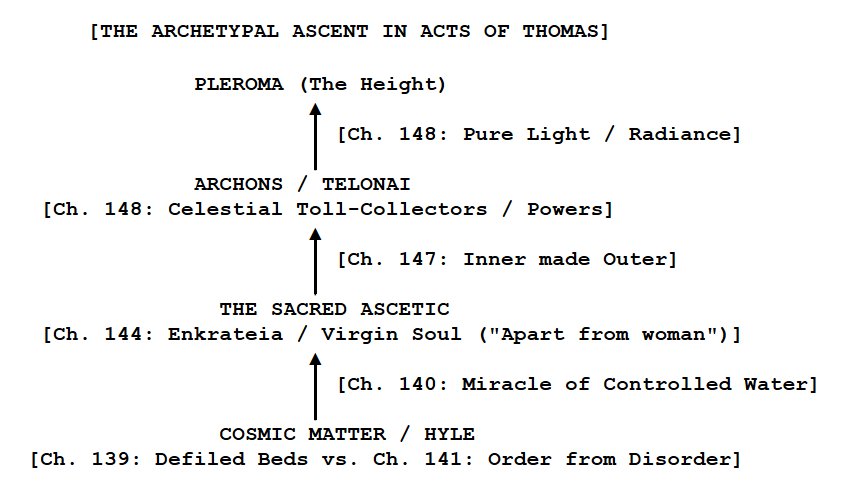
The Greek text of this portion of the Acts of Thomas (Acta Thomae)
features an intricate linguistic texture.
It sits at the intersection of classical literary idiom, Koine biblical standard, and a highly stylized Syrian-Christian theological vocabulary translated from an original Syriac Vorlage.
1)The Lexicon of Encratite Asceticism
The ideological core of the text is embedded in its vocabulary of absolute somatic renunciation, typical of early Syrian Enkrateia (self-control/abstinence):
2)
κοίταις μιαραῖς
(Ch.
139):
Meaning "defiled/polluted beds."
This is not a generic moral condemnation of licentiousness, but an explicit Encratite rejection of all marital intercourse.
Human procreation is viewed as a systemic entrapment in the transient world (πρόσκαιρος ζωή
).
3)
γυναικὸς ἀπεσχόμην
(Ch.
144):
"I kept myself apart from woman."
This directly reflects the Syrian theological concept of the Ihidaya (the "solitary"
or "single-minded"
ascetic).
Celibacy is presented as the primary structural prerequisite for the pristine preservation of the divine spark, ensuring the soul is not "found defiled with stain"
(ἐν ῥύπῳ).
4)
ἑνότητι καθαρᾶς τροφῆς
(Ch.
139):
"The unity of pure food."
This refers to strict vegetarianism and water-only fasts.
In the Acts of Thomas, the eucharist itself consists uniquely of bread and water, deliberately omitting wine.
2) Gnostic & Valentinian Ontological Terminology
The text utilizes technical vocabulary highly reminiscent of second-
and third-century Gnostic cosmological systems, particularly Valentinianism and Bardaisanite theology:
1)
υἱὸς βάθους
μονογενής
(Ch.
143):
"Only-Begotten Son of the Deep."
The use of Bάθος
(Bythos/Depth)
as a designation for the supreme, unoriginated divine source is a classic hallmark of Valentinian cosmogony.
Christ is framed as the manifestation emerging from the absolute primordial abyss.
2)
πατὴρ ὕψους
(Ch.
143):
"Father of the Height."
This contrasts directly with the demiurgic ruler of the material world.
3)
ἰδίαν ἀποκαθιστῶν φύσιν
(Ch.
141):
"Restoring [the soul]
to its own native essence/nature."
Salvation here is framed not as forensic justification or a new creation, but as an ontological reversion or reconstitution.
The pneumatic soul returns to its uncorrupted pre-material state, escaping the trap of material elements (στοιχεῖα).
3. The Mystical Logia of Reversal
Verse 147
contains a direct textual parallel to the extra-canonical Logia of Jesus found in the Gospel of Thomas (Logion 22):
τὸν ἐντὸς ἐκτός
πεποίηκα καὶ
τὸ ἐκτός
(Ch.
147):
"I have made the inner as the outer, and the outer [as the inner]."
This formula represents the collapse of somatic dualism through radical asceticism.
By eliminating sexual differentiation and biological drives, the chaotic external world is subdued and integrated into the pristine internal reality of the spirit.
Immediately following this is a highly cryptic phrase:
τὸν δέσμιον ὅν μοι
παρέδωκας ἐφόνευσα
("The prisoner whom You delivered to me, I killed").
Within this theological framework, the "prisoner"
is the fleshly, psychic ego or the animate soul (ψυχή
)
governed by cosmic passions.
"Killing"
this prisoner represents the ultimate victory of the pneumatic self over the lower physical architecture.
4. Social-Historical Analysis
1)
The Indo-Parthian and Sasanian Frontier
The Acts of Thomas names Misdaeus (Mισδαῖος,
a Greek rendering of the Iranian name Mazdai)
as the king responsible for Thomas's execution.
Historically, this places the setting within the cultural sphere of the Indo-Parthian kingdoms or the early Sasanian frontier (modern-day Pakistan and Northwest India).
The shifting political landscape of the mid-third century saw the rise of Ardashir I and Shapur I, who aggressively reasserted Zoroastrian orthodoxy.
The clash between Thomas and King Mazdai dramatically mirrors the actual historical tensions between wandering Christian/Manichaean ascetics and the royal courts of Iranian-dominated realms:
| Aspect | The Royal Court of King Mazdai | The Ascetic Realm of Judas Thomas |
|---|---|---|
| Sovereignty | Secular, geopolitical, transient (πρόσκαιρος) | Cosmic, celestial, eternal (αἰώνιος) |
| Foundational | Wealth Luxury (τρυφή), robes (πέπλοι), slaves, procreation | Poverty (πενία), philosophy (φιλοσοφία), celibacy |
| Cosmic Alignment | Relies on human laws, political authority, and status | Relies on the True King, commands the elements |
2) The Cosmic Toll-Booths (Tελῶναι) and Ancient Bureaucracy
In Verse 148, Thomas prays for his soul’s post-mortem ascent through the heavens:
"Let the toll-collectors (τελῶναι) not see me, and let the exactors of tribute (ἀπαιτηταί) not traffic within me."
This striking imagery transposes the harsh, extraction-based fiscal bureaucracy of the Roman and Sasanian empires onto the architecture of the cosmos. In the ancient world, the τελώνης (publican/toll-collector) was a deeply feared figure who occupied frontier checkpoints, arbitrarily seizing property and levying transit taxes.
In early Syrian and Gnostic soteriology, this economic reality becomes an eschatological nightmare: the planetary spheres are controlled by demonic Archons who act as celestial customs officers, searching ascending souls for the "tariffs" of material defilement or secret knowledge. Thomas can pass freely only because his radical asceticism ensures he possesses "nothing of their world" within him—rendering him fiscally invisible to the demonic collectors.
3)The Structural Collision: Family vs. Kingdom
Vazan’s conversion in Verse 140
highlights the severe social disruption caused by early Christian asceticism within ancient aristocratic households.
When Vazan, his wife, and his daughter accept the "word of life,"
they are not simply adopting a private set of beliefs;
they are actively dismantling the patriarchal family structure.
By committing to celibacy (ἁγιωσύνη),
elite converts effectively cut off the lineage of royal successions and disrupted the orderly transfer of familial wealth and estates.
King Mazdai’s absolute rage (ὀργή)
is not born out of generic religious intolerance, but out of political self-preservation.
From the perspective of the ancient state, a movement that forbids marriage and reproduction is a profound threat to civil order and imperial continuity.
Πρᾶξις ιγ ὅτε Οὐαζάνης λαμβάνει τὸ βάπτισμα μετὰ τῶν λοιπῶν.
|
150
Οὐαζάνης
δὲ
ὁ
νεανίσκος
ἐδέετο
τοῦ
ἀποστόλου
λέγων·
Δέομαί
σου
ἄνθρωπε
ἀπόστολε
τοῦ
θεοῦ,
συγχώρησόν
μοι
ἀπελθεῖν,
καὶ
πείσω
τὸν
δεσμοφύλακα
ἵνα
σοι
συγχωρήσῃ
ἐλθεῖν
οἴκαδε
μετ
ἐμοῦ,
ὅπως
διὰ
σοῦ
λάβω
σφραγῖδα,
καὶ
γένωμαι
ὑπηρέτης
σου
καὶ
φύλαξ
τῶν
ἐντολῶν
τοῦ
θεοῦ
οὗ
σὺ
κηρύσσεις.
καὶ γὰρ πρότερον ἐν οἷς σὺ διδάσκεις ἀνεστρεφόμην, ἕως οὗ ὁ ἐμὸς πατὴρ βιασάμενός με γυναικὶ συνῆψεν Ἀνισάρᾳ λεγομένῃ· ὢν γὰρ πρώτου καὶ εἰκοστοῦ ἔτους ἕβδομον ἤδη ἐνιαυτὸν ἔχω γαμήσας· πρὸ τοῦ δὲ συναλλάξαι γάμῳ ἄλλην οὐκ ἐγίνωσκον γυναῖκα· διὸ καὶ ἄχρηστος τῷ πατρὶ ἐνομιζόμην· οὐδέ ποτε οὔτε υἱὸς οὔτε θυγάτηρ γέγονέν μοι ἐκ τῆς γυναικὸς ταύτης· ἀλλὰ καὶ ἡ γυνή μου αὐτὴ ἐν σωφροσύνῃ συνέζησέν μοι τὸν ἱκανὸν τοῦτον, καὶ σήμερον εἰ ὑγιὴςἐτύγχανεν καὶ παρὰ σοῦ ἀπηκροάσατο, οἶδα ὅτι κἀγὼ ἀνεπαυόμην καὶ αὐτὴ αἰωνίαν ζωὴν ἀπελάμβανεν· ἀλλ᾽ ἐν κινδύνῳ καὶ ἐν κακώσει πολλῇ ἐξετάζεται. πείθω τοίνυν τὸν φύλακα ἐάν μοι ὑποσχῇ ἐλθεῖν μετ ἐμοῦ· ἰδίᾳ γὰρ κατ ἐμαυτὸν οἰκῶ· καὶ ἅμα θεραπεύεις τὴν ἀθλίαν ἐκείνην. Ἀκούσας δὲ ταῦτα Ἰούδας ὁ ἀπόστολος τοῦ ὑψίστου εἶπεν τῷ Οὐαζάνῃ· Εἰ πιστεύεις, ὄψει τὰ θαύματα τοῦ θεοῦ καὶ πῶς σῴζει τοὺς αὐτοῦ δούλους. | 150 Vazan the young man besought the Apostle, saying: "I beg you, O man, apostle of God, permit me to go, and I will persuade the jailer to allow you to come home with me, so that through you I may receive the seal (σφραγῖδα ), and become your attendant (ὑπηρέτης) and a keeper of the commandments of the God whom you preach. For indeed, I previously walked in the things you teach, until my father compelled me by force and joined me to a woman named Anisara. Being in my twenty-first year, I have now been married for seven years. Before I was joined in marriage, I knew no other woman; for which reason I was considered useless (ἄχρηστος) by my father. Never has either a son or a daughter been born to me from this woman; but my wife herself lived with me in chastity (σωφροσύνῃ) during this time. Today, if she happened to be well and had listened to your preaching, I know that I would find rest (ἀνεπαυόμην) and she would receive eternal life. But now she is tested in great danger and affliction. I will therefore persuade the guard if you promise to come with me, for I live privately by myself; and at the same time, you can heal that wretched woman." Hearing these things, Judas, the apostle of the Most High, said to Vazan: "If you believe, you shall see the wonders of God, and how He saves His servants." |
|
151
Διαλεγομένων
δὲ
αὐτῶν
ταῦτα
Τερτία
καὶ
Μυγδονία
καὶ
Μαρκία
ἐν
τῇ
θύρᾳ
ἵσταντο
τοῦ
δεσμωτηρίου,
καὶ
δοῦσαι
τῷ
δεσμοφύλακι
τριακοσίους
ἐξήκοντα
τρεῖς
στατῆρας
ἀργυρίου
εἰσῆλθον
πρὸς
τὸν
Ἰούδαν·
καὶ
εὗρον
τὸν
Οὐαζάνην
καὶ
τὸν
Σιφόρα
καὶ
τὴν
γυναῖκα
αὐτοῦ
καὶ
τὴν
θυγατέρα
καὶ
πάντας
τοὺς
δεσμώτας
καθημένους
καὶ
τοῦ
λόγου
ἀκούοντας.
καὶ ὡς ἔστησαν πρὸς αὐτὸν εἶπεν αὐταῖς· Τίς ὑμῖν συνεχώρησεν ἐλθεῖν πρὸς ἡμᾶς; καὶ τίς ὑμῖν ἤνοιξεν τὴν ἐσφραγισμένην θύραν τοῦ ἐξελθεῖν; Λέγει αὐτῷ Τερτία· Οὐ σὺ ἀνεπέτασας τὰς θύρας ἡμῖν εἰπὼν εἰσελθεῖν εἰς τὸ δεσμωτήριον, Ἵνα τοὺς ἀδελφοὺς ἡμῶν τοὺς ἐκεῖ παραλάβωμεν καὶ τότε ἐνδείξηται ὁ κύριος τὴν δόξαν αὐτοῦ ἐν ἡμῖν; Καὶ πλησίον τῆς θύρας γενομένων ἡμῶν οὐκ οἶδα πῶς ἐχωρίσθης ἀφ ἡμῶν καὶ ἀποκρυβεὶς ἡμᾶς προῆλθες ἐνθάδε, ὅπου καὶ τοῦ ψόφου τῆς θύρας ᾐσθόμεθα, σοῦ ἀποκλείσαντος ἡμᾶς. δοῦσαι τοιγαροῦν χρήματα τοῖς φύλαξιν εἰσήλθομεν· καὶ ἰδοὺ πάρεσμεν δεόμεναί σου ὅπως πεισθέντα σε φυγαδεύσωμεν ἕως οὗ λήξει ὁ τοῦ βασιλέως εἰς σὲ θυμός. Πρὸς ἣν ὁ Ἰούδας· Διήγησαι πρότερον ἡμῖν πῶς συνεκλείσθητε. | 151 While they were discussing these things, Tertia, Mygdonia, and Marcia stood at the door of the prison. Having given the jailer three hundred and sixty-three silver staters (στατῆρας ἀργυρίου), they entered to Judas. They found Vazan, Sifor, his wife, his daughter, and all the prisoners sitting and listening to the word. When they stood before him, he said to them: "Who permitted you to come to us? And who opened the sealed door for you to come out?" Tertia said to him: "Did you not throw open the doors for us, telling us to enter the prison, so that we might receive our brothers who were there, and that the Lord might then display His glory in us? When we came near the door, I know not how you were parted from us, and hiding yourself from us, you preceded us here—where we even heard the sound of the door as you shut us out. Therefore, having given money to the guards, we entered; and behold, we are present, begging you that we may persuade you to escape until the king's anger against you relents." Judas said to her: "Tell us first how you were shut in." |
|
152
Καί
φησιν
αὐτῷ·
Σὺ
μεθ᾽
ἡμῶν
ἦς
καὶ
οὐδέ
ποτε
ἀπελείφθης
ἡμῶν
πρὸς
ὥραν
μίαν,
καὶ
ἐρωτᾷς
ποίῳ
συνεκλείσθημεν
τρόπῳ;
ἀλλ᾽
εἰ
ἀκοῦσαι
ποθεῖς,
ἄκουσον.
μεταπεμψάμενός με ὁ βασιλεὺς Μισδαῖος ἔλεγέν μοι ὅτι οὐδέπω σου περιγέγονεν ὁ μάγος ἐκεῖνος, ἐπειδήπερ ὡς ἀκούω ἐλαίῳ καὶ ὕδατι καὶ ἄρτῳ τοὺς ἀνθρώπους μαγεύει, καὶ σὲ οὐδέπω ἐγοήτευσεν· ἀλλὰ πείσθητί μοι· ἐπεὶ σὲ μὲν ἐγκλείσας συντρίψω, ἐκεῖνον δὲ ἀπολέσω· οἶδα γὰρ ὅτι ἐὰν οὐδέπω σοι ἔλαιον καὶ ὕδωρ καὶ ἄρτον ἐπέδωκεν, περιγενέσθαι σου οὐκ ἴσχυσεν. Εἶπον δὲ πρὸς αὐτὸν ἐγώ· Τοῦ μὲν σώματός μου ἐξουσίαν ἔχεις, καὶ πᾶν ὅ τι βούλει πρᾶττε· τὴν δὲ ψυχήν μου οὐ συναπολέσω σοι. | 152 She said to him: "You were with us and never left us for a single hour, yet you ask in what manner we were shut in? But if you long to hear, listen. King Misdaeus sent for me and said to me: 'That magician has not yet triumphed over you, because, as I hear, he bewitches people with oil and water and bread (ἐλαίῳ καὶ ὕδατι καὶ ἄρτῳ), but he has not yet enchanted you. Obey me, then; otherwise, I will shut you up and crush you, and I will destroy him. For I know that if he has not yet administered oil and water and bread to you, he has lacked the power to triumph over you.' But I said to him: 'Over my body you have authority (ἐξουσίαν), and do whatever you wish; but my soul I will not destroy along with you.'" |
|
153
Ἀκούσας
δὲ
ταῦτα
συνέκλεισέν
με
ἐν
οἰκήματι·
καὶ
ὁ
Χαρίσιος
δὲ
ἤνεγκεν
τὴν
Μυγδονίαν
καὶ
κατέτήριον.
κλεισεν αὐτὴν σὺν ἐμοί. καὶ σὺ ἡμᾶς ἐξήγαγες καὶ μέχρι τῶν ὧδε παρέστησας. ἀλλὰ δὸς τάχιον τὴν σφραγῖδα ἡμῖν, ἵνα ἐκκοπῶσιν αἱ ἐλπίδες Μισδαίου τοιαῦτα βουλομένου. Ἀκούσας δὲ ταῦτα ὁ ἀπόστολος εἶπεν· Δόξα σοι πολύμορφε Ἰησοῦ, σοὶ δόξα ὁ φαινόμενος κατὰ τὴν μετρίαν ἡμῶν ἀνθρωπότητα· σοὶ δόξα ὁ παραθαρσύνων καὶ ἐνδυναμῶν ἡμᾶς καὶ χάριν ποιῶν καὶ παραμυθούμενος καὶ παριστάμενος ἡμῖν ἐπὶ πᾶσι τοῖς κινδύνοις καὶ ἐνδυναμῶν τὴν ἀσθένειαν ἡμῶν. Λέγοντος δὲ αὐτοῦ ταῦτα ἐλθὼν ὁ δεσμοφύλαξ εἶπεν· Ἀπόθεσθε τοὺς λύχνους, ἵνα μή τις ὑμᾶς τῷ βασιλεῖ διαβάλῃ. Καὶ τότε ἀποσβέσαντες τοὺς λύχνους εἰς ὕπνον ἐτράπησαν· ὁ δὲ ἀπόστολος τῷ κυρίῳ προσδιελέγετο· Καιρὸς λοιπόν ἐστιν Ἰησοῦ τῆς σῆς ταχυτῆτος· ἰδοὺ γὰρ οἱ τοῦ σκότους παῖδες ἐν τῷ αὐτῶν καθιοῦσι σκότει. σὺ οὖν ἐν φωτὶ τῆς φύσεως ὢν κατάλαμψον ἡμᾶς. Καὶ ἐξαίφνης τὸ δεσμωτήριον ὅλον ἔλαμψεν ὡς ἡ ἡμέρα. πάντων δὲ τῶν ἐν τῷ δεσμωτηρίῳ καθευδόντων βαθεῖ ὕπνῳ μόνοι οἱ πεπιστευκότες τῷ κυρίῳ ἐγρηγορότες ἐτύγχανον. | 153 "Hearing these things, he shut me up in a chamber; and Charisius brought Mygdonia and shut her in with me. But you led us out and brought us as far as this place. Grant us now the seal (σφραγῖδα ) quickly, so that the hopes of Misdaeus, who devises such things, may be cut off." Hearing this, the Apostle said: "Glory to You, O polymorphic (πούμορφε) Jesus! Glory to You, who appear according to our humble humanity. Glory to You, who encourage and strengthen us, showing grace, comforting, and standing by us in all dangers, reinforcing our weakness." While he was saying these things, the jailer came and said: "Put out the lamps, lest someone defame you to the king." Then, having extinguished the lamps, they turned to sleep. But the Apostle continued to converse with the Lord: "It is time now, Jesus, for Your swiftness; for behold, the children of darkness sit in their own darkness. You, therefore, being in the light of nature (φωτὶ τῆς φύσεως), shine upon us!" Suddenly, the whole prison shone like the day. While all those in the prison slept in a deep sleep, only those who believed in the Lord remained awake. |
|
154
Λέγει
οὖν
ὁ
Ἰούδας
τῷ
Οὐαζάνῃ·
Πρόλαβε
καὶ
εὐτρέπισον
ἡμῖν
τὰ
πρὸς
τὴν
χρείαν.
Λέγει οὖν ὁ Οὐαζάνης· Καὶ τίς μοι τὰς θύρας ἀνοίξει τοῦ δεσμωτηρίου; κλείσαντες γὰρ ταύτας οἱ δεσμοφύλακες ἐκοιμήθησαν. Καὶ λέγει ὁ Ἰούδας· Πίστευσον τῷ Ἰησοῦ, καὶ εὑρήσεις τὰς θύρας ἀνεῳγμένας. Ὡς δὲ ἐξελθεῖν ἀπῄει αὐτῶν, οἱ λοιποὶ πάντες κατόπισθεν ἠκολούθουν αὐτῷ. προελθόντος δὲ τοῦ Οὐαζάνου συνήντησεν Μνησάρα ἡ γυνὴ αὐτοῦ ἐρχομένη εἰς τὸ δεσμωτήριον. καὶ ἐπιγνοῦσα αὐτὸν λέγει· Ἀδελφέ μου Οὐαζάνη, σὺ εἶ; Ὃ δὲ Ναί φησιν· σὺ δὲ Μνησάρα; Ἣ δὲ λέγει· Ναί. Ἔφη αὐτῇ Οὐαζάνης· Ποῦ βαδίζεις; μάλιστα καὶ κατὰ τοιαύτην ἀωρίαν; πῶς δὲ καὶ ἀναστῆναι ἠδυνήθης; Ἣ δὲ εἶπεν· Ὁ νεώτερος οὗτος τὴν χεῖρά μοι ἐπιθεὶς ἤγειρέν με, καὶ ὄναρ εἶδον ἵνα ἀπέλθω ὅπου ὁ ξένος κάθηται καὶ τελείως ὑγιάνω. Λέγει αὐτῇ ὁ Οὐαζάνης· Ποῖος νεώτερός ἐστιν παρὰ σοί; Ἣ δὲ ἔφη· Οὐχ ὁρᾷς τὸν ἐκ δεξιῶν μοι χειραγωγοῦντά με; | 154 Judas said to Vazan: "Go ahead and prepare what is required for our need." Vazan said: "And who will open the doors of the prison for me? For the jailers locked them and went to sleep." Judas said: "Believe in Jesus, and you will find the doors opened." As he went out from them, all the rest followed behind him. As Vazan went ahead, he met Mnesara his wife coming to the prison. Recognizing him, she said: "My brother Vazan, is it you?" He said: "Yes. And are you Mnesara?" She said: "Yes." Vazan said to her: "Where are you going, especially at such an unseasonable hour (ἀωρίαν)? And how were you able to rise?" She said: "This younger man (νεώτερος) laid his hand upon me and raised me up, and I saw a dream telling me to go where the stranger sits, so that I might be completely healed." Vazan said to her: "What younger man is with you?" She said: "Do you not see the one at my right hand leading me by the hand?" |
|
155
Tαῦτα
δὲ
διαλεγομένων
ἐκείνων
Ἰούδας
μετὰ
Σιφόρου
καὶ
τῆς
γυναικὸς
αὐτοῦ
καὶ
τῆς
θυγατρὸς
καὶ
Τερτίας
καὶ
Μυγδονίας
καὶ
Μαρκίας
ἦλθον
εἰς
τὴν
Οὐαζάνου
οἰκίαν.
ἰδοῦσα δὲ Μνησάρα ἡ Οὐαζάνου γυνὴ προσεκύνησεν καὶ εἶπεν· Ἦλθες ὁ σωτὴρ ἡμῶν ἀπὸ τοῦ δυσκόλου νοσήματος; σὺ εἶ ὃν εἶδον ἐν νυκτὶ παραδιδόντα μοι τὸν νεώτερον τοῦτον ἀγαγεῖν με εἰς τὸ δεσμωτήριον. ἀλλ᾽ οὐκ εἴασεν ἡ χρηστότης σου καμεῖν με, σὺ δὲ αὐτὸς ἦλθες πρός με. Εἰποῦσα δὲ ταῦτα καὶ εἰς τὰ ὀπίσω ἐπιστραφεῖσαto turn around οὐκέτι εἶδεν τὸν νεώτερον. καὶ μὴ εὑροῦσα λέγει πρὸς τὸν ἀπόστολον· Οὐ δύναμαι μόνη βαδίσαι· ὁ γὰρ νεώτερος οὐ πάρεστιν ὃν παρέδωκάς μοι. Καὶ ὁ Ἰούδας εἶπεν· Ἰησοῦς τὸ λοιπόν σε χειραγωγήσει. Μετὰ ταῦτα ἤρχετο πρὸς αὐτὸν δρόμῳ χρωμένη. ὡς δὲ εἰσῆλθον εἰς τὴν οἰκίαν Οὐαζάνου υἱοῦ Μισδαίου τοῦ βασιλέως, ἔτι νυκτὸς οὔσης φῶς αὐτοῖς πολὺ περικεχυμένον ἔφαινεν. | 155 While they were conversing, Judas—along with Sifor, his wife, his daughter, Tertia, Mygdonia, and Marcia—arrived at Vazan’s house. Mnesara, Vazan’s wife, seeing them, prostrated herself (προσεκύνησεν ) and said: "Have you come, our savior from the grievous disease? You are the one whom I saw at night delivering this younger man to me, to lead me to the prison. But your goodness did not suffer me to toil, for you yourself came to me." Having said these things, she turned back and no longer saw the younger man. Not finding him, she said to the Apostle: "I cannot walk alone, for the younger man whom you delivered to me is not present." Judas said: "Jesus will lead you by the hand for the rest of the way." After this, she came toward him running. As they entered the house of Vazan, the son of King Misdaeus, though it was still night, a great light poured around them and shone. |
|
156
Καὶ
τότε
ὁ
Ἰούδας
ἤρξατο
εὔχεσθαι
καὶ
λέγειν
οὕτως·
Ὁ
ἑταῖρος
καὶ
σύμμαχος
καὶ
τῶν
ἀσθενῶν
ἐλπὶς
καὶ
πεποίθησις
τῶν
μετρίων·
καταφυγὴ
καὶ
καταγώγιον
τῶν
κεκμηκότων·
φωνὴ
οὖν
ἐξῆλθεν
ἐξ
ὕπνου·
ὁ
παρήγορος
ὁ
ἐν
μέσῳκατοικῶν·
καταγώγιον
καὶ
λιμὴν
τῶν
διιόντων
ἀρχόντων
χορῶν·
ὁ
ἰατρὸς
ὁ
ἄμισθος·
ὁ
ὑπὲρ
πολλῶν
παρὰ
ἀνθρώποις
σταυρωθείς·
ὁ
κατελθὼν
εἰς
ᾅδου
μετὰ
πολλῆς
δυνάμεως·
οὗ
τὴν
θέαν
οὐκ
ἤνεγκαν
οἱ
τοῦ
θανάτου
ἄρχοντες·
καὶ
ἀνῆλθες
μετὰ
πολλῆς
δόξης,
καὶ
Συναγαγὼν
πάντας
τοὺς
εἰς
σὲ
καταφεύγοντας
παρεσκεύασας
ὁδόν,
καὶ
ἐπὶ
τῶν
ἰχνῶν
σοῦ
πάντες
ὥδευσαν
οὓς
ἐλυτρώσω·
καὶ
εἰσαγαγὼν
εἰς
τὴν
ἑαυτοῦ
ποίμνην
τοῖς
σοῖς
ἐγκατέμειξας
προβάτοις·
υἱὸς
σπλάγχνων,
ὁ
κατὰ
φιλανθρωπίαν
ἀποσταλεὶς
ἡμῖν
υἱὸς
ἀπὸ
τῆς
ἄνω
πατρίδος
τῆς
τελείας·
ὁ
κύριος
ἀπάντων
κτημάτων·
ὁ
δουλεύων
αὐτοῦ
τοῖς
δούλοις
ἵνα
ζήσωσιν·
ὁ
πληρώσας
τὴν
κτίσιν
τοῦ
ἑαυτοῦ
πλούτου·
ὁ
πένης
ὁ
ἐνδεηθεὶς
καὶ
πεινάσας
ἡμέρας
τεσσαράκοντα·
ὁ
κορεννύων
ψυχὰς
διψώσας
τῶν
ἑαυτοῦ
ἀγαθῶν·
σὺ
ἔσο
μετὰ
Οὐαζάνου
υἱοῦ
Μισδαίου
καὶ
Τερτίας
καὶ
Μνησάρας,
καὶ
συνάγαγε
αὐτὰς
εἰς
τὴν
σὴν
μάνδραν,
καὶ
ἐγκαταμείγνυεαὐτοὺς
τῷ
σῷ
ἀριθμῷ.
ἔσο αὐτῶν ὁδηγὸς ἐν χώρᾳ πλάνης· ἔσο αὐτῶν ἰατρὸς ἐν χώρᾳ νοσήματος· ἔσο αὐτῶν ἀνάπαυσις ἐν χώρᾳ καμνόντων· ἁγίασον αὐτοὺς ἐν μιᾶς χώρας· ἔσο ἰατρὸς αὐτῶν σωμάτων καὶ ψυχῶν· ποίησον αὐτοὺς ναοὺς ἁγίους σου, καὶ οἰκείτω ἐν αὐτοῖς τὸ ἅγιόν σου πνεῦμα. | 156 Then Judas began to pray and speak thus: "O companion and ally, hope of the weak and confidence of the humble; refuge and lodging of the weary; Voice that came forth from sleep; Comforter who dwells in our midst; lodging and harbor of those passing through the dances of the rulers (ἀρχόντων χορῶν); Physician without fee; He who was crucified among men on behalf of many; He who descended into Hades with great power, whose sight the rulers of death (ἄρχοντες τοῦ θανάτου) could not bear; and You ascended with great glory, and gathering all who flee to You for refuge, You prepared a way, and along Your footprints traveled all whom You redeemed; and bringing them into Your own flock, You mingled them with Your sheep; Son of compassion, Sent to us out of philanthropy, Son from the perfect homeland above (ἄνω πατρίδος τῆς τελείας); Lord of all possessions; He who serves His own servants that they might live; He who filled creation with His own wealth; the poor one who was in want and hungered forty days; He who satisfies thirsty souls with His own good things—be with Vazan, the son of Misdaeus, and Tertia, and Mnesara, and gather them into Your sheepfold (μάνδραν), and mingle them with Your number. Be their guide in a land of error; be their physician in a land of sickness; be their rest in a land of the weary; sanctify them in a single land; be the physician of their bodies and souls; make them Your holy temples, and let Your Holy Spirit dwell within them." |
|
157
Οὕτως
αὐτοῖς
εὐξάμενος
ὁ
ἀπόστολος
τῇ
Μυγδονίᾳ
εἶπεν·
Ἀπόδυσόν
σου
τὰς
ἀδελφάς.
Ἣ δὲ ἀποδύσασα περιέζωσεν αὐτὰς περιζώματα καὶ προσήγαγεν αὐτάς· Οὐαζάνης δὲ πρότερον προσεληλύθει, κἀκεῖναι μετ αὐτόν. καὶ λαβὼν Ἰούδας ἔλαιον ἐν ἀργυρέῳ ποτηρίῳ ἐπέλεγεν οὕτως· Ὁ ὡραῖος καρπὸς τῶν ἄλλων καρπῶν, ᾧ οὐδεὶς συγκρίνεται ὅλως ἕτερος· ὁ πάνυ ἐλεήμων· ὁ τῇ τοῦ λόγου ὁρμῇ ζέων· δύναμις ἡ τοῦ ξύλου ἣν οἱ ἄνθρωποι ἐνδυόμενοι τοὺς ἑαυτῶν ἀντιπάλους νικῶσιν· ὁ στεφανῶν τοὺς νικῶντας· σύμβολον καὶ χαρὰ τῶν καμνόντων· ὁ εὐαγγελισάμενος τοῖς ἀνθρώποις τὴν ἑαυτῶν σωτηρίαν· ὁ δεικνὺς φῶς τοῖς ἐν σκότει· ὁ τὰ μὲν φύλλα πικρός, τὸν δὲ γλυκύτατον καρπὸν εὐειδής· ὁ τραχὺς μὲν τὴν θέαν, ἁπαλὸς δὲ τὴν γεῦσιν· ὁ ἀσθενὴς μὲν δοκῶν, τῇ δὲ τῆς δυνάμεως ὑπερβολῇ τὴν τὰ πάντα θεωροῦσαν βαστάζων δύναμιν· ταῦτα εἴπων περιωχείμας· Ἰησοῦ ἐλθέτω ἡ νικητικὴ αὐτοῦ δύναμις, καὶ ἐνιδρύσθω τῷ ἐλαίῳ τούτῳ ὥσπερ ἱδρύνθη ἐν τῷ συγγενεῖ αὐτοῦ ξύλῳ ἡ τότε αὐτοῦ δύναμις, ἧς τὸν λόγον οὐκ ἤνεγκαν οἱ σταυρώσαντές σε· ἐλθέτω δὴ καὶ ἡ δωρεὰ δι’ ἧς τοῖς ἐχθροῖς αὐτοῦ ἐμφυσήσας εἰς τὰ ὀπίσω ὑποχωρῆσαι ἐποίησας καὶ πρηνεῖς καταπεσεῖν, καὶ ἐπιδημῆσαι τῷ ἐλαίῳ τούτω ᾧ ἐπιφημίζομεν τὸ σὸν ἅγιον ὄνομα. Καὶ ταῦτα εἰπὼν πρῶτον τῇ κεφαλῇ Οὐαζάνου ἐπέχεεν, ἔπειτα ταῖς τῶν γυναικῶν, λέγων· Ἐν ὀνόματί σου Ἰησοῦ Χριστὲ γενέσθω ταῖς ψυχαῖς ταύταις εἰς ἄφεσιν ἁμαρτιῶν καὶ εἰς ἀποτροπὴν τοῦ ἐναντίου καὶ εἰς σωτηρίαν τῶν ψυχῶν αὐτῶν. Καὶ ἐκέλευσεν τῇ Μυγδονίᾳ ἀλεῖψαι αὐτάς, αὐτὸς δὲ ἤλειψεν τὸν Οὐαζάνην. ἀλείψας δὲ αὐτοὺς κατήγαγεν εἰς ὕδωρ εἰς τὸ ὄνομα τοῦ πατρὸς καὶ τοῦ υἱοῦ καὶ τοῦ ἁγίου πνεύματος. | 157 Having prayed for them thus, the Apostle said to Mygdonia: "Undress your sisters." She, having undressed them, tied girdles around them and brought them forward. Vazan had come forward first, and they after him. Judas took oil in a silver cup and spoke over it thus: "O beautiful fruit of all other fruits, with which no other is compared at all; O utterly merciful; boiling with the impulse of the Word (λόγου ); power of the Tree (ξύλου) which human beings put on to conquer their adversaries; Crowner of the victors; symbol and joy of the weary; He who announced the good news of salvation to men; Caller of light to those in darkness; whose leaves are bitter, but whose beautiful fruit is sweetest; rough to the sight, but soft to the taste; appearing weak, yet by the excess of power bearing the power that beholds all things." Having said these things, he poured it around: "O Jesus, let His victorious power come, and let it be established in this oil, just as His power was then established in its kinsman Tree, the word of which those who crucified You could not bear. Let the gift also come, through which, blowing upon His enemies, You caused them to retreat and fall prostrate, and let it inhabit this oil over which we invoke Your holy name." Having said these things, he first poured it upon the head of Vazan, and then upon the heads of the women, saying: "In Your name, Jesus Christ, let it be to these souls for the remission of sins, and for the turning away of the adversary, and for the salvation of their souls." He commanded Mygdonia to anoint the women, while he himself anointed Vazan. Having anointed them, he led them down into the water in the name of the Father, and of the Son, and of the Holy Spirit. |
|
158
Ἀνελθόντων
δὲ
αὐτῶν
λαβὼν
ἄρτον
καὶ
ποτήριον
εὐλόγησεν
καὶ
εἷπεν·
Τὸ
σῶμά
σου
τὸ
ἅγιον
τὸ
ὑπὲρ
ἡμῶν
σταυρωθὲν
ἐσθίομεν
καὶ
τὸ
αἷμά
σου
τὸ
ὑπὲρ
ἡμῶν
ἐκχυθὲν
εἰς
σωτηρίαν
πίνομεν·
γένηται
οὖν
ἡμῖν
τὸ
σῶμά
σου
σωτηρία
καὶ
τὸ
αἷμά
σου
εἰς
ἄφεσιν
ἁμαρτιῶν.
ἀντὶ δὲ τῆς χολῆς ἧς ἔπιες δἰ ἡμᾶς περιαιρείσθω ἀφ ἡμῶν ἡ τοῦ διαβόλου χολή· ἀντὶ δὲ τοῦ ὄξους οὗ πέπωκας ὑπὲρ ἡμῶν ἐνδυναμούσθω ἡ ἀσθένεια ἡμῶν· ἀντὶ δὲ πτύσματος οὗ ἐδέξω δι’ ἡμᾶς δεξώμεθα δρόσον τῆς σῆς χρηστότητος· καὶ ἐν τῷ καλάμῳ ᾧ ἔτυψάν σε δι’ ἡμᾶς δεξώμεθα τὸν οἶκον τὸν τέλειον· ὅτι δὲ ἀκάνθινον στέφανον ἔλαβες δι’ ἡμᾶς, στέφανον ἀναδησώμεθα ἀμαράντινον οἱ ἀγαπήσαντές σε· ἀντὶ δὲ σινδόνης ἧς ἐνειλήθης καὶ ἡμεῖς περιζωσθῶμεν τὴν ἀήττητόν σου δύναμιν· ἀντὶ δὲ μνημείου καινοῦ καὶ ταφῆς ἀνακαινισμὸν τῆς ψυχῆς δεξώμεθα καὶ τοῦ σώματος. ὅτι δὲ ἀνέστης καὶ ἀνεβίωσας, ἀναβιώσαντες ζήσωμεν καὶ στῶμεν πρὸ σοῦ ἐν κρίσει δικαίια. Καὶ κλάσας τὴν εὐχαριστίαν ἔδωκεν Οὐαζάνῃ καὶ Τερτίᾳ καὶ Μνησάρᾳ καὶ τῇ τοῦ Σιφόρου γυναικὶ καὶ θυγατρὶ καὶ εἶπεν· Γενέσθω ὑμῖν ἡ εὐχαριστία αὕτη εἰς σωτηρίαν καὶ χαρὰν καὶ ὑγίειαν τῶν ψυχῶν ὑμῶν. Καὶ αὐτοὶ εἶπον· Ἀμήν. Καὶ φωνὴ ἠκούσθη λέγουσα· Ἀμήν· μὴ φοβεῖσθε ἀλλὰ μόνον πιστεύσατε. | 158 When they came up, he took bread and a cup, blessed it, and said: "Your holy body, crucified for us, we eat; and Your blood, poured out for us for salvation, we drink. Let Your body, therefore, be our salvation, and Your blood for the remission of sins. Instead of the gall which You drank for us, let the gall of the Devil be stripped from us. Instead of the vinegar which You drank for us, let our weakness be strengthened. Instead of the spit which You received for us, let us receive the dew of Your goodness. By the reed with which they struck You for us, let us receive the perfect house. Because You received a crown of thorns for us, let us bind on an unfading crown, we who have loved You. Instead of the linen shroud in which You were wrapped, let us be girded with Your unconquerable power. Instead of the new tomb and burial, let us receive renewal of soul and body. Because You rose and came to life again, raised up, let us live and stand before You in righteous judgment." And breaking the Eucharist (εὐχαριστίαν), he gave it to Vazan, Tertia, Mnesara, and to the wife and daughter of Sifor, and said: "Let this Eucharist be to you for salvation, joy, and health of your souls." And they said: "Amen." And a voice was heard saying: "Amen. Fear not, but only believe." |
| THe INITIATORy TRIAd In ACTs Of THOMAS | ||
|---|---|---|
| CHRISMA (Oil) | BAPTISMa (Water) | EUCHARISTIa (Bread) |
| Vs.
157: Overcoming the Archontic Rulers | Vs.
157: Immersive Kinsman Cleansing | Vs.
158: Somatic Reciprocal Reversal |
| THe INVIOLABLe "SEAL" (Σφραγίς) | ||
| Ontological Excision from Cosmic Matter | ||
1. Polymorphism and Docetic Epiphanies
Verse 153
features an explicit invocation of Christ as πολύμορφος
("many-formed"
or "polymorphic"):
Δόξα
σοι
πολύμορφε
Ἰησοῦ
("Glory to You, O polymorphic Jesus").
This is a key technical term in early Christian apocryphal acts (such as the Acts of John and Acts of Peter),
reflecting a fluid, docetic-leaning Christology.
Rather than being locked into a single material body, the Savior alters His physical form according to the spiritual capacity of the perceiver.
This is dramatized when Mnesara sees a νεώτερος
("younger man"
or "youth")
walking at her side and leading her by the hand (Ch.
154).
To the uninitiated or spiritually blind, this figure is invisible (Vazan cannot see him);
to the mystic, he is the celestial twin (Syzygos)
or the transfigured Christ Himself, manifesting as an angelic guide.
2. The Liturgical Syntax of the Sfragis
The text emphasizes the term σφραγίς
("seal"):
The converts demand the seal (δὸς
τάχιον
τὴν
σφραγῖδα
ἡμῖν,
Ch.
153)
to cut off the material hopes of King Misdaeus.
In early Syrian liturgy, the sfragis is not a mere byproduct of baptism;
it is an active, defensive ontological brand.
It isolates the soul from the cosmic jurisdiction of local rulers (ἄρχοντες
).
3. The Mystical Metaphor of the Olive Tree
The epiclesis (invocation)
over the oil in Verse 157
treats the substance not simply as an elemental token, but as an energetic extension of the Cross:
δύναμις ἡ τοῦ ξύλου:
"The power of the Tree."
The olive tree is philologically and mystically fused with the wood (ξύλον)
of the crucifixion.
The oil is described as τὰ μὲν φύλλα πικρός, τὸν δὲ γλυκύτατον καρπὸν εὐειδής
("bitter in its leaves, but beautiful in its sweetest fruit").
This serves as a direct allegorical map of the ascetic life:
painful, bitter renunciation of the body yields the sweet, incorruptible fruit of pneumatic immortality.
4. Reciprocal Somatic Reversals
The Eucharistic prayer in Verse 158 operates on a sophisticated poetic system of structural balance and cosmic exchanges, using the preposition ἀντί ("instead of / in exchange for"): Somatic Indignity of Christ (Passion)
5. Social-Historical Analysis
1)
The Anti-Sacramental Panic of the State
In Verse 152,
King Misdaeus expresses a highly specific political panic:
"...he bewitches people with oil and water and bread (ἐλαίῳ καὶ ὕδατι καὶ ἄρτῳ),
but he has not yet enchanted you...
For I know that if he has not yet administered oil and water and bread to you, he has lacked the power to triumph over you."
This reveals a profound social reality of the third-century East:
the state viewed Christian sacraments not as theological rituals, but as subversive magic (γοητεία).
To the Sasanian or Indo-Parthian sovereign, the real threat of the Christian movement was its ability to permanently detach subjects from their civic obligations through an irreversible ritual oath.
The king correctly recognizes that once a subject receives the tripartite initiation (Oil, Water, Bread),
they cross an ideological line that places them beyond the psychological control of the crown.
The ritual creates an alternate, underground citizenship.
2)
Ancient Currency and Elite Infiltration
The text notes that Tertia, Mygdonia, and Marcia gain entry to the inner prison by bribing the jailer with three hundred and sixty-three silver staters (στατῆρας ἀργυρίου)
(Ch.
151).
The stater (often equivalent to a tetradrachm or a local Greco-Bactrian/Indo-Parthian silver coin)
represents an immense sum of money—effectively a small fortune or several months'
wages for an ordinary soldier.
This details the high aristocratic status of Thomas’s female converts.
Mygdonia (wife of the royal counselor Charisius)
and Tertia (the queen herself)
have direct access to private treasury funds.
The text depicts an asymmetric class warfare:
elite women use their immense wealth to corrupt the lower-level security apparatus of the state (the jailers),
turning the king's own prison into an illicit, nocturnal church.
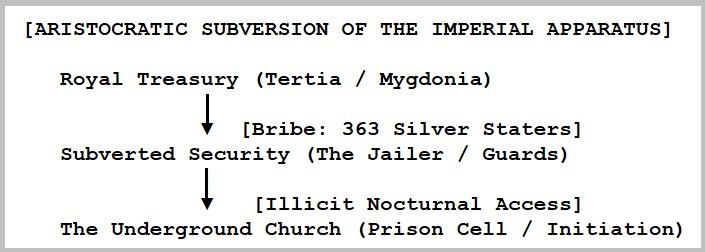
3)The Chronology of Forced Marriage
In Verse 150,
Vazan provides a rare, detailed glimpse into the domestic timeline of ancient Iranian/Near Eastern aristocracy:
"...being in my twenty-first year, I have now been married for seven years...
and my wife herself lived with me in chastity (σωφροσύνῃ)
during this time."
This indicates that Vazan was married at fourteen years old (21−7=14),
a historically accurate reflection of early marriage alliances among noble families in the Parthian and Sasanian worlds, where child marriages were common to secure lineages and retain ancestral estates.
Vazan’s pride in their seven years of mutual celibacy (σωφροσύνη)
highlights how deeply the Encratite ideal cut across ancient family structures.
By remaining virgins within a state-mandated marriage, Vazan and Anisara engaged in a quiet, domestic rebellion against the reproductive demands of the Zoroastrian state, which viewed procreation as a primary religious duty.
4)The Liturgical Sequence of East Syrian Christianity
Verses 157–158
offer an invaluable historical window into the development of early East Syrian liturgy.
Unlike Western Christian traditions (Rome, Alexandria, Carthage)
which developed a standard sequence of Water Baptism →
Post-Baptismal Anointing (Chrismation)
→
Eucharist, the Acts of Thomas preserves the primitive Syrian sequence:
Anointing of the Head (Chrism)⟶Immersion in Water⟶Breaking of Bread (Eucharist)
The oil is applied first to the head, acting as an exorcistic shield and a royal coronation that prepares the candidate to descend into the waters.
Furthermore, the Eucharist is characterized by the absence of wine, using only bread and a cup (which in the wider context of early Syrian asceticism was filled with water).
This liturgical structure directly confirms the existence of non-wine-drinking, non-meat-eating Christian communities along the Mesopotamian and Iranian frontier during the third century.
Μαρτύριον τοῦ ἁγίου καὶ ἐνδόξου ἀποστόλου Θωμᾶ.
|
159
Ἐν
ταῖς
ἡμέραις
ἐκείναις
ἀνῄει
ὁ
ἀπόστολος
Θωμᾶς
ἐπὶ
τὸ
ἐγκλεισθῆναι·
καὶ
Τερτία
σὺν
Μυγδονίᾳ
καὶ
Ναρκίᾳ
ἀπῄεσανἐπὶ
τὸ
ἐγκλεισθῆναι.
ὁ δὲ ἀπόστολος Θωμᾶς εἶπεν πρὸς αὐτάς, τοῦ πλήθους τῶν πεπιστευκότων παρόντος· Θυγατέρες καὶ ἀδελφαὶ καὶ σύνδουλοι αἱ εἰς τὸν κύριον καὶ θεόν μου πιστεύσασαι, τοῦ Ἰησοῦ μου ὑπηρέτριαι, ἀκούσατέ μου ἐν ταύτῃ τῇ ἡμέρᾳ· τὸν γὰρ ἐμὸν λόγον παραδίδωμι ὑμῖν καὶ οὐκέτι διαλεχθήσομαι ὑμῖν ἐν τῇ σαρκὶ ταύτῃ οὐδὲ ἐν τῷ κόσμῳ τούτῳ· ἀνάγομαι γὰρ πρὸς τὸν κύριον καὶ θεόν μου Ἰησοῦν Χριστόν, πρὸς ἐκεῖνον τὸν πωλήσαντά με, πρὸς ἐκεῖνον τὸν ἑαυτὸν ταπεινώσαντα ἕως ἐμοῦ τοῦ μικροῦ κύριον καὶ ἀνάξαντά με εἰς μεγαλωσύνην αἰώνιον, τὸν καταξιώσαντά με λάτρην αὐτοῦ γενέσθαι ἐν ἀληθείᾳ καὶ βεβαιότητι. ἀπέρχομαι πρὸς αὐτὸν ἐπιστάμενος ὅτι ὁ καιρὸς συμπεπλήρωται καὶ ἤγγικεν ἡ προθεσμία ἵνα ἀπελθὼν ἀπολάβω τοὺς μισθούς μου παρὰ τοῦ κυρίου μου καὶ θεοῦ· δίκαιος γάρ ἐστιν ὁ μισθαποδότης μου ὁ εἰδώς με πῶς δεῖ με λαβεῖν τὸν μισθόν· οὔτε γὰρ πονηρός ἐστιν οὔτε φθονερός· πλούσιος δέ ἐστιν ἐν τοῖς αὐτοῦ χαρίσμασιν· οὐκ ἔστιν φιλόδολος ἐν οἷς δίδωσιν· τεθάρρηκε γὰρ τῇ ἀνυστερήτῳ αὐτοῦ κτήσει. | 159 In those days, the Apostle Thomas went up to be imprisoned; and Tertia, along with Mygdonia and Narcia, departed to be imprisoned with him. The Apostle Thomas said to them, while the multitude of those who believed was present: "Daughters and sisters and fellow-servants who have believed in my Lord and God, handmaidens (ὑπηρέτριαι) of my Jesus, hear me on this day. For I am delivering my final word (λόγον) to you, and no longer will I discourse with you in this flesh, nor in this world (κόσμῳ ). For I am being taken up (ἀνάγομαι) to my Lord and God, Jesus Christ—to that One who purchased me (πωλήσαντάμε), to that One who humbled Himself (ταπεινώσαντα) even unto me, the little and unworthy one, and raised me up into eternal majesty; the One who deemed me worthy to become His servant (λάτρην) in truth and steadfastness. I depart to Him, knowing that the time is fulfilled and the appointed day (προθεσμία) has drawn near, so that by departing I may receive my rewards (μισθούς) from my Lord and God. For righteous is my Rewarder (μισθαποδότης), who knows how it is necessary for me to receive the reward. For He is neither wicked nor envious, but He is rich in His gifts; He is not deceitful in what He gives, for He has absolute confidence in His own inexhaustible possession." |
|
160
οὐκ
εἰμὶ
ἐγὼ
Ἰησοῦς,
δοῦλος
δὲ
αὐτοῦ
εἰμι·
οὐκ
εἰμὶ
ἐγὼ
ΧριστόςChrist,
διάκονος
δὲ
αὐτοῦ
ὑπάρχω·
οὐκ
εἰμὶ
ἐγὼ
ὁ
υἱὸς
τοῦ
θεοῦ,
δέομαι
δὲ
ἄξιος
τοῦ
θεοῦ
γενέσθαι.
ἐμμείνατε τῇ πίστει τοῦ Χριστοῦ· ἐμμείνατε τῇ ἐλπίδι τοῦ υἱοῦ τοῦ θεοῦ· μὴ ἐκκακήσητε πρὸς τὰς θλίψεις μηδὲ διαιρεθῆτε ἐπὰν ἴδητέ με ὑβριζόμενον ἢ ὅτι ἐγκέκλεισμαι· αὐτοῦ γὰρ τὸ θέλημα εἰς πέρας ἄγω· εἰ γὰρ καὶ ἠβουλήθην μὴ ἀποθανεῖν, ἐν ΧριστῷChrist οἶδα ὅτι δύναμαι· οὗτος δὲ ὁ νομιζόμενος θάνατος οὐκ ἔστιν θάνατος, ἀλλὰ λύσις ἀπὸ τοῦ σώματός ἐστιν. διὸ χαίρων δέχομαι τὴν τοιαύτην λύσιν τοῦ σώματος, ἵνα ἀπελθῶν ἴδω ἐκεῖνον τὸν εὐπρεπῆ καὶ εὔσπλαγχνον, τὸν ἐπέραστον. πολὺν γὰρ κάματον ὑπέστην ἐν τῇ αὐτοῦ ἐργασίᾳ, καὶ ἐμόχθησα διὰ τὴν αὐτοῦ χάριν τὴν ἐπελθοῦσάν μοι, ἥτις οὐκ ἀπέστη ἀπ’ ἐμοῦ. μὴ οὖν ὑποδύῃ ὑμῖν ὁ σατανᾶς καὶ τὰς ἐνθυμήσεις ὑμῶν διαρπάσῃ· μὴ γένοιτο ἐν ὑμῖν ἐκείνῳ χώρα· ἰσχυρός ἐστιν ὃν ὑμεῖς ὑπεδέξασθε. τὴν τοῦ Χριστοῦ παρουσίαν προσδέχεσθε· ἐλθὼν γὰρ ὑποδέξεται ὑμᾶς· οὗτός ἐστιν ὃν ὄψεσθε ἐρχόμενον. | 160 "I am not Jesus, but I am His servant (δοῦλος); I am not Christ, but I am His minister (διάκονος); I am not the Son of God, but I pray that I may be deemed worthy of God. Abide in the faith of Christ; abide in the hope of the Son of God. Do not grow weary (ἐκκακήσητε) in the face of afflictions, nor be divided (διαιρεθῆτε) when you see me insulted or that I have been shut up in prison. For I am bringing His will to its completion (εἰςπέραςἄγω). For even if I had wished not to die, I know that in Christ I am able; yet this which is thought to be death is not death, but a release (λύσις) from the body. Therefore, rejoicing, I accept such a release from the body, so that by departing I may see that One who is beautiful (εὐπρεπῆ), compassionate, and deeply longed for (ἐπέραστον). For I have endured much labor (κάματον) in His work, and I have toiled because of His grace that came upon me, which has never departed from me. Let not Satan, therefore, slip under you (ὑποδύῃ) and plunder your thoughts (ἐνθυμήσεις). Let there be no place (χώρα) for him within you; for powerful is He whom you have received. Look for the coming (παρουσίαν ) of Christ, for when He comes He will receive you; this is He whom you shall see coming." |
|
161
Ταῦτα
τελέσαντος
τοῦ
ἀποστόλου
εἰσῄεσαν
εἰς
τὸν
οῖκον·
εἶπεν
δὲ
ὁ
ἀπόστολος
Θωμᾶς·
Ὁ
σωτὴρ
ἡμῶν
ὁ
πολλὰ
παθὼν
δι’
ἡμᾶς,
γινέσθωσαν
αἱ
θύραι
αὗται
ὥσπερ
ἦσαν,
καὶσφραγῖδες
ἐπιτιθῶσιν
αὐταῖς.
Καὶ καταλείψας αὐτὰς ἀπῄει ἐπὶ τὸ ἐγκλεισθῆναι· αὐταὶ δὲ ἀθυμοῦσαι ἔκλαιον, μὴ εἰδυῖαι ὅτι Μισδαῖος ἀπολύει αὐτόν. | 161 When the Apostle had finished saying these things, they entered into the house. And the Apostle Thomas said: "Our Savior, who suffered many things for our sake, let these doors become just as they were, and let seals (σφραγῖδες) be placed upon them." And leaving them, he went away to be imprisoned. But they, losing heart (ἀθυμοῦσαι), wept, not knowing that Misdaeus was about to put him to death. |
|
162
Εὗρεν
δὲ
ὁ
ἀπόστολος
τοὺς
φύλακας
διαμαχομένους
καὶ
λέγοντας·
Τί
ἡμάρτομεν
εἰς
τοῦτον
τὸν
μάγον;
ἠνέῳξεν
γὰρ
τὰς
θύρας
τῇ
τέχνῃ
αὐτοῦ
τῇ
μαγικῇ,
καὶ
ἠβουλήθη
πάντας
τοὺς
κατακλείστους
φυγαδεῦσαι.
ἀλλ᾽ ἀπελθόντες ἀνενέγκωμεν τῷ βασιλεῖ, εἴπωμεν δὲ αὐτῷ περὶ τῆς γυναικὸς αὐτοῦ καὶ τοῦ υἱοῦ αὐτοῦ. Ταῦτα δὲ διαλογιζομένων αὐτῶν ὁ Θωμᾶς ἡσύχαζεν. ὀρθρίσαντες σὖν ἀπῄεσαν πρὸς τὸν βασιλέα καὶ ἔλεγον αὐτῷ· Κύριε ἡμῶν βασιλεῦ, τὸν φαρμακὸν ἐκεῖνον ἔκβαλε καὶ ἀλλαχοῦ αὐτὸν κατάκλειστον ποίησον. οὐ δυνάμεθα γὰρ αὐτὸν τηρεῖν· εἰ μὴ γὰρ ἡ σὴ τύχη τὸ δεσμωτήριον ἐφύλαξεν, ἐπεὶ πάντες ἂν οἱ κατάδικοι ἔφυγον. ἤδη γὰρ δεύτερον εὕρομεν τὰς θύρας ἀνεῳγμένας. ἀλλὰ καὶ ἡ γυνή σου ὦ βασιλεῦ καὶ ὁ υἱὸς καὶ οἱ λοιποὶ οὐκ ἀφίστανται ἀπ’ αὐτοῦ. Ταῦτα ἀκούσας ὁ βασιλεὺς ἀπελθὼν εὗρεν τὰς ἐπικειμένας σφραγῖδας σῴας· κατεμάνθανε δὲ καὶ τὰς θύρας, καὶ ἔλεγεν τοῖς φύλαξι· Διὰ τί ψεύδεσθε; αἱ γὰρ σφραγῖδες σῷαί εἰσιν· πῶς εἴπατε ὅτι Τερτία καὶ Μυγδονία ἔρχονται πρὸς αὐτὸν εἰς τὸ δεσμωτήριον; Οἱ δὲ φύλακες εἶπον· Ἡμεῖς τὴν ἀλήθειαν εἴπομέν σοῖ. | 162 The Apostle found the guards arguing and saying: "What sin have we committed against this sorcerer (μάγον)? For he opened the doors by his magical art (τέχνῃαὐτοῦτῇμαγικῇ), and he wished to cause all the prisoners to escape. But let us go and report it to the king, and let us tell him about his wife and his son." While they were debating these things, Thomas kept silent. When morning came, they went to the king and said to him: "Our lord king, cast out that sorcerer (φαρμακὸν) and place him in custody somewhere else. For we are unable to guard him; indeed, if your Fortune (τύχη) had not guarded the prison, all the condemned criminals would have escaped. For already, for a second time, we have found the doors opened. Moreover, your wife, O king, and your son, and the rest, do not depart from him." Hearing these things, the king went and found the applied seals (σφραγῖδας) intact. He examined the doors closely as well, and said to the guards: "Why do you lie? For the seals are intact. How can you say that Tertia and Mygdonia come to him in the prison?" But the guards said: "We have spoken the truth to you." |
|
163
Ὁ
δὲ
Μισδαῖος
ἀπελθὼν
εἰς
τὸ
δεσμωτήριον
ἐκαθέσθη·
μεταπεμψάμενος
δὲ
τὸν
ἀπόστολον
Θωμᾶν
ἐκδύσας
αὐτὸν
ἔστησεν
ἔμπροσθεν
αὐτοῦ,
καὶ
λέγει
αὐτῷ·
Δοῦλος
εἶ
ἢ
ἐλεύθερος;
Θωμᾶς
εἶπεν·
Δοῦλός
εἰμι
ἑνὸς
μόνου,
οὗ
σὺ
ἐξουσίαν
οὐκ
ἔχεις.
Ὁ δὲ Μισδαῖος λέγει αὐτῷ· Εἰς ταύτην τὴν χώραν πῶς φυγὼν ἐλήλυθας; Ὁ δὲ Θωμᾶς εἶπεν· Ἐπράθην παρὰ τοῦ δεσπότου μου ἐνθάδε, ἵνα πολλοὺς σῴσω καὶ διὰ τῶν σῶν χειρῶν μεταστῶ τοῦτον τὸν κόσμον. Ὁ δὲ Μισδαῖος εἶπεν· Τίς ἐστιν ὁ κύριός σου; καὶ τί τὸ ὄνομα αὐτοῦ; καὶ ποίας χώρας ἐστίν; Ὁ δὲ Θωμᾶς εἶπεν· Ὁ ἐμὸς κύριος δεσπότης σού ἐστιν καὶ κύριός ἐστιν οὐρανοῦ καὶ γῆς. Ὁ δὲ Μισδαῖος λέγει· Τί τούτου τὸ ὄνομα; Λέγει ὁ Θωμᾶς· Οὐ δύνασαι τὸ ἀληθινὸν ὄνομα αὐτοῦ ἀκοῦσαι ἐν τῷ καιρῷ τούτῳ· τὸ δὲ δοθὲν αὐτῷ ὄνομα Ἰησοῦς ΧριστόςChrist. Ὁ δὲ Μισδαῖος λέγει αὐτῷ· Ἐγὼ οὐκ ἐτάχυνα τοῦ ἀπολέσαι σε, ἀλλὰ μακροθυμίαν πρὸς σὲ πεποίηκα· σὺ δὲ τοῖς ἔργοις σου τοῖς πονηροῖς προσθήκην πεποίηκας, καὶ τὰ σὰ φάρμακα εἰς πᾶσαν τὴν χώραν διεδόθη καὶ ἠκούσθη. ἀλλὰ τοῦτο ποιῶ ἵνα τὰ φάρμακά σουσὺν σοὶ ἀπέλθῃ καὶ ἡ ἡμετέρα πατρὶς τούτων καθαρισθῇ. Λέγει πρὸς αὐτὸν ὁ Θωμᾶς· Ταῦτα τὰ φάρμακα καὶ σὺν ἐμοὶ ἀπέρχεται ἐμοῦ ἐντεῦθεν ἐξορμῶντος, καὶ τοῦτο γίνωσκε ὅτι οὐδὲ τῶν ἐνθάδε ἀπολιμπάνομαι. | 163 Misdaeus went into the prison and sat down. Having summoned the Apostle Thomas, he stripped him, stood him before him, and said to him: "Are you a slave or a freeman?" Thomas said: "I am the slave of only One, over whom you have no authority (ἐξουσίαν)." Misdaeus said to him: "How have you come fleeing into this country?" Thomas said: "I was sold (ἐπράθην) by my Master here, so that I might save many, and through your hands depart from (μεταστῶ) this world." Misdaeus said: "Who is your master? And what is his name? And of what country is he?" Thomas said: "My Master is your sovereign (δεσπότης), and He is the Lord of heaven and earth." Misdaeus said: "What is his name?" Thomas said: "You are not able to hear His true name at this present time; but the name given to Him is Jesus Christ." Misdaeus said to him: "I did not hasten to destroy you, but I have shown long-suffering toward you. Yet you have made an increase in your wicked deeds, and your sorceries (φάρμακα ) have been spread abroad and heard of through the whole country. But this I will do, so that your sorceries may depart along with you, and our fatherland may be cleansed of them." Thomas said to him: "These 'sorceries' depart along with me when I set out from here; yet know this: I shall not be separated from those who are here." |
|
164
Ταῦτα
εἰπόντος
τοῦ
ἀποστόλου
ἐσκέπτετο
ὁ
Μισδαῖος
πῶς
αὐτὸν
θανατώσῃ·
διὰ
γὰρ
τὸν
πολὺν
ὄχλον
τῶν
ὑπηκόων
αὐτοῦ
ἐφοβεῖτο·
πολλοὶ
γὰρ
καὶ
τῶν
ἐξάρχων
καὶ
τῶν
ἐν
ὑπεροχῇ
ὄντων
ἐπίστευσαν
εἰς
αὐτόν.
παραλαβὼν οὖν αὐτὸν ἐξῄει ἔξω τῆς πόλεως· συναπῄεσαν δὲ αὐτῷ καὶ στρατιῶται ἔνοπλοι· οἱ δὲ ὄχλοι ἐνόμιζον ὅτι ὁ βασιλεὺς μαθεῖν τιθέλει παρ αὐτοῦ, καὶ ἑστῶτες προσεῖχον. περιπατησάντων δὲ μίλιον ἓν παρέδωκεν αὐτὸν τέσσαρσι στρατιώταις καὶ ἐνὶ ἐξάρχῳ παραγγείλας αὐτοὺς ἀγαγεῖν αὐτὸν εἰς τὸ ὄρος κἀκεῖ τοῦτον λογχεύσαντας τελειῶσαι, καὶ πάλιν αὐτοὺς εἰς τὴν πόλιν ὑποστρέψαι. ἅμα δὲ τοῦτο τοῖς στρατιώταις εἰπεῖν ὑπέστρεψεν καὶ αὐτὸς εἰς τὴν πόλιν. | 164 When the Apostle had said these things, Misdaeus considered how he might put him to death; for he feared the great multitude of his subjects, since many even of the nobles (ἐξάρContentχων) and those in positions of authority (ὑπεροχῇ) believed in him. Taking him along, therefore, he went outside the city; and armed soldiers marched out with him. The crowds thought that the king wished to learn something from him, and they stood by and watched intently. When they had walked one mile, he delivered him to four soldiers and one officer (ἐξάρχῳ), commanding them to lead him up into the mountain and there to spear him (λογχεύσαντας), bringing him to his end, and then to return to the city. And as soon as he had said this to the soldiers, he himself returned to the city. |
|
165
Οἱ
δὲ
ἄνθρωποι
ἔτρεχον
ὀπίσω
τοῦ
Θωμᾶ,
θέλοντες
αὐτὸν
λυτρώσασθαι
τοῦ
θανάτου.
ἀπῄεσαν δὲ δύο ἐκ δεξιῶν τοῦ ἀποστόλου καὶ δύο ἐξ εὐωνύμων δόρυ κρατοῦντες, ὁ δὲ ἔξαρχοςκατεῖχεν τῆς χειρὸς αὐτοῦ ὑποβαστάζων αὐτόν. ἔλεγεν δὲ ὁ ἀπόστολος Θωμᾶς· Ὤoh! μυστήρια ἀπόκρυφα, ἅτινα ἕως τῆς ἐξόδου ἡμῶν ἐν ἡμῖν τελεῖται· ὢ πλοῦτος τῆς αὐτοῦ δόξης, ὃς οὐ συγχωρήσει ἡμῖν καταποθῆναι ἐν τῷ πάθει τοῦ σώματος. τέσσαρές εἰσιν οἱ καταβάλλοντες· ἐκ τεσσάρων γὰρ γεγένημαι · εἷς δὲ ὁ ἕλκων με· ἑνὸς γάρ εἰμι καὶ πρὸς αὐτὸν ἀπέρχομαι. καὶ τοῦτο νῦν μανθάνω, ὅτι ὁ κύριός μου καὶ θεὸς Ἰησοῦς Χριστὸς ἐξ ἑνὸς ὢν ἐξ ἑνὸς ἐνύγη, ἐγὼ δὲ ἐκ τεσσάρων ὑπάρχων ἐκ τεσσάρων νύσσομαι. | 165 The people ran behind Thomas, wishing to rescue him from death. But there marched two on the right of the Apostle and two on his left holding spears, while the officer held his hand, supporting him. The Apostle Thomas said: "O hidden mysteries (μυστήριαἀπόκρυφα), which are being accomplished in us even until our departure! O wealth of His glory, which will not allow us to be swallowed up in the suffering (πάθει) of the body! There are four who cast me down, for from four elements (ἐκτεσσάρων) was I brought into being; but there is One who draws me, for I belong to One (ἑνὸςγάρεἰμι) and to Him I depart. And this I now understand: that my Lord and God, Jesus Christ, being from One, was pierced (ἐνύγη) by one; but I, existing from four, am pierced (νύσσομαι) by four." |
|
166
Ἀνελθὼν
δὲ
εἰς
τὸ
ὄρος
ἐν
ᾧ
τόπῳ
ἔμελλεν
ἀναιδαίου,
ῥεῖσθαι
εἶπεν
τοῖς
κατέχουσιν
αὐτὸν
καὶ
τοῖς
λοιποῖς·
Ἀδελφοί,
καὶ
νῦν
μου
ἀκούσατε
ἐν
τέλει·
πρὸς
γὰρ
τὴν
ἔξοδον
τὴν
ἀπὸ
τοῦ
σώματος
ἕστηκα.
μὴ οὖν πηρωθῶσιν οἱ ὀφθαλμοὶ τῆς καρδίας ὑμῶν, μηδὲ τὰ ὦτα ὑμῶν κωφωθῶσιν. πιστεύσατε εἰς τὸν θεὸν ὃν κηρύσσω, καὶ μὴ ἑαυτοὺς ὁδηγήσητε ἐν τῇ σκληροκαρδίᾳ ὑμῶν, ἀλλὰ πολιτεύσατε ἐν πάσῃ ἐλευθερίᾳ ὑμῶν καὶ τῇ δόξῃ τῇ πρὸς τοὺς ἀνθρώπους καὶ τῇ ζωῇ τῇ πρὸς τὸν θεόν. | 166 Having ascended the mountain to the place where he was about to be executed, he said to those who held him and to the rest: "Brothers, hear me now at the end; for I stand at my departure (ἔξοδον) from the body. Let not the eyes of your heart be blinded (πηρωθῶσιν), nor let your ears be deafened. Believe in the God whom I preach, and do not guide yourselves in the hardness of your heart (σκληροκαρδίᾳ), but conduct your citizenship (πολιτεύσατε) in all your liberty, both in the glory that is toward men and in the life that is toward God." |
|
167
Εἶπεν
δὲ
τῷ
Ἰουζάνῃ
τῷ
υἱῷ
τοῦ
βασιλέως
Μισδαίου,
διακόνῳ
δὲ
τοῦ
κυρίου
ἡμῶν
Ἰησοῦ
Χριστοῦ·
Δὸς
τοῖς
ὑπηρέταις
τοῦ
Μισδαίου
οὗ
εἰσιν
ἄξιοι
ἵνα
μοι
συγχωρήσωσιν
ἀπελθεῖν
καὶ
εὔξασθαι.
Ὁ δὲ Ἰουζάνης ἔπεισεν τοὺς στρατιώτας ἵνα ἀφήσωσιν αὐτὸν προσεύξασθαι· ὁ δὲ μακάριος Θωμᾶςἀπῄει ἐπὶ τὸ εὔξασθαι, καὶ θεὶς τὰ γόνατα καὶ ἀναστὰς καὶ ἐκτείνας τὰς χεῖρας εἰς τὸν οὐρανὸν εἶπεν ταῦτα· | 167 He said to Vazan (Iouzanes), the son of King Misdaeus, who had become a deacon of our Lord Jesus Christ: "Give to the attendants of Misdaeus that which they deserve, so that they may permit me to go away and pray." Vazan persuaded the soldiers to let him pray. And the blessed Thomas went away to pray, and falling upon his knees, he stood up, stretched out his hands toward heaven, and spoke these words: [The text here implies his final silent or unrecorded prayer]. |
|
168
Καὶ
ταῦτα
εὐξαμένου
εἶπεν
τοῖς
στρατιώταις·
Δεῦτε,
τελέσατε
τὰς
ἐντολὰς
τοῦ
πέμψαντος
ὑμᾶς.
Καὶ ἐλθόντες οἱ τέσσαρες ἔνυξαν αὐτὸν τοῖς δόρασιν· καὶ πεσὼν ἐτελεύτα. οἱ δὲ ἀδελφοὶ πάντες ἔκλαιον. ἤνεγκαν οὖν ἐνδύματα κάλλιστα καὶ ὀθόνην πάνυ πολλὴν καὶ καλήν, καὶ ἔθαψαν αὐτὸν ἐν μνημείῳ βασιλικῷ ἐν ᾧ οἱ βασιλεῖς οἱ πρῶτοι ἐτέθησαν. | 168 And when he had prayed these things, he said to the soldiers: "Come, fulfill the commands of the one who sent you." And the four came forward and pierced him with their spears (ἔνυξαναὐτὸντοῖςδόρασιν); and falling down, he died (ἐτελεύτα). And all the brothers wept. Then they brought finest garments and an abundance of beautiful linen cloth (ὀθόνην), and they buried him in a royal tomb (μνημείῳβασιλικῷ) in which the first kings had been laid. |
|
169
Σιφὼρ
δὲ
καὶ
Ἰουζάνης
οὐκ
ἐβούλοντο
κατιέναι
εἰς
τὴν
πόλιν,
ἀλλ᾽
ἐπαρεκαθέζοντο
ὅλην
τὴν
ἡμέραν.
ἐφάνη δὲ αὐτοῖς ὁ ἀπόστολος Θωμᾶς καὶ εἶπεν· Τὶ καθέζεσθε τηροῦντές με; οὐκ εἰμὶ ἐνθάδε, ἀλλ᾽ ἀνῆλθον καὶ ἀπέλαβον πάντα ἃ εὐηγγελίσθην. ἀλλ᾽ ἀναστάντες κατέλθετε ἐντεῦθεν· μετ ὀλίγον γὰρ ἱκανὸν καὶ ὑμεῖς παρ ἐμοὶ συνάγεσθε. Μισδαῖος δὲ καὶ Χαρίσιος ἀπήνεγκαν Μυγδονίαν καὶ Τερτίαν, καὶπάνυ αὐτὰς ἔθλιψαν· αἳ δὲ οὐ συνεδόκησαν τῇ θελήσει αὐτῶν. ὁ δὲ ἀπόστολος ἀποκαλυφθεὶς αὐταῖς εἶπεν· Μὴ πλανηθῆτε· Ἰησοῦς ὁ ἅγιος, ὁ ζῶν, ἐν τάχει ὑμῖν τὴν βοήθειαν ἐξαποστελεῖ. Ὁ δὲ Μισδαῖος καὶ ὁ Χαρίσιος γνόντες ὅτι οὐ πείθονται αὐτοῖς ἥ τε Μυγδονία καὶ ἡ Τερτία συνεχώρησαν αὐτὰς τῷ ἰδίῳ θελήματι ζῆν. συνήγοντο δὲ οἱ ἀδελφοὶ καὶ ἠγαλλιῶντο ἐν τῇ χάριτι τοῦ ἁγίου πνεύματος. ὁ δὲ ἀπόστολος Θωμᾶς ἀπαλλαττόμενος τοῦ κόσμου τὸν μὲν Σιφόρα ἐποίησεν πρεσβύτερον, Ἰουζάνην δὲ διάκονον, ὅτε ἦλθεν ἐπὶ τὸὄρος ἐπὶ τὸ ἀποθανεῖν. ὁ δὲ κύριος συνήργει αὐτοῖς καὶ τῆς πίστεως αὐτῶν πρόθεσιν ἐποιεῖτο. | 169 Sifor and Vazan did not wish to go down into the city, but sat beside the tomb the whole day. Then the Apostle Thomas appeared to them and said: "Why do you sit keeping watch over me? I am not here, but I have ascended and received all that I preached as good news. But rise up and go down from here; for after a short time, you also shall be gathered with me." Misdaeus and Charisius brought back Mygdonia and Tertia, and afflicted them greatly; but they did not consent to their will. But the Apostle, appearing to them in revelation, said: "Be not deceived; Jesus the holy, the living One, will swiftly send help to you." And Misdaeus and Charisius, realizing that Mygdonia and Tertia would not obey them, permitted them to live according to their own choice (ἰδίῳθελήματι). And the brothers gathered together and rejoiced in the grace of the Holy Spirit. The Apostle Thomas, when departing from the world, had made Sifor a presbyter (πρεσβύτερον ) and Vazan a deacon (διάκονον), when he went up into the mountain to die. And the Lord worked with them and established the purpose of their faith. |
|
170
Συνέβη
δὲ
μετὰ
πολὺν
ἱκανὸν
ἓν
τῶν
τέκνων
Μισδαίου
τοῦ
βασιλέως
κρουσθῆναι
ὑπὸ
δαίμονος,
καὶ
οὐδεὶς
αὐτὸν
ἠδυνήθη
θεραπεῦσαι·
πάνυ
γὰρ
ἦν
χαλεπὸς
ὁ
δαίμων.
ἐνεθυμήθη δὲ Μισδαῖος ὁ βασιλεὺς καὶ εἶπεν· Ἀπελθὼν ἀνοίξω τὸν τάφον, καὶ ἄρας ὀστοῦν ἀπὸ τοῦ ἀποστόλου τοῦ θεοῦ κρεμάσω ἐπὶ τὸν υἱόν μου, καὶ θεραπευθήσεται. Ἐν ὅσῳ δὲ τοῦτο ὁ Μισδαῖος ἐνεθυμήθη, φανεὶς αὐτῷ ὁ ἀπόστολος Θωμᾶςεἶπεν αὐτῷ· Εἰς ζῶντα οὐκ ἐπίστευσας, καὶ εἰς νεκρὸν πιστεύεις; πλὴν μὴ φοβοῦ· σπλαγχνίζεται γὰρ εἰς σὲ καὶ ἐλεεῖ σε ὁ κύριός μου Ἰησοῦς Χριστὸς διὰ τὴν ἑαυτοῦ χρηστότητα. Ἀπελθὼν δὲ καὶ ἀνοίξας οὐχ εὗρεν ἐκεῖ τὸν ἀπόστολον· εἰς γὰρ τῶν ἀδελφῶν κλέψας αὐτὸν εἰς Μεσοποταμίαν ἀπήγαγεν. ἀπὸ δὲ τοῦ τόπου ἐκείνου ἔνθα τὰ ὀστᾶ τοῦ ἀποστόλου ἔκειτο χοῦν ὁ Μισδαῖος λαβὼν περιέθηκεν τῷ υἱῷ αὐτοῦ λέγων· Πιστεύω εἰς σὲ Ἰησοῦ Χριστὲ νῦν ὅτε κα ⋯ νος ὁ ταράσσων τοὺς ἀνθρώπους καὶ ἀντικείμενος αὐτοῖς ἵνα μὴ ἴδωσίν σε. Καὶ κρεμάσαντος αὐτοῦ τῷ παιδὶ ὑγιὴς ὁ παῖς ἐγένετο. συνηθροίζετο οὖν καὶ Μισδαῖος ὁ βασιλεὺς μετὰ τῶν ἀδελφῶν καὶ ὑπέκλινεν τὴν κεφαλὴν αὐτοῦ ὑπὸ τὰς χεῖρας Σιφόρου τοῦ πρεσβυτέρου· ἔλεγεν δὲ τοῖς ἀδελφοῖς ὁ Σιφώρ· Εὔχεσθε ὑπὲρ Μισδαίου τοῦ βασιλέως ἵνα παρὰ Ἰησοῦ Χριστοῦ εὐσπλαγχνίαν δέξηται, καὶ ἀμνησικακήσῃ αὐτῷ. Πάντες οὖν ἐν συμφωνίᾳ χαίροντες εὐχὰς ἐποιοῦντο ὑπὲρ αὐτοῦ· ὁ δὲ Φιλάνθρωπος δεσπότης ὁ βασιλεὺς τῶν βασιλευόντων καὶ κύριος τῶν κυριευ ⋯ ἔδωκεν καὶ Μισσδαίῳ τὴν εἰς αὐτὸν ἐλπίδα· καὶ συνήγετο μετὰ τοῦ πλήθους τῶν πεπιστευκότων τῷ ΧριστῷChrist, δοξάζων πατέρα καὶ υἱὸν καὶ ἅγιον πνεῦμα, οὗ τὸ κράτος καὶ ἡ προσκύνησις νῦν καὶ ἀεὶ καὶ εἰς τοὺς αἰῶνας τῶν αἰώνων. ἀμήν. | 170 It happened after a long time that one of the children of King Misdaeus was smitten by a demon, and no one was able to heal him, for the demon was exceedingly harsh. King Misdaeus reflected and said: "I will go and open the tomb, and taking a bone (ὀστοῦν) of the Apostle of God, I will hang it upon my son, and he will be healed." While Misdaeus was reflecting on this, the Apostle Thomas appeared to him and said: "In a living man you did not believe, and do you believe in a dead one? Yet fear not; for my Lord Jesus Christ has compassion on you and pities you because of His own goodness." When he went and opened the tomb, he did not find the Apostle there; for one of the brothers had stolen him away and carried him to Mesopotamia (Mεσοποταμίαν). But Misdaeus, taking dust (χοῦν) from that place where the bones of the Apostle had lain, placed it around his son, saying: "I believe in You, Jesus Christ, now when he [the demon] has left—he who troubles mankind and opposes them so that they may not see You." And when he hung it upon the child, the boy became whole. Therefore, King Misdaeus also gathered with the brothers and bowed his head under the hands of Sifor the presbyter. And Sifor said to the brothers: "Pray for King Misdaeus, that he may receive compassion from Jesus Christ, and that He may not remember his past evils against him." All of them, therefore, rejoicing in harmony, offered prayers for him; and the philanthropic Sovereign, the King of kings and Lord of lords, granted hope in Him to Misdaeus also. And he gathered with the multitude of those who believed in Christ, glorifying the Father, and the Son, and the Holy Spirit, whose is the power and the worship, now and always, and unto the ages of ages. Amen. |
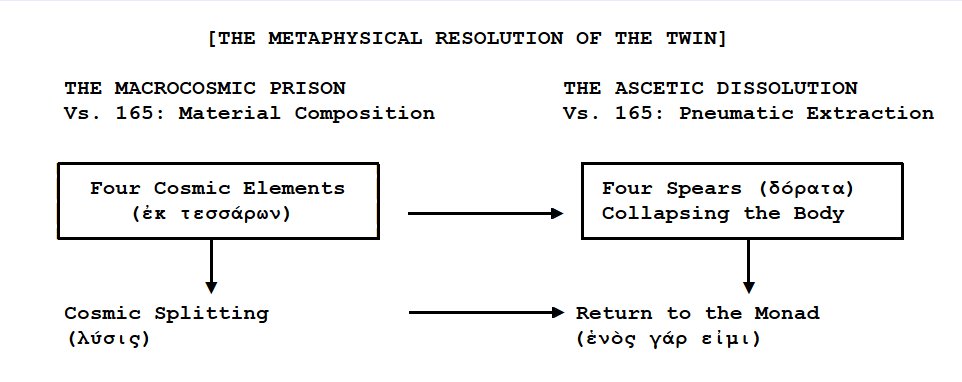
Philological & Lexical Analysis
1. The Christology of Sale and Acquisition
In Verse 159,
Thomas uses unique commercial-theological vocabulary to describe his relationship with Christ, calling Him ὁ πωλήσας με
("the One who sold me").
This references the opening framing narrative of the Acts of Thomas, where Christ physically sells Thomas into slavery to the merchant Abbanes to force his mission to India.
In Verse 163,
this is paired with ἐράθην παρὰ τοῦ δεσπότου μου
("I was sold by my Master").
Rather than viewing this slavery as a degradation, the text treats it as an ontological honor:
to be sold by Christ is to be legally extricated from the property rights of the cosmic rulers (ἄρχοντες
)
or earthly kings like Misdaeus.
When Misdaeus asks Thomas if he is a slave or a freeman (Δοῦλος
εἶ
ἢ
ἐλεύθερος),
Thomas's response relies on a sharp distinction regarding ultimate sovereignty:
Δοῦλός
εἰμι
ἑνὸς
μόνου,
οὗ
σὺ
ἐξουσίαν
οὐκ
ἔχεις
("I am the slave of only One, over whom you have no authority").
2. The Anti-Somatic Paradox of Lysis
The narrative redefines death not as an extinction or a tragedy, but as a deliberate cosmological unraveling. In Verse 160, Thomas states:...οὗτος δὲ ὁ νομιζόμενος θάνατος οὐκ ἔστιν θάνατος, ἀλλὰ λύσις ἀπὸ τοῦ σώματός ἐστιν. "...this which is thought to be death is not death, but a release (λύσις) from the body." The noun λύσις (from λύω, to unloose or dissolve) carries a heavy philosophical and Gnostic nuance here. It views the physical body as an artificial cage or compound entity that must be dissolved back into its constituent parts so that the pneumatic spark can return to its uncompounded source.
3. The Numerical Metaphor of Cosmic Dissolution
The core philological and metaphysical climax occurs in Verse 165
during Thomas’s march to the mountain:
Material Body:
Four Elements (ἐκ
τεσσάρων)
---->
Pierced by Four Spears (ἐκ
τεσσάρων
νύσσομαι)
Spiritual Core:
The Divine Monad (ἑνὸς
γάρ
εἰμι)
---->
Drawn by One Christ (εἷς
δὲ
ὁ
ἕλκων
με)
The phrase ἐκ τεσσάρων γὰρ γεγένημαι
("for from four elements was I brought into being")
refers to the classic Hellenistic and Syrian cosmology of the four material elements (earth, air, fire, water).
The execution by four soldiers who pierce him with four spears (ἐκ τεσσάρων νύσσομαι)
is read as a literal, cosmic execution where material weapons dissolve material composition.
Conversely, Christ is the Monad—ἐξ ἑνὸς
ὤν
("being from One").
Because Christ was unified, He was pierced by one spear in His historical passion;
because Thomas is a composite mortal, he must endure a fourfold shattering to achieve the same unity.
4. Social-Historical Analysis
1)
The Jurisdictional Clash:
Sorcery vs.
Political Loyalty
Throughout Verses 162
and 163,
the state apparatus under King Misdaeus operates out of a clear anti-magical and counter-subversive framework.
The jailers scream:
Τί
ἡμάρτομεν
εἰς
τοῦτον
τὸν
μάγον;
("What sin have we committed against this sorcerer?").
To the ancient mind, the structural integrity of a prison was maintained not only by iron bars but by spiritual curses and state oaths.
Thomas's effortless jailbreaks are interpreted as τέχνῃ αὐτοῦ τῇ μαγικῇ
("by his magical art").
When Misdaeus asserts his duty to execute Thomas, he phrases it as a matter of civic hygiene:
ἵνα
τὰ
φάρμακά
σου
σὺν
σοὶ
ἀπέλθῃ
καὶ
ἡ
ἡμετέρα
πατρὶς
τούτων
καθαρισθῇ
("so that your sorceries may depart along with you, and our fatherland may be cleansed of them").
This highlights the defensive posture of the Indo-Parthian and Sasanian monarchies against foreign, non-conforming religious movements, viewing them as infectious pollutants (φάρμακα
)
that threatened the stability of the state religion.
2)
Imperial Ideology and the Royal Tyche
In Verse 162,
the guards make an appeal to the political theology of Hellenistic and Near Eastern kingship:
εἰ
μὴ
γὰρ
ἡ
σὴ
τύχη
τὸ
δεσμωτήριον
ἐφύλαξεν...
("for if your Fortune [τύχη]
had not guarded the prison...").
The τύχη
(Tyche in Greek, Khwarenah or Farr in Persian)
was the divine, radiant aura of a legitimate king that ensured victory, prosperity, and cosmic order.
By claiming that the king's Tyche was the only power keeping the convicts from escaping Thomas's magic, the guards are using deep ideological flattery to shift the blame away from their own incompetence.
This specific phrasing anchors the text within the distinct political world of the Euro-Asiatic frontier, where the King's Fortune was treated as an active, defensive administrative force.
3)The Institutional Transition to the Underground Church
Verse 169
records a critical moment of institutional survival for early East Syrian Christianity:
...ὁ
δὲ
ἀπόστολος
Θωμᾶς
ἀπαλλαττόμενος
τοῦ
κόσμου
τὸν
μὲν
Σιφόρα
ἐποίησεν
πρεσβύτερον,
Ἰουζάνην
δὲ
διάκονον...
"...The Apostle Thomas, when departing from the world, made Sifor a presbyter and Vazan a deacon."
This detail is highly significant for understanding the transition from wandering, charismatic apostles to a stable, localized church hierarchy:
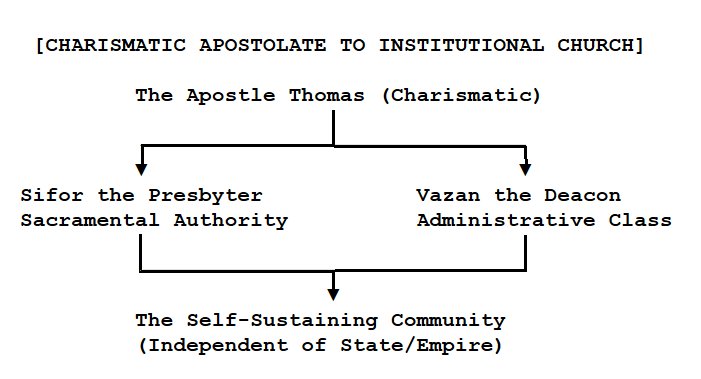
By ordaining Sifor (a former royal official)
as a priest and Vazan (the king's own son)
as a deacon right before his execution, Thomas establishes a self-sustaining church community inside the royal household.
When the king and his counselor Charisius realize their wives (Tertia and Mygdonia)
can no longer be coerced into marital or political compliance, they capitulate:
συνεχώρησαν
αὐτὰς
τῷ
ἰδίῳ
θελήματι
ζῆν
("they permitted them to live according to their own choice").
This marks the total victory of the Encratite lifestyle over the ancient patriarchal household.
4)
Early Textual Witness to Relic Translation and Dust-Healing
The final chapter (Verse 170)
contains an early textual account of Christian relic theft and dust-healing (charis via material proximity).
When Misdaeus attempts to exhume Thomas's body to cure his demonized son, he discovers the tomb is empty:
εῖς
γὰρ
τῶν
ἀδελφῶν
κλέψας
αὐτὸν
εἰς
Μεσοποταμίαν
ἀπήγαγεν
("for one of the brothers had stolen him away and carried him to Mesopotamia").
This reflects the historical tradition of the translation of Thomas’s relics from India to Edessa (Mesopotamia),
a major center of Syriac Christianity, which took place in the third or fourth century.
The subsequent resolution—where Misdaeus simply takes χοῦν
("dust/soil")
from the empty tomb and uses it to heal his son—vividly confirms the early Christian practice of treating the physical soil of a martyr's grave as a repository of divine power.
This somatic miracle leads to the ultimate submission of the state:
the king himself bows his head under the hand of Sifor the presbyter, completing the spiritual conquest of the royal house.