
| 1 Μάταιοι μὲν γὰρ πάντες ἄνθρωποι φύσει, οἷς παρῆν θεοῦ ἀγνωσία καὶ ἐκ τῶν ὁρωμένων ἀγαθῶν οὐκ ἴσχυσαν εἰδέναι τὸν ὄντα οὔτε τοῖς ἔργοις προσέχοντες ἐπέγνωσαν τὸν τεχνίτην, 2 ἀλλ' ἢ πῦρ ἢ πνεῦμα ἢ ταχινὸν ἀέρα ἢ κύκλον ἄστρων ἢ βίαιον ὕδωρ ἢ φωστῆρας οὐρανοῦ πρυτάνεις κόσμου θεοὺς ἐνόμισαν. 3 ὧν εἰ μὲν τῇ καλλονῇ τερπόμενοι ταῦτα θεοὺς ὑπελάμβανον, γνώτωσαν πόσῳ τούτων ὁ δεσπότης ἐστὶ βελτίων, ὁ γὰρ τοῦ κάλλους γενεσιάρχης ἔκτισεν αὐτά· 4 εἰ δὲ δύναμιν καὶ ἐνέργειαν ἐκπλαγέντες, νοησάτωσαν ἀπ' αὐτῶν πόσῳ ὁ κατασκευάσας αὐτὰ δυνατώτερός ἐστιν· 5 ἐκ γὰρ μεγέθους καὶ καλλονῆς κτισμάτων ἀναλόγως ὁ γενεσιουργὸς αὐτῶν θεωρεῖται. | 1 For all humans are foolish by nature, in whom there was ignorance of God; and from the good things that are seen, they lacked the power to know the One Who Is, nor by paying attention to the works did they recognize the Artisan. 2 Instead, they thought either fire or wind or swift air, or the circle of the stars or violent water, or the luminaries of heaven to be the rulers of the world and gods. 3 If, being delighted by their beauty, they took these things to be gods, let them know how much better the Sovereign Master of these is; for the Author of Beauty created them. 4 And if they were amazed by their power and energy, let them understand from them how much more powerful is the One who fashioned them. 5 For from the greatness and beauty of created things, their Creator is perceived by analogy. |
| 6 ἀλλ' ὅμως ἐπὶ τούτοις μέμψις ἐστὶν ὀλίγη, καὶ γὰρ αὐτοὶ τάχα πλανῶνται θεὸν ζητοῦντες καὶ θέλοντες εὑρεῖν· 7 ἐν γὰρ τοῖς ἔργοις αὐτοῦ ἀναστρεφόμενοι διερευνῶσιν καὶ πείθονται τῇ ὄψει, ὅτι καλὰ τὰ βλεπόμενα. 8 πάλιν δ' οὐδ' αὐτοὶ συγγνωστοί· 9 εἰ γὰρ τοσοῦτον ἴσχυσαν εἰδέναι ἵνα δύνωνται στοχάσασθαι τὸν αἰῶνα, τὸν τούτων δεσπότην πῶς τάχιον οὐχ εὗρον; |
6 Yet, for these, there is only a mild blame; for they perhaps go astray while seeking God and wishing to find Him. 7 For as they live among His works, they search them out, and they are persuaded by their sight that what is seen is beautiful.
8 But then again, not even they are excusable. 9 For if they had enough power to know so much that they could speculate about the universe, how did they not more quickly find the Sovereign Master of these things? |
| 10 ταλαίπωροι δὲ καὶ ἐν νεκροῖς αἱ ἐλπίδες αὐτῶν, οἵτινες ἐκάλεσαν θεοὺς ἔργα χειρῶν ἀνθρώπων, χρυσὸν καὶ ἄργυρον τέχνης ἐμμελέτημα καὶ ἀπεικάσματα ζῴων ἢ λίθον ἄχρηστον χειρὸς ἔργον ἀρχαίας. 11 εἰ δὲ καί τις ὑλοτόμος τέκτων εὐκίνητον φυτὸν ἐκπρίσας περιέξυσεν εὐμαθῶς πάντα τὸν φλοιὸν αὐτοῦ καὶ τεχνησάμενος εὐπρεπῶς κατεσκεύασεν χρήσιμον σκεῦος εἰς ὑπηρεσίαν ζωῆς, 12 τὰ δὲ ἀποβλήματα τῆς ἐργασίας εἰς ἑτοιμασίαν τροφῆς ἀναλώσας ἐνεπλήσθη, 13 τὸ δὲ ἐξ αὐτῶν ἀπόβλημα εἰς οὐθὲν εὔχρηστον, ξύλον σκολιὸν καὶ ὄζοις συμπεφυκός, λαβὼν ἔγλυψεν ἐν ἐπιμελείᾳ ἀργίας αὐτοῦ καὶ ἐμπειρίᾳ συνέσεως ἐτύπωσεν αὐτό ἀπείκασεν αὐτὸ εἰκόνι ἀνθρώπου 14 ἢ ζῴῳ τινὶ εὐτελεῖ ὡμοίωσεν αὐτὸ καταχρίσας μίλτῳ καὶ φύκει ἐρυθήνας χρόαν αὐτοῦ καὶ πᾶσαν κηλῖδα τὴν ἐν αὐτῷ καταχρίσας 15 καὶ ποιήσας αὐτῷ αὐτοῦ ἄξιον οἴκημα ἐν τοίχῳ ἔθηκεν αὐτὸ ἀσφαλισάμενος σιδήρῳ. 16 ἵνα μὲν οὖν μὴ καταπέσῃ, προενόησεν αὐτοῦ εἰδὼς ὅτι ἀδυνατεῖ ἑαυτῷ βοηθῆσαι· καὶ γάρ ἐστιν εἰκὼν καὶ χρείαν ἔχει βοηθείας. |
10 But wretched are they, and in dead things are their hopes, who call "gods" the works of human hands—gold and silver, the meticulous products of art, and likenesses of animals, or a useless stone, the work of an ancient hand.
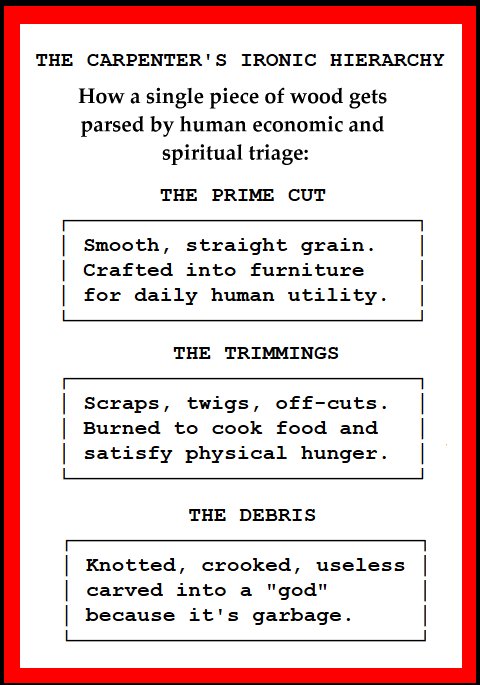
11 Consider a woodcutter who cuts down a manageable tree. He skillfully scrapes off all its bark, and crafting it elegantly, fashions a useful vessel for the service of life. 12 The scraps left over from his work he uses to prepare his food, and eats his fill. 13 But the scrap among them that was good for absolutely nothing—a crooked piece of wood full of knots—he takes and carves during his leisure time, and shapes it with the skill of his understanding. He models it into the likeness of a human being, 14 or makes it resemble some worthless animal. He coats it with red chalk, painting its surface red, and smearing over every blemish on it. 15 Then, having made a worthy dwelling place for it, he sets it in a wall, securing it with iron nails. 16 So he takes precautions so that it will not fall down, knowing that it cannot help itself—for it is only an image, and stands in need of help. |
| 17 περὶ δὲ κτημάτων καὶ γάμων αὐτοῦ καὶ τέκνων προσευχόμενος οὐκ αἰσχύνεται τῷ ἀψύχῳ προσλαλῶν καὶ περὶ μὲν ὑγιείας τὸ ἀσθενὲς ἐπικαλεῖται, 18 περὶ δὲ ζωῆς τὸ νεκρὸν ἀξιοῖ περὶ δὲ ἐπικουρίας τὸ ἀπειρότατον ἱκετεύει, περὶ δὲ ὁδοιπορίας τὸ μηδὲ βάσει χρῆσθαι δυνάμενον, 19 περὶ δὲ πορισμοῦ καὶ ἐργασίας καὶ χειρῶν ἐπιτυχίας τὸ ἀδρανέστατον ταῖς χερσὶν εὐδράνειαν αἰτεῖται. | 17 Yet, when he prays about his property, his marriage, and his children, he is not ashamed to address a lifeless thing! 18 For health, he appeals to what is weak; for life, he begs a dead thing; for aid, he supplicates what is utterly inexperienced; for a journey, he asks something that cannot even take a single step; 19 and for profit, business, and the success of his hands, he asks strength from hands that are completely powerless. |
1. The Birth of Philosophical Monotheism: Ton Onta (v. 1)
The author opens with a magnificent linguistic fusion of Hebrew theology and classical Greek philosophy. He notes that humanity failed to recognize ton onta—"the One Who Is."
This is a direct echo of the Septuagint's translation of God's holy name to Moses at the burning bush ("I am the Being/the One Who Is").
At the same time, it uses the absolute metaphysical vocabulary of Plato and Aristotle regarding ultimate reality. The author is arguing that nature is not ultimate reality; it is merely an artifact pointing back to the Technitēs (the Artisan, the Cosmic Craftsman).
2. Epistemology via Analogy (v. 5)
Verse 5 presents a cornerstone text for historical philosophy and theology: ek gar megethous kallonēs ktismatōn analogōs ho genesiourgos autōn theōreitai ("For from the greatness and beauty of created things, their Creator is perceived by analogy").
This is one of the earliest explicit formulas for the Cosmological Argument and the Argument from Design in the Jewish tradition.
The author argues that human minds possess a built-in mathematical and aesthetic capacity (analogōs) to scale upward from a beautiful sunset or an immense mountain range to deduce the properties of the invisible mind that orchestrated them. The universe is a text; its beauty is meant to be read, not worshiped.
3. "Mild Blame" (v. 6–7) and the Noble Failure of Physics
The author displays a surprising amount of intellectual empathy toward Greco-Roman nature-worshipers and natural philosophers (the Pre-Socratics and Stoics). He assigns them only a mempis oligē—a "mild, slight blame."
He acknowledges that their error comes from a good-faith place: they are actively Theon zētountes ("seeking God") and are genuinely intoxicated by the sheer splendor of the physical world (peithontai tē opsei / "they are persuaded by their sight").
However, this empathy turns into a sharp critique in verse 9: if these brilliant Greek astronomers and physicists had the raw cognitive horsepower to map out the entire universe (stochasasthai ton aiōna), it is an intellectual crime that they stopped at the stars rather than tracking down the Mind behind them.
4. The Deep Satire of Economic Triage (v. 11–14)
When shifting from sublime cosmic pantheism to the base manufacture of wooden idols, the author's tone moves from philosophical evaluation to biting, dark satire. He exposes the psychological absurdity of idolatry by mapping out the carpenter's economic triage of a single log:
The best, straightest wood is used to make actual useful furniture to sell for profit.
The messy off-cuts and splintered shavings are burned in the oven to cook lunch.
The absolute worst piece—the ugly, knot-ridden, twisted scrap that is good for absolutely nothing—becomes the "god." The deity is literally manufactured out of the carpenter's garbage.
5. The Great Reversals of Prayer (v. 16–19)
The chapter closes with a spectacular series of cutting, ironic paradoxes exposing the deep psychological delusion of the idolaters:
The Human Need The Object Addressed The Deep Absurdity
Safety (v. 16) A wooden statue fastened with iron bolts The human must protect the god from falling over.
Health (v. 18) A fragile, decaying piece of timber Begging strength from an object that cannot heal itself.
Life (v. 18) A dead, severed tree branch Looking for life from an object that is rotting away.
Travel (v. 18) A footless, carved wooden base Asking for guidance on a journey from an object that cannot walk.
Business Success (v. 19) A statue with fake, carved hands Asking for manual dexterity from hands that are completely paralyzed.
The author highlights a profound psychological inversion: the human creator becomes completely subservient to, and dependent upon, their own inferior, dead creation.