


| Greek | Meaning | Notes |
|---|---|---|
| ἔβαλον | I threw, cast | 2nd Aor. of βάλλω |
| εἶδον | I saw | 2nd Aor. of βλέπω |
| εἶπον | I said | 2nd Aor. of λέγω |
| ἔλαβον | I took | 2nd Aor. of λαμβάνω |
| ἤγαγον | I led | 2nd Aor. of ἄγω |
| ἦλθον | I came, went | 2nd Aor. of ἔρχομαι |
| ἤνεγκα | I bore, brought | 1st Aor. of φέρω |
| ἤνεγκον | I bore, brought | 2nd Aor. of φέρω |
| λεἰπω | I leave | |
| ἔλιπον | I left | 2nd Aor. of λείπω |
| πάσχω | I suffer | |
| ἔπαθον | I suffered | 2nd Aor. of πάσχω -- cognate: empathy |
| πίπτω | I fall | |
| ἔπεσον | I fell | 2nd Aor. of πίπτω |
| ἔσχον | I had | 2nd Αor. of ἔχω |
| ἔφαγον | I ate | 2nd Aor. of ἐσθίω -- cognate: esophagus |
| Singular | ||
| Form | Meaning | |
|---|---|---|
| 1st | ἔλιπον | I left |
| 2nd | ἔλιπες | yous left |
| 3rd | ἔλιπε (ν) | he/she/it left |
| Plural | ||
| Form | Meaning | |
| 1st | ἐλίπομεν | we left |
| 2nd | ἐλίπετε | youp left |
| 3rd | ἔλιπον | they left |
| Singular | ||
| Form | Meaning | |
|---|---|---|
| 1st | ἐλιπόμην | I left for myself |
| 2nd | ἐλίπου | yous left for yourself |
| 3rd | ἐλίπετο | he/she/it left for himself |
| Plural | ||
| Form | Meaning | |
| 1st | ἐλιπόμεθα | we left for ourselves |
| 2nd | ἐλίπεσθε | youp left for yourselves |
| 3rd | ἐλίποντο | they left for themselves |
- The second aorist is unlike the first aorist because it does not add σα or κα to the stem.
- Instead it radically changes the spelling of the stem.
- The second aorist passive is different from the middle forms
- The only way to tell if a verb has a first aorist form or a second aorist form is by looking at the list in the Appendix 1.
- The second aorist is formed just like the imperfect:
- Add the augment ε to the front because it is a past tense.
- Add the secondary endings to the end of the new stem: -ν, -ς, none, -μεν, -τε, -ν (or -σαν)
- The function of the second aorist is exactly the same as that of the first aorist--completed action in past time.
Rarely, some verbs, have both first aorist and second aorist forms. The first Aorist has a transitive meaning ("I did something to an object") while the second aorist operates intransitively ("I underwent/did something myself").
- ἵστημι (I stand, set, place)
- 1st Aorist (Transitive): ἔστησα – I set, I placed, I caused to stand (takes a direct object).
- 2nd Aorist (Intransitive): ἔστην – I stood (action confined to the subject).
- φύω (I produce, grow)
- 1st Aorist (Transitive): ἔφυσα – I produced, I brought forth.
- 2nd Aorist (Intransitive): ἔφυν – I grew, I came forth.
- δύω (I cause to enter, sink)
- 1st Aorist (Transitive): ἔδυσα – I plunged, I sank (something).
- 2nd Aorist (Intransitive): ἔδυν – I sank, I set (as the sun).
Some verbs have a 2nd Aorist form, but they add 1st Aorist endings.
| Verb (Present) | Standard 2nd Aorist | Koine 1st Aorist Form/Ending | Meaning |
|---|---|---|---|
| λέγω / εἶπον | εἶπον | εἶπαν / εἶπα | I/they said |
| ἔρχομαι / ἦλθον | ἦλθον | ἦλθαν / ἦλθα | I/they came |
| ὁράω / εἶδον | εἶδον | εἶδαν / εἶδα | I/they saw |
| λαμβάνω | ἔλαβον | ἔλαβαν / ἔλαβα | I/they took |
| φέρω | ἤνεγκον | ἤνεγκα | I brought/bore |
| πίπτω | ἔπεσον | ἔπεσαν / ἔπεσα | I/they fell |
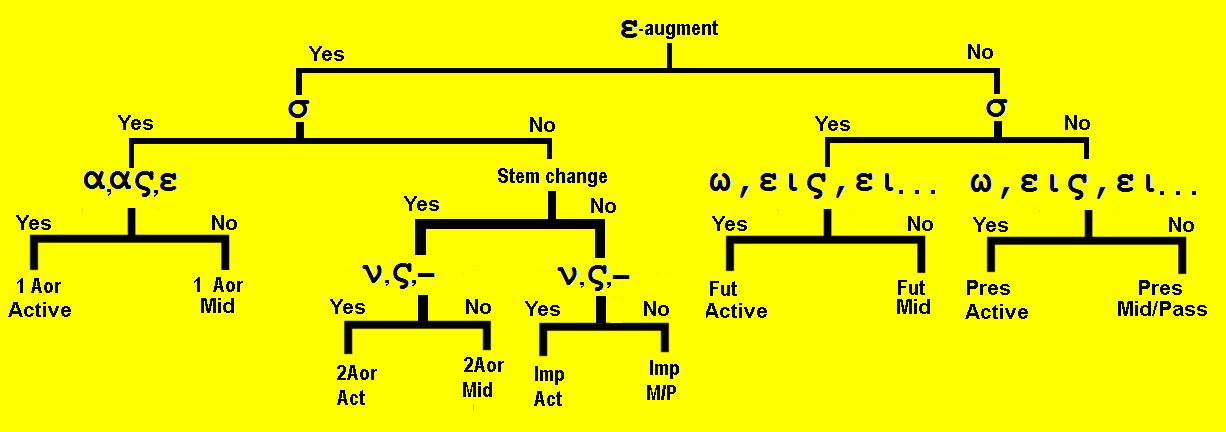
Translate the following:
- παρέλαβε τὴν ἐπαγγελίαν παρὰ τοῦ μεσσίου, καὶ κηρύσσει αὐτὴν ἐν τῇ ἐκκλησίᾳ.
- ἐγένοντο οἱ μαθηταὶ τοῦ κυρίου.
- ὁ χριστός ἐξέβαλε τὰς ἁμαρτίας τῶν ἁμαρτωλῶν καὶ ἐθεράπευσεν αὐτούς.
- καὶ εἴδομεν τὸν κύριον καὶ ἠκούσαμεν τῶν λόγων αὐτοῦ.
- οἱ ἀπόστολοι εἶδον τὸν υἱὸν τοῦ θεοῦ, ἐγένετο γὰρ αὐτὸς ἄνθρωπος καὶ ἔμενεν ἐν τῷ κόσμῳ.
- ταῦτα εἴπετε ἡμῖν ἐν τῷ ἱερῷ, ἐκεῖνα δὲ ἐν τῷ οἴκῳ.
- οὐδὲ εἰσῆλθες εἰς τὴν ἐκκλησίαν, οὐδὲ εἶπες λόγους ἀγάπης τοῖς τέκνοις.
- τὰ ἱερὰ αἱ πισταὶ ἔλιπον, καὶ κατῆλθον εἰς τοὺς οἴκους αὐτῶν.
- ὁ ἄνθρωπος ἤγαγε τὰ τέκνα πρὸς τὸν κύριον ὅτι ἔσχε τὴν ἀγάπην τοῦ θεοῦ ἐν τῇ καρδίᾳ αὐτοῦ.
- οἱ δίκαιοι ἔφαγον ἄρτον ἐν τῇ ἐρήμῳ καὶ ἐδόξασαν τὸν θεόν.
- ὁ χριστὸς ἔπαθε πονηρὰ ὑπὲρ ἁμαρτωλῶν.
- τὰ τέκνα ἤνεγκε λίθους καὶ εἰσέβαλεν αὐτοὺς εἰς τὸν οἶκον τοῦ προφήτου.

ὁ πέμψας με ἀληθής ἐστιν, κἀγὼ ἃ ἤκουσα παρ' αὐτοῦ ταῦτα λαλῶ εἰς τὸν κόσμον.
1"He who sent me is true, and the things which I heard from him, these things I speak to the world." (John 8:26)
1"He who sent me is true, and the things which I heard from him, these things I speak to the world." (John 8:26)